Proven Ways to Improve Critical Care Knowledge for ICU Nurses
The highest-impact ways to improve critical care knowledge are: practice metacognition on every patient assessment, sketch mechanism maps to connect pathophysiology to clinical signs, use short simulation drills with structured debriefs, subscribe to curated literature alerts, and build deliberate practice habits with question banks and spaced repetition. These are not abstract study tips. They are the specific behaviors that separate nurses who pass the CCRN on the first attempt from those who feel like they studied hard but still came up short.
Here is what you can do right now, before your next shift ends:
- Verbalize your reasoning on one complex patient: say out loud why the MAP is dropping and what the physiology tells you to do next.
- Sketch a one-minute mechanism map connecting a patient’s ARDS to their oxygenation failure, ventilator settings, and sedation needs.
- Run 15 CCRN practice questions tonight, then read every rationale, including the ones you got right.
- Set one journal TOC alert (Critical Care Medicine or CHEST) so new evidence comes to you instead of requiring a search.
- Log one case error or near-miss in a pocket notebook with a “what I’d do differently” note.
- Ask a colleague one “how/why” question during handover: “Why do you think his lactate is still climbing despite fluids?”
- Identify one cognitive bias you caught yourself using this week and name it.
- Review one AACN KSA domain relevant to your current orientation phase.
Pro Tip: Set a 15-minute timer before your shift ends. Spend 10 minutes on a mechanism map for your most complex patient and 5 minutes on 5 practice questions. That 15-minute habit, repeated three times a week, compounds faster than any weekend study marathon.
Key Takeaways
Deliberate practice with mechanism-based reasoning, structured feedback, and targeted literature surveillance are the three behaviors that most reliably improve critical care knowledge and CCRN exam performance.
| Point | Details |
|---|---|
| Mechanism maps over memorization | Sketch one mechanism map per shift to connect pathophysiology to clinical decisions and prevent anchoring. |
| Five evidence-based strategies | Make thinking explicit, discuss biases, model inductive reasoning, use how/why questions, and assess with feedback. |
| Sustainable literature surveillance | Use Read by QxMD, EvidenceAlerts, and one curated newsletter; limit active reading to 30–60 minutes per week. |
| Measure progress with milestones | Track question-bank accuracy by system weekly and use the beginner-to-accomplished framework to benchmark growth. |
| Zerodeficitccrnprep for exam-ready prep | The 695+ practice questions with rationales and system study guides map directly to the CCRN blueprint and the strategies in this guide. |
Table of Contents
- Why clinical reasoning directly changes patient outcomes in the ICU
- Five evidence-based strategies to build critical thinking in the ICU
- Practical exercises you can run this week without a simulation lab
- How to stay current without burning out on literature
- CCRN study strategies that build exam-ready knowledge
- How to measure your progress in clinical reasoning
- Common ICU cognitive biases and how to counter them on shift
- Trusted resources for building a reliable critical care knowledge base
- One habit that actually moves the needle, from Zero Deficit Critical Care Prep
- Zero Deficit™ CCRN prep resources that map to these strategies
- Sources
- FAQ
Why clinical reasoning directly changes patient outcomes in the ICU
Improved clinical reasoning reduces the rate of cognitive error, which is one of the leading contributors to preventable adverse events in the ICU. When you move from reactive task completion to deliberate, mechanism-based thinking, you catch the early sepsis before the lactate triples, you recognize the ventilator dyssynchrony before it causes barotrauma, and you question the anchored diagnosis before the team commits to the wrong treatment path.
The theoretical backbone here is dual-process theory. Type 1 thinking is fast, automatic, and pattern-based: you see a BP of 70/40 with cool extremities and you immediately think distributive shock. Type 1 is useful and often correct, but it fails in complex, atypical, or high-stakes ICU cases where the pattern is misleading. Type 2 thinking is slow, deliberate, and analytical: you pause, verbalize the physiology, consider alternatives, and check your reasoning against the mechanism. The most common trap for ICU clinicians is over-reliance on Type 1 thinking, and deliberate Type 2 strategies such as verbalizing physiological rationale or sketching mechanism maps reduce diagnostic anchoring.
The scale of the evidence problem makes passive reading an unreliable strategy. PubMed now holds over 39 million citations, with 1.57 million new papers added in 2023 alone. No individual nurse or intensivist can read their way current. A Delphi-style task force identified 541 essential knowledge and skills items for intensivists, with 145 requiring advanced-level mastery. That scope demands a targeted, system-based study plan, not a general reading habit.
| Metric | Figure | Source |
|---|---|---|
| PubMed total citations (2023) | Over 39 million | PMC / staying current review |
| New PubMed papers added in 2023 | 1.57 million | PMC / staying current review |
| Essential intensivist knowledge items (Delphi) | 541 total | PubMed master list |
| Items requiring advanced knowledge | A significant subset | PubMed master list |
The implication is direct: you cannot read everything, so you need a system. The rest of this guide gives you that system, mapped to both bedside practice and CCRN exam prep.
Five evidence-based strategies to build critical thinking in the ICU
A peer-reviewed framework published in PMC identifies five practical strategies for teaching and learning critical thinking in the ICU: make thinking explicit, discuss cognitive biases, model inductive reasoning, use how/why questions, and assess with feedback. Each one translates directly to something you can do at the bedside or in a study session.
1. Make thinking explicit
Goal: Surface the reasoning process so it can be examined, corrected, and learned from.
What to do:
- During rounds, narrate your assessment: “I’m thinking septic shock because the lactate is 4.2, the MAP is 58 despite 2L, and the WBC is 22. My next step is norepinephrine titration and blood cultures before antibiotics.”
- Ask yourself: “What is the mechanism driving this finding?” before acting.
- Write a one-sentence “clinical story” at the start of each shift: patient, primary problem, physiological driver, and your priority intervention.
CCRN example: For a patient on pressure-controlled ventilation with rising PaCO₂ (normal: 35–45 mmHg), verbalize why: “Increased dead space from ARDS reduces CO₂ clearance. I need to increase respiratory rate or tidal volume, but I’m balancing plateau pressure below 30 cmH₂O.”
2. Discuss cognitive biases
Goal: Name the bias before it costs the patient.
What to do:
- At the start of a huddle, ask: “Are we anchored to yesterday’s diagnosis?”
- Use the phrase “What else could explain this?” as a team reset.
- Keep a personal bias log: write down one bias you caught each week.
CCRN example: A patient admitted for COPD exacerbation develops new hypotension on day 3. Anchoring bias keeps the team focused on bronchospasm. Naming it opens the differential to PE, tension pneumothorax, or sepsis.
3. Model inductive reasoning through mechanism maps
Mechanism-based learning connects pathophysiology to clinical signs and treatment decisions, which deepens reasoning rather than reinforcing rote memorization. A mechanism map is a simple diagram: write the root cause in the center, draw arrows to physiological consequences, then to clinical signs, then to interventions.
Quick template:
Root cause → Physiological change → Clinical sign → Intervention
(e.g., Sepsis → Vasodilation → MAP ↓ → Norepinephrine)
What to do:
- Sketch a map for your most complex patient each shift (1–2 minutes).
- Use the OpenCriticalCare project templates as a starting framework for job aids and checklists.
- Build a personal library of maps by system: shock, ARDS, AKI, DKA, ICP elevation.
4. Use how/why coaching questions
Goal: Push reasoning one level deeper than the task.
Prompts to use:
- “Why is the SVR elevated in cardiogenic shock but low in distributive shock?”
- “How does PEEP improve oxygenation in ARDS, and at what point does it become harmful?”
- “What does a widening pulse pressure tell you about aortic regurgitation?”
The ANA’s guidance on critical thinking in nursing reinforces that asking structured questions during clinical practice is one of the most reliable ways to develop reasoning skills over time.
5. Assess and give feedback
Goal: Close the learning loop so errors become lessons.
What to do:
- After each simulation or complex case, complete a 3-question debrief: What did I think? What happened? What would I change?
- Track question-bank accuracy by system weekly. A drop in cardiovascular accuracy is a signal, not a failure.
- Ask your preceptor for one specific piece of feedback per shift, not general praise.
Comparison: Type 1 vs. Type 2 thinking in the ICU
| Feature | Type 1 (Pattern Recognition) | Type 2 (Analytical) |
|---|---|---|
| Speed | Fast, automatic | Slow, deliberate |
| Best for | Familiar, stable presentations | Complex, atypical, high-stakes cases |
| Risk | Anchoring, premature closure | Cognitive fatigue if overused |
| Trigger to switch | Unexpected finding, treatment failure | Any time the pattern “doesn’t fit” |
| ICU example | Recognizing classic STEMI pattern | Working up new shock in a post-op patient |
Pro Tip: Preceptors: during rounds, narrate your own reasoning out loud before asking the orientee for theirs. Modeling Type 2 thinking is more effective than asking them to “think critically” without showing what that looks like.
Practical exercises you can run this week without a simulation lab
The most effective hands-on activities for building critical care competency are rapid scenario micro-sims, bedside mechanism-mapping, case-based mini-huddles, and focused simulation with a structured debrief. Systematic reviews of critical care education consistently recommend simulation and directed assessment as high-impact methods for transferring knowledge into practice.
Five-step micro-simulation script (15 minutes, charge nurse or educator)
- Set the scenario (2 min): “Your patient is a 58-year-old post-op day 1 CABG. BP 80/50, HR 120, CVP 2, CO 2.8. What’s your first move?”
- Let the learner think aloud (3 min): No interrupting. Note where reasoning stalls or jumps.
- Introduce a complication (2 min): “Chest tube output just went from 50 to 200 mL/hr. Now what?”
- Pause and map (3 min): Ask the learner to sketch the mechanism driving the hemodynamic picture.
- Debrief (5 min): Use the three questions below.
Debrief template (use after any simulation or complex case)
What were you thinking? (Surface the reasoning, not just the action.) What did the data tell you? (Connect clinical signs to physiology.) What would you do differently, and why? (Close the learning loop with a mechanism-based answer.)
Building personal job aids, such as drip titration scales or ventilator troubleshooting flows, is itself a high-value learning activity. The act of synthesizing information into a one-page reference forces you to understand the mechanism, not just recall the task. The OpenCriticalCare project hosts templates you can adapt for your unit.
Quality improvement tools to pair with learning:
- PDSA micro-tests: Pick one practice change (e.g., always verbalizing your shock differential before calling the attending), run it for one week, and note what changed in your reasoning speed or accuracy.
- Root-cause framing: After a near-miss or unexpected deterioration, write a two-sentence root cause: “The mechanism was X. The reasoning error was Y.”
- Learning outcome log: Keep a weekly table with three columns: case, error or gap identified, and action taken.
How to stay current without burning out on literature
A sustainable weekly workflow for literature surveillance takes 30–60 minutes and relies on push tools rather than active searching. Human-curated surveillance combined with targeted digital tools is the most effective approach for managing the volume of critical care evidence without burning out.
Your weekly surveillance recipe:
- Journal TOC alerts: Subscribe to table-of-contents emails from Critical Care Medicine, CHEST, Intensive Care Medicine, and NEJM. Scan titles and abstracts only. Read one full article per week that directly applies to your patient population.
- Read by QxMD: Configure your specialty filters for critical care, pulmonary, and cardiology. The app surfaces new papers matched to your interests without requiring a PubMed search.
- EvidenceAlerts: Set up automated PubMed searches for your highest-priority topics (e.g., “sepsis AND fluid resuscitation” or “ARDS AND prone positioning”). New papers meeting your criteria arrive by email.
- Society summaries: SCCM, AACN, and AHA publish guideline updates and curated evidence summaries. These are pre-filtered by experts and carry the weight of consensus review.
- Curated newsletters: Critical Care Reviews pairs daily journal surveillance with a weekly newsletter, compressing new evidence into a format that takes minutes to scan.
Paywall and preprint considerations: Many high-impact papers sit behind paywalls. Use PubMed Central for free full-text access, request papers through your hospital library, or check for posted preprints on medRxiv. Treat preprints as hypothesis-generating, not practice-changing, until peer review is complete. AI tools can accelerate literature triage, but they must be paired with expert human curation to avoid misinterpretation. Always verify AI-summarized findings against the original abstract before applying them clinically.
Pro Tip: Embed literature surveillance into your existing workflow. At the start of your weekly journal club or shift handover, spend 5 minutes sharing one new finding relevant to a current patient. That micro-review habit keeps the team current without requiring anyone to read alone.

CCRN study strategies that build exam-ready knowledge
The highest-yield study behaviors for the CCRN are deliberate practice with question banks, spaced repetition for weak topics, and mechanism-based review tied to AACN blueprint systems. Passive re-reading of notes is the least effective approach. Active retrieval, error analysis, and system-based mechanism review are what move the needle.
Modular study plan template
| Week | Blueprint System | Daily Focus (20–45 min) | Question Target |
|---|---|---|---|
| 1–2 | Cardiovascular | Hemodynamics, shock states, ACS, vasoactive drips | 20 questions/day, cardio set |
| 3 | Pulmonary | ARDS, ventilator management, ABGs (normal PaO₂: 80 mmHg, SpO₂: normal) | 15 questions/day, pulmonary set |
| 4 | Neurology | ICP management (normal ICP: 5–15 mmHg), stroke, sedation | 15 questions/day, neuro set |
| 5 | Sepsis/MODS, Renal | Sepsis-3 criteria, CRRT indications, AKI staging | 20 questions/day, mixed set |
| — | Endocrine, Hematology | DKA, HHS, DIC | 15 questions/day, endocrine/heme set |
| 7 | Synergy Model, Ethics, Full Review | KSAs, advocacy, full-length simulated exam | 50-question timed mock exam |
How to use practice questions effectively
The SCCM’s self-assessment question bank offers validated practice questions with rationales and accredited continuing education credit, which makes it a strong baseline tool. The strategy for using any question bank is the same: answer the question, then read the full rationale regardless of whether you got it right. A correct answer from the wrong reasoning is a gap waiting to surface on exam day.
Practice question workflow:
- Answer 15–20 questions per session under timed conditions.
- After each session, flag every question where your confidence was low, even if correct.
- Build an error log: system, topic, mechanism missed, and corrective action.
- Return to flagged topics using spaced repetition: review them at 1 day, 3 days, and 7 days.
- Use rationales to build mechanism maps for the topics you missed. Reviewing CCRN rationales as a mechanism-building exercise is one of the highest-yield study habits available.
For working nurses, 20–45 minutes per day is realistic and sufficient when the time is structured. Split your session: 15 minutes of questions, 15 minutes of rationale review and mechanism mapping, and 10 minutes of spaced repetition on your error log. That structure mirrors the deliberate practice principles that case study review research supports for contextual knowledge retention.
How to measure your progress in clinical reasoning
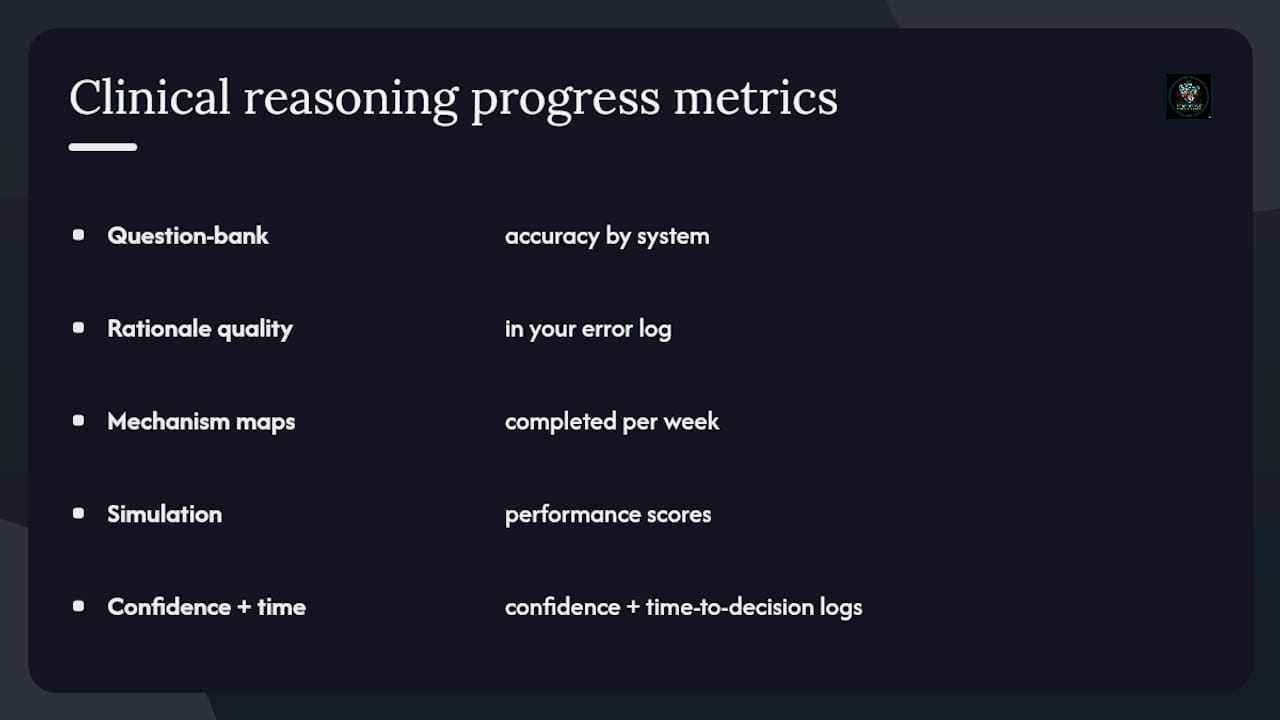
Three to five measurable indicators give you a clear picture of growth: question-bank accuracy by system, rationale quality in your error log, mechanism maps completed per week, simulation performance scores, and confidence-plus-time-to-decision logs. Tracking these weekly turns vague “I feel like I’m improving” into evidence.
Milestone framework
| Level | Observable Behaviors |
|---|---|
| Beginner | Identifies correct intervention but cannot explain the mechanism; relies on protocols |
| Developing | Explains one physiological link; catches errors after the fact; accuracy 50% on practice questions |
| Proficient | Verbalizes full mechanism before acting; catches errors in real time; accuracy 70–80% |
| Accomplished | Anticipates complications from mechanism; teaches others; accuracy consistently above 80% |
Weekly reflective template
At the end of each week, write three sentences:
- “The most complex case I managed was ___. The mechanism driving the presentation was ___.”
- “The reasoning error or gap I identified was ___.”
- “The learning action I took was ___, and I will review it again on ___ (date).”
Preceptors can use the AACN Competence Framework for Progressive and Critical Care to benchmark orientation progress against validated KSA domains. The AACN competence toolkit provides downloadable scoring tools, tip cards, and documentation forms that operationalize those KSAs into observable, measurable behaviors during orientation. AACN’s Synergy Model-aligned KSAs assess clinical judgment and contextualized application of knowledge, not just task completion.
Common ICU cognitive biases and how to counter them on shift
The five most common cognitive biases in the ICU are premature closure, anchoring, confirmation bias, availability bias, and diagnostic momentum. Each one has a one-line script you can use to interrupt it.
| Bias | Clinical Example | Debiasing Script |
|---|---|---|
| Premature closure | Diagnosing sepsis and stopping the workup before ruling out adrenal crisis | “What else could explain the refractory hypotension?” |
| Anchoring | Sticking with “COPD exacerbation” when the patient is not responding to bronchodilators | “If this weren’t COPD, what would fit the picture?” |
| Confirmation bias | Ordering only tests that confirm the working diagnosis | “What test would most likely prove us wrong?” |
| Availability bias | Over-diagnosing PE after a recent high-profile case on the unit | “Is this presentation actually consistent with PE, or are we pattern-matching to last week?” |
| Diagnostic momentum | Accepting a transferred diagnosis without re-examining the evidence | “Let’s rebuild the differential from the primary data, not the transfer summary.” |
How a mechanism map interrupted an anchoring error
A patient with known CHF presented with worsening dyspnea and was treated for acute decompensation. The team sketched a mechanism map during rounds: elevated JVP, S3 gallop, bilateral crackles, and a BNP of 1,800 pg/mL all pointed to volume overload. But the map also showed a new finding that didn’t fit: unilateral leg swelling and a HR of 118. The “how does this fit?” question prompted a CT pulmonary angiogram. The result was bilateral PE on top of CHF. The map forced the team to account for every data point, not just the ones that confirmed the initial impression.
Tie this back to the metacognition practice from the earlier strategies: asking “How are we thinking about this?” is not a soft skill. It is a clinical safety behavior.
Pro Tip: Post a laminated “bias check” card at the nursing station with the five bias names and one debiasing question each. A 10-second visual prompt during rounds costs nothing and catches errors that cost patients.
Trusted resources for building a reliable critical care knowledge base
The top resources for adult critical care evidence are: Critical Care Medicine, CHEST, Intensive Care Medicine, NEJM, SCCM’s self-assessment platform, AACN’s competence framework, ANA’s critical thinking guidance, the PMC staying-current review, and OpenCriticalCare for bedside job aids.
Annotated resource list:
- PMC staying-current review: Best for understanding how to build a sustainable surveillance workflow; read once and implement the tools it recommends.
- Five-strategy ICU critical thinking framework (PMC): Read this once in full. It is the evidence base for the teaching strategies in this guide.
- AACN Competence Framework: Use during orientation and annual competency review to benchmark KSA progress.
- AACN Competence Toolkit: Download the scoring tools and tip cards for preceptor use.
- OpenCriticalCare: Free bedside job aid templates; use to build your own drip titration scales and ventilator troubleshooting flows.
- ANA Critical Thinking in Nursing: Practical prompts for developing clinical reasoning habits; useful for new ICU nurses.
- Annals of the American Thoracic Society (mechanism-based learning): Foundational guidance on using mechanism maps to deepen clinical reasoning.
- PubMed master list of intensivist knowledge: Use to identify gaps in your knowledge base and prioritize study topics.
Recommended reading order for nurses new to a topic:
- ARDS: start with the ARDSNet trial summary, then current SCCM/ATS guidelines, then ventilator strategy rationales.
- Sepsis: Sepsis-3 definitions first, then Surviving Sepsis Campaign bundles, then fluid responsiveness evidence.
- Hemodynamics: shock classification by mechanism, then vasoactive agent pharmacology, then hemodynamic monitoring interpretation.
Quick verification checks: Before applying a guideline, confirm the publication year (guidelines older than 5 years may be superseded), the issuing society (SCCM, AHA, AACN carry the highest authority for critical care), and whether a newer update exists. For journals, check the impact factor and whether the journal is indexed in PubMed. Predatory journals often lack PubMed indexing and charge authors for publication without rigorous peer review.
Subscribe to one or two curated alert services rather than trying to follow every journal. EvidenceAlerts and Read by QxMD are the two highest-yield tools for busy ICU nurses.
One habit that actually moves the needle, from Zero Deficit Critical Care Prep
Most nurses who struggle with the CCRN are not underprepared in terms of hours studied. They are under-practiced in terms of how they study. Reading a textbook chapter on ARDS is not the same as answering 20 ARDS questions under timed conditions, reading the rationales, sketching the mechanism, and logging what you missed. The second approach takes the same amount of time and produces a fundamentally different result.
The one habit worth starting this week: every Tuesday and Thursday, set a 30-minute block. Spend 15 minutes on 15 CCRN practice questions, then 15 minutes building a mechanism map from the topic you missed most. Do that for four weeks and compare your accuracy scores at the start and end. The gap will close faster than you expect, because you are practicing the reasoning, not just the recall.
Your bedside care and your exam prep are not separate goals. Every mechanism map you sketch for a real patient is a study session. Every “why is this happening?” question you ask during rounds is a practice question. Align them deliberately, and both improve at once.
Zero Deficit™ CCRN prep resources that map to these strategies
Every strategy in this guide requires two things: a question bank with detailed rationales and a system-based study structure. That is exactly what Zerodeficitccrnprep was built to provide.
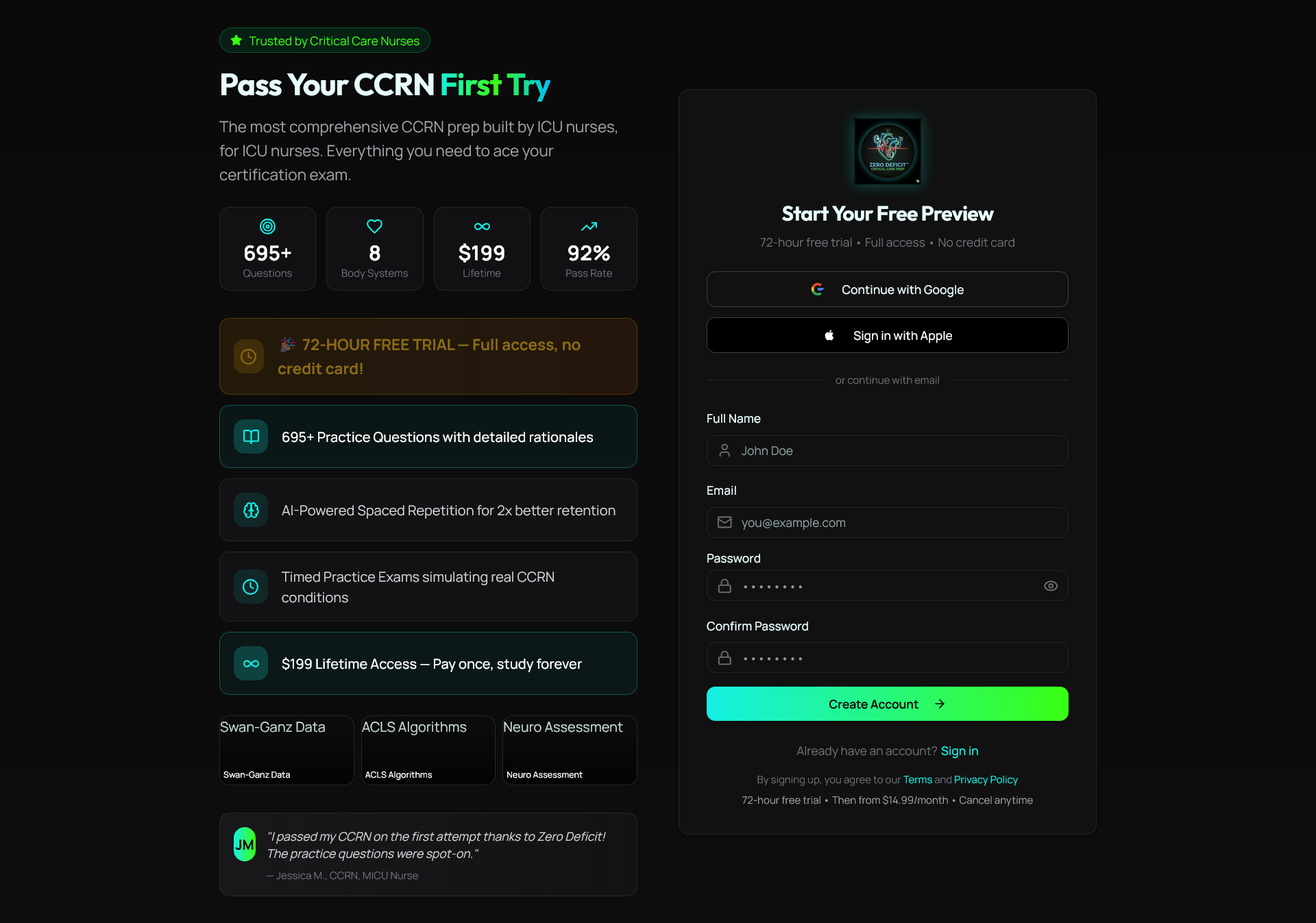
The 695+ CCRN practice questions at Zerodeficitccrnprep are organized by AACN blueprint system, written by expert ICU nurses, and paired with detailed rationales that explain the mechanism behind every answer. That means you are not just checking right or wrong. You are building the physiological reasoning that the CCRN tests and that your patients need.
Here is how to plug Zerodeficitccrnprep into the study plan from this guide:
- Cardiovascular week: Use the cardio question set to test hemodynamics, shock states, and vasoactive drip titration. Read every rationale and sketch one mechanism map per session.
- Pulmonary week: Work through the ventilator and ARDS questions. Use the rationales to build a personal ABG interpretation flowchart.
- Neurology week: The neurology study guide maps directly to ICP management, stroke protocols, and sedation pharmacology.
- Full-system review: Use the practice test index to run timed, system-specific mock exams and track accuracy trends week over week.
Progress tracking and spaced repetition are built into the platform, so your error log and weak-topic review happen automatically. The subscription plans include monthly, annual, and lifetime options, with a free trial to start. There is no reason to wait until you feel “ready enough” to begin. The practice questions are where readiness gets built.
Sources
- The challenge of staying up-to-date in critical care - PMC
- Critical Thinking in Critical Care: Five Strategies to Improve Teaching and Learning in the Intensive Care Unit - PMC
- Competence Framework and Toolkit for Progressive and Critical Care - AACN
- Master list of common core knowledge and skills required of intensivists - PubMed
- Mechanism-based learning guidance (Annals of the American Thoracic Society DOI)
- OpenCriticalCare project
Subscribe to EvidenceAlerts or Read by QxMD as your primary push tool, and let one curated newsletter (such as Critical Care Reviews) handle the rest. Trying to follow every journal is the fastest way to stop following any of them.
This article is general information, not a substitute for advice from a qualified doctor. Consult a qualified healthcare professional about your own circumstances before acting on anything here.
FAQ
What are the most effective ways to improve critical care knowledge?
The highest-impact methods are deliberate practice with question banks and spaced repetition, mechanism-based reasoning using concept maps, structured simulation with debriefs, and curated literature surveillance using tools like Read by QxMD and EvidenceAlerts. A peer-reviewed ICU education framework identifies five specific strategies: make thinking explicit, discuss cognitive biases, model inductive reasoning, use how/why questions, and assess with feedback.
What are the five strategies for teaching critical thinking in the ICU?
The five evidence-based strategies are: (1) make thinking explicit by verbalizing reasoning aloud, (2) discuss cognitive biases and name them during rounds, (3) model inductive reasoning through mechanism and concept maps, (4) use how/why coaching questions to push reasoning deeper, and (5) assess performance and provide specific feedback to close the learning loop.
What are the four pillars of critical care?
The four pillars of critical care are generally described as airway and ventilation management, hemodynamic monitoring and support, organ protection and failure prevention, and infection control and sepsis management. These align directly with the highest-weighted domains on the AACN Adult CCRN exam blueprint.
How do you stay current in critical care without reading every journal?
Set up automated TOC alerts for two or three high-impact journals, configure Read by QxMD with your specialty filters, and subscribe to one curated newsletter. Human-curated surveillance combined with targeted digital tools reduces the burden of managing over 1.57 million new PubMed papers added annually. Limit active reading to 30–60 minutes per week and rely on SCCM, AACN, and AHA society summaries for guideline updates.
How can CCRN practice questions improve clinical reasoning, not just exam scores?
Reading the rationale behind every practice question, including correct answers, forces you to understand the mechanism rather than recognize the pattern. Building a mechanism map from each topic you miss converts an exam drill into a clinical reasoning exercise. Zerodeficitccrnprep’s question bank pairs each of its 695+ questions with detailed rationales written by expert ICU nurses, making the rationale review as valuable as the question itself.
Recommended
- Role of Nurses in the ICU: A Complete Clinical Guide | Zero Deficit CCRN Prep
- The Role of Leadership in Nursing: An ICU Guide | Zero Deficit CCRN Prep
- What Is Critical Thinking in Nursing? A Clinical Guide | Zero Deficit CCRN Prep
- The Role of Ethics in Critical Care: 2026 ICU Guide | Zero Deficit CCRN Prep
Take a Respiratory practice quiz
Master ARDS, ventilation, ABGs, oxygenation, and pulmonary emergencies.
Get Your Free 20-Question CCRN Diagnostic
20 high-yield CCRN-style questions across every body system, with detailed rationales — emailed to you instantly.
No spam. One email + a couple of helpful follow-ups. Unsubscribe anytime.
Ready to pass your CCRN?
Join 12,000+ nurses using Zero Deficit — 695+ practice questions with rationales, AI-powered weak-area drilling, and spaced-repetition flashcards.
Start Free Trial →