What Is a Comprehensive Review? A Guide for CCRN Prep
TL;DR:
- A comprehensive review systematically evaluates all significant literature on a topic, guiding clinical practice with high-quality evidence. It involves defining a focused SMART question, conducting systematic searches, critical appraisal, and meaningful synthesis of findings. This approach enhances critical thinking, evidence application, and exam performance in critical care nursing.
A comprehensive review is defined as a systematic, thorough examination of all significant literature on a given topic, conducted with explicit methods to evaluate and synthesize high-quality evidence. In critical care nursing and CCRN exam preparation, this type of review goes far beyond skimming a few articles. It organizes dispersed evidence, identifies research gaps, and produces authoritative conclusions that directly inform clinical practice. Whether you are studying for the AACN Adult CCRN exam or updating a nursing protocol in your ICU, understanding how to conduct and apply a thorough literature review is a skill that pays off at the bedside and on exam day.
What is a comprehensive review in nursing and healthcare research?
A comprehensive review, also called a thorough or exhaustive literature review, systematically covers all key aspects of a topic by organizing dispersed evidence to identify research gaps and future directions. This is the standard industry term used in academic and clinical research settings. The phrase “comprehensive review” describes both the scope and the intent: nothing significant gets left out, and every included source is evaluated critically.

The comprehensive review meaning in nursing is practical. When AACN publishes updated practice guidelines, those guidelines are built on exactly this kind of exhaustive evidence synthesis. When you read a clinical protocol for managing septic shock or ARDS ventilator settings, a comprehensive review of the literature likely underpins it. For CCRN candidates, recognizing how evidence is built and evaluated sharpens your critical thinking, which is exactly what the exam tests.
Selective reviews, by contrast, may include as few as 10 sources for small projects, while comprehensive reviews may include hundreds for formal academic work like dissertations. That difference in scope is not just academic. It determines whether a clinical conclusion is trustworthy enough to guide care for a ventilated patient in your unit. The importance of comprehensive reviews in critical care cannot be overstated: they are the foundation of evidence-based practice.
How to write a comprehensive review: a step-by-step process
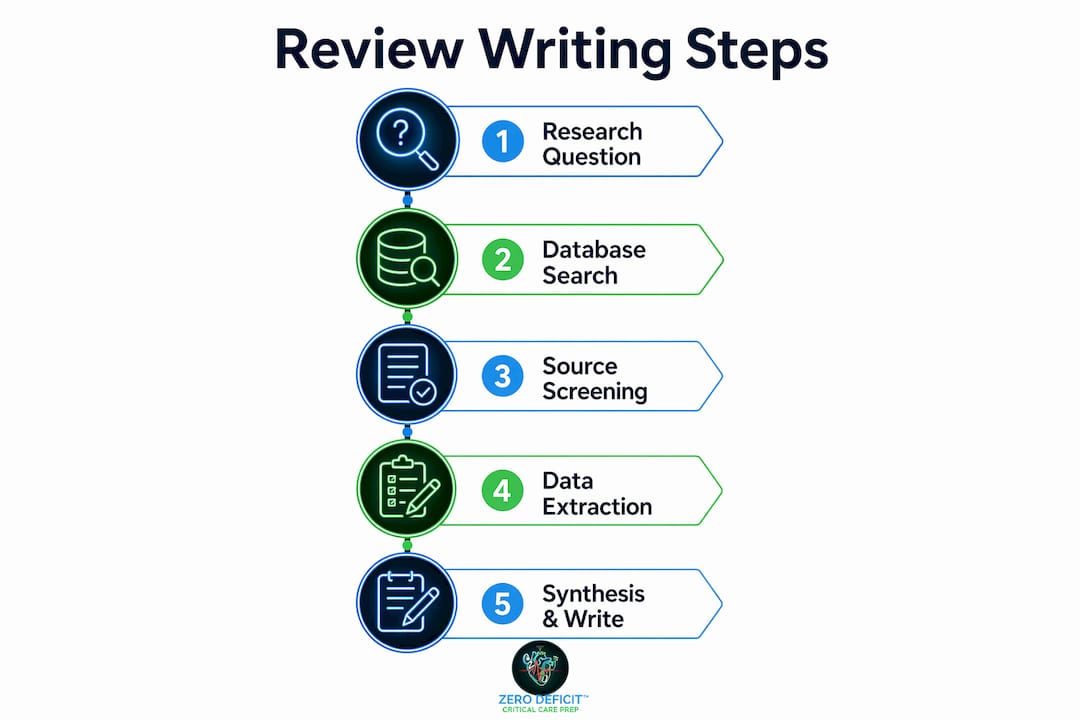
Writing a thorough literature review follows a reproducible sequence. Conducting a systematic review requires explicit, reproducible steps: focused question definition, database search, careful selection, critical synthesis, and clear conclusions. Here is how each step works in practice for critical care topics.
-
Define a focused SMART research question. Your question is your north star. A vague question like “What do we know about sepsis?” produces an unmanageable review. A SMART question like “In adult ICU patients with septic shock, does early vasopressin initiation reduce 28-day mortality compared to norepinephrine alone?” gives you clear inclusion criteria and a defined endpoint. Using SMART research questions helps maintain a manageable scope and a meaningful contribution to the literature.
-
Conduct a systematic literature search. Search PubMed, CINAHL, and the Cochrane Library using controlled vocabulary (MeSH terms) and Boolean operators. Document every search string, every database, and every date range from the start. Failure to document reproducible methods is a major red flag in peer review and will get your work rejected.
-
Apply inclusion and exclusion criteria. Prioritize primary research articles published within the last two to five years to maintain relevance and quality. For CCRN-relevant topics like ARDS management or hemodynamic monitoring, this means focusing on post-2020 trials and guidelines that reflect current SCCM and AACN standards.
-
Critically appraise each source. Evaluate study design, sample size, bias risk, and clinical applicability. A randomized controlled trial on vasopressor dosing carries more weight than a single-center retrospective chart review. Tools like the CASP (Critical Appraisal Skills Programme) checklists make this step structured and repeatable.
-
Synthesize, do not summarize. This is where most nursing students and early-career nurses stumble. Synthesis means comparing methodologies, identifying contradictions across studies, and explaining what findings mean collectively for patient care. It is not a list of what each paper said.
Pro Tip: Before you search a single database, write your research question on a sticky note and keep it visible. Every source you evaluate should answer that question directly. If it does not, exclude it, regardless of how interesting it seems.
What distinguishes a comprehensive review from other review types?
Not all literature reviews are created equal. Understanding the differences helps you read clinical research critically and choose the right review type for your own work.
| Review type | Scope | Methodology | Best use in nursing |
|---|---|---|---|
| Comprehensive review | Broad, covers all significant literature | Systematic search, critical synthesis | Updating clinical protocols, CCRN study synthesis |
| Systematic review | Narrow, focused question | Strict PRISMA framework, meta-analysis possible | Answering one specific clinical question |
| Integrative review | Broad, mixed methods | Combines quantitative and qualitative evidence | Complex nursing phenomena like patient experience |
| Mini-review | Narrow, limited sources | Less rigorous, faster | Quick overviews, introductory education |
| Scoping review | Broad, maps evidence | Identifies gaps, no quality appraisal | Emerging topics with limited evidence |
Systematic reviews focus on focused questions and strict methodology, while comprehensive reviews are broader and more inclusive but still systematic. Mini-reviews are narrow in scope. This distinction matters for CCRN prep because the exam draws on evidence synthesized across multiple review types, and your ability to recognize the strength of evidence behind a clinical recommendation is a tested skill.
The advantage of a comprehensive review over a systematic review is flexibility. Moving beyond strict frameworks like PRISMA to flexible, justified sample selection methods leads to more widely applicable literature syntheses. In critical care, where patient populations are heterogeneous and study designs vary widely, that flexibility often produces more clinically useful conclusions.
Common challenges when conducting comprehensive reviews and how to avoid them
Even experienced researchers make predictable mistakes in comprehensive review work. Recognizing these pitfalls before you start saves you weeks of wasted effort.
-
Scope creep. Starting with a broad question and letting it expand further is the most common failure mode. Unclear boundaries often cause research project failure, according to editors who review submitted manuscripts. Define your inclusion criteria before you search, and hold the line.
-
The laundry list trap. Avoid the laundry list approach by synthesizing findings rather than cataloging them. A review that says “Smith found X, Jones found Y, and Lee found Z” without connecting those findings adds no clinical value. Compare methodologies, identify contradictions, and explain what the collective evidence means.
-
Outdated sources. Relying on studies from 2010 to review current ARDS ventilator management is a credibility problem. Recent primary articles published within two to five years are the standard for maintaining review relevance in clinical fields.
-
Poor search documentation. If you cannot reproduce your search six months later, your review lacks scientific integrity. Log every database, every search term, and every filter applied. This is non-negotiable for any work you intend to publish or present.
-
Skipping critical appraisal. Including every study you find without evaluating quality inflates your source count but weakens your conclusions. A review built on low-quality evidence produces low-quality recommendations.
Pro Tip: Use a reference manager like Zotero or Endnote from day one. Tracking 200 sources in a spreadsheet is manageable at 50 and a disaster at 150. Set up your organizational system before you start searching.
Application of comprehensive reviews in critical care nursing and CCRN prep
The practical value of thorough literature reviews in critical care nursing is direct and measurable. Comprehensive syntheses improve critical thinking and clinical application, which are the exact competencies the CCRN exam evaluates. Here is how this plays out across core exam blueprint areas:
-
Cardiovascular. A comprehensive review of hemodynamic monitoring literature consolidates evidence on pulmonary artery catheter use, arterial line waveform interpretation, and vasopressor titration. Understanding the evidence base helps you answer CCRN questions about cardiogenic shock management with confidence rather than guesswork.
-
Pulmonary. Reviews synthesizing ARDS ventilator trials, including the landmark ARDSNet low tidal volume data and subsequent prone positioning studies, give you the clinical reasoning framework the exam expects. You understand not just the protocol but why it exists.
-
Neurology. Literature reviews on ICP management and stroke intervention timelines help you connect pathophysiology to nursing interventions, a connection the CCRN exam tests repeatedly.
-
Sepsis and MODS. The Surviving Sepsis Campaign guidelines are themselves a product of systematic and comprehensive evidence synthesis. Knowing how that evidence was built helps you apply the guidelines correctly in both clinical practice and exam scenarios.
-
CCRN exam prep directly. Reviewing the step-by-step exam review process at Zerodeficitccrnprep alongside your literature review skills creates a study approach that is both evidence-grounded and exam-focused. You stop memorizing isolated facts and start understanding clinical patterns.
The skill of synthesizing evidence also transfers directly to how you review CCRN rationales. When you understand why an answer is correct based on evidence, you retain it far longer than when you memorize it by repetition alone.
Key takeaways
A comprehensive review is the gold standard for evidence synthesis in critical care nursing, requiring focused questions, systematic searching, and critical analysis rather than simple summarization.
| Point | Details |
|---|---|
| Definition and scope | A comprehensive review covers all significant literature on a topic using explicit, reproducible methods. |
| Focused question first | Define a SMART research question before searching to prevent scope creep and information overload. |
| Synthesis over summary | Compare findings across studies and explain collective meaning rather than listing what each paper said. |
| Source quality and recency | Prioritize primary research from the last two to five years to maintain clinical relevance. |
| CCRN exam application | Comprehensive review skills build the critical thinking and evidence appraisal the CCRN exam directly tests. |
Why comprehensive reviews changed how I think about ICU practice
I spent years in the ICU treating comprehensive reviews as something academics did, not bedside nurses. That was a mistake I corrected when I started building the content at Zerodeficitccrnprep. The moment I began synthesizing literature on vasopressor management and ARDS protocols rather than just reading individual studies, my clinical reasoning sharpened in a way that years of bedside experience alone had not produced.
Here is what I have found that most articles on this topic miss: the discipline of writing a focused research question before you search is the same discipline that makes you a better clinical decision-maker. When you walk into a patient room and ask “What is the specific problem I am solving right now?” instead of running a generic assessment, you get better answers faster. The literature review process trains that exact cognitive habit.
For CCRN candidates, the practical advice is this: do not treat your exam prep as a separate activity from your clinical learning. Use the same critical appraisal skills you apply to a research article when you work through a practice question rationale. Ask why the evidence supports that answer. That connection between literature synthesis and exam reasoning is where real mastery lives. The assessment skills you build through rigorous review work are the same ones that carry you through the CCRN and through every complex patient scenario after it.
— Zero
Build your CCRN prep on evidence-based foundations
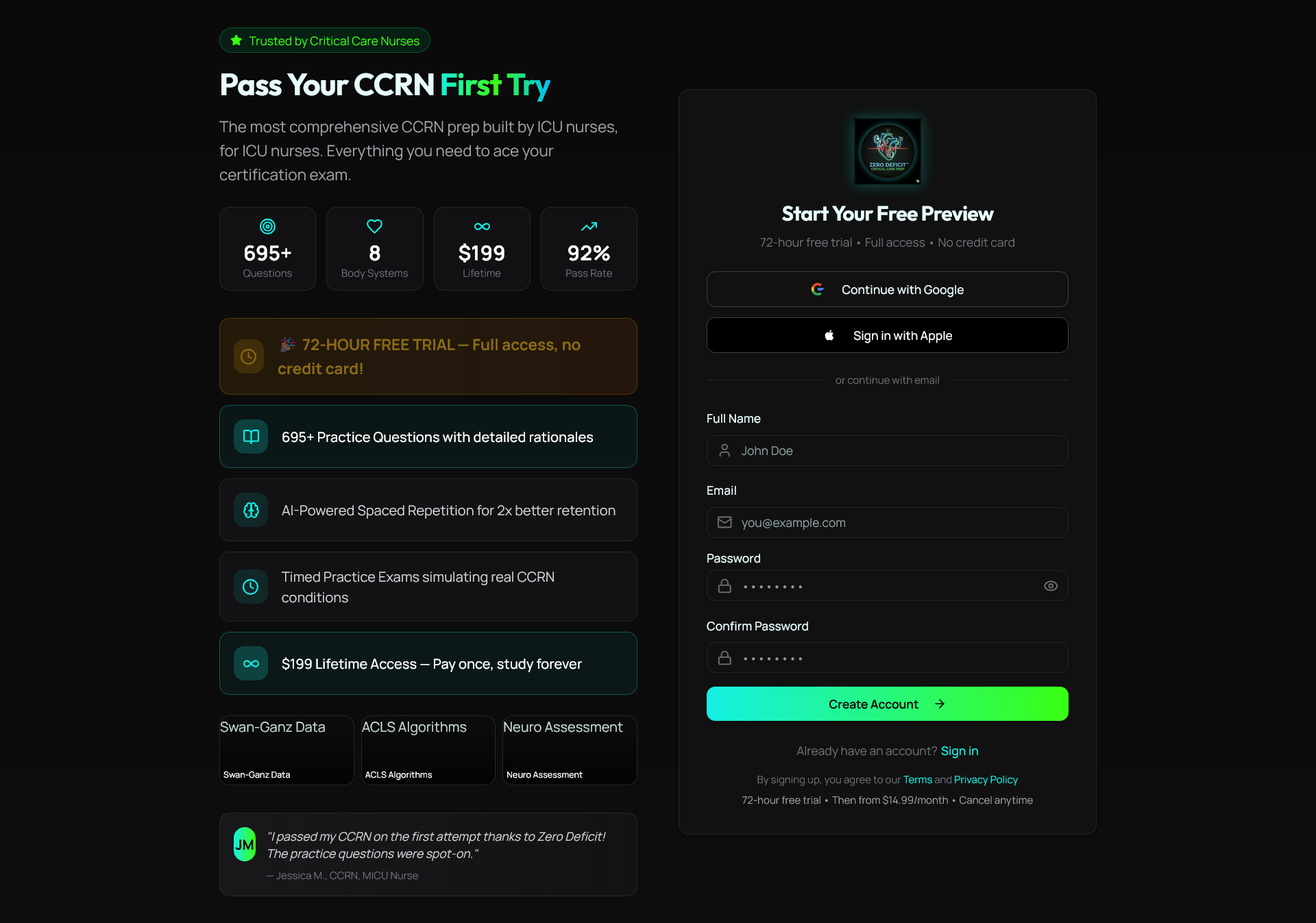
Zerodeficitccrnprep aligns every study guide and practice question with the latest evidence from AACN, SCCM, and AHA, so your prep reflects the same standards that comprehensive literature reviews are built on. The CCRN study guides at Zerodeficitccrnprep are organized by body system and cover every high-yield topic on the AACN Adult CCRN blueprint, from hemodynamic monitoring to sepsis management to neuro assessment. Each guide synthesizes current evidence into clinically precise, exam-ready content. Pair that with over 695 practice questions and detailed rationales, and you have a prep system grounded in the same evidence-synthesis principles that make comprehensive reviews powerful. Start studying free at Zero Deficit CCRN Prep today, no credit card required.
FAQ
What is a comprehensive review in simple terms?
A comprehensive review is a thorough, systematic examination of all significant research on a topic, using explicit methods to evaluate and synthesize evidence rather than simply listing what studies found.
How does a comprehensive review differ from a systematic review?
A systematic review focuses on one narrow clinical question with strict PRISMA methodology, while a comprehensive review covers broader topics and allows more flexible source selection while remaining systematic.
Why are comprehensive reviews important for CCRN exam prep?
Comprehensive reviews consolidate current best evidence on critical care topics, building the clinical reasoning and critical thinking skills the CCRN exam directly tests across cardiovascular, pulmonary, neuro, and sepsis content areas.
What are the key elements of a comprehensive review?
The key elements are a focused SMART research question, a systematic database search across sources like PubMed and CINAHL, rigorous inclusion criteria, critical appraisal of each source, and synthesis that compares findings rather than summarizing them individually.
How recent should sources be in a comprehensive review?
Primary research articles published within the last two to five years are the standard for maintaining clinical relevance, particularly in fast-moving fields like critical care nursing and evidence-based practice.
Recommended
- Step by Step Exam Review for the CCRN: 2026 Guide | Zero Deficit CCRN Prep
- How to review CCRN rationales: A critical care nurse’s guide | Zero Deficit CCRN Prep
- How educators boost CCRN certification success for nurses | Zero Deficit CCRN Prep
- Top CCRN study topics to master for exam success | Zero Deficit CCRN Prep
Take a Multisystem practice quiz
Master sepsis, shock, MODS, and multi-organ failure scenarios.
Get Your Free 20-Question CCRN Diagnostic
20 high-yield CCRN-style questions across every body system, with detailed rationales — emailed to you instantly.
No spam. One email + a couple of helpful follow-ups. Unsubscribe anytime.
Ready to pass your CCRN?
Join 12,000+ nurses using Zero Deficit — 695+ practice questions with rationales, AI-powered weak-area drilling, and spaced-repetition flashcards.
Start Free Trial →