What Is Test Anxiety? A Nurse-to-Nurse CCRN Guide
Test anxiety is a form of situational performance anxiety that can impair working memory and block recall of information you genuinely know. It does not reflect your clinical competence. If you feel it rising during the CCRN exam, three actions work immediately:
- Paced diaphragmatic breathing: Inhale for 4 counts, hold for 2, exhale for 6. One cycle lowers autonomic arousal enough to restore focus.
- Micro-simulation mental run-through: Spend 60–90 seconds mentally walking through a familiar clinical scenario (your last sepsis patient, a vent wean you managed) to reactivate the retrieval pathways anxiety just suppressed.
- Question triage: Skip the question that’s blocking you, flag it, and return. Forward momentum resets your cognitive state.
Pro Tip: Run at least two full timed simulations before exam day. Repeated exposure to high-stakes conditions desensitizes the physiological arousal response, so your heart rate on test day feels familiar rather than alarming.
Table of Contents
- What are the symptoms of test anxiety for ICU nurses?
- How does test anxiety actually hurt your exam performance?
- Evidence-based daily strategies to reduce test anxiety
- An 8-week CCRN study plan that integrates anxiety management
- What to do when anxiety hits during the CCRN exam
- When should you seek professional help for test anxiety?
- Key Takeaways
- The part most CCRN guides miss
- Zerodeficitccrnprep gives you the simulated practice that actually reduces anxiety
- Useful sources
- FAQ
What are the symptoms of test anxiety for ICU nurses?
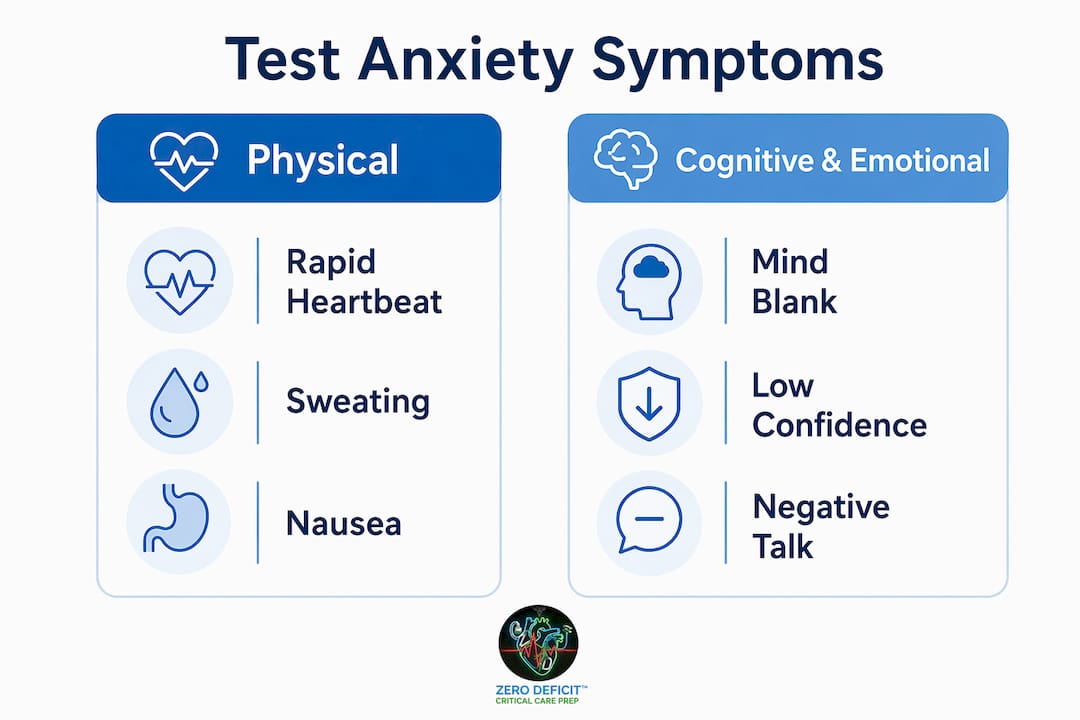
Symptoms of test anxiety fall across three domains, and recognizing your pattern matters because the fix for tachycardia is different from the fix for mind-blank.
Physical: Rapid heartbeat, sweating, nausea, shallow breathing, lightheadedness. You might notice your hands shaking when you sit down at the testing station, or your mouth going dry the moment a hemodynamics question appears.

Emotional: Feelings of helplessness, low confidence, fear, and a creeping sense that you don’t belong in that chair. An ICU nurse with five years of managing cardiogenic shock can suddenly feel like a first-semester student when anxiety hits.
Cognitive and behavioral: Mind going blank, difficulty concentrating, negative self-talk, making careless errors. The classic CCRN version: you read a question about ventilator settings for ARDS and the plateau pressure target you’ve used clinically a hundred times simply isn’t there.
The line between normal pre-exam nerves and performance-impairing anxiety is crossed when symptoms actively prevent you from demonstrating what you know, not just when they make you uncomfortable.
How does test anxiety actually hurt your exam performance?
The mechanism is cognitive, not motivational. When the body releases adrenaline in a high-stakes situation, the fight-or-flight response redirects neural resources away from the prefrontal cortex, where working memory lives. Researcher Sian Beilock’s work on “choking under pressure” shows that anxiety consumes the working memory capacity you need to reason through complex, multi-step problems, exactly the kind the CCRN presents.
This is why a competent ICU nurse blanks on a vasopressor titration question. The knowledge is encoded. Anxiety is blocking retrieval, not erasing the memory. That distinction matters clinically: the problem is access, not absence.
Statistic callout: Test anxiety is a form of performance anxiety that can “steal” working memory resources, causing candidates to blank on answers they genuinely know.
A baseline level of nervousness can actually sharpen focus and motivate preparation. The clinical concern is when arousal crosses the threshold where it interferes with performance rather than supporting it.
Pro Tip: Practice answering questions under mild time pressure daily. Controlled exposure trains your nervous system to treat the timed-test environment as familiar rather than threatening, which keeps arousal at the productive level.
Evidence-based daily strategies to reduce test anxiety
Managing test anxiety is not about eliminating nerves. It’s about keeping arousal in the range where it helps rather than hurts. Mayo Clinic guidance consistently points to daily relaxation practice, sleep hygiene, physical wellness, and simulated practice as the core interventions.
Daily behavioral skills:
- Diaphragmatic breathing: Five minutes each morning builds the habit so the technique is automatic under pressure.
- Progressive muscle relaxation (PMR): Tense and release muscle groups from feet to shoulders. Ten minutes before bed reduces baseline cortisol and improves sleep quality.
- Short mindfulness practice: Even a 5-minute body scan between study blocks lowers resting anxiety and improves attention on return.
- Sleep hygiene: Seven to nine hours is not optional during CCRN prep. Sleep consolidates memory; cutting it short undoes the spaced repetition you spent the day building.
- Exercise: Even 20–30 minutes of moderate aerobic activity reduces anxiety and supports memory retention by promoting neuroplasticity.
Study methods that lower anxiety and improve retrieval:
Spaced repetition distributes review across increasing intervals, which reduces the panic of “I haven’t reviewed this in weeks” because the system schedules it for you. Interleaving, mixing cardiac questions with pulmonary and neuro rather than blocking by topic, trains your brain to retrieve under the same unpredictable conditions the CCRN uses. Simulated high-stakes practice under timed conditions is the single most effective anxiety-reduction tool because it makes the test environment familiar.
Statistic callout: Practice under exam-like conditions, including timed practice tests and progressive exposure, reduces situational anxiety and improves retrieval under pressure.
Avoiding burnout during intense study periods is equally important. Strategies for managing workload and recovery, similar to those used by students navigating college burnout, apply directly to CCRN prep: scheduled breaks, realistic daily targets, and protecting sleep.
An 8-week CCRN study plan that integrates anxiety management
This plan pairs the CCRN exam blueprint with progressive anxiety-management milestones. Adapt the topic order to your weakest systems.
| Week | Topic Focus | Question Block | Simulation | Anxiety Practice |
|---|---|---|---|---|
| 1 | Cardiovascular (hemodynamics, ACS) | 20 Qs/day | None | 5 min breathing daily |
| 2 | Pulmonary (ARDS, vents, ABGs) | — | None | 5 min PMR nightly |
| 3 | Neuro (ICP, stroke) + Renal/CRRT | — | 30-min timed quiz | 10 min mindfulness |
| 4 | Sepsis/MODS + Endocrine emergencies | 30 Qs/day | 30-min timed quiz | Sleep audit + exercise |
| 5 | Hematology + Synergy Model & ethics | 30 Qs/day | 60-min simulation | Full daily routine |
| 6 | Mixed interleaved review | — | 60-min simulation | Breathing + PMR |
| — | Weak-area targeted review | — | 90-min simulation | Stress inoculation |
| 8 | Light review + rest | 20 Qs/day | Full 150-Q simulation | Pre-exam routine lock-in |
Progressively longer simulations in weeks 5–8 build tolerance for the sustained cognitive load of the actual CCRN. By week 8, a 150-question simulation should feel like a known quantity, not a threat.
Pro Tip: Short, timed 10-question quizzes on a single topic create controlled exposure without the fatigue of a full simulation. Use them on high-anxiety topics like hemodynamics or vasopressors to build confidence incrementally.
What to do when anxiety hits during the CCRN exam
Follow this sequence if you feel anxiety rising mid-exam:
- Stop and breathe. One full diaphragmatic cycle (4-2-6 count) before reading the next question.
- Ground yourself. Name three things you can physically feel: the chair, the keyboard, your feet on the floor. This interrupts the anxiety spiral.
- Triage the question. If you’ve read it twice and still feel stuck, flag it and move on. Return with fresh eyes.
- Check your time. At question 50 and question 100, confirm you’re on pace. Time pressure amplifies anxiety; knowing you’re on track reduces it.
- Use a self-talk script. “I know this material. I’ve managed this in the ICU. I can work through this question.” Keep it short and factual.
For a full pre-exam morning routine, including sleep, caffeine timing, and arrival logistics, the CCRN exam day checklist covers every logistical detail. Arrive early enough to settle, not so early that you’re sitting with your anxiety for an hour.
When should you seek professional help for test anxiety?
Situational test anxiety and generalized anxiety disorder (GAD) are distinct conditions. Most CCRN candidates experience the former: anxiety that is specific to high-stakes testing and manageable with behavioral strategies. Seek professional evaluation when symptoms cross into functional impairment.
Red flags that warrant professional help:
- Panic attacks before or during exams (racing heart, chest tightness, feeling of impending doom)
- Persistent avoidance of scheduling or sitting for the exam
- Anxiety that is present most days regardless of testing context
- Inability to study due to anxiety, not just discomfort while studying
CBT techniques, talk therapy, and structured skills training are effective for test anxiety. Your employer’s Employee Assistance Program (EAP) is often the fastest, lowest-barrier entry point. Many hospitals offer free counseling sessions through EAP with no referral required.
If an underlying condition such as ADHD or a learning difference is contributing, formal evaluation can secure testing accommodations. Exam accommodations such as extended time or a separate testing room level the playing field without changing what the exam measures. Contact the AACN testing authority with documentation from a licensed clinician to begin that process.
Key Takeaways
Test anxiety is a physiological and cognitive response, not a measure of clinical competence, and behavioral strategies reliably reduce it for most CCRN candidates.
| Point | Details |
|---|---|
| Test anxiety defined | Situational performance anxiety that blocks working memory access, not a sign of missing knowledge. |
| Immediate tactics | Use paced breathing (4-2-6), question triage (skip-flag-return), and grounding during the exam. |
| Daily habits | Combine sleep hygiene, exercise, diaphragmatic breathing, and PMR to lower baseline anxiety. |
| Study method | Spaced repetition, interleaving, and progressive timed simulations reduce anxiety and improve retrieval. |
| Zerodeficitccrnprep | Over 695 practice questions with AI-driven review and timed simulations build the exam familiarity that reduces anxiety. |
The part most CCRN guides miss
Here’s what I’ve seen over and over in working with critical care nurses preparing for this exam: the anxiety isn’t about the content. You’ve titrated norepinephrine at 3 AM. You’ve managed a patient on CRRT and a balloon pump simultaneously. You know this material in your bones. What you haven’t done is sit in a quiet room, alone, for hours, with a timer running and your career credential on the line.
That specific environment is what triggers the anxiety response, and the only way to neutralize it is to rehearse it. Not just study the content, but rehearse the environment. That’s why the exam confidence work we’ve built into Zerodeficitccrnprep centers on simulated, timed practice rather than passive review. Nurses who report first-attempt passes consistently describe the exam as feeling “familiar,” not easy, but familiar. That familiarity is built, not found.
Zerodeficitccrnprep gives you the simulated practice that actually reduces anxiety
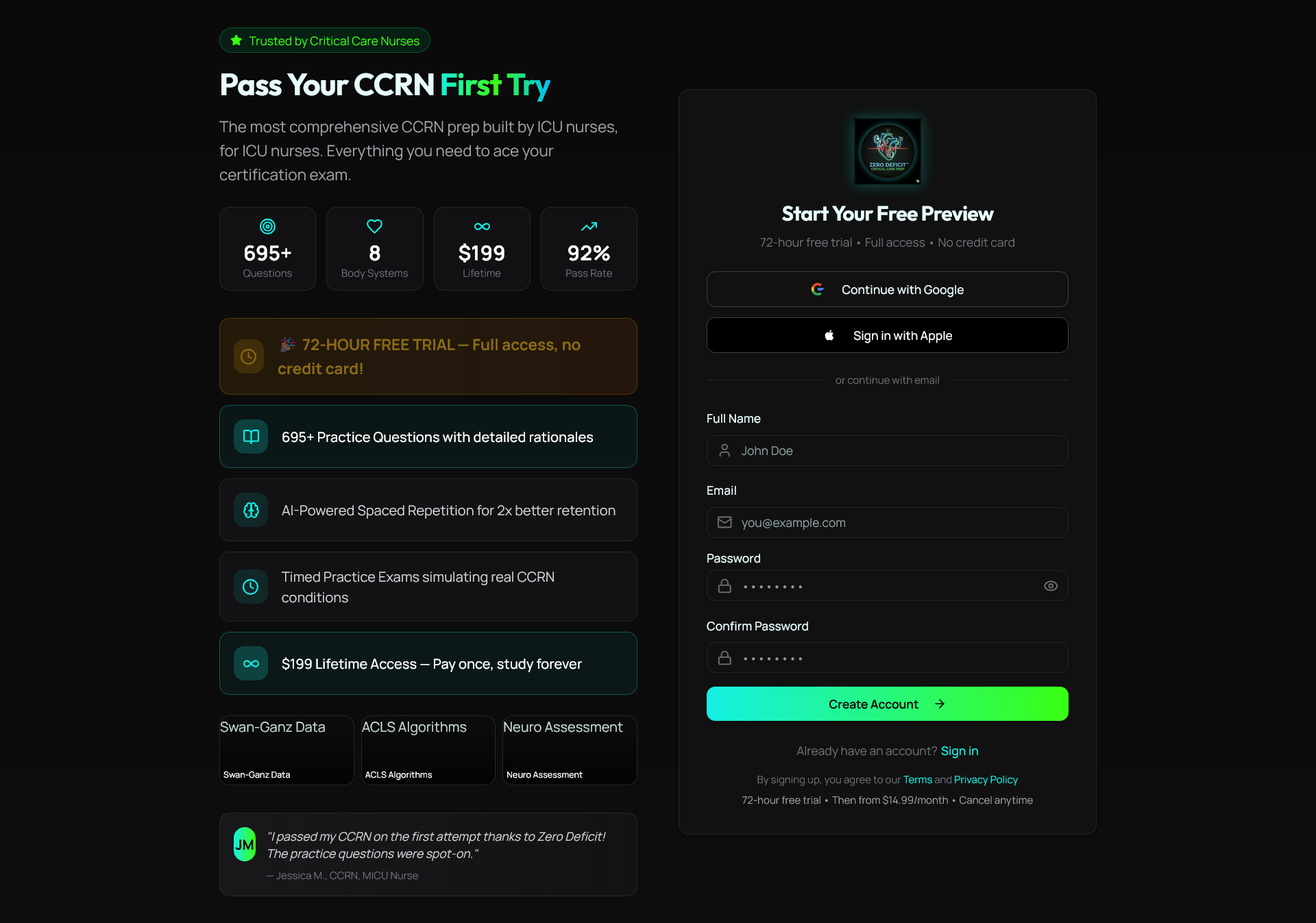
The fastest path from anxious to confident is repeated, realistic practice under timed conditions. Zerodeficitccrnprep’s platform is built specifically for that: over 695 CCRN practice questions with detailed rationales, AI-powered review that targets your weak areas, and timed simulations across all eight body systems. The spaced repetition engine schedules your review automatically, so you’re not guessing what to study next.
System-based CCRN study guides written by expert ICU nurses give you the clinical framing the AACN exam blueprint demands, from hemodynamics and vasopressors to the Synergy Model. Start with a free timed sample test and see exactly where your retrieval breaks down under pressure. That’s where the real prep begins.
Useful sources
The following authoritative sources informed this article and are available for further reading or documentation when requesting accommodations or clinical counseling.
Key sources used in this article:
- Mayo Clinic: Test anxiety overview and management — symptoms, normalization, and treatment options including CBT
- Mayo Clinic expert Q&A: Can test anxiety be treated? — professional referral criteria and accommodation evaluation
- Verywell Mind: Symptoms of test anxiety — domain-specific symptom mapping
- Simply Psychology: Test anxiety and working memory — cognitive mechanism and retrieval interference
- Wikipedia: Test anxiety — spectrum and distinction from GAD
- Oregon State University Academic Success Center — pre-test routines and in-test tactics
- UNC Learning Center: Tackling test anxiety — symptom categories and student strategies
- Zero Deficit CCRN Prep: Advantages of practice tests — simulation and progressive exposure evidence
- Zero Deficit CCRN Prep: Building exam confidence — first-attempt pass outcomes and confidence-building strategies
FAQ
What is test anxiety in simple terms?
Test anxiety is situational performance anxiety that impairs working memory and blocks recall during an exam, even when you know the material. It is not a measure of your knowledge or clinical competence.
Can test anxiety affect nurses who are clinically competent?
Yes. Highly competent ICU nurses experience test anxiety because the exam environment, not the clinical knowledge, triggers the stress response. The fight-or-flight reaction suppresses the prefrontal cortex regardless of experience level.
How do you overcome test anxiety for the CCRN exam?
Combine daily behavioral practices (diaphragmatic breathing, sleep hygiene, exercise) with progressive timed simulations. Repeated exposure to exam-like conditions is the most reliable way to reduce situational anxiety before test day.
When does test anxiety require professional help?
Seek evaluation when anxiety causes panic attacks, persistent avoidance of the exam, or inability to study. CBT and structured skills training are effective, and your hospital’s EAP can connect you to counseling quickly.
Does Zerodeficitccrnprep help with test anxiety?
Zerodeficitccrnprep’s timed simulations and spaced repetition engine build the exam familiarity that reduces situational anxiety. Nurses who complete progressive practice tests consistently report that the actual CCRN feels familiar rather than overwhelming.
Recommended
- How to Build Exam Confidence for CCRN Success | Zero Deficit CCRN Prep
- Why Is Confidence Important in Exams: A Nurse’s Guide | Zero Deficit CCRN Prep
- Pass the CCRN Exam: Proven Guide for Critical Care Nurses | Zero Deficit CCRN Prep
- Checklist for Exam Day: CCRN and NCLEX Nurse Guide | Zero Deficit CCRN Prep
Take a Cardiovascular practice quiz
Test your mastery of hemodynamics, ACLS, MI, arrhythmias, and heart failure.
Get Your Free 20-Question CCRN Diagnostic
20 high-yield CCRN-style questions across every body system, with detailed rationales — emailed to you instantly.
No spam. One email + a couple of helpful follow-ups. Unsubscribe anytime.
Ready to pass your CCRN?
Join 12,000+ nurses using Zero Deficit — 695+ practice questions with rationales, AI-powered weak-area drilling, and spaced-repetition flashcards.
Start Free Trial →