Why Review Case Studies: A Critical Care Nurse's Guide
TL;DR:
- Reviewing case studies reveals the mechanisms behind clinical outcomes, which enhances critical care decision-making.
- They build judgment skills through realistic scenarios that mirror ICU complexities and incomplete data situations.
Reviewing case studies is the most direct method for understanding how and why clinical outcomes occur in real patients, making it a core skill for every critical care nurse. The formal term for this practice is case study review, sometimes called case-based analysis in nursing education and continuing professional development. The AACN and SCCM both endorse evidence-based case analysis as a foundation for clinical decision-making in the ICU. Whether you are preparing for the Adult CCRN exam or refining your bedside judgment, knowing why review case studies matters will sharpen how you think through every patient you manage.
Why review case studies: what other research methods can’t tell you
Case studies answer the “how” and “why” questions that randomized controlled trials and surveys simply cannot address. A randomized controlled trial tells you that vasopressin reduces mortality in septic shock. A case study shows you exactly how a 58-year-old with distributive shock responded when norepinephrine was titrated alongside vasopressin, including the hemodynamic trajectory, the timing of each decision, and where the care team hesitated.

Case studies track systems, relationships, and clinical outcomes over months or years, uncovering the mechanisms behind interventions. That depth is irreplaceable when you are managing a patient with multi-organ dysfunction syndrome where no single variable explains the picture.
The table below compares the three main research methods used in clinical practice.
| Method | Strengths | Limitations |
|---|---|---|
| Randomized controlled trial | High internal validity, controls for confounders | Excludes complex or rare presentations |
| Survey | Large sample, identifies trends | Cannot explain causation or process |
| Case study | Captures real-world complexity, reveals mechanisms | Not generalizable across populations |
The biggest misconception in clinical settings is treating case studies as anecdotes. True case studies use triangulated data sources including interviews, clinical records, and direct observations to rigorously expose the mechanisms of intervention success or failure. That rigor is what separates a publishable case report from a hallway story.
Pro Tip: When you read a case study, ask yourself whether the authors used more than one data source. Single-source reports carry a much higher risk of bias and should be weighted accordingly.

How case studies build clinical judgment you can’t get from a textbook
Case-based learning builds clinical judgment by placing you inside ambiguous, incomplete data situations that mirror real ICU conditions. No textbook presents a patient who is simultaneously hypotensive, oliguric, and febrile with a lactate of 4.2 mmol/L and a chart full of conflicting documentation. Case studies do.
Case-based learning significantly improves professionals’ ability to manage ambiguity by simulating realistic incomplete data scenarios. Learners prioritize trade-offs and evaluate missing information before acting, which increases decision precision. That is the exact skill set the CCRN exam tests across every body system domain.
At Yale, case studies bridge theory and practice by developing professional judgment to act when no textbook answers are available. Critical care nursing operates in that space constantly.
The specific skills case-based learning builds include:
- Prioritization under pressure. You practice deciding what to address first when multiple systems are failing simultaneously.
- Risk evaluation. You weigh the cost of acting against the cost of waiting, using only the data in front of you.
- Pattern recognition. Repeated exposure to similar presentations accelerates your ability to recognize deterioration early.
- Trade-off assessment. You learn that correcting one abnormality, such as aggressive fluid resuscitation, can worsen another, such as pulmonary edema in ARDS.
- Communication clarity. Case reviews sharpen how you frame clinical concerns to physicians and the rest of the care team.
The case method places learners in decision-maker roles, fostering clinical responsibility and critical thinking. That responsibility is not hypothetical in the ICU. It is the standard every shift.
Pro Tip: After reading a case study, write down the three decisions you would have made differently and why. That single habit accelerates critical thinking in nursing faster than passive reading alone.
How to analyze case studies for clinical application and CCRN prep
Effective case study analysis is a disciplined process, not a passive read. Most nurses skim case studies for the conclusion and miss the clinical reasoning buried in the middle. That reasoning is where the learning lives.
Follow these steps to extract real knowledge from every case you review:
- Verify the data sources. Confirm the authors used more than one source, such as chart review plus direct observation. Single-source cases carry higher bias risk.
- Check for specific metrics and timeframes. Credible case studies cite concrete numbers. Verifiable metrics with timeframes are what separate rigorous analysis from vague success stories. A case that says “the patient improved” tells you nothing. A case that says “MAP increased from 52 to 68 mmHg within 90 minutes of norepinephrine titration” tells you everything.
- Identify the inference gap. The inference gap occurs when decision rationale is implied rather than explicitly documented. If you cannot tell why the team made a specific choice, flag it and consider what the most likely reasoning was.
- Test rival explanations. Active case study review requires testing alternative explanations to separate superficial observations from real clinical knowledge. Ask yourself: what else could have caused this outcome?
- Strip away narrative fluff. Many case reports bury their key findings in storytelling. Actionable insights require stripping away that narrative to find the load-bearing facts that actually drive the outcome.
The table below shows the difference between weak and strong case study analysis habits.
| Analysis habit | Weak approach | Strong approach |
|---|---|---|
| Data verification | Accept the author’s conclusion | Confirm data sources and triangulation |
| Metrics | Note general trends | Record specific values and timeframes |
| Causation | Assume the obvious explanation | Test at least two rival explanations |
| Application | File away as interesting | Write one practice change it suggests |
Integrating case study review into your daily critical care practice
Routine case study review supports evidence-based practice, quality improvement, and CCRN exam readiness at the same time. The nurses who pass the CCRN on their first attempt are rarely the ones who memorized the most facts. They are the ones who can apply knowledge to an unfamiliar clinical scenario under time pressure.
Case studies illuminate barriers and facilitators in clinical interventions, providing practical lessons for quality improvement and future implementation. Tracking both successes and failures supports iterative learning across your unit.
Practical ways to build case review into your professional routine:
- Review one case per week. Choose cases that match CCRN exam blueprint topics: cardiovascular, pulmonary, neuro, sepsis, renal, and endocrine. The AACN blueprint weights cardiovascular at the highest percentage, so prioritize hemodynamic and shock cases.
- Use failed cases deliberately. Examining failed or complex cases yields the most valuable clinical insights by revealing the limits of interventions beyond success narratives. A case where the team missed early sepsis signs teaches more than a textbook-perfect resuscitation.
- Connect cases to protocols. After each review, identify which SCCM or AHA guideline the case either followed or violated. That connection builds the protocol fluency the CCRN exam rewards.
- Share cases with your team. Brief case discussions during huddles build unit-wide pattern recognition and support ethical decision-making in critical care when similar situations arise.
- Track your own cases. Document one complex patient per month using a structured format: presentation, key decisions, outcomes, and what you would do differently. This builds audit readiness and professional credibility over time.
The CCRN exam tests your ability to apply clinical knowledge to case-based scenarios, not recall isolated facts. Every case study you analyze is direct preparation for that format. Use CCRN question breakdown methods to practice applying case-based reasoning to exam-style questions.
Key takeaways
Reviewing case studies builds the clinical judgment and decision-making precision that both the CCRN exam and the ICU demand, making it a non-negotiable part of professional development for critical care nurses.
| Point | Details |
|---|---|
| Case studies answer “how” and “why” | They reveal mechanisms that randomized trials and surveys cannot capture. |
| Case-based learning builds ambiguity tolerance | Simulating incomplete data scenarios increases decision precision under pressure. |
| Strong analysis requires rival testing | Always ask what else could explain the outcome before accepting the author’s conclusion. |
| Failed cases teach the most | Complex or failed cases expose the limits of interventions beyond success narratives. |
| Weekly review builds CCRN readiness | Consistent case review aligned to the AACN blueprint directly prepares you for exam scenarios. |
What I’ve learned from years of case study review in critical care
Most nurses approach case studies the same way they approach a textbook chapter: read it, highlight a few things, move on. That habit produces almost no lasting clinical growth. The nurses I have seen develop the sharpest judgment in the ICU treat every case review as a structured exercise, not a passive read.
The single most underused practice is reading failed cases. When a patient deteriorated despite what looked like appropriate management, the case report holds the answer to why. That answer is almost always more useful than a success story, because it shows you exactly where the clinical reasoning broke down. I have found that one failed case, analyzed carefully, is worth five successful ones.
The other thing I want you to know is that case study review and CCRN prep are not separate activities. Every case you analyze is a practice question in disguise. The exam presents you with a clinical scenario and asks what you would do next. If you have spent months reading and critiquing real cases, you will recognize the pattern faster than any nurse who only drilled isolated facts.
Make it a habit. One case per week, analyzed with the five-step process above, will change how you think at the bedside and how you perform on exam day.
— Zero
Zerodeficitccrnprep: case-based learning built for the CCRN
Zerodeficitccrnprep was built by expert ICU nurses who understand that the CCRN exam is a clinical reasoning test, not a memorization contest. Every resource on the platform reflects that reality.
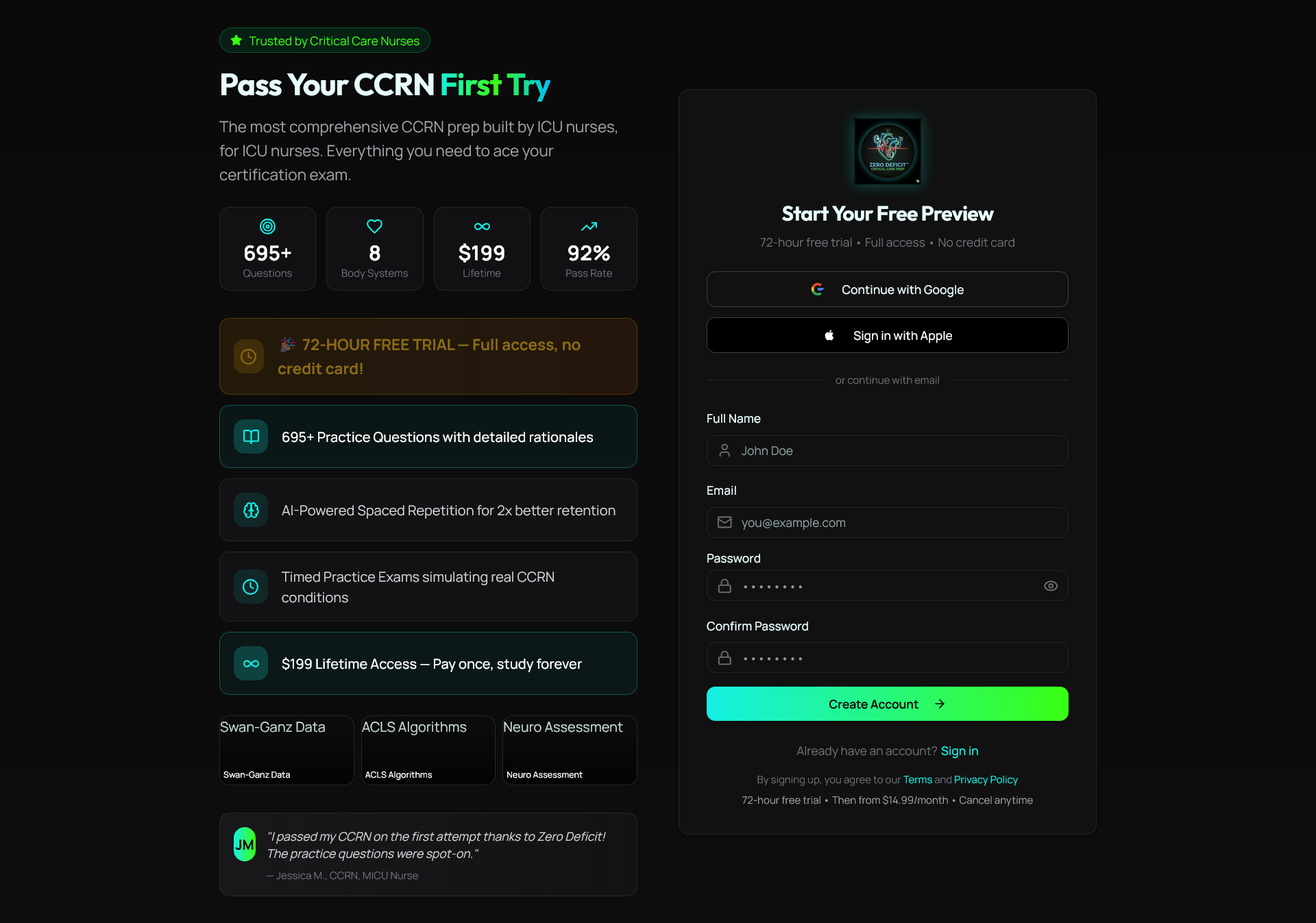
The CCRN study guides cover all 8 body systems with clinical case examples woven throughout, so you are always connecting knowledge to patient scenarios. The CCRN practice questions include over 695 case-based items with detailed rationales that explain not just the right answer but why the other options fail. That level of explanation is what builds the case analysis skill the exam demands. If you are ready to put case-based learning into practice, Zerodeficitccrnprep gives you the structure to do it.
FAQ
Why review case studies instead of just reading guidelines?
Guidelines tell you what to do. Case studies show you how real clinical decisions unfold when the patient does not follow the textbook, which is most of the time in the ICU.
What makes a case study credible for clinical use?
A credible case study uses triangulated data sources, such as clinical records, observations, and interviews, and reports specific metrics with timeframes rather than vague outcome statements.
How do case studies help with CCRN exam preparation?
The CCRN exam presents case-based scenarios requiring applied clinical reasoning. Reviewing real cases builds the pattern recognition and decision-making skills that exam questions directly test.
What is the inference gap in case study analysis?
The inference gap occurs when a case study implies the rationale behind a clinical decision without stating it explicitly. Identifying this gap forces you to think critically about what the team was actually weighing.
How often should a critical care nurse review case studies?
One structured case review per week, aligned to AACN blueprint topics like cardiovascular, pulmonary, and sepsis, builds meaningful clinical judgment over time without adding unsustainable workload.
Recommended
- What Is a Comprehensive Review? A Guide for CCRN Prep | Zero Deficit CCRN Prep
- How to review CCRN rationales: A critical care nurse’s guide | Zero Deficit CCRN Prep
- Pass the CCRN Exam: Proven Guide for Critical Care Nurses | Zero Deficit CCRN Prep
- What Is Critical Thinking in Nursing? A Clinical Guide | Zero Deficit CCRN Prep
Take a Multisystem practice quiz
Master sepsis, shock, MODS, and multi-organ failure scenarios.
Get Your Free 20-Question CCRN Diagnostic
20 high-yield CCRN-style questions across every body system, with detailed rationales — emailed to you instantly.
No spam. One email + a couple of helpful follow-ups. Unsubscribe anytime.
Ready to pass your CCRN?
Join 12,000+ nurses using Zero Deficit — 695+ practice questions with rationales, AI-powered weak-area drilling, and spaced-repetition flashcards.
Start Free Trial →