Your 6 Week CCRN Plan: A Nurse-to-Nurse Study Blueprint
Yes, you can reach CCRN readiness in six weeks if you confirm eligibility, schedule your exam, follow an AACN-weighted study plan, and train your pacing with mixed timed practice. This 6 week CCRN plan works because it treats the exam like what it is: an endurance event built on 150 items and 3 hours, not a trivia contest you cram for the night before.
Before you touch a single flashcard, do these five things today:
- Verify your eligibility hours against the AACN requirements.
- Schedule your exam date now so the six weeks have a hard finish line.
- Take a full timed diagnostic to find your true baseline, not your assumed one.
- Start an error log on day one, even before you know what categories it’ll hold.
- Block your study calendar around your shift rotation, not around wishful thinking.
Eligibility check: the Adult CCRN requires completion of direct care hours for acutely or critically ill adult patients within a recent time period, confirming this before committing to a six-week timeline. Confirm this before you commit to a six-week timeline because a hard blocker here costs you far more time than any study delay would.
Key Takeaways
A structured 6 week CCRN plan succeeds when study time follows AACN test plan weightings and practice volume is matched by deliberate pacing training.
| Point | Details |
|---|---|
| Confirm eligibility first | Verify 1,750 direct care hours (875 in the last year) before locking your six-week timeline. |
| Follow the weekly sequence | Diagnose in week 1, sprint through systems in weeks 2 to 4, remediate in week 5, simulate in week 6. |
| Weight cardiovascular and pulmonary | These systems carry the heaviest test plan weight and deserve roughly a third of total study hours. |
| Train pacing, not just content | Target 72 to 80 seconds per item and complete at least two full 150-item simulations before test day. |
| Use Zero Deficit™ to close gaps | Its 695+ practice questions, AI-generated mixed blocks, and rationales turn your error log into targeted review. |
Where to Verify Exam Rules and Pacing Benchmarks
- AACN’s official prep guidance for eligibility and test plan weighting.
- AACN certification practice exams for realistic, timed benchmarking.
- Preppool’s CCRN study blueprint for additional pacing and interleaving examples.
Table of Contents
- Building Your 6 Week CCRN Plan Week by Week
- How Do You Fit Studying Around 12-Hour Shifts?
- Which Topics Deserve the Most Study Time?
- What’s the Right Practice Question Strategy?
- Turn Your Error Log Into Your Highest-Yield Study Tool
- What Should You Bring on CCRN Exam Day?
- Sources
- FAQ
Building Your 6 Week CCRN Plan Week by Week
A 6 week CCRN plan only works if each week has a distinct job. Randomly rotating topics without a sequence is how nurses burn six weeks and still feel unprepared on test day.
- Week 1: Diagnose and map. Take your full-length diagnostic, score it by system, and map results against the AACN test plan weightings. Spend three days on cardiovascular fundamentals (hemodynamics, shock states, ACS, common drips) since it carries the heaviest weight on the exam. Close the week with a 60-question mixed timed block.
- Weeks 2 through 4: System sprints with interleaving. Each week targets one or two priority systems in depth, but every day still includes a shorter mixed block pulling from prior weeks. Week 2 covers pulmonary (ARDS, ventilator settings, ABG interpretation). Week 3 covers neuro (ICP management, stroke) plus sepsis and MODS. Week 4 covers endocrine emergencies and renal/CRRT. Each week ends with a 75 to 90 item mini-simulation.
- Week 5: Integration and remediation. Stop introducing new content. Pull your error log and rebuild your weakest three categories into one-page algorithm cards. Run two mixed 100 item blocks that intentionally weight toward your miss categories.
- Week 6: Taper and simulate. Take two full 150 item, three-hour simulations, spaced by at least 48 hours. Between them, review only flagged items and rationales. The final two days are light: light review, sleep protection, and logistics confirmation, not new material.
Shift workers, build your daily microblocks around this pattern:
- Post-night-shift days: one 20 to 25 minute review block only, no new content.
- Day-off days: one long 90 to 120 minute session covering a full system sprint plus a timed mixed block.
- 12-hour shift days: a single 15-minute pre-shift flashcard pass and a 20-minute post-shift error-log update.
Skip week 6’s simulations and you’ve built a knowledge base without stress-testing it. That gap is exactly where exam-day pacing failures come from.
How Do You Fit Studying Around 12-Hour Shifts?
The realistic weekly target for a 6 week CCRN plan is 10 to 14 hours during weeks 1 through 4, dropping to 8 to 10 hours in week 5 and tapering to 5 to 6 hours in week 6. That’s roughly 90 minutes a day on workdays and two to three hours on days off, not the unsustainable four-hour daily sessions some study guides promise.
Structure every microblock the same way: state your goal (for example, “master norepinephrine and vasopressin dosing thresholds”), pick your method (flashcards, a mixed question set, or a rationale review), then debrief for two minutes on what you missed and why. That debrief is what separates studying from just reviewing.
Protect at least one full rest day per week where you touch zero material. Six weeks without a single reset is how nurses arrive at week 5 mentally fried and start missing questions they knew cold in week 2.
- If your time-per-item is climbing or your repeat-error rate is rising, cut your block length by roughly 10 to 15% and shift that saved time into focused remediation instead of more volume.
- Track this weekly, not daily. One rough day means nothing; a rough week means adjust.
- Never add hours to compensate for a bad week. Add precision instead.
Pro Tip: Studying tired doesn’t just waste the hour, it can actively teach your brain the wrong pattern. If you’re post-night-shift and foggy, do flashcard review only, and save new content for when you’re rested.
Which Topics Deserve the Most Study Time?
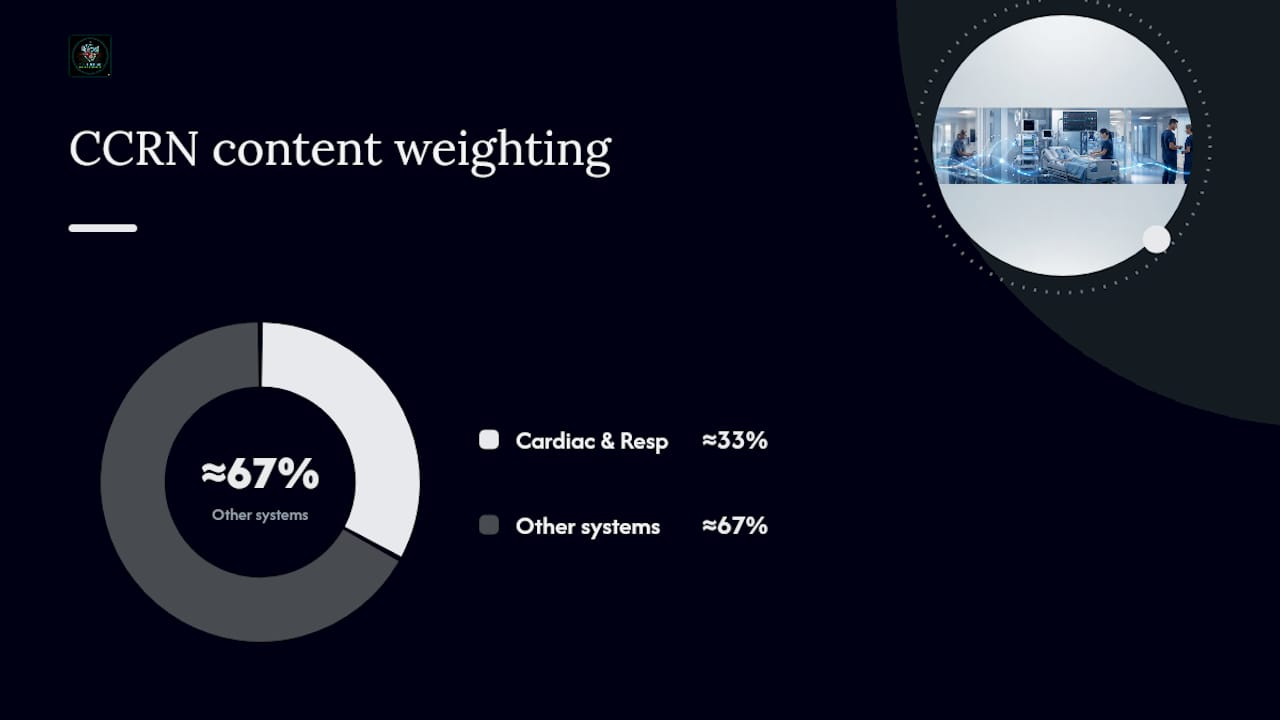
The AACN adult CCRN test plan heavily weights Clinical Judgment on the exam, with cardiovascular and respiratory content dominating the system-specific portions. That’s your answer to “where do I spend my limited hours”: cardiovascular and pulmonary content should consume roughly a third of your total study time combined, with the remaining systems distributed by their relative test plan weight rather than by your personal comfort level.
Build a one-page summary for each system before you leave that week, covering labs, ABG interpretation rules, hemodynamic parameters, and the indications for common vasoactive drips (norepinephrine, vasopressin, dobutamine, milrinone).
Memorize common lab value ranges for electrolytes, hemoglobin, and blood gases, as the exam expects instant recall rather than lookup time. Familiarity with typical reference ranges supports efficient exam performance.
What’s the Right Practice Question Strategy?
Practice volume without pacing discipline is wasted hours. The full CCRN exam consists of 150 items administered over three hours (125 scored and 25 pretest), so pacing yourself to roughly a little over one minute per item allows time for the more difficult questions.
- Run mixed 60 to 75 item timed blocks starting in week 2, scored strictly against that per-item pace.
- Complete at least two full 150 item simulations before test day, ideally in week 6, spaced at least 48 hours apart to allow recovery.
- Use checkpoint marks during every timed block: you should be at roughly item 50 by the 60-minute mark and item 100 by 120 minutes.
- Apply a two-pass method: answer everything you know instantly on pass one, then return to flagged calculation or comparison items on pass two with a fresh reasonableness check.
- Track three metrics weekly: first-order correctness (did you get it right without flagging), average time per item, and repeat-error rate on categories you’ve already studied.
A rising repeat-error rate on a system you “finished” two weeks ago is your clearest signal that content needs to move back into active rotation, not archive.
Turn Your Error Log Into Your Highest-Yield Study Tool
Your error log should capture the reasoning trap, not just the correct answer. “Missed a shock question” tells you nothing in week 5. “Confused cardiogenic and distributive shock hemodynamic profiles” tells you exactly what to rebuild.

Run this loop: log the miss with the specific reasoning error, convert it into a flashcard or a one-page algorithm card (a shock ladder, an ARDS ventilator settings card), retest it in your next mixed block, and re-log it if you miss it again. Interleave systems deliberately, don’t finish cardiovascular then abandon it, keep pulling old material into new blocks so spaced retrieval does its job across all six weeks.
This is exactly what Zero Deficit™ CCRN Exam Prep is built for. Its AI review tool can generate a mixed quiz weighted toward your specific frequent misses, its nurse-written rationales explain the reasoning trap behind every question rather than just naming the right answer, and its flashcard system lets you convert a logged miss into a spaced-repetition card in seconds.
Pro Tip: Don’t just re-read a missed rationale. Explain it out loud in your own words as if you’re teaching a new grad. If you can’t explain it simply, you haven’t actually learned it.
What Should You Bring on CCRN Exam Day?
Bring two forms of ID and your exam confirmation, and arrive at least 30 minutes before your scheduled time. Sleep protection matters more than any last-minute review: a rested brain outpaces a crammed one on a three-hour exam.
- Eat something with protein beforehand; you don’t want a blood sugar crash at item 90.
- Use a 10-second micro-reset (a breath, a shoulder drop) if you feel your pacing slipping, rather than spiraling into panic.
- Check your pacing at item 50 (60 minutes) and item 100 (120 minutes); if you’re behind, speed up on straightforward items rather than rushing the complex ones.
- After the test, resist the urge to do an immediate deep post-mortem. Write down how you felt, then go live your life until your results arrive.
A Nurse-to-Nurse Note on Getting Through These Six Weeks
Block two days a week as completely non-negotiable study days, and defend them the way you’d defend a patient assignment. If your unit allows shift trades, use one to protect a study block during a heavy week. You already handle codes and triage under pressure. Six weeks of disciplined practice is well within what you can do.
Get Exam-Ready Faster With Zero Deficit™
Six weeks moves fast, and the biggest time-waster in most study plans is hunting for quality questions instead of answering them. Zero Deficit™ CCRN Exam Prep gives you 695+ practice questions with nurse-written rationales already organized by system, so your week 2 through 4 sprints don’t require you to build your own question sets from scratch.
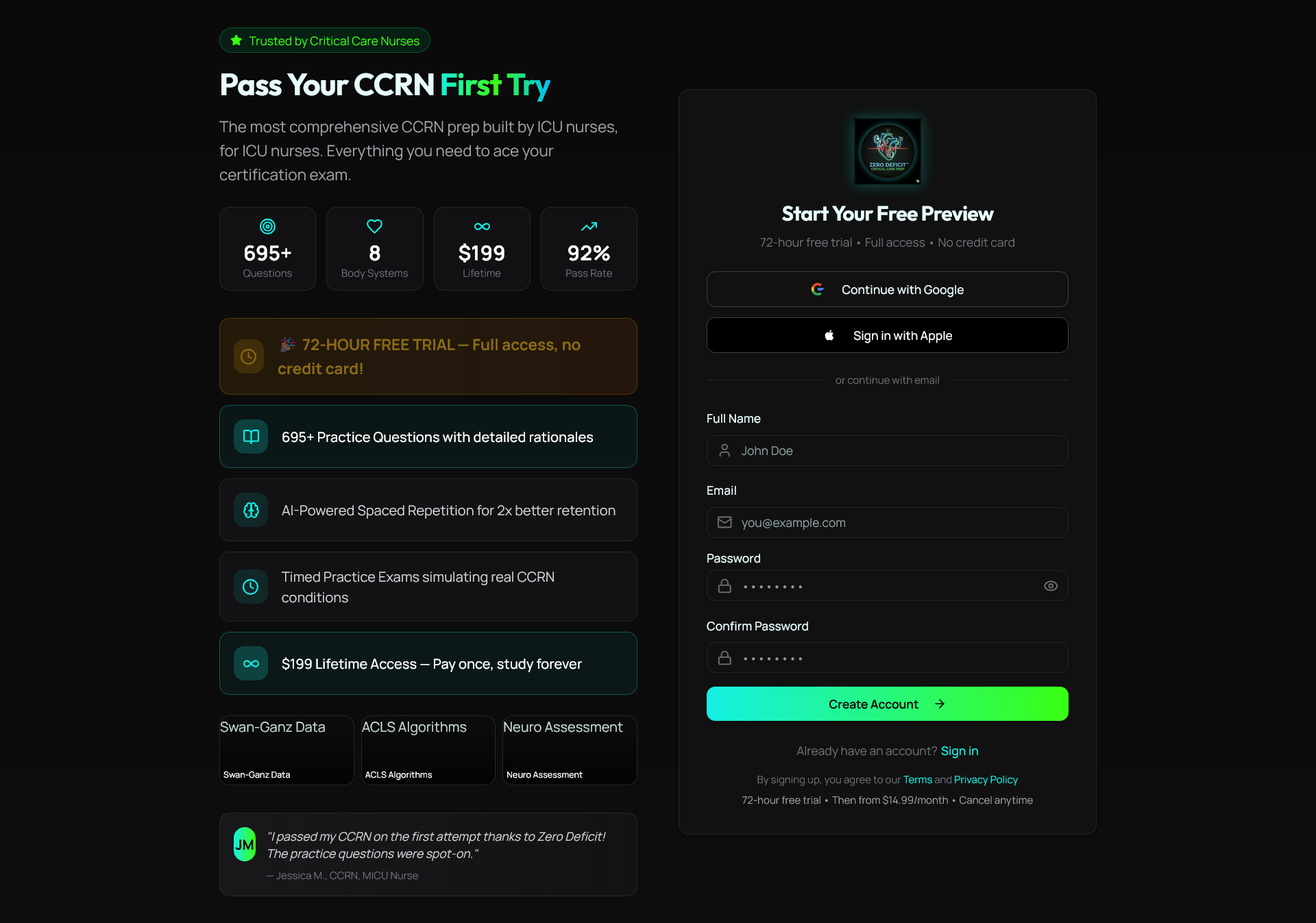
The AI review tool builds mixed blocks automatically from your frequent misses, which does the interleaving work this plan calls for without you tracking it manually in a spreadsheet. Pair that with the system-by-system study guides mapped to the AACN test plan, and your week 5 remediation becomes targeted instead of guesswork. Start a free trial, run your diagnostic this week, and let the six weeks work in your favor instead of against you.
Sources
FAQ
How long should you study for the CCRN exam?
Six weeks of disciplined, AACN-weighted study is enough for most candidates with active ICU experience, though four to six weeks is the commonly reported sufficient range among recent test-takers when paired with daily mixed practice.
How many people fail the CCRN exam?
Exact pass rate figures fluctuate and aren’t published in a single fixed number by AACN, so rather than citing a specific percentage, focus on what improves your odds: weighting study time to the test plan and completing full-length timed simulations before test day.
How many hours of critical care experience does CCRN require?
You need 1,750 hours of direct care for acutely or critically ill adult patients within the past two years, with at least 875 of those hours completed in the most recent year, per the AACN eligibility requirements.
How many questions are on the CCRN exam and how much time do you get?
The exam has 150 total items (125 scored, 25 pretest) administered over three hours, which means pacing yourself to roughly 72 to 80 seconds per item.
What score do you need to pass the CCRN exam?
AACN sets the passing standard using a scaled score rather than a fixed raw percentage, so instead of chasing a specific number, benchmark your readiness with full simulations like those on Zero Deficit™ and AACN’s own official practice exams.
Recommended
Take a Respiratory practice quiz
Master ARDS, ventilation, ABGs, oxygenation, and pulmonary emergencies.
Get Your Free 20-Question CCRN Diagnostic
20 high-yield CCRN-style questions across every body system, with detailed rationales — emailed to you instantly.
No spam. One email + a couple of helpful follow-ups. Unsubscribe anytime.
Ready to pass your CCRN?
Join 12,000+ nurses using Zero Deficit — 695+ practice questions with rationales, AI-powered weak-area drilling, and spaced-repetition flashcards.
Start Free Trial →