Nursing Study Platforms: Why CCRN Prep Starts With Rationales

Zero Deficit™ CCRN Exam Prep is the platform we recommend for critical care certification study, because it pairs an exam-style question bank with AI-personalized review and detailed rationales. That matches how the NCLEX-RN test plan frames readiness: judgment, not recall. Below we cover platform types, how to choose, and the study routines that make any tool work.
TL;DR:
- Trial a weak system with daily questions, full rationale review, flashcards from misses, and a timed block; continue only if accuracy or confidence improves.
- Aim for roughly 85% success during practice; lower the difficulty if needed, avoid unverified shared decks, and review rationales even when you guessed correctly.
- Spend 20 to 30 minutes daily on spaced flashcards, answer mixed questions, and take a weekly timed simulation while logging why you missed each item.
- Start with cardiovascular and pulmonary sets, then use progress by system to target weak areas instead of spending extra time on familiar subjects.
- Monthly access costs $14.99, yearly access costs $84.99, and lifetime access suits retakers or nurses planning to recertify; try the platform before paying.
Table of Contents
- What Zero Deficit™ gives you and how to use it
- Which types of study platforms fit which problem?
- How do you choose the right study platform?
- What study routines work with any platform?
- What do the standards and evidence say?
- What do user success stories tell us about effectiveness?
- How I would structure your final eight weeks
- Start practicing with Zero Deficit™
- FAQ
- Sources
What Zero Deficit™ gives you and how to use it
We built Zero Deficit™ for ICU nurses sitting the Adult CCRN, so every feature maps to a specific study problem. Here is what you get:
- A substantial bank of practice questions organized by body system.
- Detailed rationales for practice questions, so you learn why the right option is right and why each distractor fails.
- AI-powered personalized review that steers you toward the topics you keep missing.
- Spaced repetition and flashcards for lab values, drip titration parameters and drug classes.
- Exam simulations that build stamina for a long, mixed-topic test.
- Study guides by system: cardiovascular, pulmonary, neurology, sepsis, renal and endocrine.
- Progress tracking so your weak spots show up in numbers, not guesses.
Rationales do the heavy lifting. Reading why a distractor is wrong exposes the misconception behind your miss, and we explain that process in our post on exam rationales. Spaced repetition then keeps the corrected fact from fading, whether it is a normal-ranges table or a vasopressor’s mechanism.
Pro Tip: Start your trial with the cardiovascular and pulmonary question sets, take a short timed block on each, then read every rationale before moving on. Those two systems show you fastest whether the explanations match how you think.
You can preview the format on our practice page or browse the full practice test index covering the body systems.
Which types of study platforms fit which problem?
Not every tool solves every problem. Match the category to what is actually holding you back.
Question banks and exam simulators. Best for: learning to reason through exam-style items. Look for timed modes, mixed-topic quizzes, rationale depth for correct and incorrect options, and content tied to the current test plan. Because the NCLEX is delivered by computerized adaptive testing, adaptive practice mirrors how that exam selects items.
Spaced-repetition flashcards. Best for: lab values, drug classes and formulas you must recall instantly. Checklist:
- Scheduling that resurfaces missed cards sooner
- Cards you can edit yourself
- Source citations on shared decks
- Offline access
Treat unverified shared decks with suspicion, since one wrong value repeated fifty times sticks. If privacy matters to you, one on-device option is a private active recall app for iOS that keeps your review data off the cloud.
Video libraries and microlectures. Best for: concept walkthroughs and procedure demos, such as waveform interpretation or ventilator mode comparisons. Checklist:
- Instructors with clinical credentials
- Short, focused segments
- Content updated to current guidelines
- Playback speed controls
Visual anatomy and interactive reference tools. Best for: physiology you need to picture, such as the Frank-Starling curve or nephron function. Checklist:
- 3D models you can rotate
- Normal ranges shown beside the visuals
- Labeled systems you can quiz yourself on
Study planners and microlearning apps. Best for: building a habit when your schedule is chaotic after long shifts. Checklist:
- Reminders tied to your shift pattern
- Streaks or progress logs
- Short sessions that fit your schedule
- Calendar integration
Many candidates combine complementary categories. A question bank is the backbone; the rest fill gaps it exposes.
How do you choose the right study platform?
Run each candidate through the same checklist, then test it with a short trial. A platform that looks polished can still teach the wrong things.
Selection criteria:
- Does the content align to the current exam blueprint or test plan?
- Are rationales detailed enough to teach, not just announce the answer?
- Does it adapt to your weak areas?
- Does it include spaced repetition?
- Can you see progress by system, like on our progress tracking page?
- Do simulations resemble the real test’s length and mix?
- Does it work on your phone between tasks?
- Is there a free trial before you pay?
Questions to ask during the trial: Who wrote the rationales and what are their credentials? How current are the references? Can you take a quiz limited to one system? Does missing a question change what you see next?
Pricing shapes. Free tiers suit sampling. Monthly plans suit a short sprint. Yearly plans lower the monthly cost if you need several months. Lifetime access suits retakers or nurses who plan to recertify. Our own options are listed on our subscription page: Premium Monthly at 14.99 USD per month and Yearly Access at 84.99 USD per year, plus Lifetime Mastery. Judge value by time to pass, not sticker price. A cheap tool you abandon costs more than a fair one you finish.
The trial challenge: pick a weak system, do a daily set of questions, read every rationale, make flashcards from your misses, and finish with a timed block. If your accuracy and confidence did not move, move on.
Pro Tip: Keep a simple log of why you missed each question: knowledge gap, misread stem, or second-guessing. The pattern tells you whether you need content or test-taking practice.
What study routines work with any platform?
The platform supplies material; your routine turns it into retention. These habits come from the same structured strategies that Chamberlain University recommends: spaced retrieval, active recall, and writing your own questions.
Daily:
- 20–30 minutes of spaced flashcard review
- One block of mixed practice questions
- Write instructor-style questions of your own after a lecture or guide chapter
Weekly:
- One timed, mixed-topic simulation
- A log of missed-question patterns
- Mini-decks built from those misses, so your flashcards target your real gaps
As the exam approaches:
- Full-length timed simulations
- Focused review of your weakest systems
- Brief spaced rehearsal of lab values and drug prototypes
Our question strategies guide goes deeper on reading stems and eliminating distractors.
Common pitfalls:
- Starting at too high a difficulty. Research summarized by Wolters Kluwer suggests practice works best at around 85% success, so build up from easier sets.
- Leaning on shared decks you never verified.
- Cramming just before the exam instead of spacing the work.
- Reading rationales only for questions you missed. Review the ones you guessed right too.
What do the standards and evidence say?
The case for question banks and active study rests on how the exams themselves are built. The NCLEX-RN Test Plan states that the exam is delivered through computerized adaptive testing, selecting items to match candidate ability. Practicing with large item pools and adaptive selection prepares you for that decision-making rhythm.
Educators recommend integrating clinical-judgment frameworks across curricula rather than treating licensure prep as isolated test prep, because it builds the habits needed in practice.
That is the position taken in AACN’s Essentials guidance, and it explains why rationales matter more than raw scores. Active strategies such as team-based learning and unfolding case studies are recommended to bridge theory and bedside readiness, and team-based learning studies report better engagement and critical thinking than passive methods.
Research suggests practice tasks work best when you succeed about 85% of the time. That is hard enough to stretch you and easy enough to keep you going.
The Feynman Technique fits here too: explain a hard concept aloud in plain language, and the gaps reveal themselves. Nursing pedagogy experts highlight it as an effective active-learning tool, as the NCLEX site notes. Try it on ARDS ventilation strategy or the stages of shock. If you stumble, that is your next study target. For licensure candidates, question banks with rationales are widely recommended as a core part of preparation.
What do user success stories tell us about effectiveness?
Candidates who use Zero Deficit™ tell us they passed, and they credit rationales that explained the reasoning, practice by system, and steady daily review. We treat those accounts as encouraging, not as guarantees, because individual results depend on your starting point, schedule and consistency.
The pattern we hear most often is useful whatever platform you pick. Nurses who improve stop treating practice questions as a score and start treating them as a diagnosis. They read the rationale, name why they missed the item, and fix the gap the same day. A retaker who failed once typically finds the problem was not effort but method: too much passive reading, too few timed blocks, and rationales skipped when the answer was right.

When you evaluate any platform’s claims, look for specifics. Real evidence names what changed in a study routine, not just a pass announcement. Ask whether the content is written by clinicians, whether it tracks your progress by system, and whether you can try it free before committing. Those questions keep you grounded in your own results.
How I would structure your final eight weeks
If I were sitting for the CCRN again, I would stop trying to cover everything evenly. The blueprint is weighted, and your weak systems matter more than your favorite ones. Start with daily mixed questions, full rationale review, and the cardiovascular and pulmonary guides, since hemodynamics and ventilation show up everywhere. Then add neuro, sepsis, renal and endocrine, and take timed simulations regularly. As the exam approaches, focus on full-length simulations and targeted fixes.
Block short, frequent sessions around your shifts, and let progress analytics choose your next topic instead of your mood. Set a realistic goal, such as steady accuracy gains over a perfect score. And if you are unsure where to begin, run a system-focused set of our practice questions and see where you land. Overpreparing a strong area feels productive; it is the weak one that decides your result.
— Zero
Start practicing with Zero Deficit™
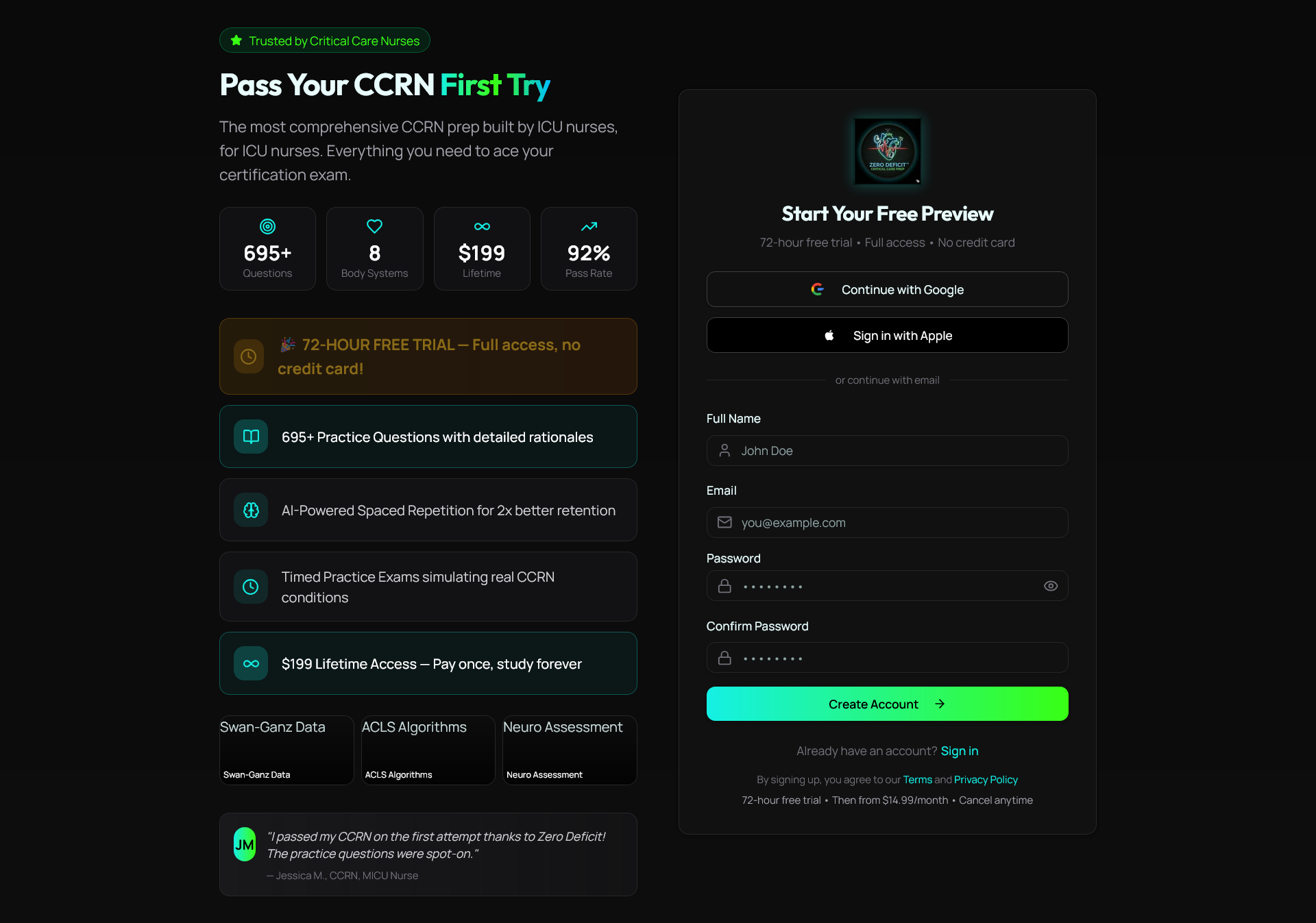
Our platform matches the job you are trying to do: pass the Adult CCRN with confidence. You get practice questions, detailed rationales, AI-powered review, spaced repetition and exam simulations in one place.
- Try a system-focused set on our practice page or the respiratory quiz with rationales.
- Pick the access shape that fits your timeline: Premium Monthly, Yearly Access or Lifetime Mastery on our subscription page.
- Begin with your weakest system, then let our review tools guide the rest. Start your CCRN practice questions today.
FAQ
What is the best study guide for nursing exams?
The best guide matches your exam and explains its answers. For licensure, choose one aligned to the current NCSBN test plan; for the Adult CCRN, ours organizes content by body system with rationales and spaced repetition. Pair any guide with timed practice questions.
Which online platform type is best for nursing students?
Question banks with detailed rationales are the strongest backbone for exam prep, because they train clinical judgment as well as recall. Add flashcards for labs and drugs, and video lessons for concepts you cannot picture.
How do I study for nursing exams effectively?
Use spaced retrieval, active recall and mixed practice questions, as Chamberlain University recommends. Review every rationale, log your missed-question patterns, and take a timed simulation weekly.
Should I pay for a nursing study platform?
Pay once a free trial shows the content matches your exam and the rationales teach you something. Monthly plans suit short sprints, while yearly or lifetime access suits longer preparation. Judge the cost against how quickly it helps you pass.
Sources
- Aacnnursing
- 10 Proven Nursing Exam Study Strategies That Actually Work | Chamberlain University
- Nclex
Recommended
Take a Respiratory practice quiz
Master ARDS, ventilation, ABGs, oxygenation, and pulmonary emergencies.
Get Your Free 20-Question CCRN Diagnostic
20 high-yield CCRN-style questions across every body system, with detailed rationales — emailed to you instantly.
No spam. One email + a couple of helpful follow-ups. Unsubscribe anytime.
Ready to pass your CCRN?
Join 12,000+ nurses using Zero Deficit — 695+ practice questions with rationales, AI-powered weak-area drilling, and spaced-repetition flashcards.
Start Free Trial →