AI Study Plan for the CCRN: Build One That Works

By Zero Deficit Critical Care Prep
A good AI study plan for the CCRN does three jobs. It weights your time by the exam blueprint, it finds your weak systems from your own practice data, and it reshuffles your week when life on the unit gets in the way. Zero Deficit™ CCRN Exam Prep brings those jobs into one place: tailored study plans, 695+ practice questions with detailed rationales, AI-powered review tools, spaced repetition and progress tracking. This guide shows you how to build the plan, how to use tutor mode without fooling yourself, and how to tell when the plan needs to change.
We wrote it nurse-to-nurse for the Adult CCRN. If you work a few 12s a week and have a few months before your exam, you can follow it as written.
TL;DR
- Start from the AACN blueprint, not from the AI. Study time should follow each content area’s weight, with the heaviest Clinical Judgment body systems first.
- Give your AI coach real inputs: exam date, minutes per day, days per week, strongest and weakest systems. A plan built on vague inputs is a vague plan.
- Use tutor mode as a quiz-and-explain loop: attempt first, then ask why the right answer is right and why each wrong option is wrong.
- Mix content review, spaced repetition, untimed question sets and timed simulations, and shift the ratio toward timed work as the exam nears.
- Check the plan every week against your scores by system, and revise it. Confirm exam content on AACN’s site before you commit.
Table of Contents
- Start with what the exam actually tests
- What an AI study plan does that a paper calendar doesn’t
- Build the plan in six steps
- Using AI tutor mode to learn hard concepts
- Using AI-generated questions and explanations safely
- How to tell your plan is working
- What we believe about AI study plans
- Put the plan into practice
- FAQ
- Sources
Start with what the exam actually tests
An AI plan is only as good as the target you hand it. The CCRN is built from a test plan (also called the blueprint), and AACN’s own preparation guidance calls it the key study tool. It lists the content areas with percentage weights. AACN’s advice is to plan your study emphasis and time in proportion to those weights, and to self-assess the most heavily weighted Clinical Judgment body systems first.
The blueprint also changed recently. AACN announced that updated Adult, Pediatric and Neonatal test plans apply to exams taken on and after November 12, 2025, following its 2024 study of practice. If you are using a plan, a forum thread or a study guide written before that date, check it against the current Adult CCRN Exam Handbook. The same announcement lists three eligibility pathways: Direct Care, Knowledge Professional and Tele-critical Care. Confirm which one fits you on AACN’s site before you pay an exam fee.
Two habits keep this step honest:
- Download the current Adult handbook and copy the content areas and weights into your plan by hand. Typing them once means you actually read them.
- Treat any AI tool that cannot tell you where a topic sits on the blueprint as a flashcard deck, not a planner.
What an AI study plan does that a paper calendar doesn’t
A paper calendar assumes you will follow it. A good AI plan assumes you won’t, and adapts. That is the real advantage, and it comes down to four functions:
- Goal to daily work. You set the exam date and available time. The plan converts that into a short list for each study day.
- Weakness detection. Every question you answer is data. The plan sees that you miss CRRT questions twice as often as ventilator questions and moves time accordingly.
- Resequencing. You pick up two extra shifts and lose a week. The plan compresses or reorders instead of leaving you staring at a missed schedule.
- Review timing. Spaced repetition brings back the concepts you are about to forget, not the ones you already own.
One caution about forecasts. Some AI platforms show a readiness estimate. Treat it as a planning aid, not a replacement for official exam requirements or your own judgment. Your score by system over several sessions tells you more than a single number.
On Zero Deficit™, the study tools are built for this loop: tailored study plans, progress tracking, spaced repetition and personalized question generation sit alongside the question bank, so your results feed your next session. For a closer look at how AI fits into prep, see our piece on the role of AI in exam preparation for CCRN success.
Build the plan in six steps
Step 1: Set your inputs
Before you ask any AI for a schedule, write down:
- Your exam date, or the window you are aiming for
- Realistic minutes per day and days per week (count your shift pattern, not your best week)
- Years of ICU experience and the unit type: cardiac, medical, surgical, neuro, mixed
- Your two strongest and two weakest systems, from honest gut check
The gut check will be wrong in places. That is fine. Step 2 corrects it.
Step 2: Take a baseline
Do a mixed set of 50 or more questions across all body systems before you study anything. Do not look anything up. The goal is a map, not a score. Log your percentage correct by system and note whether each miss was a knowledge gap, a misread stem or a second-guess.

That last distinction matters. A knowledge gap needs content review. A misread stem needs slower reading and more question practice. Our CCRN practice question strategies cover how to separate them.
Step 3: Weight your weeks by blueprint and by weakness
Now combine two lists: the blueprint weights and your baseline. A heavily weighted system where you scored low goes first and gets the most hours. A lightly weighted area where you scored high gets maintenance only. Priority areas for most ICU nurses include:
- Cardiovascular: hemodynamics, the shock states, ACS, vasoactive and inotropic drips
- Pulmonary: ARDS, ventilator modes and troubleshooting, ABG interpretation
- Neuro: ICP management, stroke
- Sepsis and MODS
- Endocrine emergencies: DKA, HHS, thyroid storm, adrenal crisis
- Renal: AKI and CRRT
- Synergy Model and ethics
For each system, write the normal ranges you need cold (ABG values, hemodynamic parameters, electrolytes, renal and glucose labs) on your own sheet, from your current reference. Then quiz yourself on them until they are automatic. The exam punishes nurses who have to calculate what a value means before they can interpret it.
Our study guides by body system are organized to match this approach, and the top CCRN study topics article walks through where to spend your first weeks.
Step 4: Set the weekly rhythm
A workable week for a nurse on three 12-hour shifts looks like this:
| Day type | Time | Task |
|---|---|---|
| Shift day | 15 to 20 minutes | Spaced-repetition cards, reviewed before or after shift |
| Day off 1 | 60 to 90 minutes | Content review for one weighted system, then 15 to 20 questions on it |
| Day off 2 | 60 minutes | Mixed question set, then rationale review |
| Once a week | 30 minutes | Check scores by system, adjust next week |
Adjust the minutes to your life. Consistency beats volume: short daily contact with the material holds up better than one long weekend session. Our guide to CCRN spaced repetition explains how to space reviews so they stick.
Step 5: Shift the mix as the exam approaches
A plan should not look the same in week 10 as in week 1. A common pattern:
- Early weeks: heavier on content review and untimed questions. You are building understanding.
- Middle weeks: mixed question sets, with rationale review longer than the questions themselves.
- Final weeks: timed simulations to build stamina and pacing, with review concentrated on the systems still scoring lowest.
The point of a simulation is not the score. It is learning how you behave at question 90 when your attention is thinning. Zero Deficit™ includes exam simulations so you can rehearse that before test day.
Step 6: Review weekly and revise
Once a week, compare your scores by system to last week. If a system has not moved after two weeks of focused work, change the method: swap passive reading for questions, or switch from questions to a visual such as our interactive shock flowchart. If a system has hit your target, drop it to maintenance and free the time.
If you are retaking, AACN suggests you review your printed score report, concentrate on the most heavily weighted areas without ignoring low-scoring ones, and consider small study groups or shadowing on other acute or critical care units. Feed those results into your baseline in place of the diagnostic.
Using AI tutor mode to learn hard concepts
Tutor mode is where an AI plan earns its keep, and where it can quietly make you worse. The failure mode is simple: you read the explanation, nod, and feel like you know it. Recognition is not recall.
Here is the loop that works:
- Pick one topic from this week’s plan, for example distinguishing cardiogenic from distributive shock by hemodynamic profile.
- Ask for 5 to 10 practice questions on that topic.
- Answer every one before you see any explanation.
- For each question, ask why the right answer is right and why each wrong option is wrong.
- Ask follow-ups in your own words until you can explain the concept without looking.
- Repeat the set later in the week. Move on only when you are consistently scoring around 80% on that topic.
That last threshold is a working target, not an AACN rule. Pick one and hold yourself to it.
The evidence for tutor-style AI in nursing education is encouraging. A September 2026 BMC Nursing study of 89 pre-licensure nursing students found that an AI-guided clinical reasoning tutor raised posttest scores on next-generation-style pathophysiology items from a mean of 8.01 to 11.71 (p < .001). Students said the tutor slowed premature answer selection and helped them link findings to pathophysiology. They also reported less anxiety. These were students, not CCRN candidates, but the mechanism carries over: a tutor that makes you slow down and reason through cues is doing what the CCRN demands.
The design principle matters too. The National League for Nursing’s AI toolkit describes a tutor that gives a guiding hint first and reveals the full answer only after the student attempts a response. Build that into your own habit. Commit to an answer, then read the rationale.
A good rationale does more than name the answer. It teaches the decision. That is why every Zero Deficit™ practice question comes with a detailed rationale written by ICU nurses, and why our advantages of practice tests piece focuses on what you do after you answer.
Using AI-generated questions and explanations safely
AI can generate questions in seconds, which makes it easy to practice a lot and learn a little. Keep these guardrails:
- Check clinical content against a current reference. The NLN toolkit tells nurses to evaluate AI-generated outputs and recognize bias and limitations. Compare any explanation with your unit protocols, current guidelines from AHA and SCCM, and your study guides.
- Protect privacy. Never enter patient identifiers or real chart details into any AI tool. Describe a scenario in general terms.
- Keep your clinical judgment. An AI plan organizes your study. It does not replace your bedside reasoning or your facility’s policies.
- Use questions written for the exam. Questions with expert-written rationales keep your study anchored to what the CCRN tests. Zero Deficit™ pairs its AI-powered review tools with a bank of 695+ questions written and reviewed by expert ICU nurses.
For a wider view of where AI helps and where it falls short, read our breakdown of the best AI tools for CCRN prep.
How to tell your plan is working
A plan is working when the numbers and your reasoning both improve. Watch for these signs:
- Your scores by system rise across consecutive sets, especially in heavily weighted areas.
- Your misses shift from “I didn’t know that” to “I narrowed it to two and chose wrong.” That is progress, and it calls for more rationale work.
- You finish timed sets with minutes to spare, not by guessing the last ten.
- You can teach a concept to a new grad on your unit without notes.
It is not working when you are hitting your daily minutes but your scores are flat, or when you keep redoing questions you have already memorized. Memorized answers inflate scores. Fresh questions show your real level, which is why personalized question generation and a deep bank both matter.
AACN also offers a subscription-based CCRN Practice Exam and Questions that gives rationales, scores and a realistic exam-day experience. Whatever you use, take a full timed simulation at least once in your last few weeks and treat the result as a guide for your final revision.
What we believe about AI study plans
We built Zero Deficit™ because critical care nurses told us the same thing: the content is not the hard part, the organization is. You know shock, vents and ABGs from the bedside. What you need is a way to see which of those areas will cost you points on exam day and to keep returning to them until they stop costing you.
That is what an AI study plan should do. It should tell you where you stand by system, bring back the concepts you are about to forget, and generate fresh questions when you have outgrown the old ones. Our AI-powered review tools, spaced repetition, progress tracking and detailed rationales are designed around that loop.
The goal is zero deficit: no system you are quietly avoiding, no rationale you skipped. A plan that leaves nothing uncovered is a plan you can walk into the exam with.
Zero
Put the plan into practice
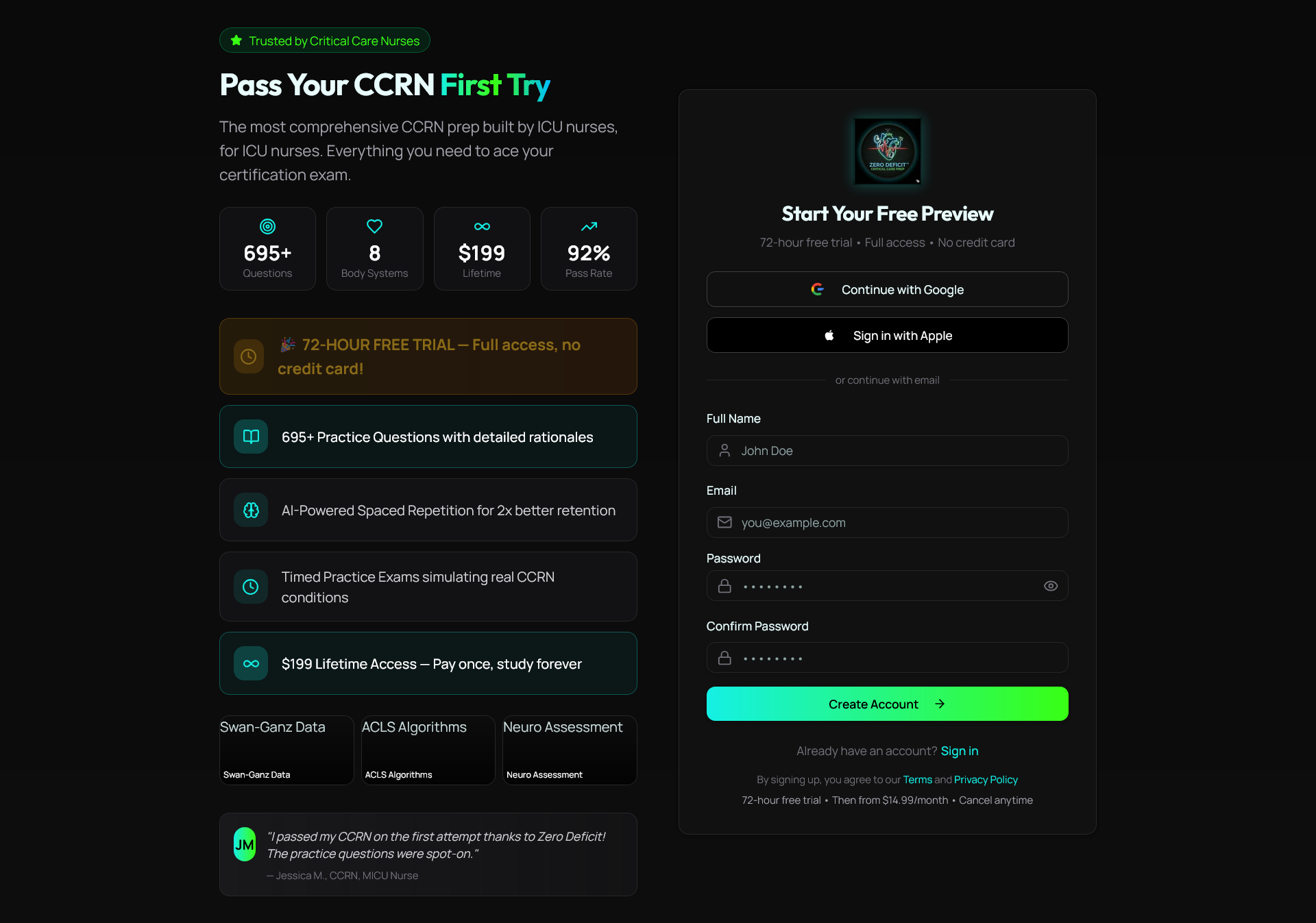
If you want the plan, the questions and the review tools in one place, Zero Deficit™ gives you tailored study plans, 695+ practice questions with detailed rationales, flashcards, spaced repetition, exam simulations and progress tracking. A free trial is available. Paid plans are Premium Monthly at $14.99 per month and Yearly Access at $84.99 per year, and Lifetime Mastery is also offered. See the options on the subscription page.
Not sure where to begin? Start with a baseline set from the CCRN practice tests across all 8 body systems, log your results by system, and build week one from there. If you want a structured timeline, our 6-week case study plan for ICU RNs is a good model, and our guide to passing the CCRN covers the wider picture. When nerves creep in, building exam confidence is part of the plan too.
FAQ
How long should my CCRN study plan be?
It depends on your experience, your weakest systems and how many hours you can protect each week. Many nurses plan several weeks to a few months. Let your baseline set decide: broad low scores call for a longer plan, and a few gaps call for a shorter, targeted one.
Can an AI study coach replace a study guide?
No. They do different jobs. The study guide gives you organized, trustworthy content by system, and the AI coach schedules, tracks and adapts. Zero Deficit™ offers both, so your plan and your content stay connected.
What should I tell an AI tutor to get useful help?
Give it your exam date, minutes per day, days per week, years of ICU experience and your strongest and weakest systems. Then ask for short question sets on one topic at a time, and ask it to explain every wrong option. Never include patient details.
How do I know when to move to timed practice?
Move to timed sets once you are scoring consistently well on untimed questions in your heavily weighted systems. Then add timed work gradually, with full simulations in your final weeks. Keep reviewing rationales afterward, because that is where the learning happens.
Sources
- How to Prepare for the CCRN Exam, AACN
- Revised CCRN Certification Exams Launch Nov. 12, 2025, AACN
- Evaluating an AI-guided clinical reasoning tutor, BMC Nursing
- AI Toolkit, National League for Nursing
- How it works, AccelaStudy AI Nursing
Recommended
Take a Respiratory practice quiz
Master ARDS, ventilation, ABGs, oxygenation, and pulmonary emergencies.
Get Your Free 20-Question CCRN Diagnostic
20 high-yield CCRN-style questions across every body system, with detailed rationales — emailed to you instantly.
No spam. One email + a couple of helpful follow-ups. Unsubscribe anytime.
Ready to pass your CCRN?
Join 12,000+ nurses using Zero Deficit — 695+ practice questions with rationales, AI-powered weak-area drilling, and spaced-repetition flashcards.
Start Free Trial →