Best ECG Courses for Nurses: 9 Options Compared

The best ECG course for you depends on where you are right now: rhythm strips, 12-lead ischemia localization, or a CCRN date on your calendar. If you are sitting the CCRN, start with the arrhythmia and ECG material built for that exam, then add a standalone CE course if you want continuing education credit or a deeper 12-lead skill set. Below, each course is laid out by level, price, CE hours and format, nurse to nurse.
TL;DR
- Basic rhythm recognition: AHA’s ACLS Prep: ECG, Rutgers’ Basic ECG Course, Kiser CPR’s Basic Dysrhythmias, or the AACN Essentials course, which also reaches 12-lead.
- Advanced 12-lead: Mayo Clinic ($300, 4.50 ANCC contact hours), CNEA’s 12 Lead ECG Mastery (11.42 CE hours) and ECG Academy Level 1+2 ($397, 30 CE/CME hours).
- For the CCRN, a CE course teaches the skill, but the exam tests it inside patient scenarios. Zero Deficit™ pairs arrhythmia study with practice questions and detailed rationales.
- Credit rules vary by state, so confirm with your state board of nursing that a course will count.
Table of Contents
- How to choose an ECG course as an ICU nurse
- The courses at a glance
- Where Zero Deficit™ fits for CCRN candidates
- Basic rhythm recognition courses
- Advanced 12-lead courses
- ECG course versus ECG certification
- A simple plan by situation
- Perspective
- Practice what you learn
- FAQ
- Sources
How to choose an ECG course as an ICU nurse
Three questions sort the options quickly.
What level are you at? If you cannot yet name a junctional rhythm or a second-degree block on sight, you need a rhythm-strip course. If you read strips comfortably and want to localize ischemia, spot subtle T-wave changes or tell a mimic from a true STEMI, you need an advanced 12-lead course. Several of the advanced courses below say outright that they are not basic classes.
Do you need CE credit? Some courses award contact hours, some are memberships with no paperwork. ECG Academy, for example, advises checking with your state board that credit will be honored, because regulations vary by state.
What is the goal? A CE course builds bedside skill. A certification exam asks you to apply that skill to a hypotensive patient with a new rhythm and pick the next intervention. Those are different tasks, and the second one needs question practice.
The courses at a glance
| Course | Level | Format | Price | Credit |
|---|---|---|---|---|
| AHA ACLS Prep: ECG | Basic | Self-directed eLearning | See AHA page | ACLS pre-course |
| Rutgers Basic ECG | Basic | Online, live via WebEx | $200 ($170 Rutgers affiliates) | 6 contact hours |
| Kiser CPR Basic Dysrhythmias | Basic | Classroom (CA, OR) | See Kiser page | 4.0 hours (CA BRN) |
| AACN Essentials of ECG & Dysrhythmia Monitoring | Basic to 12-lead | Online | See AACN page | Up to 14.25 contact hours |
| ECGEDU EKG Interpretation for Nurses | Basic to intermediate | Self-paced video, about 8 hours | See ECGEDU page | See ECGEDU page |
| Mayo Clinic Advanced 12-Lead | Advanced | Nine online modules | $300 | 4.50 ANCC contact hours |
| CNEA 12 Lead ECG Mastery | Novice to expert | Video, 12 months access | See CNEA page | 11.42 contact hours |
| ECG Academy Level 1+2 | Basic to advanced | Self-paced, one year access | $397 (2026) | 30 CE/CME hours |
| Dr. Stanley’s ECGcourse.com 12-Lead | Intermediate to advanced | Online | See site | 30 CME hours |
Prices are as published by each provider and change, so confirm on the course page before you register.
Where Zero Deficit™ fits for CCRN candidates
If the reason you are searching is the CCRN, put exam-aligned practice first. Zero Deficit™ CCRN Exam Prep gives you over 695 practice questions with detailed rationales, study guides by system and topic, spaced repetition and AI-powered review tools, all written by ICU nurses. Its arrhythmia recognition topic guide covers EKG rhythms and ACLS, and the arrhythmia flowchart helps you sort rhythms the way you will on exam day.
Two of our articles go deeper on the skill itself: reading ECGs for CCRN and CCRN rhythm strips. The rationale on each practice question is where the learning happens: you see why the right answer is right and why the distractors are not, which is what turns a rhythm you recognize into a decision you can defend.
Basic rhythm recognition courses
These suit new ICU grads, nurses moving from med-surg to telemetry, and anyone whose strip reading is shaky.
AACN Essentials of ECG & Dysrhythmia Monitoring
AACN’s online course covers atrial, junctional and ventricular dysrhythmias, AV blocks, pacemaker rhythms and malfunctions, and identifying ischemia and infarction on a 12-lead ECG. It offers up to 14.25 CE contact hours, with case studies, real rhythm strips and lesson tests. It teaches a standardized 8-step process for analyzing rhythms and a 5-step process for pacemaker rhythms, and CE is awarded only after you pass each lesson and module exam with 80% or above. Because it comes from the body that runs the CCRN, the vocabulary matches what you will see in critical care.
Rutgers Basic ECG Course
Rutgers Nursing runs a 6-contact-hour online course via WebEx at $200 for the general public or $170 for Rutgers affiliates. It teaches step-by-step rhythm analysis, normal and abnormal rhythms, and treatments, and you receive a certificate of completion. A live format helps if you learn better with an instructor than with recorded video.
AHA ACLS Prep: ECG
This is a self-directed eLearning pre-course, updated to the 2025 AHA CPR and ECC Guidelines. It teaches heart anatomy and basic electrophysiology, normal ECG measurements and basic arrhythmia recognition. It is a targeted gap-closer before ACLS, not a full interpretation course, so treat it as a foundation rather than a finish line.
Kiser CPR Basic Dysrhythmias
For West Coast nurses, Kiser CPR teaches in classrooms in Redding, Chico and Eureka, California, and Medford, Oregon. The basic course covers normal and abnormal rhythms, cardiac conduction and lead placement, has no prerequisites, includes a workbook and carries 4.0 hours of California BRN-approved continuing education. It is in-person only, which matters if you live outside that region.
ECGEDU EKG Interpretation Course for Nurses
ECGEDU’s self-paced video course runs about 8 hours, with a 2.25-hour rhythm-only option. Topics run from ECG fundamentals through AV blocks, bundle branch blocks, QT interval, ischemia, injury and infarction, WPW, lead reversal and pacemakers, and it finishes with practice ECG tests. It is a good middle step if you want rhythm and 12-lead basics in one place.
Advanced 12-lead courses
These are for nurses who already read strips fluently and want to localize ischemia, recognize subtle changes and separate mimics from true infarcts.
Mayo Clinic Advanced 12-Lead ECG Interpretation
Mayo’s online CNE course has nine self-guided modules on ischemia, injury, infarction, bundle branch blocks, hypertrophy, axis deviation, ectopy and aberrancy, and QT intervals. It costs $300 and awards 4.50 ANCC contact hours. Mayo strongly recommends prior basic ECG knowledge, so pair it with one of the basic courses above if you are not there yet.
CNEA 12 Lead ECG Mastery: Novice to Expert
Presented by Karen Marzlin and Cynthia Webner, this course offers 11.42 CE contact hours with 12 months of 24/7 video access and downloadable handouts. It covers subtle and early ischemia signs, reciprocal and evolutional MI changes, myocardial mimics and wide-complex tachycardia differentiation, for RNs and APRNs. The course description cites a 2022 systematic review pointing to an urgent need to maintain nurses’ ECG competency. Of the courses here, this one fits best if “subtle T-wave changes” is the exact gap you want to close.
ECG Academy (Vanderbilt University School of Nursing)
The Vanderbilt-hosted ECG Academy offers roughly 11-hour video-tutorial courses in 16 sections with quizzes and a final exam. Level 1 covers rhythm strip and arrhythmia analysis, taught by Nicholas Tullo, MD, and Level 2 covers 12-lead interpretation. Weekly five-minute ChalkTalks give you an unknown tracing to practice on. The approach is physiologic: it explains why ECGs look the way they do rather than relying only on memorized patterns.
On pricing, ECG Academy’s 2026 certificate courses are $247 for Level 1 Advanced Rhythm Strip Analysis (17 CE hours for RNs, NPs and PAs) and $397 for combined Level 1+2 12-Lead Interpretation (30 CE/CME hours), each with one year of unlimited access. Its non-CE memberships start at $9.95 per month or $100 per year for Basic Level 1, and one-time hybrid courses with quizzes but no CE paperwork are $175 for Level 1 and $325 for Level 1+2.

Dr. Stanley’s ECGcourse.com
ECGcourse.com offers a 12-Lead ECG Interpretation course (30 CME hours) covering LBBB, RBBB, WPW, LVH, STEMI and NSTEMI patterns, plus an Animated ECG Rhythm Interpretation course (9 CME hours), a 50 ECG Case Studies course (13 CME hours) and a STEMI Recognition Review (6 CME hours). The case-study format is useful once you have the basics and want volume.
Rutgers 12-Lead ECG Interpretation
Rutgers’ two-day 12-lead course is designed for practitioners caring for critically ill adults and analyzing challenging tracings. It is not a basic class and strongly recommends a basic cardiac monitoring course first. If you work in a cardiac ICU, the focus fits your patients.
Other formats worth knowing
- UC Davis Health Introduction to 12 Lead ECG: a half-day in-person course in Sacramento priced at $60 for community registrants, 3.58 contact hours, with an ECG Interpretation Blended Learning prerequisite.
- APHE 12 Lead ECG: an 8-hour class at $99.99 with no prerequisites, reviewing 3-lead basics and introducing 12-lead placement and interpretation.
- Kiser CPR 12-lead: covers STEMI, pulmonary embolus, cardiac axis, Sgarbossa criteria, bundle branch blocks and right-sided and posterior leads, and requires demonstrated competency in basic dysrhythmias, per the Kiser course page.
- ABC Medical Certification: a Mastering the 12-Lead ECG course at $249, plus practice exams that each carry 2 CE credits.
ECG course versus ECG certification
A course teaches interpretation. A certification is a credential. HCTA, for instance, separates telemetry certification (interpreting tracings) from ECG technician certification, which adds hands-on acquisition and stress testing, and suggests you check which one your employer requires. For ICU nurses, the credential that matters most for your career is usually the CCRN, which is a separate exam. You can read the differences in our guide to types of critical care certifications.
A simple plan by situation
New ICU grad, shaky on rhythms: take a basic course (AACN Essentials or Rutgers Basic), then use daily strip practice. Our CCRN EKG interpretation guide shows how rhythm recognition connects to treatment decisions.

Comfortable with strips, 12-lead is weak: choose Mayo, CNEA or ECG Academy Level 2. Expect to spend a weekend or several weeks depending on the format.
Sitting the CCRN in the coming months: do not wait for a CE course to finish before you start question practice. Build rhythm and 12-lead skill in parallel, and test it in scenarios where an ECG finding sits next to hemodynamics, labs and drips. For example, a new wide-complex rhythm in a patient with a low potassium or magnesium is a different question from the same strip on its own, which is why our electrolyte imbalances guide and shock guide belong in the same study week as your rhythm review.
Educator supplementing a class: a mix of a rhythm-strip course for the foundation and exam-style questions with rationales for case discussion works well.
Perspective
Rhythm skill and exam skill are not the same skill. You can name every rhythm on a strip and still miss the question, because the CCRN asks what you do next, with the full picture of the patient in front of you.
That is why we built Zero Deficit™ around over 695 practice questions with detailed rationales, written by ICU nurses, and why we added spaced repetition and AI-powered review tools. Our formula is designed so a rhythm you learned in week one comes back before you forget it, in a different clinical context each time.
A CE course is a strong way to build ECG skill. Pair it with exam-style practice and your rhythm knowledge becomes decisions you can make under time pressure.
Zero
Practice what you learn
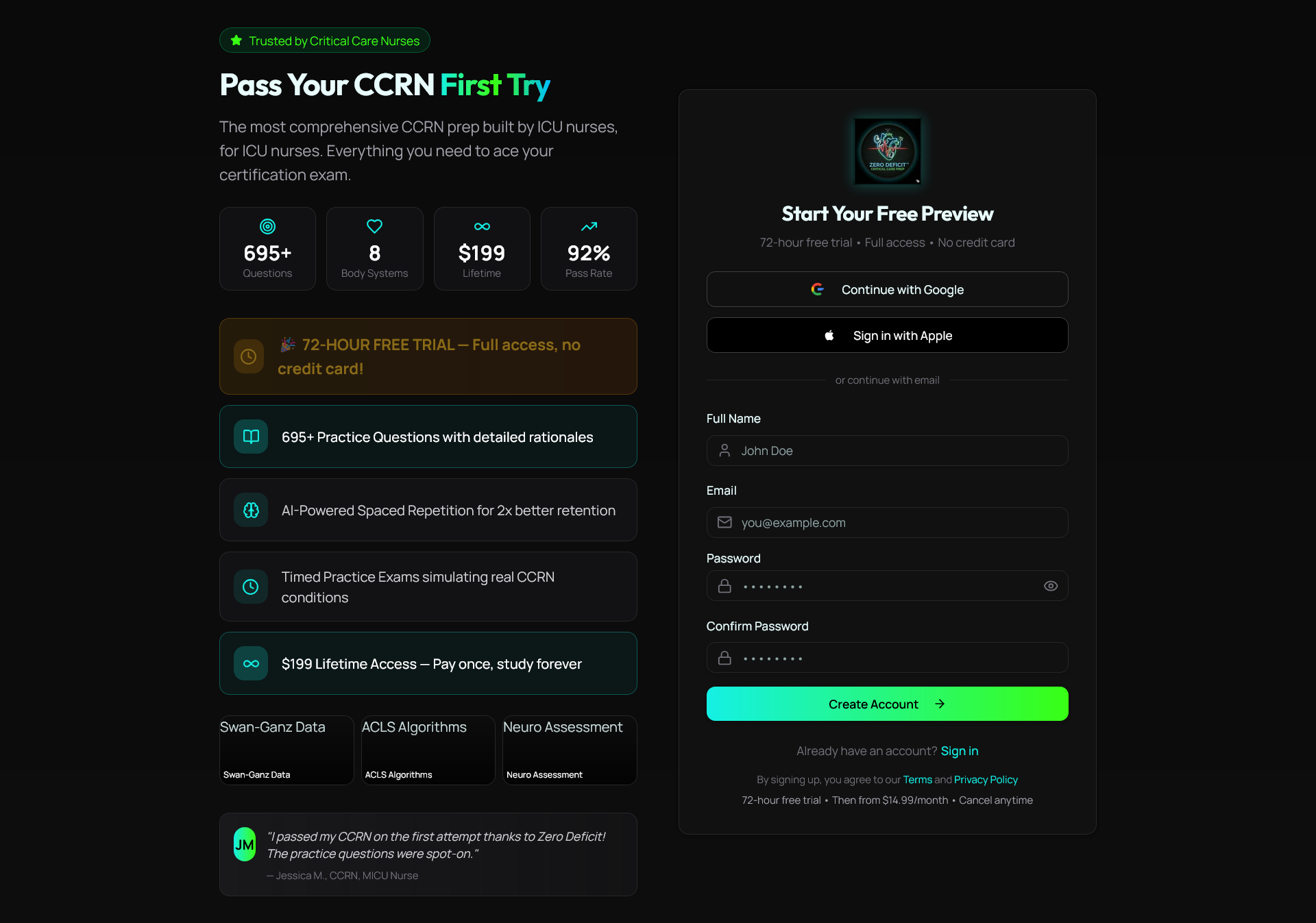
Once you have your rhythm foundation, apply it. Zero Deficit™ offers Premium Monthly at $14.99 per month and Yearly Access at $84.99 per year, plus a Lifetime Mastery option, with a free trial available. You get study guides by system and topic, flashcards, exam simulations, progress tracking and personalized question generation, and you can see the full set of CCRN practice questions before you commit.
If you want to learn the method for reading a question stem and eliminating distractors, our question breakdown methods walk through it step by step.
FAQ
Can a nurse interpret an ECG?
Yes, interpreting rhythms is a routine part of telemetry, ICU and emergency nursing. What you are permitted to do and who must confirm it depends on your state and your employer’s policy, so check both. A course gives you the competency, and your facility defines how it is used.
Is a basic ECG course enough for critical care?
It is a start. A basic course covers normal and abnormal rhythms and conduction. Critical care also demands 12-lead skills such as ischemia localization and mimics, which is why advanced courses like Mayo’s or CNEA’s list a basic course as a prerequisite or strong recommendation.
Will an ECG course count for CE credit in my state?
Many providers award ANCC or state-board-approved contact hours, but acceptance varies. ECG Academy notes that regulations differ between state boards, so confirm with your own board before paying for a course you need for renewal.
How should I study ECGs for the CCRN?
Learn the rhythms and 12-lead patterns first, then practice them inside clinical scenarios with rationales. Start with the CCRN practice questions on Zero Deficit™, review every rationale, and let spaced repetition bring weak rhythms back until they are automatic. Start your Zero Deficit CCRN Prep practice questions today and walk into the exam ready.
Sources
- AACN: Essentials of ECG & Dysrhythmia Monitoring
- AACN: Essentials of ECG and Dysrhythmia Monitoring sales sheet
- Rutgers Nursing: Basic ECG Course
- Rutgers Health: 12 Lead ECG Interpretation
- American Heart Association: ACLS Prep: ECG & Pharmacology
- Kiser CPR: ECG courses
- ECGEDU: EKG Interpretation Course for Nurses
- Mayo Clinic: Advanced 12-Lead ECG Interpretation
- CNEA: 12 Lead ECG Mastery: Novice to Expert
- Vanderbilt University School of Nursing: ECG Academy
- ECG Academy: Features and Pricing
- ECG Academy: Start here
- ECG Academy: A Better Way To Read ECGs
- ECGcourse.com: Online ECG courses
- UC Davis Health: Introduction to 12 Lead ECG
- APHE: 12 Lead ECG
- ABC Medical Certification: Board review courses
- HCTA: ECG Certification Course
Recommended
Take a Cardiovascular practice quiz
Test your mastery of hemodynamics, ACLS, MI, arrhythmias, and heart failure.
Get Your Free 20-Question CCRN Diagnostic
20 high-yield CCRN-style questions across every body system, with detailed rationales — emailed to you instantly.
No spam. One email + a couple of helpful follow-ups. Unsubscribe anytime.
Ready to pass your CCRN?
Join 12,000+ nurses using Zero Deficit — 695+ practice questions with rationales, AI-powered weak-area drilling, and spaced-repetition flashcards.
Start Free Trial →