Ventilator Alarms for the CCRN: Causes and Fast Responses

By Zero Deficit Critical Care Prep
A ventilator alarm is a question the machine asks you: is the problem the patient, the airway, the circuit, or the ventilator? On the CCRN, the right answer is almost always the one that assesses the patient first and then sorts the cause by pressure pattern. This guide gives you that sequence, the cause lists you need for high-pressure, low-pressure, apnea and PEEP alarms, and how the same reasoning shows up in exam questions. It covers adult patients only.
TL;DR
- Look at the patient before you touch the ventilator. If the patient is distressed, cyanotic or deteriorating, disconnect and bag.
- High peak pressure with a normal plateau points to an airway or resistance problem. High peak with a high plateau points to a compliance problem.
- Low-pressure alarms mean a leak, disconnection or displaced tube until proven otherwise.
- Fixing the cause beats widening the limits. Alarm fatigue is a patient-safety problem, and The Joint Commission treats it that way.
- On the exam, expect scenarios, not definitions: the stem gives you a pressure pattern and asks for your next action.
Table of Contents
- What the common alarms are telling you
- Your first 30 seconds: patient, airway, circuit, ventilator
- High-pressure alarms: read the plateau
- Low-pressure, apnea, high-rate and PEEP alarms
- Alarm limits and alarm fatigue
- How CCRN questions use ventilator alarms
- Practice it with Zero Deficit™
- Our perspective
- FAQ
- Sources
What the common alarms are telling you
Ventilator alarms fall into three groups. Drasovean’s respiratory therapy text on LibreTexts classifies them as input alarms (loss of electric or pneumatic power), control alarms (incompatible settings or a failed self-test) and output alarms (high or low tidal volume, minute volume, rate, and airway pressures). At the bedside you spend nearly all your time on output alarms.
The AACN’s mechanical ventilation settings resource lists the alarms you will see most: low volume, high volume, pressure and apnea, with causes and nursing interventions for patients in respiratory failure or ARDS. Learn them in pairs, because each alarm has a mirror image:
| Alarm | What it signals | First thoughts |
|---|---|---|
| High pressure | Pressure above the set limit | Secretions, cough, biting, kink, bronchospasm, falling compliance |
| Low pressure | Pressure below the set limit | Disconnection, cuff leak, displaced tube, circuit leak |
| High rate | Patient or machine cycling too fast | Agitation, pain, autotriggering |
| Low rate or apnea | Too few breaths detected | Oversedation, failure to trigger, disconnection, neuro event |
| High PEEP | Pressure not returning to baseline | Auto-PEEP, air trapping |
The Tracheostomy Education overview describes high-pressure alarms as the most common, with coughing the most frequent cause, and notes the risk of barotrauma when pressure stays above the limit. High-rate alarms may reflect agitation or autotriggering. High PEEP alarms most often mean auto-PEEP or air trapping.
Your first 30 seconds: patient, airway, circuit, ventilator
The order matters, and it is the order exam writers reward.
- Patient. Look at the chest rise, work of breathing, color, SpO2, heart rate and blood pressure. RTB2’s alarm guide says a distressed, cyanotic or hemodynamically deteriorating patient needs immediate hands-on help and, if necessary, disconnection from the ventilator and bag-valve-mask ventilation.
- Airway. Check tube position and depth, cuff, secretions, biting. Listen to lung sounds. Suction if indicated.
- Circuit. Follow the tubing from the patient to the machine: water, kinks, loose connections, humidifier, exhalation limb.
- Ventilator. Only now confirm the ordered settings, the alarm limits and the power and gas supply.
For a sudden decline, use DOPE: displacement, obstruction, pneumothorax, equipment failure. RTB2 pairs it with the patient-airway-circuit-ventilator sequence. If you want a memory aid for this and other bedside sequences, our CCRN mnemonics roundup collects the ones that hold up under exam pressure.
Two teamwork points are worth knowing. The Wolters Kluwer 2025 pocket card on caring for the mechanically ventilated patient stresses that no one should change ventilatory settings or start weaning without consulting both the respiratory therapist and the provider, and that the RT should hear about every adjustment so alarm settings can be reviewed. And the ATS just-in-time troubleshooting tool notes that sudden agitation in a previously calm ventilated patient can signal a ventilator or circuit problem, and the first step is to call for help.
High-pressure alarms: read the plateau
A high-pressure alarm fires when peak inspiratory pressure (PIP) exceeds the set limit. PIP reflects both airway resistance and lung compliance, so the next move is to separate them with an inspiratory hold, which gives you plateau pressure.
- High peak, normal plateau: the problem is resistance, upstream of the alveoli. Think secretions, mucus plug, bronchospasm, kinked tubing, biting the tube, or water in the circuit.
- High peak, high plateau: the problem is compliance, in the lungs or chest wall. Think pulmonary edema, pneumonia, ARDS, atelectasis, mainstem intubation, pneumothorax, effusion or abdominal distension.
CorePendium’s ventilator troubleshooting chapter lays out the same split: a normal plateau suggests ETT kinking, mucus plugging or bronchospasm, while a high plateau suggests atelectasis, worsening disease, abdominal distension or pneumothorax. Respiratory Therapy Zone gives the longer cause lists, including cuff herniation and exhalation valve obstruction on the resistance side and hemothorax and chest wall rigidity on the compliance side.
For a number to anchor on, a 2022 Canadian Journal of Nursing review of respiratory failure management gives normal airway resistance in a ventilated patient as under 10 cmH2O/L/s, which corresponds to a peak-to-plateau gradient of 10 cmH2O at a flow of 60 L/min. A gradient well beyond that points you toward resistance.
What you do about it
The Wolters Kluwer pocket card lists interventions that match the causes: assess lung sounds, suction, use a bite block or sedation per orders when the patient is biting or dyssynchronous, and notify the provider if sedation is inadequate. A patient who is coughing may just need suctioning. A patient with a high plateau and unilateral absent breath sounds needs a provider immediately, because tension pneumothorax is on the list.
Patient-ventilator dyssynchrony deserves its own thought. When a patient fights the breath, pressure spikes and the alarm sounds, but the cause is the mismatch between the patient’s drive and the ventilator’s delivery, not a mechanical fault. Our comparison of pressure support and assist control walks through six ICU scenarios where mode choice changes how the patient and machine interact. For a refresher on modes, PEEP and weaning, see our mechanical ventilation topic page.
Low-pressure, apnea, high-rate and PEEP alarms
Low pressure
Pressure is not reaching the set threshold, so air is going somewhere other than the lungs. The pocket card lists an air leak in the circuit or the ETT or trach cuff, circuit disconnection and self-extubation. Interventions include locating the leak, checking the pilot balloon for cuff failure and replacing tubing per policy. Respiratory Therapy Zone adds a loose humidifier or exhalation tubing, a mispositioned ETT, loss of gas supply or power, and incorrect settings.

Limit placement matters here. Tracheostomy Education warns that a low-pressure limit set too low, especially below 10 cmH2O, may not alarm even with a disconnect. Respiratory Therapy Zone describes setting the low-pressure limit about 5 to 10 cmH2O below the patient’s PIP.
Apnea and low rate
An apnea alarm means the machine is not detecting breaths. The pocket card prompts you to check patient effort, SpO2, disconnections and mental status, looking for oversedation or stroke-related central apnea. Tracheostomy Education lists failure to trigger and ventilator failure as other causes. If the patient is not breathing and not oxygenating, bag first and investigate second.
High rate
A patient breathing fast triggers the alarm, so ask why: pain, anxiety, agitation, hypoxemia, acidosis, or autotriggering from a leak or condensation in the circuit. Treating the number without finding the driver is the classic wrong answer.
High PEEP and auto-PEEP
If expiratory pressure will not return to baseline, suspect auto-PEEP from incomplete exhalation. The 2022 Canadian Journal of Nursing review explains that you can see it on the flow-time waveform when expiratory flow has not returned to zero before the next breath starts. Think obstructive disease, high rates and short expiratory times, and involve the provider and RT before changing settings.
Alarm limits and alarm fatigue
Silencing or widening limits is tempting when the unit sounds like a slot machine. A Johns Hopkins review of ventilator alarms is not the only data point on volume; the research you need is practical. A 2025 randomized trial in BMC Nursing found that a 4-hour training on the causes and solutions of common ventilator alarms, plus an evidence-based alarm-management guideline, lowered ICU nurses’ alarm fatigue scores and cut high-pressure alarm frequency by 34.3% over one month. Understanding the cause is what reduces the noise.
RTB2 makes the same point: nuisance alarms should be fixed at the source (trigger sensitivity, auto-cycling, leaks, sensor or circuit problems, poorly individualized limits) rather than by simply widening limits, and limits should be reassessed after any significant clinical change or setting adjustment per institutional protocol.
This is also a regulatory priority. The Joint Commission’s National Patient Safety Goals effective January 2025 include Goal 6 on clinical alarm systems. NPSG.06.01.01 requires hospitals to identify the most important alarm signals and set policy on clinically appropriate settings, when alarms may be disabled or changed, who has the authority to change them, and how alarms are monitored and answered. Its rationale names desensitization to numerous alarms, default settings that are not actionable and limits that are too narrow as key issues.
Your own unit’s policy is the final word. As one example, the University of Toledo Medical Center clinical alarms policy (effective 11/2025) sets the high-pressure alarm initially at 50 cmH2O, then adjusts it to 10 to 20 cmH2O above peak inspiratory pressure, and has alarms checked by the oncoming-shift RT and after patient transport. Numbers differ between hospitals, so learn the principle: limits sit close enough to catch a change and far enough to avoid alarming on every movement.

How CCRN questions use ventilator alarms
The exam rarely asks you to define an alarm. It gives you a patient, a pressure pattern and a time pressure, then asks for the priority action. Here is how to read those stems.
- Find the patient state first. If the stem says the patient is cyanotic, hypotensive or not moving air, the answer involves bagging, not troubleshooting the circuit.
- Pull out the pressure pattern. A high peak with a normal plateau steers you toward suctioning, a bite block or bronchodilator therapy. A high peak and high plateau steers you toward the cause of the stiff lung, including pneumothorax, edema or mainstem intubation.
- Match direction to cause. High-pressure means something is blocking or stiffening. Low-pressure means something is leaking or disconnected.
- Watch for the unsafe distractor. Turning off the alarm, widening the limits or changing settings without the RT and provider are wrong answers when the cause is unresolved.
- Connect it to the disease. In ARDS, falling compliance changes the plateau story. Our CCRN ARDS guide and the respiratory study guide tie this together.
When you miss a question, the useful step is to name which of the four layers you skipped: patient, airway, circuit or ventilator. Our question breakdown methods show how to dissect a stem and its distractors step by step.
A worked example
Your patient on assist control suddenly triggers the high-pressure alarm. He is coughing, SpO2 is 93%, and you hear coarse crackles. An inspiratory hold shows a normal plateau. That pattern says resistance, so you suction, reassess lung sounds and check for biting. You do not increase the pressure limit, and you do not sedate before you know why he is coughing. If SpO2 had dropped and breath sounds were absent on one side, the plateau would likely be high and the priority would change to urgent provider notification for pneumothorax.
Practice it with Zero Deficit™
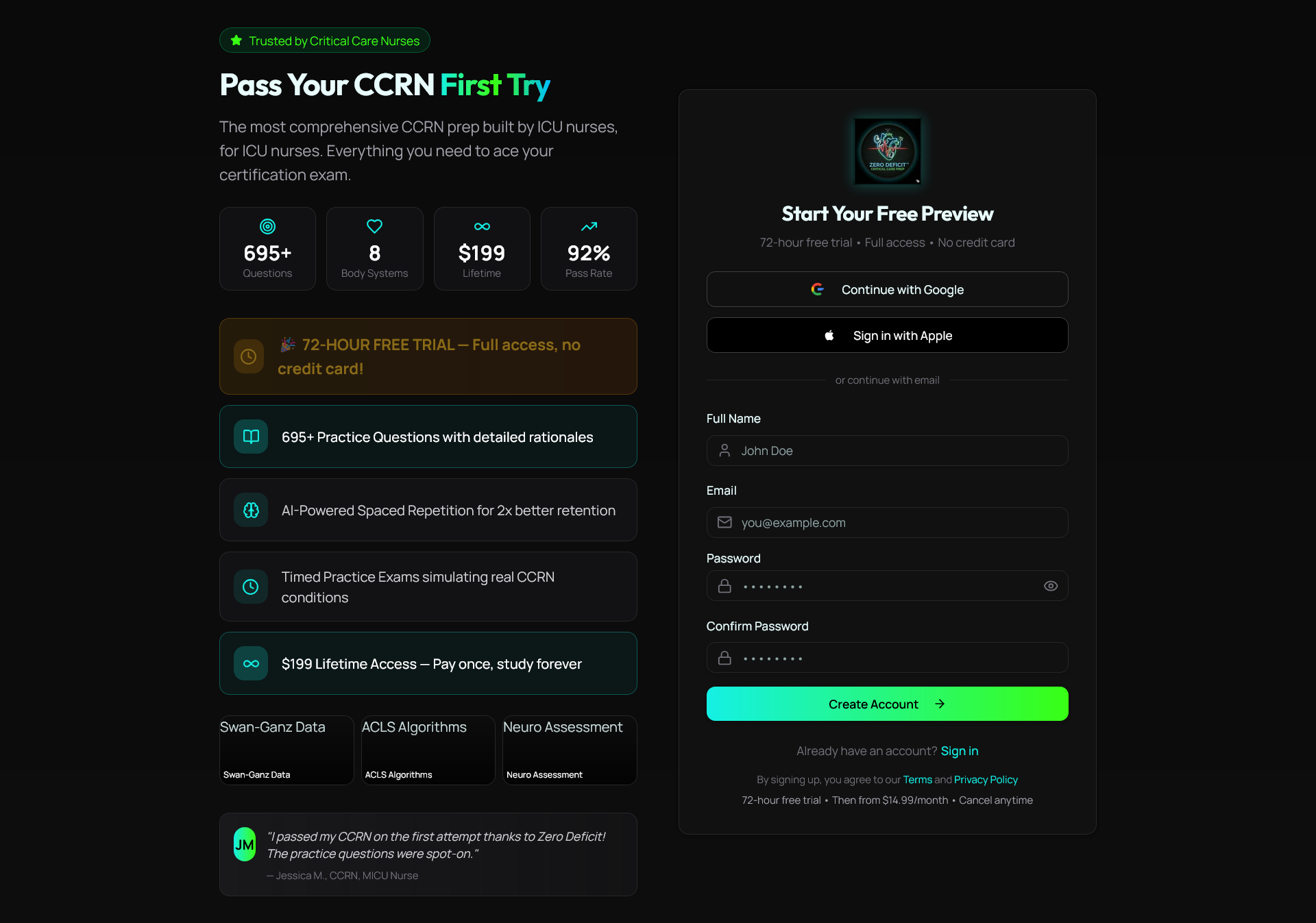
Alarm reasoning sticks when you apply it repeatedly to different stems. Zero Deficit™ CCRN Exam Prep gives you over 695 practice questions with detailed rationales, study guides by system written by expert ICU nurses, AI-powered review tools, spaced repetition and exam simulations. Premium Monthly is $14.99 per month and Yearly Access is $84.99 per year, and a Lifetime Mastery option is also available. See the options on the subscription page.
If you want to start with a system, the practice tests hub covers all eight body systems.
Our perspective
We built Zero Deficit™ around one idea: you should never memorize an alarm list without knowing what to do next. Alarm questions are decision questions. The nurse who passes is the one who looks at the patient, reads the pressure pattern and chooses the safe action, in that order.
That is why our rationales explain why each wrong answer is wrong, and why our spaced repetition brings back the questions you missed. Our AI-powered review tools help you see where your reasoning slips, whether you skip the patient assessment or confuse a resistance problem with a compliance problem.
Our content is created by expert ICU nurses, so the scenarios look like the ones you manage at the bedside. Ventilator alarms are one of the most practical topics on the exam, and they are a topic you can fully master.
Zero
FAQ
What causes a ventilator to alarm?
Alarms come from the patient (coughing, biting, agitation, dyssynchrony), the airway (secretions, tube displacement, cuff leak), the circuit (disconnection, water, kinks) or the ventilator (power, gas supply, settings). Pressure alarms are the most common. Work through patient, airway, circuit, ventilator in that order.
What is the difference between high-pressure and low-pressure alarms?
High-pressure alarms mean pressure exceeded the limit, usually from a blockage, cough, bronchospasm or a stiff lung. Low-pressure alarms mean pressure fell short, usually from a leak, cuff problem or disconnection. A plateau pressure from an inspiratory hold helps you separate resistance from compliance on the high side.
Should I silence the alarm or widen the limits?
Not until you have found and addressed the cause. Limits are set per unit policy and clinical status, and changes involve the respiratory therapist and provider. Repeated nuisance alarms are a sign to look at triggers, leaks and individualized limits.
When do I disconnect the patient and bag?
When the patient is distressed, cyanotic, hemodynamically deteriorating or ventilating poorly and you cannot quickly fix the cause. Disconnect, bag with 100% oxygen per your protocol, and call for help while you work through DOPE.
Sources
- Mechanical Ventilation Settings, AACN
- 3.6 Ventilator Alarms, Medicine LibreTexts
- Mechanical Ventilator Alarms, Tracheostomy Education
- Ventilator Alarms Guide, RTB2
- Caring for the Mechanically Ventilated Patient pocket card, Wolters Kluwer
- Just-In-Time Tools for Training Non-Critical Care Clinicians, ATS
- Troubleshooting the Ventilator, CorePendium
- Ventilator Alarms: Types, Causes, and Troubleshooting, Respiratory Therapy Zone
- Management of Respiratory Failure, Canadian Journal of Nursing
- Effect of a clinical approach to ventilator alarm management, BMC Nursing
- National Patient Safety Goals Effective January 2025, The Joint Commission
- Clinical alarms policy, University of Toledo Medical Center
Ready to turn alarm knowledge into exam points? Start with Zero Deficit CCRN Prep practice questions.
Recommended
Take a Respiratory practice quiz
Master ARDS, ventilation, ABGs, oxygenation, and pulmonary emergencies.
Get Your Free 20-Question CCRN Diagnostic
20 high-yield CCRN-style questions across every body system, with detailed rationales — emailed to you instantly.
No spam. One email + a couple of helpful follow-ups. Unsubscribe anytime.
Ready to pass your CCRN?
Join 12,000+ nurses using Zero Deficit — 695+ practice questions with rationales, AI-powered weak-area drilling, and spaced-repetition flashcards.
Start Free Trial →