CCRN ABG Mastery for U.S. ICU Nurses: Run 15 to 20 Daily Questions
The best ABG practice for CCRN combines a compact, repeatable interpretation algorithm with daily question-bank reps mapped to the AACN test plan, not passive reading or memorized flowcharts. Run every gas through the same five-step sequence until it’s automatic, then drill that sequence against exam-style stems built around ventilator and oxygenation decisions. That’s the whole strategy. Everything below just shows you how to build it.
TL;DR:
- Running every gas through a consistent five-step algorithm and drilling it with exam-style questions improves speed and accuracy under exam conditions.
- Memorize key values such as pH (7.35–7.45), PaCO2 (35–45 mmHg), HCO3 (22–26 mEq/L), and oxygenation thresholds like PaO2 below 60 mmHg.
- Recognize common patterns such as acute versus chronic respiratory acidosis and metabolic acidosis from sepsis or DKA, focusing on immediate interventions.
- Daily practice with 15 to 20 mixed ABG questions, tracking errors, and gradually increasing difficulty helps develop confident interpretation skills.
- Prioritize understanding clinical context and response over memorization, especially with mixed disorders, to make effective decisions on exam and bedside.
Table of Contents
- Your High-Yield ABG Study Checklist and Quick Reference
- How Do You Interpret an ABG for the CCRN Exam?
- What Are the Common ABG Patterns You’ll See on the CCRN?
- How Should You Build ABG Drills Into Your CCRN Study Schedule?
- Why Does This Method Match the AACN Test Plan?
- A Nurse-to-Nurse Note on Studying Around Your Shifts
- Get Started With Zero Deficit™'s ABG Practice Package
- Sources
- FAQ
Your High-Yield ABG Study Checklist and Quick Reference
Before you touch a single practice question, lock in the numbers below cold. You should be able to recite them faster than your coffee order.
- pH: 7.35–7.45. Below is acidosis, above is alkalosis.
- PaCO2: 35–45 mmHg. The respiratory piece of the puzzle.
- HCO3-: 22–26 mEq/L. The metabolic piece.
- PaO2: 80–100 mmHg on room air. Below 60 mmHg signals significant hypoxemia.
- SaO2: 95–100%. Below 90% is a red flag on the exam and at the bedside.
- Base excess: negative 2 to positive 2 mEq/L. Outside that range points to a metabolic contribution.
Quick fact: the CCRN exam handbook confirms the Adult CCRN runs 150 items in three hours, with 125 scored, and pulmonary content (ABGs included) carries real weight in that mix. That’s why fluency here pays off across the whole test, not just the respiratory section.
Two memory aids worth keeping: “ROME” (Respiratory Opposite, Metabolic Equal, comparing pH and the driving value) for quick directionality, and a simple rule that PaCO2 and pH move opposite in respiratory issues but the same direction in metabolic ones. Memorize the normal ranges outright. Reason through compensation and mixed patterns every time. Never guess.
Pro Tip: Build a one-page ABG reference sheet with these six values, your two mnemonics, and three “gotcha” mixed-disorder examples. Review it the morning of the exam, then put it away and trust your reps.
How Do You Interpret an ABG for the CCRN Exam?
Every CCRN-style ABG stem answers to the same sequence. Run it in order, every time, and you’ll stop second-guessing yourself under time pressure.
- Check the pH first. Acidosis, alkalosis, or normal. If it’s normal but PaCO2 and HCO3- are both off, suspect full compensation or a mixed disorder before you move on.
- Identify the primary process. Compare PaCO2 to pH. If PaCO2 moved opposite the pH, it’s respiratory. If HCO3- moved with the pH, it’s metabolic.
- Evaluate compensation. Look at the value that isn’t primary. If it shifted in the direction that would normalize pH but pH still isn’t normal, that’s partial compensation. If pH normalized, it’s fully compensated.
- Assess oxygenation separately. PaO2, SaO2, and, when given, the P:F ratio (PaO2 divided by FiO2). A P:F ratio under 300 suggests acute lung injury; under 200 tracks with ARDS under the Berlin criteria framework most CCRN prep sources reference.
- Apply clinical context, then pick the action. A septic patient with a widening anion gap and rising lactate points to metabolic acidosis from tissue hypoperfusion. A COPD patient with a chronically elevated PaCO2 needs a different read than someone acutely retaining CO2 post-sedation.
Mixed disorders are where most candidates lose points. If pH is markedly abnormal but PaCO2 and HCO3- both point in directions that should have offset each other, you’re looking at two competing primary processes, not compensation. Run a two-minute check: does the direction and magnitude of the “compensating” value actually match what you’d expect physiologically? If not, flag it as mixed.
- If the stem gives you a decompensating trend (worsening pH despite intervention), the safest answer is almost always escalation of care or notifying the provider immediately.
- If oxygenation and ventilation are both compromised, prioritize the airway and oxygenation intervention over metabolic correction.
- When two answers look defensible, pick the one that treats the underlying cause rather than the number itself.
Pro Tip: Time yourself on 10 ABG stems in a row, under two minutes each. If you’re consistently going over, you’re still translating the algorithm instead of running it from memory. That gap closes with reps, not more reading.
What Are the Common ABG Patterns You’ll See on the CCRN?
Pattern recognition is what separates a slow, correct answer from a fast, correct answer. Here’s what shows up again and again, along with the immediate action most CCRN item writers expect.
Acute respiratory acidosis (low pH, high PaCO2, normal HCO3-) usually comes from hypoventilation, oversedation, or an airway obstruction. Your first move is airway and ventilation support, often a ventilator setting change or reversal of sedation.
Chronic respiratory acidosis shows a near-normal pH with elevated PaCO2 and elevated HCO3-, classic in COPD. Don’t chase the CO2 to normal here. Aggressive correction can drop the patient’s respiratory drive.
Metabolic acidosis with a widened anion gap points to lactic acidosis from sepsis or shock, or DKA. Treat the underlying cause: fluids and source control for sepsis, insulin and fluids for DKA. Watch for a compensatory drop in PaCO2 (Kussmaul respirations).
Metabolic alkalosis often traces back to prolonged NG suctioning, vomiting, or diuretic use. Correcting the volume and electrolyte deficit, not the pH directly, is the nursing priority.
Mixed disorders appear when two processes hit at once, like a DKA patient who also has respiratory failure. These stems test whether you can hold two threads at once instead of forcing a single clean pattern.
Pivot values worth memorizing: a pH under 7.20 or a PaO2 under 60 mmHg on the stem typically shifts the correct answer toward immediate intervention rather than monitoring. A P:F ratio under 200 almost always points toward an ARDS-focused answer rather than a simple oxygen titration.
How Should You Build ABG Drills Into Your CCRN Study Schedule?
Reading about ABGs and being able to interpret one cold under time pressure are two different skills. Build the second one deliberately.
- Run 15 to 20 mixed ABG questions daily during your core study weeks, pulled from a set that mirrors CCRN item style and includes rationales, not just answer keys.
- Log every miss. Capture what you thought the answer was, what tripped you up, and the corrected reasoning chain in a few sentences. This turns a wrong answer into a study asset instead of a bruised ego.
- Convert your error log into flashcards weekly. If you missed three questions on compensation logic, that’s your next micro-simulation, not your next full read-through of a textbook chapter.
- Escalate to full-length simulations in your final two weeks, mixing ABG items with cardiovascular, sepsis, and neuro content the way the real exam does, since prep experts recommend pairing daily question-bank reps with progressively longer simulations as test day approaches.
Pro Tip: Set a hard two-minute cap per ABG question during timed drills, even in week one. Slow, “correct” answers under untimed conditions don’t transfer to the exam room. Speed is a skill you build, not a bonus you get automatically once you know the content.
Why Does This Method Match the AACN Test Plan?
The AACN’s exam handbook directs candidates to proportion study time to the test plan’s content weighting rather than studying every system equally. Clinical judgment, not rote recall, drives roughly 80% of scored content on the exam, which is exactly why an algorithm you can apply to a clinical scenario beats a memorized flowchart you can only recite.
Clinical judgment isn’t a bonus skill on the CCRN. It’s the exam. An ABG value in isolation means little; what you do with it, in context, is what’s being tested.
Zero Deficit™ builds its ABG resources around that same weighting, with over 695 practice questions, detailed rationales for every ABG scenario, AI-powered review tools, and an expert-written ABG interpretation guide created by ICU nurses. AACN doesn’t endorse or require any specific commercial product, so treat any prep platform, including this one, as a tool that supports the official test plan rather than a replacement for it.
A Nurse-to-Nurse Note on Studying Around Your Shifts
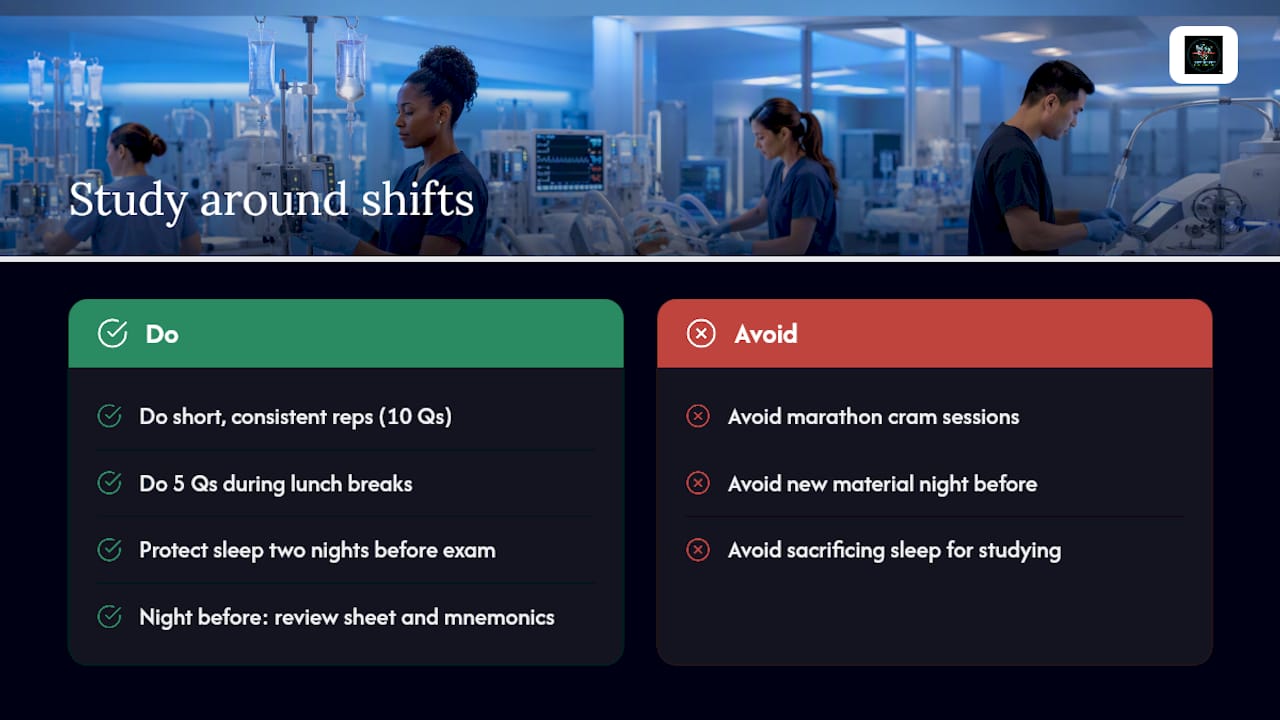
You don’t need three uninterrupted hours to make progress. Ten ABG questions between med passes, or five during a lunch break, adds up faster than one long weekend cram session you keep postponing. Protect your sleep the two nights before your exam over anything else on your checklist.
One candidate who used this approach described it simply: short, consistent reps beat marathon study sessions, especially with a demanding ICU schedule. The night before your test, skip new material. Review your one-page ABG sheet, check your two mnemonics, and stop there.
— Zero
Get Started With Zero Deficit™'s ABG Practice Package
Zero Deficit™ gives you the question-bank-driven ABG practice this article recommends, built specifically for the way the CCRN actually tests gases: in context, tied to ventilator and oxygenation decisions, not in isolation.
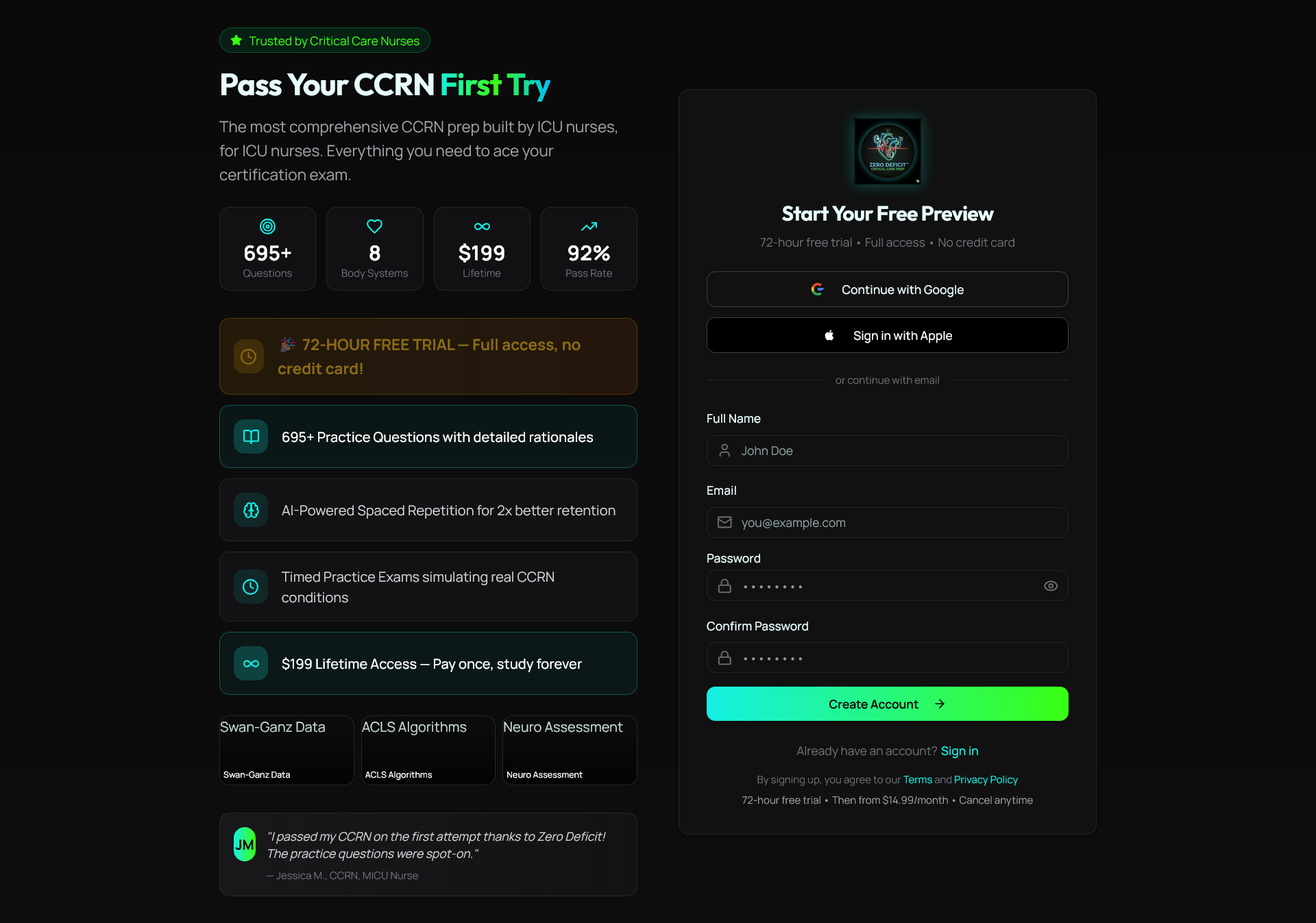
The ABG package includes targeted respiratory and ABG-focused question sets with full rationales, a quick-reference sheet you can adapt for your own one-pager, AI-powered review that flags your weak patterns, and progress tracking that shows you exactly where compensation logic or mixed-disorder questions are still slowing you down. If you want a broader baseline check before diving into ABGs specifically, a quick self-assessment like the healthcare career quiz from NueCareer can help you gauge where you’re starting from.
Fold ABG reps into the daily schedule outlined above: 15 to 20 mixed questions a day, an error log every week, and full simulations in your final stretch. Start with the 695+ practice question bank, pair it with the respiratory-specific quiz set when you’re ready to focus, and use the free trial to see how the rationales and AI review fit your study rhythm before committing.
Sources
FAQ
What Is the Fastest Way to Learn ABG Interpretation for CCRN?
Run every ABG through the same five-step algorithm (pH, primary process, compensation, oxygenation, clinical context) and drill it daily against CCRN-style question sets with rationales rather than reading passively.
How Many ABG Practice Questions Should I Do Per Day?
Most successful candidates run 15 to 20 mixed ABG-related questions daily during core study weeks, then escalate to full-length simulations in the final two weeks before the exam.
What Percentage of the CCRN Exam Involves ABGs and Pulmonary Content?
The AACN test plan doesn’t isolate ABGs as a standalone percentage, but pulmonary content, including gas interpretation, carries substantial weight within the broader clinical judgment component that drives roughly 80% of the scored exam.
How Do I Tell a Compensated ABG From a Mixed Disorder?
Check whether the secondary value shifted in the direction and magnitude physiology would predict; if it did and pH normalized or moved toward normal, it’s compensation, but if the shift doesn’t match what you’d expect, you’re likely looking at a mixed disorder.
Does Zero Deficit™ Cover ABG-Specific Practice Questions?
Practice question sets covering ABG and respiratory topics are available, including detailed rationales and an expert-written ABG interpretation guide.
Recommended
Take a Respiratory practice quiz
Master ARDS, ventilation, ABGs, oxygenation, and pulmonary emergencies.
Get Your Free 20-Question CCRN Diagnostic
20 high-yield CCRN-style questions across every body system, with detailed rationales — emailed to you instantly.
No spam. One email + a couple of helpful follow-ups. Unsubscribe anytime.
Ready to pass your CCRN?
Join 12,000+ nurses using Zero Deficit — 695+ practice questions with rationales, AI-powered weak-area drilling, and spaced-repetition flashcards.
Start Free Trial →