1,750 Hours to CCRN Eligibility for U.S. ICU Nurses
If you hold a current, unencumbered U.S. RN or APRN license and can document either 1,750 hours of direct critical-care practice in two years (875 in the last year) or 2,000 hours in five years (144 in the last year), you meet the core CCRN eligibility requirements. Knowledge Professionals need 1,040 hours over two years, with 260 in the most recent year. Your hours have to be verifiable, focused on critically ill adults, and you must notify AACN Certification Corporation within 30 days if anything changes with your license.
TL;DR:
- Nurses must document at least 875 hours of direct critical-care practice in the last year for two-year eligibility or at least 144 hours for five-year eligibility, with hours focused on critically ill adults.
- Practice hours must come from U.S. or Canadian facilities and be verified by a professional associate; shadowing hours do not qualify.
- An unencumbered license is required, meaning no active discipline, probation, or restrictions, and any license status change must be reported to AACN within 30 days.
- The most common reasons for application denial are improper documentation, such as counting observation hours or misinterpreting unit roles, rather than lack of experience.
- Preparation tools like practice questions and focused review are essential after confirming eligibility, with special emphasis on adult critical-care content.
Table of Contents
- Which CCRN pathway fits your role?
- How many clinical hours does CCRN eligibility require?
- What does “unencumbered license” mean for CCRN?
- How does AACN verify your practice hours?
- How do you apply for the CCRN exam?
- What are the CCRN renewal requirements?
- What eligibility mistakes cost nurses their CCRN application?
- A nurse-to-nurse note on getting eligibility right
- Get Exam-Ready After You Confirm Eligibility
- Sources
- FAQ
Which CCRN pathway fits your role?
AACN built three eligibility pathways because critical care nursing does not look the same everywhere. Picking the right one before you count a single hour saves you from redoing paperwork later.
- Direct Care: This is the pathway most bedside ICU nurses use. It covers nurses providing hands-on care to acutely or critically ill adults, including transport nurses and ED nurses whose assignments include critical-care patients. The expectation is direct, primary-nurse patient contact, not observation.
- Knowledge Professional: This fits educators, clinical managers, and unit directors whose work shapes critical-care practice without daily bedside assignments. AACN still requires practice hours, just framed around influencing patient outcomes rather than direct hands-on tasks.
- Tele‑critical Care: Built for nurses monitoring critically ill patients remotely. Hours are counted differently here, tied to monitoring encounters linked to actual bedside events rather than simple clock time.
You are not locked into one lane forever. If your hours satisfy the population-specific requirements for more than one exam, you can pursue additional certifications such as Adult vs. Pediatric CCRN down the road.
How many clinical hours does CCRN eligibility require?
The hour math is the single most common source of confusion, so get the exact numbers locked in before you apply.
- Two-Year Direct Care: 1,750 hours total, with at least 875 completed in the most recent year before you apply.
- Five-Year Direct Care: 2,000 hours total, with at least 144 completed in the most recent year.
- Knowledge Professional: 1,040 hours during the previous two years, with 260 of those in the most recent year.
These numbers are non‑negotiable minimums. AACN’s direct care eligibility policy states that a majority of your logged hours must focus on caring for critically ill patients, not routine or stable-patient assignments.
Orientation hours only count when you were the assigned primary nurse actually delivering care. Shadowing a preceptor, no matter how many shifts, does not count toward your total. Hours also need to come from a U.S. or Canadian facility, or one that demonstrably meets U.S. practice standards through Magnet or Joint Commission International status. If your critical-care experience happened outside those settings, expect your hours to go through AACN’s Internal Review Panel before they count.
What does “unencumbered license” mean for CCRN?
An unencumbered license is one with no active discipline, probation, or practice-limiting condition attached. Common examples include a board-ordered practice restriction, a mandated supervision requirement, or an active investigation tied to your license number.
Here’s where nurses get tripped up: state boards and AACN don’t always use identical language to describe license status. A “conditional” designation on your state’s website might not match how AACN defines “encumbered,” so read AACN’s own CCRN FAQ rather than assuming your state’s terminology translates directly.
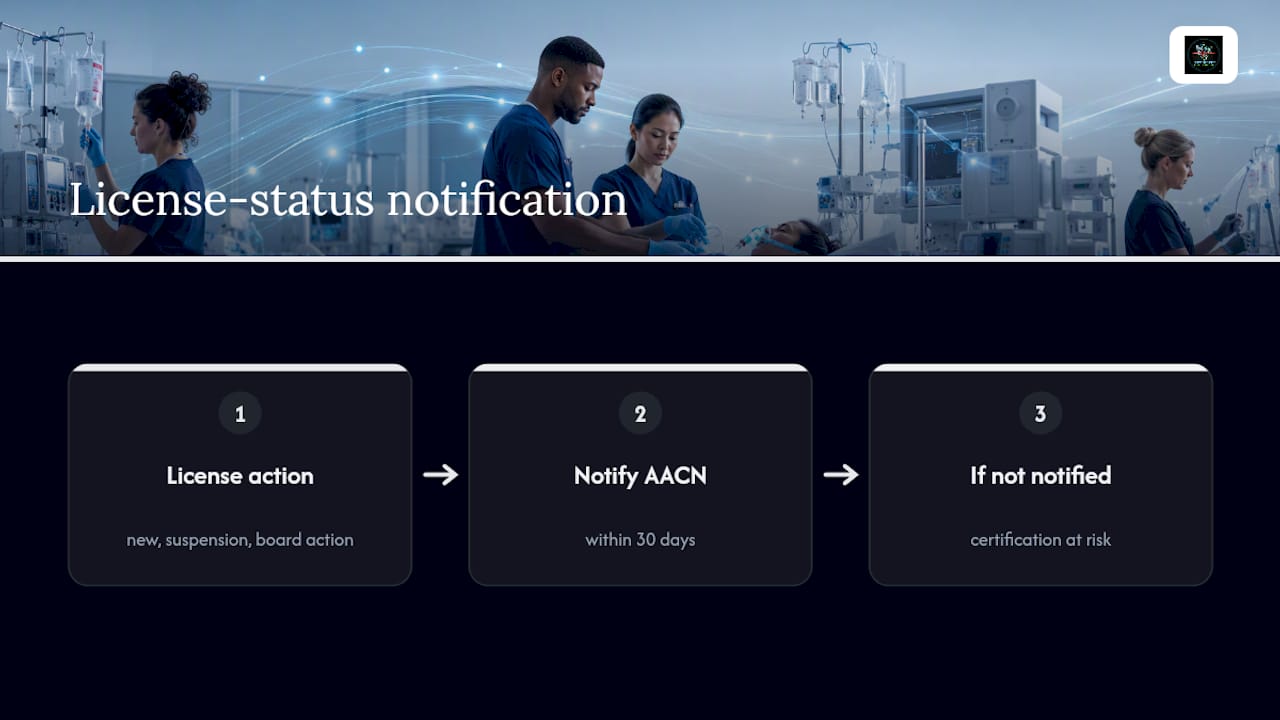
If anything changes with your license status after you apply or after you certify, you must notify AACN Certification Corporation within 30 days. That includes new provisions, suspensions, or any board action, and skipping this step can jeopardize your certification regardless of how you passed the exam.
How does AACN verify your practice hours?
AACN doesn’t just take your word on hours. It verifies them, and you need to be ready for that before you submit anything.
- Name a professional associate. This is typically a manager, educator, or colleague who can confirm your assignments if AACN selects your application for audit.
- Gather your documentation. Assignment records, orientation notes showing you were the assigned nurse, and supervisor letters all count as usable evidence.
- Understand the audit process. A percentage of applications get randomly selected for hour verification, and your named associate may be contacted directly.
- Know the appeal and refund terms. If AACN determines you’re ineligible, your application fee is refunded within 30 days of that determination, per the direct care eligibility policy.
Pro Tip: Export your assignment logs and orientation checklists into a single PDF before you apply. If you get audited, your professional associate can confirm everything in minutes instead of digging through six months of schedules.
How do you apply for the CCRN exam?
Your application needs your license number and expiration date, plus your professional associate’s contact information, ready to enter accurately the first time.
- Online applications work for most candidates and process faster than paper.
- Paper applications exist for edge cases, like candidates needing accommodations or those without reliable portal access, but expect a slower turnaround.
- Fees are due at submission, and refund timing follows the same 30-day window used for eligibility denials.
Give yourself real buffer time before your target test date. If your professional associate takes a week to respond to an audit request, you don’t want that eating into your study window. Review the CCRN clinical hours breakdown if you’re still unsure whether your hours qualify before you pay the fee.
What are the CCRN renewal requirements?
Passing the exam gets you three years of certification, and after that, you choose how to maintain it.
- Renewal by CERP: Requires continuing education points across defined categories, plus documented practice hours during the certification period.
- Renewal by exam: Retake the CCRN instead of accumulating CERPs, useful if you prefer testing over tracking education credits.
- Practice hour minimum: Common renewal guidance calls for 432 hours over the three-year period, with 144 of those in the 12 months before renewal, according to AACN’s CCRN adult renewal requirements.
Check AACN’s Renewal Handbook well before your certification expiration date. Renewal deadlines don’t bend for a busy unit schedule.
What eligibility mistakes cost nurses their CCRN application?
The most common denial reason isn’t lack of experience. It’s documentation that doesn’t match AACN’s definitions.
- Counting shadowing hours as practice hours, even partial shifts spent observing a preceptor.
- Assuming a “step-down” or “progressive care” title automatically disqualifies hours, when acuity is what actually matters.
- Missing the 30-day license notification window after a status change.
- Applying without confirming your professional associate can actually verify your specific assignments.
If you work in a non-ICU unit that still manages critically ill patients, like a busy ED, a procedural area, or a stepdown unit with frequent acuity spikes, your hours can still count. AACN evaluates based on patient acuity, not your unit’s name. Document specific patient conditions and confirm you were the primary assigned nurse, not a secondary or float support role.
Pro Tip: Build a one-page evidence packet with your unit’s typical acuity examples, your assignment sheets, and a line from a supervisor confirming your role. Handing your professional associate a tight packet beats making them reconstruct your last two years from memory.
If hemodynamics and shock management make up a chunk of your unit’s daily reality, that content overlaps directly with CCRN’s cardiovascular blueprint, and reviewing it now saves double work later; try this CCRN Hemodynamics Review: What Actually Matters on Exam Day for focused prep.
A nurse-to-nurse note on getting eligibility right
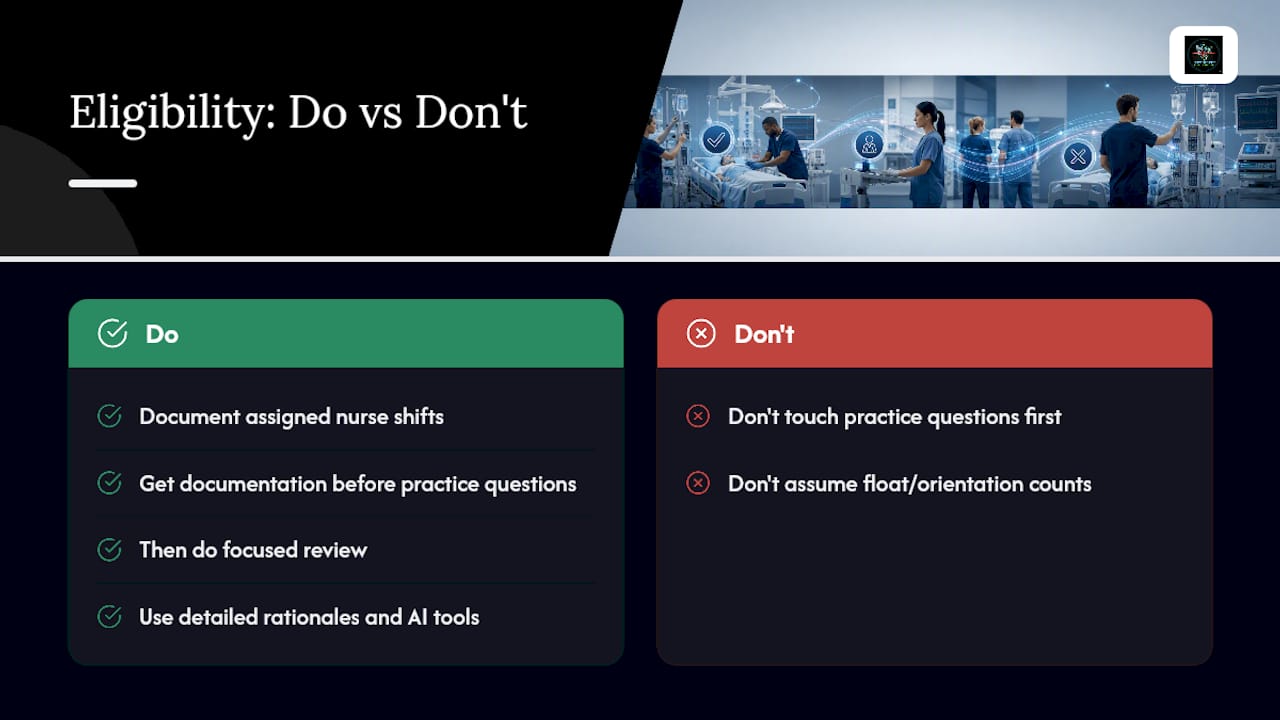
Most eligibility questions we hear aren’t about the exam content. They’re “does my float pool time count?” or “I orientated for six weeks, does any of that help?” The honest answer is usually: some of it, if you can prove you were the assigned nurse.
Get your documentation buttoned up before you touch a single practice question. Once your eligibility is solid, pair that confidence with focused review, detailed rationales, and AI-driven practice tools that adapt to what you’re actually missing.
— Zero
Get Exam-Ready After You Confirm Eligibility
Once your hours check out and your license is clean, the real work starts: knowing the material cold. Zerodeficitccrnprep gives you over 695 practice questions with detailed rationales written by ICU nurses, plus AI-powered review tools that adjust to your weak spots instead of making you grind through content you’ve already mastered.
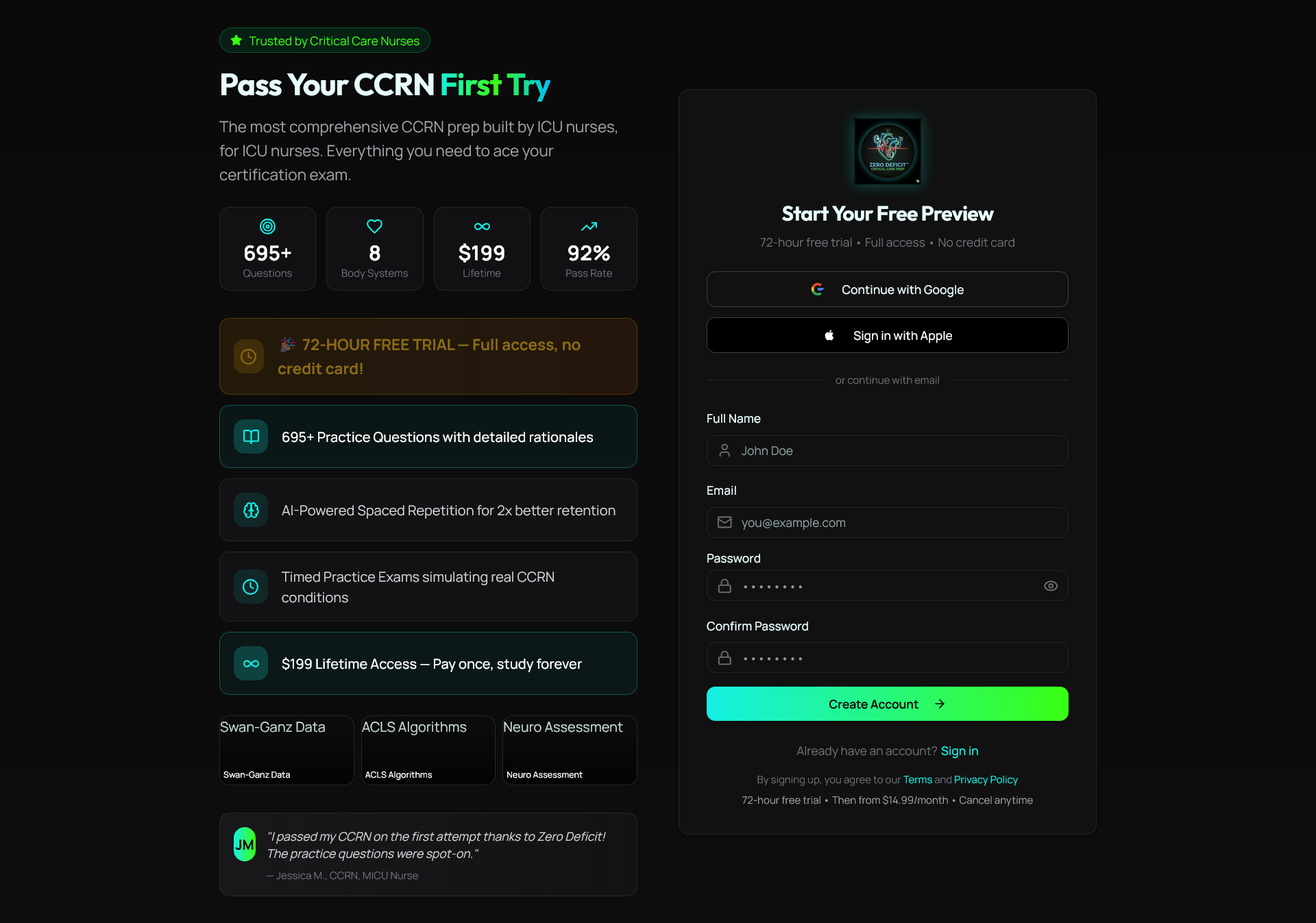
Adult-population-specific practice matters here. Generic critical-care questions won’t drill the exact hemodynamics, ABG interpretation, and shock management scenarios the Adult CCRN blueprint tests. Try the free respiratory practice quiz to see how your ABG interpretation holds up before exam day, then decide if the full question bank and exam simulations fit your study timeline. Trial access is available before you commit to a subscription.
FAQ
What are the eligibility criteria for becoming a CCRN?
You need a current, unencumbered U.S. RN or APRN license and enough verified clinical practice hours under one pathway, meeting the minimum practice hour requirements for Direct Care or Knowledge Professional as detailed by AACN Certification Corporation.
Do CCRN-certified nurses make more than RNs without certification?
Certification pay varies by employer and region, and AACN doesn’t publish a standardized wage differential, but many hospitals offer certification pay differentials or preferential consideration for charge and specialty roles.
How long does it take to go from RN to CCRN?
If you’re working full-time in a qualifying critical-care role, the fastest realistic timeline is around one year, since the Two-Year Direct Care pathway still requires 875 hours in your most recent year alone.
Can an ER nurse become a CCRN?
Yes, if your ED assignments regularly include direct care of critically ill or acutely unstable patients and you can document that acuity and your assigned-nurse role, ED experience counts toward Direct Care eligibility.
Recommended
Take a Respiratory practice quiz
Master ARDS, ventilation, ABGs, oxygenation, and pulmonary emergencies.
Get Your Free 20-Question CCRN Diagnostic
20 high-yield CCRN-style questions across every body system, with detailed rationales — emailed to you instantly.
No spam. One email + a couple of helpful follow-ups. Unsubscribe anytime.
Ready to pass your CCRN?
Join 12,000+ nurses using Zero Deficit — 695+ practice questions with rationales, AI-powered weak-area drilling, and spaced-repetition flashcards.
Start Free Trial →