CCRN Audio Review for ICU Nurses: 4 Formats, Then AI Question Drills

Yes, audio review works for CCRN prep, but only when you treat it as reinforcement, not your primary method. Audio builds habit and keeps clinical concepts active during commutes or downtime on shift, yet it cannot teach you to read a waveform or interpret hemodynamic data on its own. Pair daily listening with a real question bank like Zero Deficit™ and you get both the repetition and the visual practice the exam actually tests.
TL;DR:
- Check audio publication dates against the AACN CCRN Exam Handbook; revised test plans took effect November 12, 2025, and older recordings may use outdated weighting.
- Use audio to review sepsis reasoning, DKA steps, and shock concepts, but study cardiovascular waveforms, ventilator changes, and CT findings with images.
- Pause after each major concept, recall its clinical meaning aloud, then write three to five questions from memory and answer them without notes.
- Pair 20 to 30 minutes of listening with 15 practice questions that day, then track your accuracy by system each week.
Table of Contents
- What “Audio CCRN Review” Looks Like: Formats and Where to Find Them
- How to Listen Actively So Audio Actually Sticks
- System-by-System: Where Audio Helps and Where You Need to See It
- Zero Deficit™: Pairing Audio-Friendly Review With a Nurse-Authored Question Bank
- What Zero Deficit™ Audio-Style Review Sounds Like in Practice
- What Nurses Say About Studying This Way
- Zero Deficit™ vs. Generic Audio Materials: What Actually Sets It Apart
- Nurse-to-Nurse Perspective: Keep Your Expectations Honest
- Start Now: Pair Your Audio Habit With Real Practice Questions
- FAQ
- Sources
What “Audio CCRN Review” Looks Like: Formats and Where to Find Them
Audio review for the CCRN comes in a few distinct flavors, and knowing the difference matters more than most candidates realize. A podcast episode walks through a clinical topic conversationally, often with case examples. A narrated review condenses a study guide into spoken form, usually more structured and test-plan aligned. Text-to-speech, or TTS, converts your written notes or a study guide into audio you can listen to passively. Audio flashcards use short question-and-answer pairs you can drill during a five-minute break.
Each format fits a different moment in your day and a different kind of content:
- Podcasts work best for context and clinical reasoning, the “why” behind a diagnosis or intervention, and fit naturally into a commute.
- Narrated reviews suit dense, fact-heavy topics like lab values or drug classes where structure matters more than storytelling.
- TTS conversions let you turn your own written study guides into listening material, useful for repetition of material you already studied visually.
- Audio flashcards are the fastest way to drill recall during a short break between patients.
One caution applies across all four formats: content currency. AACN announced revised CCRN certification test plans effective November 12, 2025, so any audio series recorded before that date may reference outdated weighting or categories. Most audio resources update less frequently than formal exam prep platforms, so check the publish date and cross-reference it against the current AACN CCRN Exam Handbook before you build a study plan around it.
How to Listen Actively So Audio Actually Sticks
Passive listening feels productive, but it rarely transfers to exam performance on its own. SCCM’s discussion on building lifelong learning habits for nurses makes the case that audio is an effective habit-building tool, provided you pair it with active, evidence-based study methods. Here is a simple sequence that converts listening time into retained knowledge.
- Pause after every major concept. When an episode finishes explaining a mechanism, stop and ask yourself out loud what you just heard and why it matters clinically.
- Jot a single keyword, not a sentence. You are not transcribing; you are flagging a term to quiz yourself on later, like “preload” or “PEEP.”
- Replay the rationale, not the whole segment. If a concept didn’t land, rewind thirty seconds instead of the whole chapter.
- Convert each episode into a mini self-quiz. After listening, write three to five questions from memory and answer them without your notes.
- Schedule separate blocks for listening and question practice. Use drive time or a quiet break for audio, and reserve a dedicated 20 to 30 minute block at home for question-bank work where you can see images and waveforms.
Across a study week, this might look like listening during your commute four days a week and running two focused question-bank sessions on your days off, when you have the screen time to review rationales properly.
Pro Tip: After any audio case study, pause and write five questions from memory: one on the primary diagnosis, one on an expected lab or hemodynamic value, one on first-line intervention, one on a complication to watch for, and one on nursing priority. Answer them cold, then check yourself against your notes.
System-by-System: Where Audio Helps and Where You Need to See It
Not every CCRN topic responds to audio the same way. Some systems translate well to spoken explanation; others demand that you look at an image or interact with a waveform.
- Cardiovascular: listen to reviews of hemodynamic concepts like preload, afterload, and contractility, but practice waveform interpretation and 12-lead changes with image-based question sets, since you cannot “hear” a ST-elevation pattern.
- Pulmonary: audio works well for explaining ARDS pathophysiology and the rationale behind lung-protective ventilation, but ventilator setting changes and waveform troubleshooting need visual review and simulation practice.
- Neuro: audio reviews of ICP management and stroke protocols reinforce the clinical reasoning, while CT findings and pupillary exam scenarios still need image-based drilling.
- Sepsis and MODS: audio fits the timeline-based reasoning of sepsis bundles and early recognition criteria.
- Endocrine and renal/CRRT: audio handles the stepwise logic of DKA correction or CRRT modality selection, but dosing calculations and circuit troubleshooting benefit from written practice.
Our guide on mastering every type of shock and our mechanical ventilation breakdown are built to provide a visual complement.
Zero Deficit™: Pairing Audio-Friendly Review With a Nurse-Authored Question Bank
We built a CCRN exam prep platform around the idea that listening and answering questions should work together, not compete for your limited study time. The platform provides tools to close the gap that audio alone leaves open.
- Study guides organized by body system to match how you already think through a shift.
- A large set of practice questions with detailed rationales you can review after any listening session to test what actually stuck.
- Review tools that personalize which questions you see next based on where you are weak.
- Spaced repetition prompts that resurface missed concepts automatically instead of relying on you to remember to revisit them.
- Exam simulations that mirror the timed, scenario-based structure of the actual test.
A practical study loop looks like this: listen to a topic review during your commute, then that evening attempt a targeted question set on that same system in our practice question bank, then review the rationales and let spaced repetition resurface anything you missed within a few days.
Our content maps to the current AACN test plan, and we recommend you verify any resource, ours included, against the AACN CCRN Exam Handbook before you commit your remaining study weeks to it. Test plans are developed from a study of practice and organized around the AACN Synergy Model, so content that ignores that structure will leave gaps.
What Zero Deficit™ Audio-Style Review Sounds Like in Practice
When we write a topic guide meant to pair with listening, we structure it the way a charge nurse would explain a concept at report: start with the clinical picture, move to the mechanism, then land on the nursing priority. A guide on cardiogenic shock, for example, opens with the presenting signs you’d actually see at the bedside, walks through why preload and contractility are failing, and closes with the interventions you need to recognize on a test item. That structure reads naturally out loud, whether you’re running it through text-to-speech or reading it during a quiet moment on shift.

The goal is always the same: explain the “why” behind a concept clearly enough that you could repeat it back without notes, then immediately test that understanding with a related question set. A guide that only lists facts doesn’t survive being read aloud, so we write ours to hold up as spoken explanation and as a written reference. You can see this approach directly in our study guides organized by body system, which work equally well read silently or converted to audio for a commute.
What Nurses Say About Studying This Way
Nurses preparing for the CCRN consistently tell us the same thing: the combination of listening for context and then immediately testing themselves is what finally made concepts stick, compared to passive listening alone. Many candidates report that reviewing a topic by audio first, then running a focused question set that same day, helped them retain drip titration logic and shock differentiation far better than either method alone. That pattern lines up with what SCCM’s discussion on lifelong learning habits describes: audio builds the habit and keeps you in a clinical mindset, but the active self-testing is what converts that exposure into exam-ready recall.
Nurses who passed on a retake often point to the same shift in approach: less passive re-listening to the same episodes, more deliberate question practice tied to the topics those episodes covered. The lesson is consistent across these accounts: treat audio as the on-ramp to studying, not the destination.
Zero Deficit™ vs. Generic Audio Materials: What Actually Sets It Apart
Generic CCRN audio content, whether a general nursing podcast or a TTS conversion of someone else’s notes, gives you exposure to a topic but rarely ties that exposure back to a measurable practice loop. You finish the episode, and there’s no immediate way to check whether it stuck.
Zero Deficit™ closes that gap by design. Every topic we cover in writing is also the subject of a dedicated question set with detailed rationales, so listening and testing live in the same ecosystem instead of two disconnected resources you have to manage yourself. Our content is written by ICU nurses and mapped to the current AACN test plan, which matters given how often generic audio content lags behind test plan revisions like the one that took effect in November 2025. And because our question bank uses AI-powered review and spaced repetition, the questions you see after a listening session adjust to your actual weak spots rather than repeating the same generic set every candidate gets. The practical difference is simple: generic audio informs you, our workflow tests and reinforces what you heard until it holds.

Nurse-to-Nurse Perspective: Keep Your Expectations Honest
We’ll be direct with you: audio alone will not get you through the CCRN. It will not teach you to eyeball a strip or catch a subtle ABG trend, and anyone who tells you otherwise is overselling a convenient format. What audio does well is keep concepts warm during the hours you can’t sit with a question bank, which for most ICU nurses is most of the day.
The habit that moves the needle is small and repeatable: 20 to 30 minutes of audio during your commute or a break, followed the same day by a 15-question mini-set on that topic. Track your question-bank accuracy by system week over week. That single metric tells you more about your readiness than how many episodes you’ve finished.
— Zero
Start Now: Pair Your Audio Habit With Real Practice Questions
Your next move is simple: give your audio habit something to prove itself against. Run a 50-question mock exam on our practice tests page, see where your accuracy drops by system, then go back to listening on the topics that need it most.
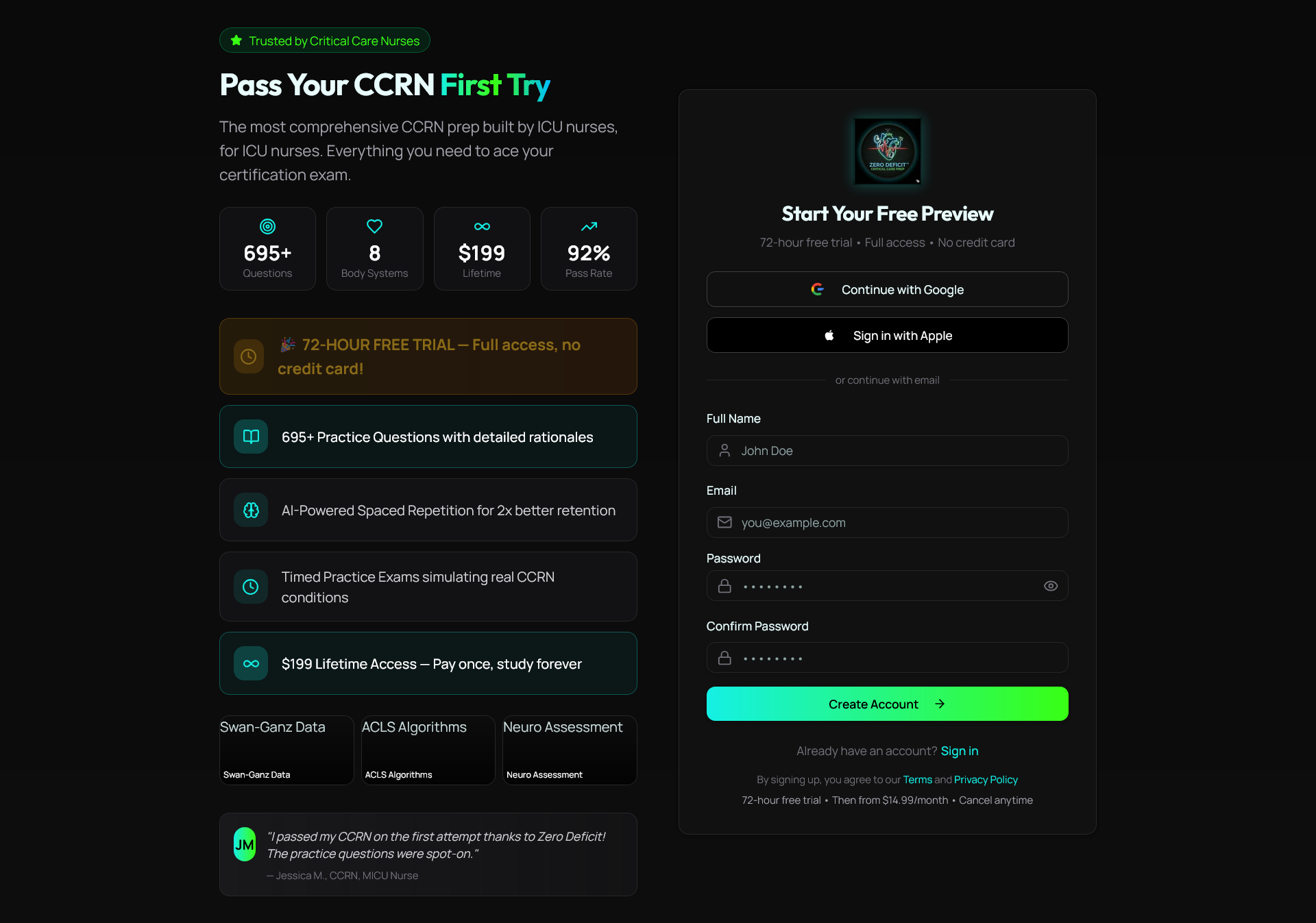
Here’s how to get started today:
- Try our free trial or head straight to the 695+ question practice bank to test your baseline.
- Use the detailed rationales after each question to turn a missed answer into a concept you actually understand.
- Choose a plan that fits your timeline: Premium Monthly at $14.99 per month, Yearly Access at $84.99 per year, or Lifetime Mastery for ongoing access.
Once you’ve run your first mock exam, follow the study loop we outlined above: listen, test, review rationales, repeat. Visit our subscription page when you’re ready to unlock full access to the question bank and study guides that make that loop work.
FAQ
Can I pass the CCRN using only audio review?
No, audio review alone is unlikely to get you through the CCRN because the exam includes waveform interpretation and visual clinical data that spoken explanation cannot fully convey. Use audio for daily reinforcement and pair it with a question bank like our 695+ practice question set for the visual and recall practice the exam actually tests.
How many practice questions should I answer alongside audio study?
There’s no single required number, but working through a substantial, rationale-backed question bank such as the 695+ questions we offer gives you enough coverage across all exam systems to pair meaningfully with your listening sessions. Consistency across weeks matters more than hitting one specific count in a single sitting.
What’s the best way to fit audio review into a busy ICU schedule?
Reserve audio for moments when you can’t engage visually, like your commute or a quiet break, and save dedicated at-home time for question-bank work where you can see images and rationales. A simple weekly split of several audio sessions paired with two to three focused question-bank blocks tends to work well for most ICU schedules.
Does audio content stay current with AACN test plan changes?
Not always. AACN’s revised CCRN test plans took effect on November 12, 2025, and audio resources update less frequently than formal exam prep platforms, so always check the publish date of any audio series against the current AACN CCRN Exam Handbook before relying on it.
Which CCRN topics are hardest to learn through audio alone?
Cardiovascular waveform interpretation and ventilator setting changes are the hardest topics to learn through audio alone, since both require visual pattern recognition rather than spoken description. Use audio to understand the underlying mechanism, then switch to image-based question practice, such as our shock topic guide, to build the visual recognition skills the exam tests.
Sources
- Revised CCRN Certification Exams Launch Nov. 12, 2025 - AACN
- SCCM Pod 556: Building lifelong learning habits for nurses
Recommended
Take a Respiratory practice quiz
Master ARDS, ventilation, ABGs, oxygenation, and pulmonary emergencies.
Get Your Free 20-Question CCRN Diagnostic
20 high-yield CCRN-style questions across every body system, with detailed rationales — emailed to you instantly.
No spam. One email + a couple of helpful follow-ups. Unsubscribe anytime.
Ready to pass your CCRN?
Join 12,000+ nurses using Zero Deficit — 695+ practice questions with rationales, AI-powered weak-area drilling, and spaced-repetition flashcards.
Start Free Trial →