Best CCRN Practice Tests: 2026 Comparison for ICU Nurses

The best CCRN practice test is the one that teaches you why an answer is right, tracks your weak systems and lets you repeat what you missed. For most ICU nurses preparing for the Adult CCRN, that is Zero Deficit™ CCRN Prep: 695+ practice questions with detailed rationales, AI-powered review, spaced repetition and exam simulations, starting at $14.99 per month. Below is how the main options compare and how to pick for your timeline.
TL;DR
- Choose a test on four things: rationale quality, system-by-system coverage, review tools for missed questions and price per month of study.
- Zero Deficit™ offers 695+ questions with detailed rationales, AI-powered review, flashcards, spaced repetition and simulations for $14.99 per month or $84.99 per year.
- AACN’s own practice exams and Pocket Prep are the other options most nurses weigh. Both are listed with their published prices below.
- Use one full 150-question simulation to check readiness, but spend most of your time on rationales and missed-question review.
- Aim above the passing line: the Adult exam scores 125 items and you need 83 correct.
Table of Contents
- What the Adult CCRN asks of a practice test
- How the best CCRN practice tests compare
- Zero Deficit™ CCRN Prep: our pick for most ICU nurses
- AACN practice exams: the official 150-question benchmark
- Pocket Prep: a mobile question app
- Other places nurses find practice questions
- How to choose: match the test to your timeline
- What a good question teaches you: three examples
- How to use any practice test so it raises your score
- Our perspective
- Start with Zero Deficit™ CCRN Prep
- FAQ
- Sources
What the Adult CCRN asks of a practice test
The Adult CCRN is 150 multiple-choice questions, and 125 of them are scored. The passing line is 83 of 125. We break that down in our CCRN scoring guide, but the practical meaning is simple: you can miss a fair number of items and still pass, so the goal is steady accuracy across every system, not perfection in your favorite one.
That shapes what a good practice test must do:
- Match the question style. CCRN items are patient scenarios that ask for the best next action or the most likely cause. Recall-only quizzes train the wrong skill.
- Explain every answer. A rationale that covers why the correct option is right and why each distractor is wrong is where most of the learning happens. We cover this in the role of exam rationales.
- Cover all body systems. Cardiovascular, pulmonary, neuro, renal, endocrine, hematology/immunology, GI, musculoskeletal/integumentary and the multisystem and professional caring content all show up. Neglecting one can cost you.
- Let you review what you missed. Reading a rationale once rarely fixes a gap. Missed questions need to come back on a schedule.
- Fit shift work. Ten minutes on a break counts only if the tool works on your phone and remembers where you stopped.
How the best CCRN practice tests compare
| Criteria | Zero Deficit™ CCRN Prep | AACN practice exams | Pocket Prep CCRN Adult |
|---|---|---|---|
| Question volume | 695+ practice questions | 150-question exam, plus a larger bank with hundreds of questions | Up to 1,000 Adult questions on premium |
| Rationales | Detailed rationales on every question | Correct-answer rationales | Included with questions |
| Review tools | AI-powered review, spaced repetition, flashcards, progress tracking | Exam scores | Missed-question quiz, build-your-own quiz |
| Simulations | Exam simulations and personalized question generation | Full 150-question practice exam | One full-length mock exam |
| Study guides | Guides by system and topic, written by ICU nurses | Not part of the practice exam product | Not the focus |
| Published price | $14.99 per month or $84.99 per year; Lifetime Mastery option | $35 member or $45 nonmember for the 150-question exam; $75 member or $90 nonmember for the larger bank | $20.99 per month, or $124.99 per year |
| Free option | Free trial | One-time free 30-question trial | 50 free questions |
Prices for AACN and Pocket Prep are as each lists them on its own page at the time of writing and can change, so confirm on their sites before you buy. Zero Deficit™ prices are from our subscription page.
Zero Deficit™ CCRN Prep: our pick for most ICU nurses
We built Zero Deficit™ for one exam, the Adult CCRN, and one reader: an ICU nurse studying between shifts. Here is what that means in practice.
Rationale-first questions. All 695+ CCRN practice questions come with detailed rationales written by expert ICU nurses. Read the rationale even when you answer correctly. Many correct answers are lucky guesses, and the rationale tells you which. Our guide to questions with rationales shows the routine.
AI-powered review and spaced repetition. Missed concepts return at intervals instead of disappearing after one session. The AI-powered review tools and personalized question generation let you build sets around the systems that pull your score down.
Practice by body system. The practice tests by system let you drill all eight areas, so you can treat a weak spot (say, hemodynamics) with a focused block rather than a random mix.
Study guides and flashcards beside the questions. When a question exposes a gap, you can go straight to the study guides by system or the high-yield topic guides on shock, vasopressors and sepsis.
Progress tracking and simulations. You can see which systems are improving and take exam simulations when you are ready to test pacing across a full session.
Pricing. Premium Monthly is $14.99 per month and Yearly Access is $84.99 per year. A free trial lets you start before paying, and Lifetime Mastery is also available on the subscription page. If your exam is eight weeks out, the monthly plan covers it. If you are a new ICU grad planning a six-to-twelve-month runway, or you may retake, the yearly plan keeps everything open for the whole stretch.
AACN practice exams: the official 150-question benchmark
AACN owns the CCRN credential and sells its own practice exams. The 150-question exam, with rationales for correct answers, is priced at $35 for AACN members and $45 for nonmembers. A larger bank with hundreds of questions, content-area exams and regular new questions is $75 for members and $90 for nonmembers. A one-time free 30-question trial is also offered.
That makes it a reasonable checkpoint late in your prep: one full-length exam to see where you stand. It is a test-taking tool rather than a study system, so it does not give you guides, flashcards or spaced repetition. Many nurses pair a single AACN exam with a daily practice platform. Our post on question banks, AACN first covers how to sequence them.

Pocket Prep: a mobile question app
Pocket Prep’s CCRN Adult app offers 50 free questions and, on its premium plan, up to 1,000 Adult questions, a missed-question quiz, a build-your-own quiz and one full-length mock exam. The app store lists $20.99 for one month and $124.99 for a year. It suits short phone sessions, though it is built as a question app and not as a combined question, guide and review system.
Other places nurses find practice questions
Search results also show nurse forum threads, general test-prep sites and printed practice books. A printed book with three full tests and 450 questions, for example, appears among the top results. Books and forum recommendations are fine for variety, but they rarely track your performance by system or schedule your reviews. Treat them as extras, and let one platform be your daily driver.
How to choose: match the test to your timeline
Eight weeks or fewer. Pick the monthly plan, start with a diagnostic block across all systems, then spend your time on the two or three weakest. Add one full simulation in the final week.
Three to six months. Use the yearly plan. Study one system per week with the guide, then do a question block on it, then revisit it with spaced repetition. Our top CCRN study topics post helps you rank what to cover first.
Retaking the exam. Your score report shows which areas were weaker. Build personalized question sets around those and read every rationale, including those for questions you got right.
New ICU grad. Spend the first month on bedside fundamentals the exam assumes: waveform and hemodynamic basics, vent modes, ABG interpretation. Build the habit of explaining each answer aloud before you read the rationale.
If you want a calendar to anchor this, a week-by-week exam study plan built for a different nursing exam shows how to split weeks between content review and practice questions, and the same logic transfers to the CCRN.
What a good question teaches you: three examples
A strong practice test makes you reason with numbers. These are the kinds of reference values your questions should have you using without hesitation:
- ABGs: pH 7.35 to 7.45, PaCO2 35 to 45 mmHg, HCO3 22 to 26 mEq/L, PaO2 80 to 100 mmHg on room air. A question might give you pH 7.28, PaCO2 30 and HCO3 14 and ask for the interpretation: metabolic acidosis with respiratory compensation. The rationale should then explain why it is not a primary respiratory problem.
- Hemodynamics: MAP of about 70 to 105 mmHg, CVP 2 to 6 mmHg, cardiac output 4 to 8 L/min, SVR 800 to 1,200 dynes. A scenario with low CO, high SVR and elevated wedge pressure points toward cardiogenic shock. Our CCRN shock guide and interactive shock flowchart walk through each type.
- Labs in sepsis and renal questions: lactate below 2 mmol/L, potassium 3.5 to 5.0 mEq/L, creatinine about 0.6 to 1.2 mg/dL. Expect items that ask what to do first when potassium climbs on CRRT or when lactate fails to clear.
Values can differ slightly between labs, so use the ranges your unit and the exam handbook use, and always answer within the question’s own stem.
How to use any practice test so it raises your score
- Take a short diagnostic first. Fifty mixed questions are enough to show your weakest systems.
- Work in timed blocks of 10 to 25 questions. You have roughly a minute per item on exam day, so practice that pace.
- Read every rationale. Write one line on why the distractors fail.
- Log misses by cause. Was it a knowledge gap, a misread stem or a rushed choice? Each needs a different fix. Our practice question strategies and question breakdown methods show how.
- Return to misses on a schedule. Spaced repetition does this automatically.
- Simulate once or twice. A full 150-question session builds stamina. Read why practice tests help for how often to schedule one.
Watch your trend, not a single score. Scores that settle comfortably above the passing mark (83 of 125, about 66%) across mixed sets are a better readiness signal than one good day.
Our perspective
We built Zero Deficit™ because a question bank alone is not enough. Critical care nurses already know how to work hard. What they need is a way to turn each miss into a lasting gain.
That is why every one of our 695+ questions has a detailed rationale written by ICU nurses, why missed concepts come back through spaced repetition, and why our AI-powered review tools build sets around your weak systems. The name describes the goal: no gaps going into exam day.
When you compare the best CCRN practice tests, ask what happens after you get a question wrong. In our platform, that moment is where the learning starts.
Zero
Start with Zero Deficit™ CCRN Prep
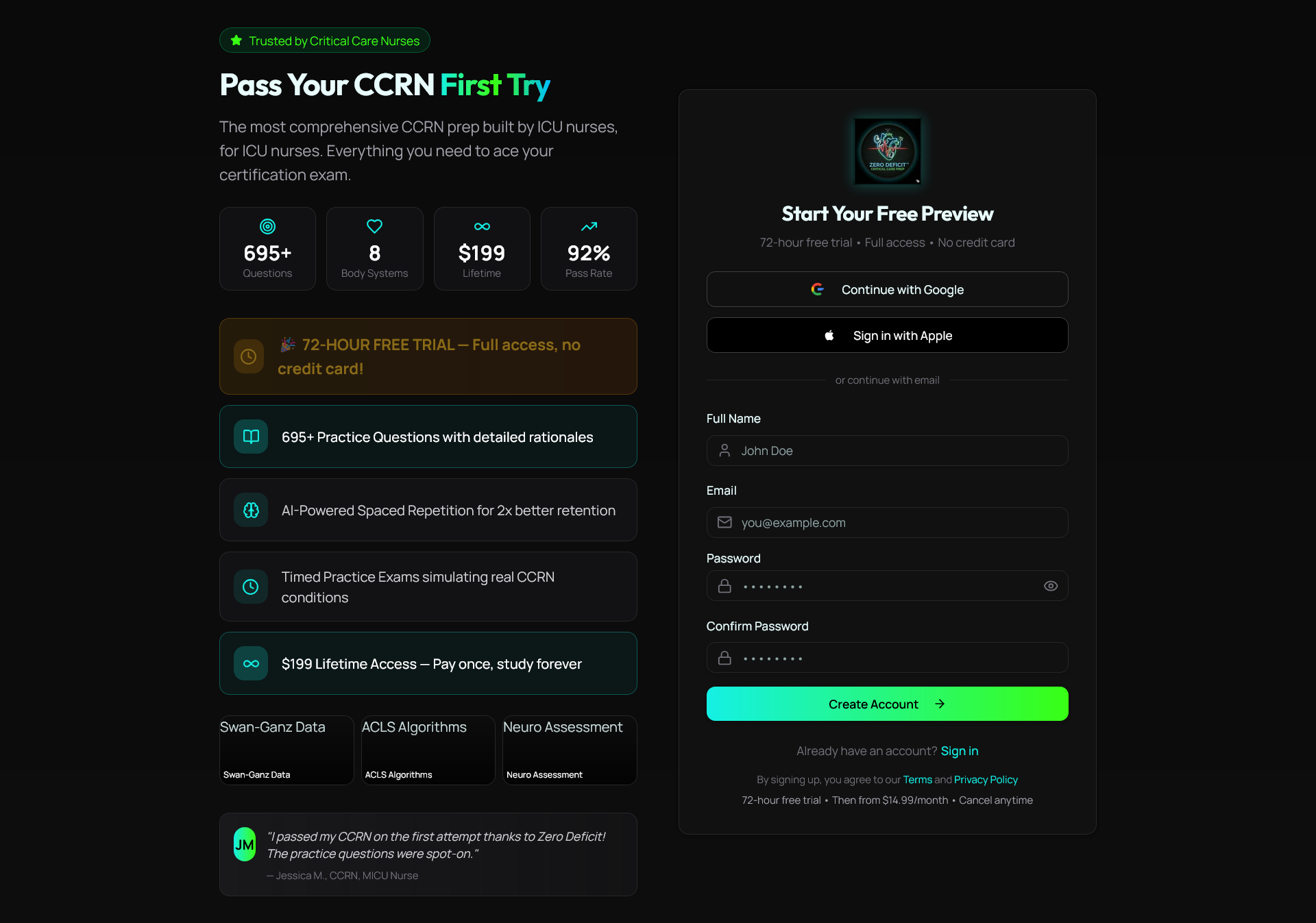
Zero Deficit™ gives you 695+ practice questions with detailed rationales, study guides by system, flashcards, progress tracking, spaced repetition and exam simulations in one place. Start with the free trial, then choose Premium Monthly at $14.99 per month or Yearly Access at $84.99 per year on the subscription page.
FAQ
How many practice questions do I need to do before the CCRN?
There is no official number. Quality matters more than volume: a few hundred questions with every rationale read and every miss reviewed beat a thousand questions rushed through. Work through every system at least once, then repeat your weakest areas.
Are free CCRN practice tests enough?
Free samples are useful for checking a platform’s style and getting a first read on your level. For a full prep cycle you want complete coverage of all systems, rationales and a way to revisit misses. Our free trial lets you begin, and the subscription unlocks the full question bank and tools.
Should I take a full 150-question practice exam?
Yes, once or twice, in the last few weeks. The real exam has 150 questions with 125 scored, so a full session shows your pacing and stamina. Use the results to pick what to review, not to judge yourself.
What score on a practice test means I am ready?
Practice scores vary by source, so compare yourself with the passing standard of 83 of 125 scored items, about 66%. Consistent results well above that across mixed, timed sets across all systems are a good sign. Check the details in our CCRN scoring guide.
Which plan fits a first-time test taker?
If your exam is within two months, Premium Monthly at $14.99 per month covers it. For a longer runway or a possible retake, Yearly Access at $84.99 per year keeps the question bank, guides and review tools available throughout.
Ready to put this into practice? Start your CCRN prep with Zero Deficit™ CCRN practice questions today.
Sources
Recommended
Take a Multisystem practice quiz
Master sepsis, shock, MODS, and multi-organ failure scenarios.
Get Your Free 20-Question CCRN Diagnostic
20 high-yield CCRN-style questions across every body system, with detailed rationales — emailed to you instantly.
No spam. One email + a couple of helpful follow-ups. Unsubscribe anytime.
Ready to pass your CCRN?
Join 12,000+ nurses using Zero Deficit — 695+ practice questions with rationales, AI-powered weak-area drilling, and spaced-repetition flashcards.
Start Free Trial →