Best CCRN Podcasts: What to Listen To and How to Use Them

There is no single “official” CCRN podcast, but a short list of shows is worth your commute time: CCRN Review for systematic content review, the CRNA School Prep Academy Podcast for study strategy, and the Sepsis Spectrum Podcast for deeper clinical knowledge. Podcasts are best used to reinforce what you already study, not to replace practice questions. This guide compares each option, tells you what it covers and what it costs, and shows you how to build listening into a plan that gets you to a pass.
TL;DR
- CCRN Review is the most exam-specific podcast. It works through critical care content episode by episode and runs about 30 minutes per episode.
- CRNA School Prep Academy Podcast is the one to hear for study strategy, timelines and what the CCRN means for a CRNA application.
- Sepsis Spectrum Podcast builds clinical depth in sepsis and multi-organ dysfunction, and offers free CE credit.
- Research on nursing podcasts says to pair them with other study methods. Pair audio with practice questions and rationales.
- Use listening for the moments you can’t study, then lock in each topic with questions in the same week.
Table of Contents
- How we compared these podcasts
- The best CCRN podcasts at a glance
- CCRN Review: the most exam-specific option
- CRNA School Prep Academy Podcast: strategy and timeline
- Sepsis Spectrum Podcast: clinical depth you can use at the bedside
- Not a podcast, but worth knowing: Nurse Jenny on YouTube
- What the research says about podcasts for nurses
- How to combine podcasts with the rest of your study plan
- Perspective
- Turn listening into points on exam day
- Tips for getting the most from any CCRN podcast
- FAQ
- Sources
How we compared these podcasts
We judged each option on four things you care about as an ICU nurse studying around shifts:
- Exam relevance. Does it map to the Adult CCRN test plan?
- Format and length. Can you finish an episode on a commute or a walk?
- Cost and access. Where can you hear it, and is it free?
- Currency. Is the content recent enough to match current guidelines?
One note on the last point: the CCRN test plan weights Clinical Judgment at 80% and Professional Caring and Ethical Practice at 20%. AACN’s Adult CCRN course syllabus breaks the Clinical Judgment share down further: Cardiovascular 13%, Respiratory 12%, a combined group of Endocrine, Hematology, Gastrointestinal, Renal and Genitourinary, and Integumentary at 21%, a group of Musculoskeletal, Neurological, and Behavioral and Psychosocial at 18%, and Multisystem 16%. A podcast that spends most of its time on one niche area is useful, but it won’t cover the blueprint evenly. Keep that in mind as you read the comparison.
The best CCRN podcasts at a glance
| Podcast | Best for | Format | Cost to listen |
|---|---|---|---|
| CCRN Review (host Kay Hoppe) | Content review that follows a critical care core curriculum | Medium-form, about 30 minutes per episode | Available on podcast apps |
| CRNA School Prep Academy Podcast | Study strategy, timelines, CCRN for CRNA applicants | Interview and solo episodes | Available on podcast apps |
| Sepsis Spectrum Podcast (Sepsis Alliance) | Sepsis, MODS and real-world cases | Expert interviews and clinical deep dives | Free, with free CME and CNE credit |
| Nurse Jenny (Nurse Life Academy) | Last-weeks content review | YouTube video, not a podcast | Free on YouTube |
Pick one for content (CCRN Review), one for strategy (CRNA School Prep Academy), and one for clinical depth (Sepsis Spectrum). More than that tends to turn into passive listening.
CCRN Review: the most exam-specific option
If you want audio that is built around the CCRN itself, start here. Feedspot’s 2026 directory of critical care podcasts lists CCRN Review at position 19 of 53, hosted by Kay Hoppe, with a 4.9 out of 5 Apple rating from 121 reviews, a medium-form format and an average episode length of 30 minutes. The same directory estimates 1,000 to 10,000 monthly listeners. Feedspot’s US nursing podcast list also includes it, at position 47 of 65, with the same rating.
What it’s good for:
- Going through the content system by system, in a structured order.
- Passive review after you’ve seen a topic once. It works as a second pass, not a first exposure.
- Short, repeatable sessions: one episode is about one commute leg.
What to watch for: the show’s episodes were released over several years, so check anything involving a guideline (for example, sepsis bundles or resuscitation algorithms) against current AHA and SCCM guidance. The Surviving Sepsis Campaign and AHA publish updates, and the CCRN tests current practice. When an episode and a recent guideline disagree, the guideline wins.
CRNA School Prep Academy Podcast: strategy and timeline
This show isn’t a content review. It earns a place on the list because it answers the questions nurses actually lose sleep over: how long to study, in what order, and what score matters.
In Episode 96, published in December 2022, guest Nicole Kupchik covers the CCRN eligibility requirement of 1,750 hours within two years, administered by the American Association of Critical-Care Nurses. She recommends at least two to three months of studying before sitting for the exam.
A more recent episode, covered on Castro, is hosted by Jenny Fennell, CRNA, and published October 21, 2026. It suggests studying one body system at a time with cumulative practice questions, saving full-length practice exams for the end, and notes that a CCRN score of at least 100 out of 125 (about 80%) can strengthen a CRNA application.

That advice applies whether or not you’re headed to CRNA school. One system at a time with cumulative questions is a sound structure for any CCRN candidate.
Sepsis Spectrum Podcast: clinical depth you can use at the bedside
Sepsis and multi-organ dysfunction sit in the Multisystem portion of the blueprint, and they show up in real ICU practice constantly. The Sepsis Spectrum Podcast from Sepsis Alliance is hosted by critical care RN and CNS Nicole Kupchik. It covers multi-organ dysfunction syndrome, antimicrobial resistance and real-world sepsis cases through expert interviews, and it offers free CME and CNE credits for healthcare professionals.
This one is not a CCRN review. Use it for context: why a patient’s lactate trend matters, how teams think about source control, and what the reasoning looks like at the bedside. That context is what helps with CCRN scenario questions, which ask you to choose the best next action rather than recall a number.
Not a podcast, but worth knowing: Nurse Jenny on YouTube
Search results for CCRN audio often lead to video content. One nurse on allnurses said they watched Nurse Jenny’s Nurse Life Academy YouTube videos during the last three weeks of CCRN study and found she explains the must-know content well. That’s one person’s experience, not a study result, but it fits a pattern: many candidates add short video or audio review near the end for fast reinforcement. The same poster reported adding a question bank for extra question exposure. Audio and video help you hear the material. Questions show you whether you can use it.
What the research says about podcasts for nurses
A 2024 qualitative systematic review in the Canadian Journal of Nursing Informatics found that podcasts in nursing education should be used together with other learning mediums rather than alone. It identified benefits including flexibility of access, support for different learning styles, help with review and revision, and a boost to self-efficacy or motivation.
The same review lists the barriers: digital literacy requirements, technical problems such as inconsistent internet access or being unable to download material, and the extra time and tech skill needed.
For you, that translates into three habits:
- Download episodes before your shift so spotty hospital or commute coverage doesn’t break your plan.
- Treat audio as review and revision, which is where the research sees the strongest benefit.
- Pair every listening block with active recall: questions, flashcards or a short written summary.
AACN also treats podcasts as a legitimate education tool. Its From Earbuds to the Bedside CE activity describes how podcasts can reinforce critical care concepts, and even how a unit journal club can become a virtual podcast club. If your unit has a certification group, that’s a low-effort way to study together.
How to combine podcasts with the rest of your study plan
AACN’s CCRN preparation guidance lists the test plan, practice exams and questions, review courses (including audio review courses through the AACN Online Bookstore), study groups and certified colleagues as study tools. It also advises planning your study emphasis in proportion to each topic area’s weight. A podcast is one tool on that list, and it’s the easiest one to fit between shifts.
Here is a simple weekly structure:
- Pick one body system for the week, weighted toward the big blocks: cardiovascular and respiratory first, then the combined groups.
- Read or review the system once with a study guide.
- Listen to one or two matching podcast episodes while driving, walking or doing chores.
- Do 20 to 40 practice questions on that system and read every rationale, including the ones you got right.
- Revisit missed topics with spaced repetition a few days later. Our guide to CCRN spaced repetition shows how to schedule that.
- Close the week with a short review. A simple weekly review routine beats cramming because it forces you to retrieve what you studied.
For a fuller sequence from first week to exam day, see our step by step exam readiness workflow. If you’re deciding what to prioritize, our list of top CCRN study topics maps well to the blueprint.
Match the audio to the weak spot
Don’t listen at random. If your practice results show hemodynamics or ventilator questions slipping, pick episodes on those topics. If ethics and the Synergy Model are your gap, spend a listening block there, since Professional Caring and Ethical Practice carries 20% of the exam. Audio is cheap to repeat, so use it on the topics you most need to hear three times.
Perspective
We built Zero Deficit™ because we saw how many ICU nurses were piecing together CCRN prep from scattered sources: a podcast here, a video there, a book on the nightstand. Listening helps, and we encourage it. But hearing a concept and answering a scenario question under exam conditions are two different skills.
That’s why our platform is designed around practice. Over 695 practice questions come with detailed rationales, our study guides are organized by system and topic and created by expert ICU nurses, and our AI-powered review tools and spaced repetition are designed to put your weak areas back in front of you at the right time.
Our advice: let podcasts carry the passive hours, and let practice questions carry the real preparation. Use audio to hear it, then use questions to prove you’ve got it. That combination is how we designed Zero Deficit™ to get you to a first-attempt pass.
Zero
Turn listening into points on exam day
Podcasts fill the gaps in your day. Zero Deficit™ fills the gap between knowing and answering. The platform includes practice questions with detailed rationales, flashcards, study guides by system, progress tracking, spaced repetition, exam simulations and personalized question generation.
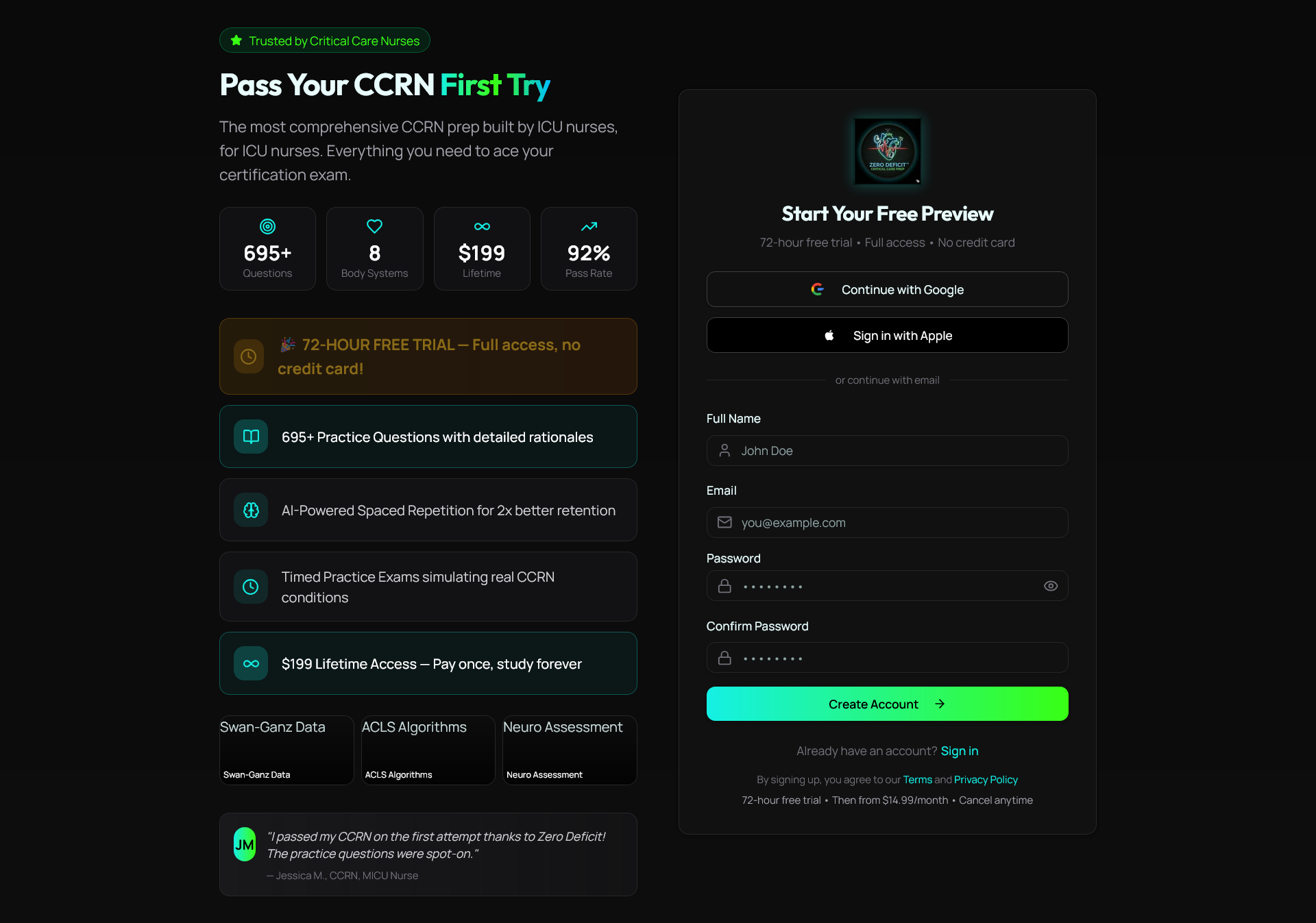
Plans are published at $14.99 per month or $84.99 per year, and a Lifetime Mastery option is also available on the subscription page. A free trial is available, so you can try the question format before you commit. If you’d rather start with content, browse our CCRN study guides by body system. You can also check the CCRN exam cost breakdown to plan your budget.
Tips for getting the most from any CCRN podcast
- Listen at 1.25x only after you know the topic. New material needs normal speed.
- Keep a one-page “heard it” list. Jot down any value, range or step you want to verify, then check it against a current guideline from AHA, SCCM or AACN.
- Check dates. An episode recorded before 2020 may predate current guidance. Verify anything clinical.
- Stop passive listening a week before the exam. Switch to full-length practice sets and review of missed rationales.
- Don’t hunt for the perfect show. Pick one and finish a system, because consistency matters more than variety.
If you’re planning your overall approach, our guide to passing the CCRN exam covers the full path.
FAQ
What are the best podcasts for critical care nursing?
For CCRN-specific content review, CCRN Review is the most direct match. For clinical depth, the Sepsis Spectrum Podcast from Sepsis Alliance offers expert interviews and free CE credit. For study strategy, the CRNA School Prep Academy Podcast has CCRN-focused episodes. Pick one from each group at most.
Can I pass the CCRN by listening to podcasts alone?
We wouldn’t plan on it. A 2024 systematic review in nursing education recommends using podcasts alongside other learning methods, and AACN lists practice exams and questions among its recommended tools. Use podcasts for review, and rely on practice questions with rationales to build exam skills.
How long should I study for the CCRN?
In a podcast episode, Nicole Kupchik recommends at least two to three months of studying before the exam. Your timeline may be shorter or longer depending on how recently you’ve worked with each system. Plan by blueprint weight and let your practice results show where to spend extra time.
How do I fit podcasts into a busy shift schedule?
Download episodes ahead of time and attach them to routines you already have, such as your commute or workouts. Aim for one or two episodes a week that match the system you’re studying. Follow each with a short set of practice questions the same week.
Sources
- CCRN Syllabus Revision Draft, AACN Adult CCRN course syllabus
- 53 Best Critical Care Podcasts to Listen to in 2026, Feedspot
- 65 Best US Nursing Podcasts to Listen to in 2026, Feedspot
- CCRN for CRNA School, CRNA School Prep Academy Podcast Episode 96
- How to Study for the CCRN, CRNA School Prep Academy episode on Castro
- The Sepsis Spectrum Podcast, Sepsis Alliance
- I PASSED the CCRN!, allnurses
- Podcasting in Nurse Education: Qualitative Systematic Review, Canadian Journal of Nursing Informatics
- How to Prepare for the CCRN Exam, AACN
- From Earbuds to the Bedside, AACN CE activity
Recommended
Take a Multisystem practice quiz
Master sepsis, shock, MODS, and multi-organ failure scenarios.
Get Your Free 20-Question CCRN Diagnostic
20 high-yield CCRN-style questions across every body system, with detailed rationales — emailed to you instantly.
No spam. One email + a couple of helpful follow-ups. Unsubscribe anytime.
Ready to pass your CCRN?
Join 12,000+ nurses using Zero Deficit — 695+ practice questions with rationales, AI-powered weak-area drilling, and spaced-repetition flashcards.
Start Free Trial →