Best Multisystem CCRN Review: How the Options Compare

The best multisystem CCRN review is the one that pairs a focused content review of shock, sepsis, MODS and acid-base with practice questions that explain every answer, then shows you which topics are still costing you points. Multisystem is the domain where cardiac, pulmonary, renal and infectious problems all land in one patient, so a single-system book rarely covers it well. Below, we compare the resources nurses commonly use, explain what to look for, and show how to build a plan around the domain.
TL;DR
- Multisystem questions blend body systems, so choose a review that teaches reasoning across systems (sepsis, shock, MODS, acid-base), not just facts.
- Look for four things: a question bank with full rationales, content organized by topic, performance tracking, and spaced repetition.
- Books, video reviews, instructor-led courses and question banks do different jobs. Most passing candidates combine two or three.
- Zero Deficit™ CCRN Exam Prep gives you multisystem practice questions with rationales, AI-powered review tools, flashcards and progress tracking in one subscription.
- Start with a baseline quiz, find your two weakest topics, and rebuild your plan around them.
Table of Contents
- What the multisystem domain actually covers
- What a good multisystem review needs
- The main types of CCRN review, compared
- How Zero Deficit™ handles multisystem prep
- How to choose for your situation
- A multisystem study plan that uses your time well
- Our perspective
- Ready to start your multisystem review?
- FAQ
- Sources
What the multisystem domain actually covers
Before you compare resources, know what you are buying prep for. The published Adult CCRN content outline, as reproduced in a copy of the test plan that applies to exams taken on and after November 12, 2025, lists these multisystem topics:
- Acid-base imbalance
- Anoxic injury
- Transplant comorbidity
- Palliative and end-of-life care
- Failure to thrive
- Fluid and electrolyte imbalance
- Healthcare-associated infections and infectious disease
- Maternal/fetal complications
- MODS and SIRS
- Obesity complications
- Pain
- Rhabdomyolysis
- Sepsis and shock states
- Sleep disruption
- Submersion injuries
- Thermoregulation
- Toxic exposures
Two things stand out. First, the list is broad: some items you manage every shift (sepsis, electrolytes, pain), and others you may see a few times a year (submersion injury, toxic exposure, maternal complications in an adult ICU). Second, many of these topics sit on top of other systems. A septic patient with ARDS and AKI is a multisystem question, a pulmonary question and a renal question at once.
To confirm current weighting and the most recent test plan, always check the official AACN certification pages before you finalize your plan.
What a good multisystem review needs
Use these criteria to judge any option, including ours.
Rationales for every answer, right and wrong
Multisystem questions often offer several answers that are clinically reasonable and ask for the best next action. A rationale that only says why the correct choice is correct leaves you guessing about the distractors. You want the reasoning for each option, written at the bedside level.
Content organized by topic, not only by system
Sepsis, shock and MODS cross system lines. A review that lets you study by topic as well as by body system helps you connect the pieces. Our high-yield topic guides and study guides by system exist for this reason: you can move between both views.
Feedback on what you miss
A score alone does not tell you whether you missed a question from a knowledge gap, a misread stem or a rushed decision. Tracking by topic, plus tools that generate more questions in your weak areas, shortens the time from “I got that wrong” to “I understand why.”

Spaced repetition
Multisystem content is a lot of small, connected facts. Seeing them again at increasing intervals is more efficient than one long pass through a book followed by a cram week.
A format that fits your life
If you work three twelves and sleep in between, a phone-friendly question bank that you can open for ten minutes beats a two-day course you cannot attend. If you learn best from a live instructor, the reverse may hold.
The main types of CCRN review, compared
Candidates commonly mention a handful of resources. The table compares the formats, using what each is generally known for. Confirm current pricing and features on each provider’s own page, because they change.
| Option | Format | Best for | Rationales and tracking |
|---|---|---|---|
| Zero Deficit™ CCRN Exam Prep | Online question bank, study guides by system and topic, flashcards, AI-powered review, exam simulations | Nurses who want questions, content and tracking in one place | Detailed rationales, progress tracking, spaced repetition, personalized question generation |
| Barron’s Adult CCRN Exam book | Print book with practice questions | Readers who like a linear, paper-based review | Practice questions in book form, no adaptive tracking |
| AACN’s official practice question bank and review offerings | Official online practice and review from the certifying body | Candidates who want material from the organization that writes the exam | Varies by product |
| Video reviews, such as those by Laura Gasparis Vonfrolio | Recorded or live lecture-style review | Auditory learners who want a guided pass through the content | Lecture-based, with limited question feedback |
| Pass CCRN | Online review and question bank | Candidates who want a dedicated online CCRN program | Check the provider’s site |
| Pocket Prep | Mobile question app | Short sessions on the go | Check the provider’s site |
| Mometrix and similar test-prep publishers | Practice test books and online tests | Extra practice volume | Check the provider’s site |
Several of these appear in what nurses recommend on forums and prep roundups, usually in combinations. A common pattern is a book or video series for content, plus a question bank for volume. That pattern makes sense, and it points to the real choice: which tool will carry your question practice, since that is where most of your study hours should go.
How Zero Deficit™ handles multisystem prep
We built Zero Deficit™ around the idea that passing comes from understanding why, not memorizing what. Here is how that applies to this domain.
- Multisystem question practice. Our multisystem practice questions come with rationales, so you see the reasoning behind each answer choice.
- Topic guides for the big overlaps. Our sepsis management guide covers the hour-1 bundle and septic shock, and our CCRN sepsis mastery guide walks through how exam questions frame it. For healthcare-associated infections, see our infection control review topics.
- Shock reasoning. The interactive shock flowchart helps you sort distributive, cardiogenic, hypovolemic and obstructive presentations step by step.
- Cross-system practice. Because MODS pulls in lungs and kidneys, you can move straight into our respiratory and renal question sets.
- Study features. The platform includes over 695 practice questions, flashcards, spaced repetition, exam simulations, progress tracking and AI-powered review tools, and the study guides were created by expert ICU nurses.
If you want to learn how to read a stem and strip it down, our question breakdown methods give you a repeatable process.
How to choose for your situation
If you are 6 to 12 weeks out and starting cold
Pair content with questions from day one. Study one topic guide, then do a short set of questions on it the same day. Use the platform’s tracking to see which topics need a second pass. A subscription that covers everything in one place keeps this simple.

If you are a few weeks out
Skip long content passes. Take a timed multisystem quiz, read every rationale (including the ones you got right), and use flashcards and spaced repetition for the facts you keep missing.
If you are retaking the exam
Your score report tells you where you lost points. Build your plan around those areas first, and use question generation focused on them rather than redoing material you already own.
If you are a new ICU grad
You may have met some multisystem topics only in class. Start with the topic guides for sepsis and shock so the vocabulary and sequence are solid before you push volume.
If your budget is a factor
Compare total cost across your whole plan, not only one product. Our published plans are Premium Monthly at $14.99 per month and Yearly Access at $84.99 per year, and a Lifetime Mastery plan is also listed on the same page. Monthly suits a short, intense runway. Yearly suits a longer plan or a possible retake.
A multisystem study plan that uses your time well
- Baseline. Take a mixed multisystem quiz untimed. Note your score by topic, not just overall.
- Pick two targets. Most nurses have two weak spots. Maybe it is acid-base and electrolytes, or toxic exposures and thermoregulation. Name yours.
- Study to the question. Read the guide for one target, then do ten to twenty questions immediately.
- Write your misses. For each wrong answer, write one sentence on what you misread or did not know. Patterns show up fast.
- Connect systems. Take a septic shock case and walk it through lungs (ventilation strategy), kidneys (AKI and renal replacement), and metabolic status (acid-base). This is how multisystem questions think.
- Space it out. Return to missed topics after a few days, then a week, using flashcards.
- Simulate. In the last two weeks, do full-length timed practice to build stamina and pacing.
If you like to build your own outline from the blueprint and turn it into summaries and flashcards, a study tool such as an AI exam crash course can help you structure a plan around the specialized topics you listed. Use it alongside, not in place of, practice questions with clinical rationales.
Our perspective
We hear the same thing from ICU nurses again and again: the multisystem questions feel different. There is no single organ to anchor on, and the answer choices all sound like something you might do.
That is why we built Zero Deficit™ around rationales and connections. Every practice question is meant to teach the reasoning, so when a new scenario shows up on exam day, you recognize the pattern even if you have never seen that exact stem. Our AI-powered review tools and spaced repetition are designed to keep you working on what you are most likely to miss, not on what you already know.
Our study guides were created by expert ICU nurses, and we write them the way we would explain a case to a colleague at the bedside. Our goal is simple: you walk into the exam with no gaps you could have closed.
Zero
Ready to start your multisystem review?
Zero Deficit™ CCRN Exam Prep brings 695+ practice questions with detailed rationales, study guides by system and topic, flashcards, exam simulations and progress tracking into one subscription, with a free trial available. You can compare plans on our subscription page and pick monthly or yearly access based on your exam date.
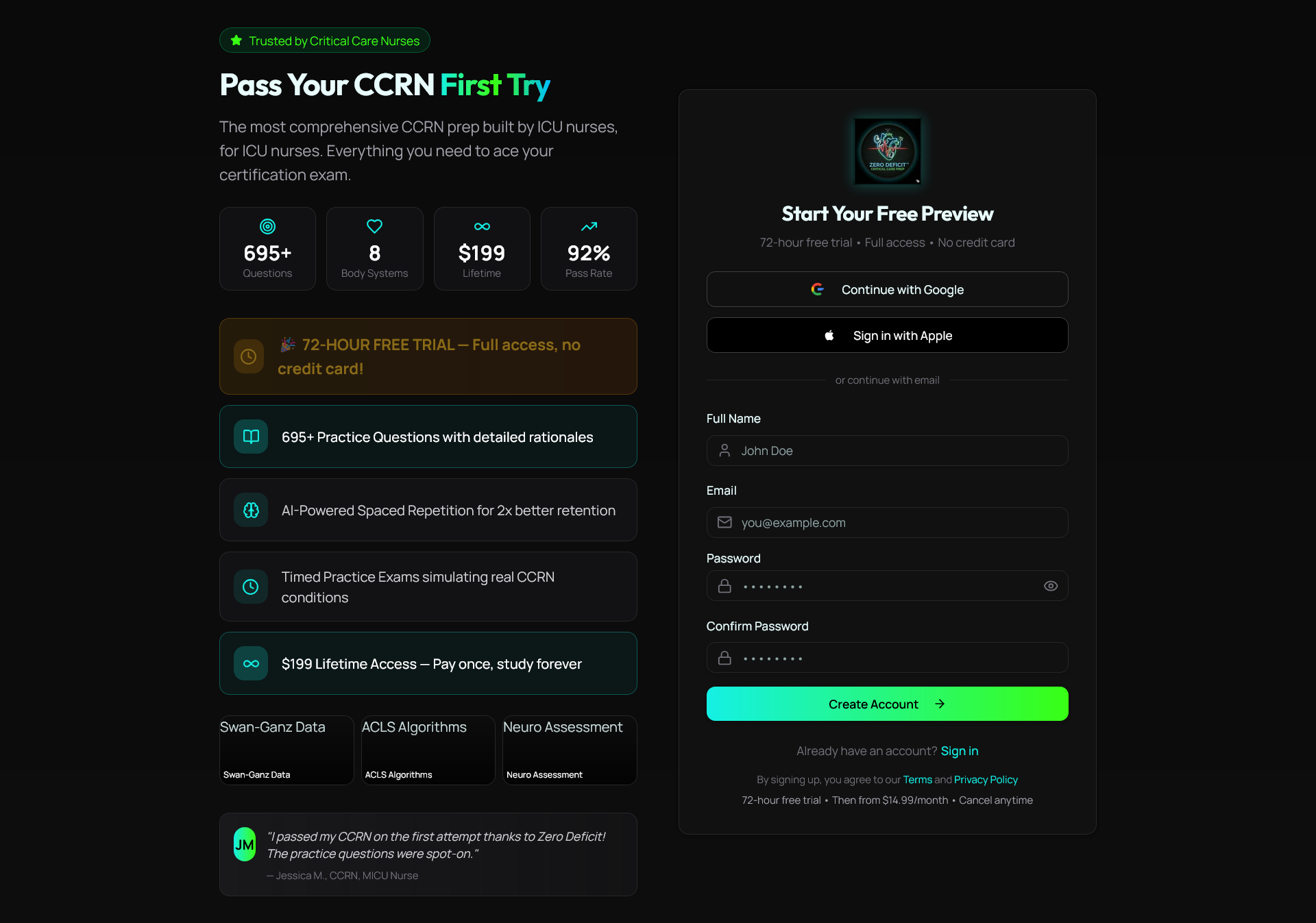
If you are not sure where to begin, try the free multisystem quiz first and see where you stand.
FAQ
What is the best CCRN review for the multisystem section?
The best choice combines a topic-based content review with a question bank that explains every answer option. Zero Deficit™ offers multisystem questions with rationales, topic guides for sepsis and shock, and tracking that shows your weakest areas. Many nurses also add a book or video review for the content pass.
Is a question bank enough, or do I need a course too?
It depends on your starting point. If you work in the ICU and mainly need practice applying what you know, a question bank with strong rationales and study guides may be enough. If you are newer to critical care, add a structured content review first, then spend most of your hours on questions.
How many weeks should I study for the CCRN?
Plan around your experience and schedule. Many candidates use six to twelve weeks of steady sessions, with the final two weeks on timed simulations. Short, frequent sessions with spaced repetition tend to be easier to sustain on a shift-work schedule than occasional marathon sessions.
Which topics should I prioritize in multisystem?
Start with sepsis, shock states, MODS, acid-base and fluid and electrolyte imbalance, because they connect to nearly every other system. Then work through infection control, toxic exposures and thermoregulation. Check the current AACN test plan for the exact weighting.
Sources
- CCRN Adult Test Plan: Comprehensive Review for Exam Prep (Studocu)
- AI Exam Crash Course for Last-Minute Revision (Examo)
Recommended
Take a Multisystem practice quiz
Master sepsis, shock, MODS, and multi-organ failure scenarios.
Get Your Free 20-Question CCRN Diagnostic
20 high-yield CCRN-style questions across every body system, with detailed rationales — emailed to you instantly.
No spam. One email + a couple of helpful follow-ups. Unsubscribe anytime.
Ready to pass your CCRN?
Join 12,000+ nurses using Zero Deficit — 695+ practice questions with rationales, AI-powered weak-area drilling, and spaced-repetition flashcards.
Start Free Trial →