CCRN Question Banks for ICU Nurses: AACN First, Prep Between Shifts

The best approach for most Adult CCRN candidates pairs official AACN practice exams with a high-volume, rationale-rich question bank. Official practice calibrates you to the real exam’s style and timing. A larger bank gives you the repetition and spaced review you need to actually retain the material. Start with one official AACN practice set to see where you stand, then build a daily habit with a deep question bank.
TL;DR:
- Take an official AACN practice exam early to identify weak areas, then use a second attempt in the final one to two weeks if access permits.
- Complete 20 to 30 mixed questions most days, review each explanation, and retry incorrect items after 48 to 72 hours to strengthen recall.
- Reserve full length timed simulations for every two to three weeks, using content area scores to guide the next round of review.
- Focus review on cardiovascular and pulmonary topics, which carry the heaviest exam weighting, and confirm materials reflect AACN’s revised test plan launched November 12, 2025.
- Before subscribing, try a free question set and inspect three rationales; choose a bank that explains physiology or guidelines rather than merely naming answers.
Table of Contents
- Why the AACN’s official practice exams matter
- What to look for in a CCRN question bank
- How to use a CCRN question bank effectively
- What question-bank features actually do for you
- A nurse-to-nurse take on getting this right
- How Zero Deficit supports your CCRN prep
- FAQ
- Sources
Why the AACN’s official practice exams matter
If you want to know exactly what the CCRN exam feels like, nothing substitutes for a product built by the organization that writes the test. AACN’s certification practice exams mirror the real exam’s item style, structure, and interface, so you walk in on test day without surprises. These aren’t generic nursing questions repackaged for CCRN. They’re built directly from the same test plan the actual exam draws from.
The Premium subscription for the Adult CCRN practice exam includes 600+ questions with correct answer rationales and 180-day access, giving you enough runway to use it more than once. You’ll find:
- Content-area exams organized by the same categories the real CCRN tests
- Timed and untimed modes so you can practice both knowledge and pacing
- The ability to take notes, flag questions for review, and see content-area scores
- New questions added periodically so repeat use doesn’t feel stale
Here’s how to slot this into your timeline: take an official AACN practice exam early, as a diagnostic, before you’ve done heavy review. Your score breaks down by content area, so you’ll immediately see whether cardiovascular, pulmonary, neuro, or renal content needs the most attention. Then save a second official practice exam, if your subscription allows it, for the final one to two weeks before your test date. That second attempt tells you whether your focused study actually closed the gaps, and it resets your sense of pacing right before the real thing. Third-party question banks give you volume. The AACN product gives you calibration. You need both.
What to look for in a CCRN question bank
Not every question bank earns a spot in your study plan. Before you commit time or money to one, run it through a short checklist.
- Test-plan alignment. Confirm the bank organizes questions by the Adult CCRN test plan: cardiovascular, pulmonary, neurologic, sepsis and MODS, renal and CRRT, and endocrine emergencies, with coverage that reflects how heavily each area is weighted.
- Question count and variety. Look for a bank large enough to avoid repetition fatigue and organized into content-area sets with a range of difficulty levels, not just one long undifferentiated list.
- Rationale quality. Every question should come with an explanation that teaches, not just states the correct answer. Strong rationales reference current guidelines and include normal lab ranges where relevant, such as an arterial pH of 7.35 to 7.45 or a serum potassium of 3.5 to 5.0 mEq/L, reflecting the importance of quality in healthcare to ensure accurate clinical decisions (The Importance of Quality in Healthcare).
- Exam simulation features. Timed, full-length simulations with content-area scoring help you build the stamina and pacing you’ll need for the actual test.
- Active learning tools. Spaced repetition, AI-assisted review, and performance dashboards that track your progress by topic turn passive quizzing into targeted remediation.
- Access and support. Check the subscription length, whether a trial is available, and whether you can study from your phone between patients or on a quick break.
Pro Tip: Run a free trial question set from any bank you’re considering and read three rationales closely before you subscribe. If the explanations teach you something you didn’t already know, the bank is worth your time.
A bank that checks every box above will do more for your score than one with a flashy interface and thin explanations.
How to use a CCRN question bank effectively
Owning a good question bank means nothing if your routine doesn’t use it well. The nurses who pass on the first attempt tend to build small, consistent habits rather than cramming in long weekend sessions.
A few habits separate efficient prep from wasted hours:
- Do a short, mixed-topic quiz of 20 to 30 questions most days, then follow it immediately with rationale review for anything missed.
- Reattempt missed questions after 48 to 72 hours instead of moving on permanently, so the material resurfaces before you forget it.
- Pair question review with flashcards for high-yield numbers like ABG values and electrolyte ranges.
- Write a one-line takeaway for each rationale you review and keep those notes together for a quick pre-exam scan.
- Reserve full-length, timed simulations for every two to three weeks, not every session, so they stay a meaningful checkpoint rather than routine noise.
Spaced repetition and active recall, when applied to short daily practice with targeted remediation, produce stronger retention than infrequent marathon study sessions. That single shift, trading one long Sunday cram for daily 20-minute sessions, is often the difference between information you recognize and information you can actually apply at 3 a.m. on a bad night.
For the rationale-review step specifically, read the explanation slowly, note which guideline or physiologic principle it’s drawing from, and ask yourself how that concept would show up differently in a sicker or more stable patient. Our guide to reviewing CCRN rationales walks through this process step by step if you want a more structured method.
Here’s what a one-week plan might look like for someone working three to four clinical shifts: on workdays, fit in one 20-question mixed set before or after your shift. On days off, do a focused content-area set, maybe 40 questions on pulmonary or renal, followed by a full rationale review. Reserve one day every two weeks for a timed, full-length simulation. This rhythm respects your schedule while still building the repetition your brain needs.
What question-bank features actually do for you
Some features matter more than others, and knowing why each one helps keeps you from wasting study time on the wrong priorities.
- Detailed rationales turn a missed question into a teaching moment. A rationale that explains why a mixed venous oxygen saturation of 58% signals inadequate perfusion, not just that the answer is “decreased cardiac output,” gives you something you can apply at the bedside the next shift.
- Flashcards and spaced review target the numbers you need instantly recallable: ABG normals, a normal ICP of 5 to 15 mmHg, electrolyte ranges, and common vasoactive drip dosing. These are facts you don’t want to be reasoning through under exam pressure.
- Performance dashboards map your weak spots directly to CCRN test-plan topics, so instead of guessing where you’re behind, you know exactly which content area needs another pass.
- AI-powered review resurfaces questions tied to your specific weak areas rather than cycling you through material you’ve already mastered, which keeps every study session efficient.
- Realistic exam simulation teaches you to pace yourself against the clock and gives you a content-area score breakdown, the same kind of feedback the official AACN product provides.
Pro Tip: When a dashboard shows a weak content area, don’t just redo more questions in that category. Pull the matching system study guide first, review the underlying physiology, then return to the questions with that framework fresh in your mind.
A nurse-to-nurse take on getting this right
We’ve reviewed enough CCRN prep habits to notice a pattern: nurses who treat question banks as a volume game, grinding through hundreds of questions without slowing down for rationales, tend to plateau. The nurses who pass on their first attempt treat every missed question as data, not a scoreboard hit.

Our honest recommendation is to weight your study time the way the exam weights its content. Cardiovascular and pulmonary carry the heaviest representation on the Adult CCRN test plan, so if you’re going to over-study anything, let it be hemodynamics, shock states, ACS, vasoactive drips, ARDS, and ventilator management. Neuro, sepsis and MODS, renal and CRRT, and endocrine emergencies deserve focused blocks, not an afterthought.
One more thing worth saying plainly: the CCRN tests clinical judgment, not memorization. A question bank with strong rationales teaches you to think the way the exam wants you to think, connecting a lab value or a hemodynamic number to the decision it should drive at the bedside. That’s the skill that gets you through the real thing.
— Zero
How Zero Deficit supports your CCRN prep
We built Zero Deficit™ around the gap we kept seeing: nurses had access to plenty of questions but not enough explanation behind them. Our platform pairs 695+ practice questions with detailed, clinically grounded rationales, AI-powered review tools that resurface your weak areas, and system-based study guides organized around the Adult CCRN test plan.
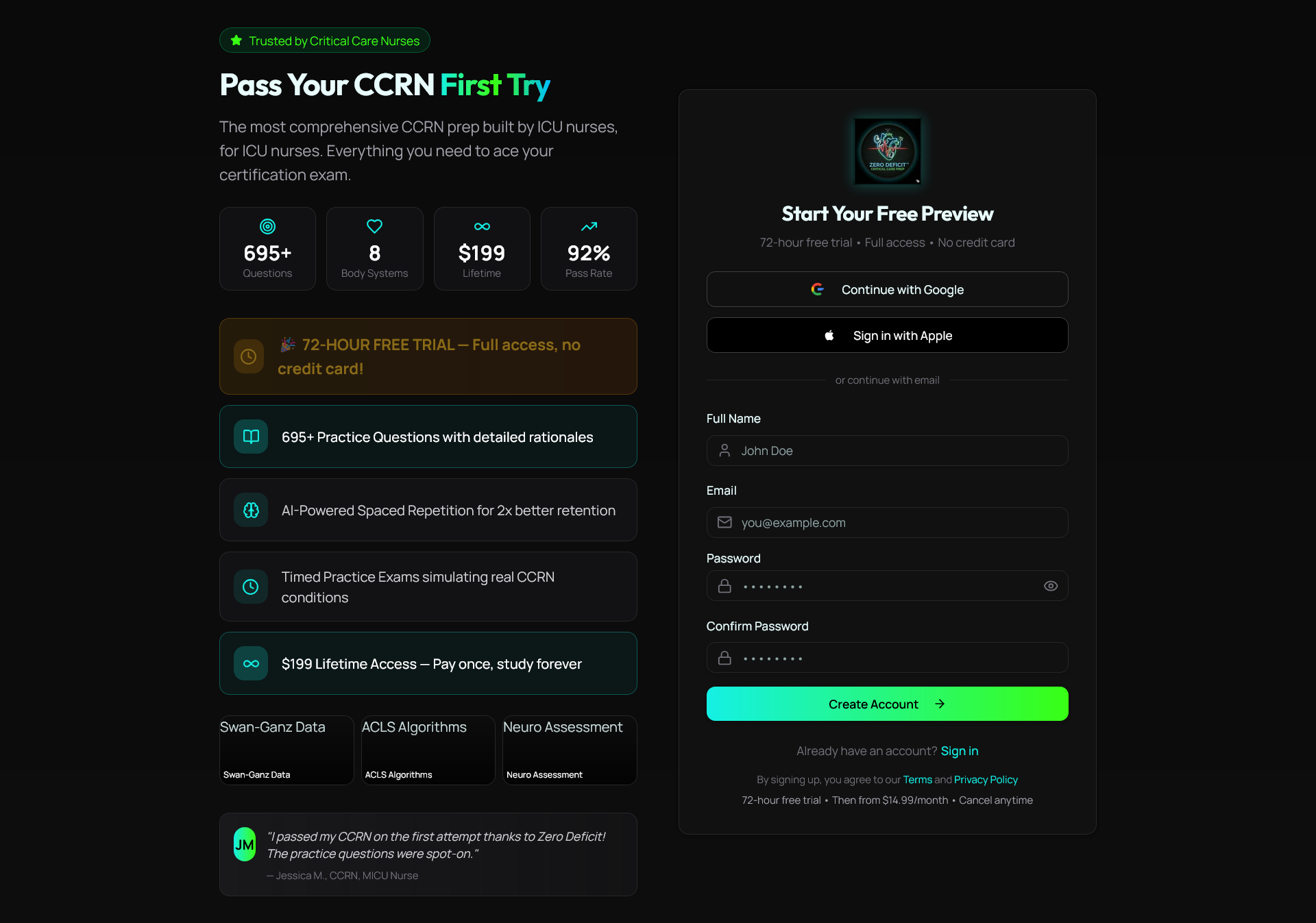
This fits you well if you’re a new ICU grad building your first study plan, an RN with one to five years of ICU experience preparing for your first attempt, or a retaker who wants a more structured approach than a straight question dump. Our spaced repetition system and exam simulations are built to work the way the study habits above recommend: short, consistent sessions with rationale review built in, not a single long cram.
- Explore the full question bank and sample tests to see the format firsthand.
- Review our CCRN study guides by body system to pair content review with question practice.
- Check subscription options, including monthly, annual, and lifetime access plans.
Start with a trial, see how the rationales read, and build your routine from there.
FAQ
Is a question bank better than a CCRN review book?
A question bank and a review book serve different purposes, and most successful candidates use both. A book builds your foundational understanding of a topic, while a question bank, especially one with strong rationales, trains you to apply that knowledge the way the exam actually tests it.
How many practice questions should I complete before the CCRN exam?
There’s no single number that guarantees a pass, since retention matters more than raw volume. A bank with 600 or more questions, like the AACN Premium subscription, gives you enough range to cover every content area multiple times without excessive repetition.
Should I use the official AACN practice exam or a third-party question bank?
Use both, but for different reasons. The official AACN practice exam calibrates you to the real test’s style and interface, while a third-party bank with detailed rationales gives you the daily volume and spaced repetition needed to build retention.
What changed with the CCRN exam in 2026?
AACN launched revised CCRN certification exams on November 12, 2025, with updated test plans reflecting current critical care practice. Candidates preparing now should confirm their study materials reflect this updated test plan rather than older exam blueprints.
How do I know if a question bank’s rationales are good enough?
A strong rationale explains the underlying physiology or guideline behind the correct answer, not just which choice is right. If you read an explanation and come away understanding a concept better than before, like why a normal central venous pressure sits within a typical clinical range and what a deviation suggests, the rationale is doing its job.
Recommended
Take a Respiratory practice quiz
Master ARDS, ventilation, ABGs, oxygenation, and pulmonary emergencies.
Get Your Free 20-Question CCRN Diagnostic
20 high-yield CCRN-style questions across every body system, with detailed rationales — emailed to you instantly.
No spam. One email + a couple of helpful follow-ups. Unsubscribe anytime.
Ready to pass your CCRN?
Join 12,000+ nurses using Zero Deficit — 695+ practice questions with rationales, AI-powered weak-area drilling, and spaced-repetition flashcards.
Start Free Trial →