Best Hemodynamics Courses for Nurses: How to Choose

By Zero Deficit Critical Care Prep
If you are an ICU nurse who wants hemodynamics to finally click and you are heading toward the CCRN, the best course is the one that makes you reason through cases and then tests you on them. That means a structured hemodynamics curriculum with scenario-based questions, rationales and spaced review. Zero Deficit™ CCRN Exam Prep is built that way for the Adult CCRN, and a live or hospital-based course can sit beside it for hands-on monitoring skills.
This guide compares the main types of hemodynamics learning open to US nurses, tells you what each does well, and shows how to pick based on where you are: new ICU grad, nurse with a few years at the bedside, or retaker.
TL;DR
- Hemodynamics is a reasoning skill: you read pressures, flow and the patient together, then decide on fluids, pressors or inotropes. Choose a course that makes you practice that, not one that only shows waveforms.
- Three kinds of learning are open to you: hospital or university courses, your unit’s orientation material, and exam-focused prep. Each covers a different part of the job.
- For CCRN, exam-style practice questions with detailed rationales and spaced repetition turn knowledge into points.
- Zero Deficit™ gives you 695+ practice questions, AI-powered review, a hemodynamics guide and a cardiovascular study guide, from $14.99 per month or $84.99 per year.
Table of Contents
- What a good hemodynamics course should teach
- The main options for nurses compared
- How to choose based on where you are
- A study plan that actually builds hemodynamic reasoning
- What a hemodynamics course does not replace
- Our perspective
- Start with the plan that fits your timeline
- FAQ
- Sources
What a good hemodynamics course should teach
Hemodynamic monitoring means measuring the pressures and flow of the cardiovascular system, usually with an arterial line, central venous catheter, pulmonary artery catheter or less invasive cardiac output device, so you can detect and treat instability early. Vanderbilt University Medical Center’s cardiovascular ICU orientation manual states that nurses in that unit must have a proficient understanding of cardiac anatomy, physiology and hemodynamics. It walks through the same building blocks you will meet on the CCRN: preload, afterload, contractility, arterial line monitoring and CVP waveform interpretation.
Use that list as your yardstick. A course worth your time should cover:
- The determinants of cardiac output. Cardiac output is heart rate times stroke volume. Stroke volume depends on preload, afterload and contractility. If you can say which of the three is off in a given patient, you can predict what a drug will do.
- Setting up and trusting your numbers. The Vanderbilt manual describes leveling the transducer to the phlebostatic axis and zeroing to atmosphere. A wrongly leveled transducer gives a wrong number, and a wrong number drives a wrong decision.
- Waveform interpretation. Arterial line waveforms, CVP waveforms and, where your unit uses them, PA catheter tracings. The same manual lists a normal CVP of 2 to 8 mmHg.
- Shock states. Hypovolemic, cardiogenic, distributive and obstructive shock each have a recognizable hemodynamic profile. You should be able to look at a set of numbers and name the shock.
- Therapy. Fluids, vasopressors, inotropes and vasodilators, with the targets and the reason for each choice.
- Normal values. Know your reference ranges cold, including the units. Always check them against your facility’s policy and current references.
A course that stops at items 1 to 3 leaves you able to read a monitor but not to act on it. The CCRN tests items 4 to 6 constantly, usually as a short clinical scenario with four plausible answers.
The main options for nurses compared
The market for hemodynamics education is a patchwork. Rather than rank products you may never meet, it is more useful to compare the types, because most nurses end up combining two of them.
| Option | Best for | What you get | Where it falls short for the CCRN |
|---|---|---|---|
| Zero Deficit™ CCRN Exam Prep | ICU RNs preparing for the Adult CCRN | Hemodynamics guide, cardiovascular study guide, 695+ practice questions with detailed rationales, AI-powered review, flashcards, spaced repetition, progress tracking, exam simulations | Built around the Adult CCRN exam, so it does not replace hands-on competency sign-off at your hospital |
| Hospital or university continuing-education course (example: UC Davis Health) | Nurses who want instructor-led case discussion and a defined session | Principles, monitoring indications, drug therapy, normal values and case scenarios | Typically a set session rather than a question bank you can repeat daily |
| Unit orientation manuals and preceptor teaching (example: Vanderbilt CVICU) | New hires learning their own unit’s devices and policies | Unit-specific setup, waveforms and protocols | Tied to one unit’s equipment and not organized as exam practice |
Zero Deficit™ CCRN Exam Prep
If your goal is the CCRN, this is our pick, and it is the one we built. The platform pairs study guides by system and topic, written by expert ICU nurses, with a bank of more than 695 practice questions. Every question comes with a detailed rationale, so a miss becomes a lesson instead of a score.
For hemodynamics specifically, you can start with our hemodynamic monitoring guide for CCRN and then move into the cardiovascular study guide, which sits with the rest of the blueprint’s cardiovascular content. From there the shock guide and the guide to vasoactive drips and MAP 65 targets connect the numbers to the drugs.
What sets it apart from a one-time course is the learning loop: AI-powered review tools, spaced repetition, progress tracking, personalized question generation and exam simulations. You see which areas pull your score down and the platform brings them back before you forget them. Many members report passing on their first attempt.
Hospital and university courses
UC Davis Health runs Hemodynamic Monitoring: Principles and Patient Management, a course covering hemodynamic principles, monitoring indications, drug therapy and normal values, taught with case scenarios. Its page lists 2026 to 2027 sessions, so check it for current dates, format and registration, because schedules and fees change.
A course like this suits you if you learn best from an instructor and live discussion. Put it next to question-based practice and you cover both understanding and exam performance.
Your own unit’s orientation
Orientation material such as the Vanderbilt CVICU manual teaches what your hands will actually do: which catheter, which monitor, which unit policy. If your hospital shares its orientation packet or runs a hemodynamics class, take it. It teaches the equipment you use daily. It does not try to be a question bank, so pair it with practice for the exam.

How to choose based on where you are
You are a new ICU grad
Your first six to twelve months are about safe bedside monitoring. Lean on your preceptor and your unit’s orientation for transducer setup, line care and alarm limits. Start the study guides early so the vocabulary is familiar: preload, afterload, SVR, stroke volume variation. Zero Deficit™ lets you build the foundation system by system without committing to an exam date.
You have one to five years in the ICU and a test date in mind
This is the reader we write for. You can already run a drip and read an art line. What the CCRN asks is why: why a patient in septic shock with a low SVR needs a vasoconstrictor, and why the same drug would hurt a patient in cardiogenic shock with high afterload. Work through practice questions with rationales, then use the question breakdown methods to practice pulling the real question out of a long scenario.
You are retaking the exam
A retake needs diagnosis before more content. Look at which categories dragged your score down, then drill those. Progress tracking and spaced repetition are made for this: you stop rereading what you already know and spend the hours where points were lost.
You are a student, educator or nurse building skills
If you are on a critical care rotation or teaching one, the study guides and topic pages work as supplemental reading. Start with the high-yield topic guides for shock, vasopressors and sepsis.
A study plan that actually builds hemodynamic reasoning
Taking a course is not the same as being able to use it. This six-step sequence is how we suggest you turn any hemodynamics content into exam performance.
- Anchor on the formulas. Write cardiac output, MAP and SVR in your own words and tie each to a bedside sign. If you can explain why a vasodilated patient has a low SVR and cool or warm skin as the case may be, the formula is doing its job.
- Study the shock profiles as a table. One row per shock type, columns for preload, contractility, afterload, cardiac output and the first-line treatment. Fill it from memory, then check.
- Attach drugs to numbers. For every vasoactive drip, know the receptor effect, the hemodynamic effect and the target. Our vasoactive drip guide lays this out for the CCRN.
- Add rhythm and ECG context. Hemodynamics rarely stands alone on the exam. Use the arrhythmia flowchart and our guide to reading ECGs for CCRN so a rate or rhythm change connects to cardiac output.
- Do questions in short, frequent sets. Twenty questions a day with the rationales read carefully beats a weekend marathon. Flag every miss and note whether it was a knowledge gap or a misread.
- Simulate the exam. Closer to your test date, run timed simulations so the pacing and fatigue are familiar.
What a hemodynamics course does not replace
A course teaches principles. It does not sign you off on your hospital’s equipment, and it does not replace your facility’s policies or a preceptor watching you zero a transducer. For the CCRN, it also does not provide the volume of scenario questions you need to get comfortable with the exam’s style. The most efficient path is a course or orientation for the hands-on piece, and question-based prep for the exam.

The CCRN you are preparing for is the adult exam. If you are weighing other credentials, our guide to the types of critical care certifications explains how they differ, and our overview of the role of nurses in the ICU shows where hemodynamic skills fit in daily practice.
Our perspective
Most nurses we talk to about hemodynamics do not lack exposure. They have seen the numbers on a hundred patients. What they lack is a reliable way to move from “I recognize this” to “I can explain this under exam pressure.”
That gap is why Zero Deficit™ is built around practice questions with detailed rationales, written by expert ICU nurses. A rationale does the teaching that a lecture cannot: it shows you why the right answer is right and why each distractor is tempting. Add AI-powered review and spaced repetition and the weak spots come back until they are not weak any more.
The name says what we aim for: no deficit between what you know and what the exam asks. If you take one course for hands-on skills, take it. Then make Zero Deficit™ the place where that knowledge becomes a pass.
Zero
Start with the plan that fits your timeline
Zero Deficit™ offers three ways in: Premium Monthly at $14.99 per month, Yearly Access at $84.99 per year, and Lifetime Mastery. A free trial is available so you can see the question style and rationales first. Pick monthly if your test is close, yearly if you want a steady runway of study, and see the subscription page for current plan details.
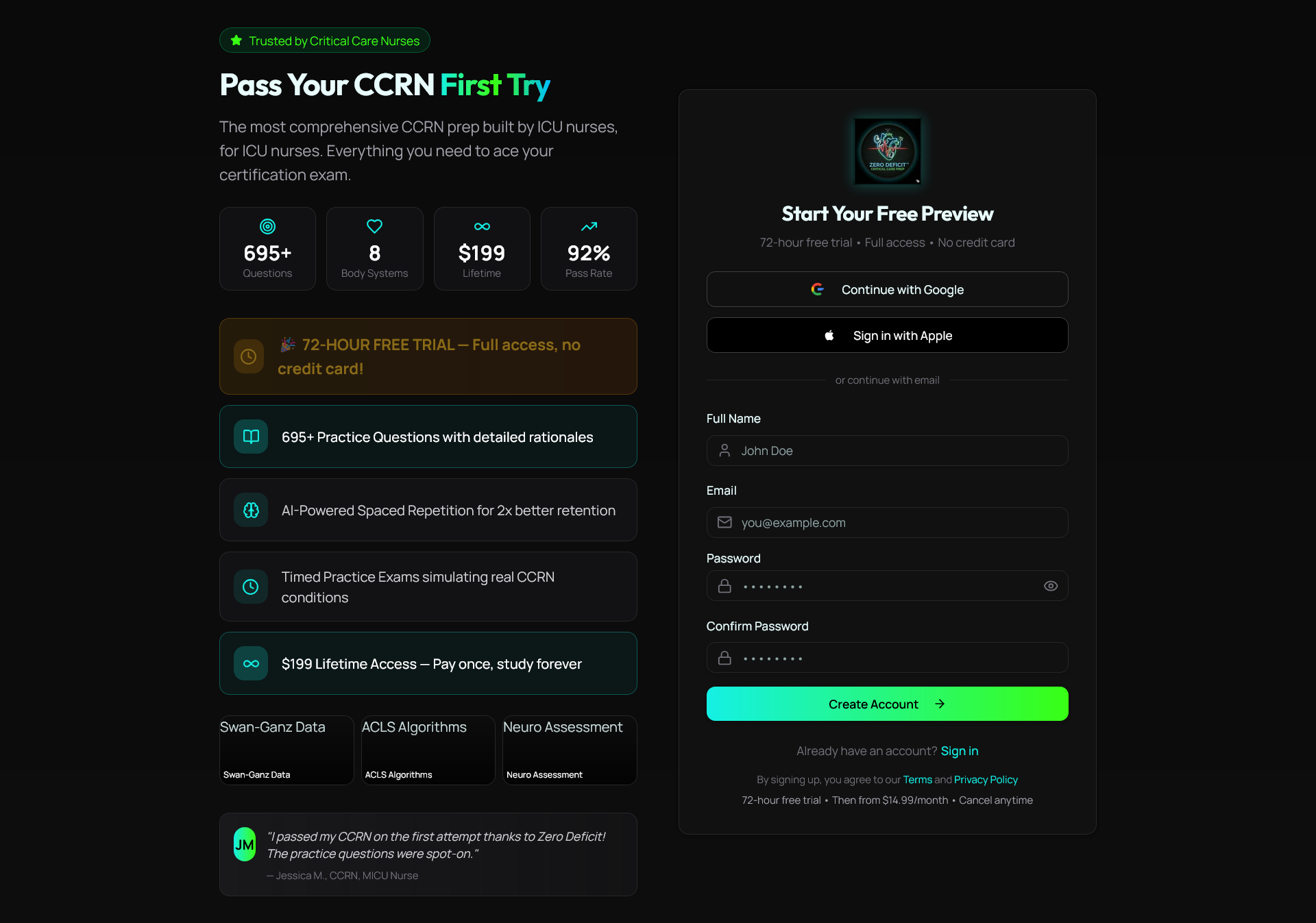
If you want to try before you commit, the CCRN practice quiz is a quick way to see where your hemodynamics stands today.
FAQ
What is hemodynamic monitoring in nursing?
It is the measurement of pressures and flow in the cardiovascular system, using tools such as arterial lines, central venous catheters and pulmonary artery catheters. The goal is to detect and treat instability early. Nurses use the readings, along with the patient’s exam, to guide fluids, vasopressors and inotropes.
Is there an online or continuing-education course in hemodynamics for nurses?
Yes. Health systems and universities offer them, such as the UC Davis Health hemodynamic monitoring course, which covers principles, drug therapy and normal values with case scenarios. Check the course page for current sessions, format and fees before you register.
Do I need a hemodynamics course to pass the CCRN?
Not as a separate requirement, but you do need to understand hemodynamics well, because it threads through cardiovascular, pulmonary, shock and sepsis questions. Study guides plus rationale-based practice questions cover it in exam format. Our hemodynamic monitoring guide is a good starting point.
How should I start assessing hemodynamics at the bedside?
Secure a correctly leveled and zeroed transducer first, since the Vanderbilt CVICU manual describes leveling to the phlebostatic axis and zeroing to atmosphere. Then read the numbers together with the patient’s perfusion, urine output, mentation and skin. Follow your unit’s policy and escalate per your facility’s protocol.
Ready to turn hemodynamics into points? Start with Zero Deficit™ CCRN practice questions and see the rationale behind every answer.
Sources
- Hemodynamic Monitoring: Principles and Patient Management, UC Davis Health
- Cardiovascular Intensive Care Orientation Manual, Vanderbilt University Medical Center (2022)
Recommended
Take a Cardiovascular practice quiz
Test your mastery of hemodynamics, ACLS, MI, arrhythmias, and heart failure.
Get Your Free 20-Question CCRN Diagnostic
20 high-yield CCRN-style questions across every body system, with detailed rationales — emailed to you instantly.
No spam. One email + a couple of helpful follow-ups. Unsubscribe anytime.
Ready to pass your CCRN?
Join 12,000+ nurses using Zero Deficit — 695+ practice questions with rationales, AI-powered weak-area drilling, and spaced-repetition flashcards.
Start Free Trial →