CCRN Question Bank Updates: What Changed and What to Check

The Adult CCRN exam changed on Nov. 12, 2025, so a question bank is only as useful as its match to the current test plan. When a bank says “updated,” check three things: the content weights, the generic medication names, and whether the rationales teach clinical judgment. Below is what changed, how to test any bank against it, and how to study with the Zero Deficit™ CCRN question bank.
TL;DR
- AACN launched revised CCRN exams for all three populations on Nov. 12, 2025, based on its 2024 study of practice.
- The Adult exam is 150 multiple-choice items in 3 hours: 125 scored and 25 unscored pretest items. It is weighted 80% Clinical Judgment and 20% Professional Caring and Ethical Practice.
- “Updated” has no standard meaning. The only useful definition is a bank that maps to the current blueprint and uses current references.
- AACN is moving to generic drug names only, so you may still see both generic and trade names on test day.
- Our 695+ question bank has rationales on every item, spaced repetition, and progress tracking, so you can see whether your misses line up with the blueprint.
Table of Contents
- What actually changed in November 2025
- The current Adult CCRN blueprint in one table
- What “updated” should mean on a question bank
- A 20-minute blueprint check for any bank
- Why a bigger question count is not the goal
- Where to put your questions by blueprint section
- Practice exams are practice, not prediction
- Promo: practice with the blueprint in view
- Our perspective
- FAQ
- Sources
What actually changed in November 2025
AACN announced that updated CCRN exams for Adult, Pediatric, and Neonatal would go live on Nov. 12, 2025. The change follows the 2024 National Practice Analysis. A task force met in September 2023 and built a survey of 78 nursing action statements and 142 patient care problem statements for adults. Of 2,337 usable responses, 1,383 came from adult-population nurses. Each exam item is then validated against at least one evidence-based reference on the exam bibliography, and a committee sets the cut score.
Two points from AACN’s own announcement matter for how you study:
- The test plans go through a consensus process with a national task force, are analyzed by AACN’s psychometrician, and are approved by the certification board.
- AACN notes that current CCRN study materials remain relevant and useful for anyone testing on or after Nov. 12, 2025.
So a 2024 study guide is not trash, and you do not need to restart. You need to rebalance. The physiology you learned for hemodynamics, vent management, and DKA has not changed. What shifted is how the exam is weighted and framed, so your question practice should follow the same weights.
The current Adult CCRN blueprint in one table
The AACN CCRN Exam Handbook publishes the test plan for exams taken on or after Nov. 12, 2025. Here is how it breaks down:
| Category | Weight |
|---|---|
| Clinical Judgment (total) | 80% |
| Cardiovascular | 13% |
| Respiratory | 12% |
| Endocrine, Hematology/Immunology, GI, Renal/GU, Integumentary | 21% |
| Musculoskeletal, Neurological, Behavioral/Psychosocial | 18% |
| Multisystem | 16% |
| Professional Caring and Ethical Practice | 20% |
The 20% category covers advocacy and moral agency, caring practices, clinical inquiry, collaboration, facilitation of learning, response to diversity, and systems thinking. That is the Synergy Model territory many ICU nurses skim because it feels less “clinical.” One question in five comes from it. If your bank has no ethics or Synergy items, it is leaving a fifth of your score unpracticed.
Two things stand out in the numbers:
- Cardiovascular is not the biggest slice. Nurses who spend most of their time on shock, ACS, and drips often over-study the 13%. The combined endocrine, heme/immune, GI, renal, and integumentary block is 21%. Neuro, musculoskeletal, and behavioral questions add up to 18%.
- Multisystem is 16%. These are the patients who do not fit one organ system: sepsis with MODS, for example. A bank that sorts questions only by single body system can hide this.
What “updated” should mean on a question bank
Anyone can type “updated for 2026” on a product page. The label does not tell you which parts changed. Here is what a genuinely current bank does, and what you can verify yourself.
It follows the blueprint weights
AACN’s How to Prepare for the CCRN Exam page tells candidates to use the test plan in the Exam Handbook, which assigns each content area a percentage weight, to self-assess and plan study time in proportion to topic weight. Apply the same logic to a bank. Tally your practice by category. If 40% of your questions are cardiovascular, the bank is not mirroring the exam, or you are choosing only the topics you already like.
It uses current references
The same AACN page points you to the Exam Bibliography, the list of references item writers use to validate correct answers. It also recommends a critical care textbook published within the last five years for lab values and medications. A rationale that cites a guideline from a decade ago is a red flag for any bank. When a rationale states a target, such as a vasopressor threshold or an ARDS ventilation goal, confirm it against current AHA, SCCM, or textbook guidance published in 2020 or later.

It handles drug names the way the exam does
The Exam Handbook says AACN is transitioning to generic medication names only in exams and practice products, and that candidates may still see both generic and trade names during the transition. Practically, you should know that norepinephrine is what the exam wants, and also recognize the brand names you hear at the bedside. Learn both, then drill with generic names.
Its rationales teach the why
The exam is built on clinical judgment, so a bank that only tells you the right letter trains recall, not reasoning. You want a rationale that explains why the right answer is right, why each distractor is wrong, and what the priority is. We go deeper on this in the role of exam rationales in CCRN success and in our guide to CCRN questions with rationales.
A 20-minute blueprint check for any bank
You do not need a spreadsheet degree. Use this routine on whatever bank you are studying with.
- Take 50 consecutive questions across mixed topics, not one system.
- Tag each question with the blueprint category it belongs to: cardiovascular, respiratory, the 21% block, the 18% block, multisystem, or professional caring.
- Compare your tally with the table above. A rough match is what you want. A large gap means you need to choose questions by category yourself.
- Flag any rationale that names a drug by brand only, or cites a threshold you cannot match to a current reference.
- Log your misses by blueprint category, not by topic you remember. This shows where points are actually leaking.
Our platform tracks progress and uses spaced repetition, so missed concepts come back on a schedule instead of depending on your memory of what went wrong. Step 5 gets far easier when the software does the logging.
Why a bigger question count is not the goal
Search results for this topic lean on headline numbers: 500+, 850+, 1,000+, 1,100. Volume matters less than coverage and rationale quality. You can only meaningfully review so many questions with full rationales before the exam. If you study 10 to 12 weeks and complete 40 questions a day on three or four days a week, a few hundred well-reviewed items is plenty, provided you actually study each rationale. The balance of the work is reading, not clicking.
A workable pattern for ICU nurses coming off 12-hour shifts:
- Shift days: 15 to 20 questions in one topic, reviewed the same day.
- Days off: one timed mixed set of 50 or more, then 45 minutes of rationale review and a short study guide pass on your weakest category.
- Last two weeks: full-length simulations that match the exam’s 3-hour, 150-item format, so you build stamina for the real thing.
If you need a calendar, our 12-week CCRN study plan and our piece on managing study time for the CCRN lay out the weeks.
Where to put your questions by blueprint section
Here is how to read the table as a study plan, with the topics ICU nurses ask about most.
Cardiovascular (13%). Hemodynamics, shock states, ACS, arrhythmias, and titratable drips. Practice interpreting numbers and predicting the intervention, not reciting definitions.
Respiratory (12%). ARDS, ventilator settings and alarms, and ABG interpretation. Work ABGs as a repeatable steps routine until you can do them without notes.
The 21% block. Endocrine emergencies such as DKA, HHS, and adrenal crisis, plus renal and CRRT, GI bleeding, and hematology/immunology. It is a broad set of topics, and it is the section most candidates under-prepare because no single topic feels heavy.
The 18% block. ICP management, stroke, seizures, and behavioral and psychosocial issues like delirium and withdrawal.
Multisystem (16%). Sepsis, MODS, and patients with several failing systems. The reasoning here is prioritization: which problem do you treat first?
Professional Caring and Ethical Practice (20%). Advocacy, ethics, collaboration, and the Synergy Model. Read each stem for the patient’s or family’s needs and the nurse’s role.
Our study guides by body system and high-yield topic guides are organized so you can pair a weak category with the matching review in one sitting.
Practice exams are practice, not prediction
No question bank, ours included, predicts your score. Treat bank percentages as a trend line over several weeks rather than a verdict on any single set. A rising average on mixed, timed sets with clean rationale review is the signal that matters. Track it by blueprint category, and let that, not a single good day, tell you when to book your test.
If you want a method for the questions themselves, our question breakdown methods walk through reading a stem, finding what is being asked, and eliminating distractors.

Promo: practice with the blueprint in view
The Zero Deficit™ CCRN platform gives you 695+ practice questions with detailed rationales, study guides by system and topic, flashcards, spaced repetition, exam simulations, and AI-powered review tools, with personalized question generation and progress tracking so you can see where your misses cluster. Our questions and guides were created by expert ICU nurses. Premium Monthly is $14.99 per month and Yearly Access is $84.99 per year. Lifetime Mastery is also offered, and a free trial is available. See the subscription options to pick the one that fits your test date.
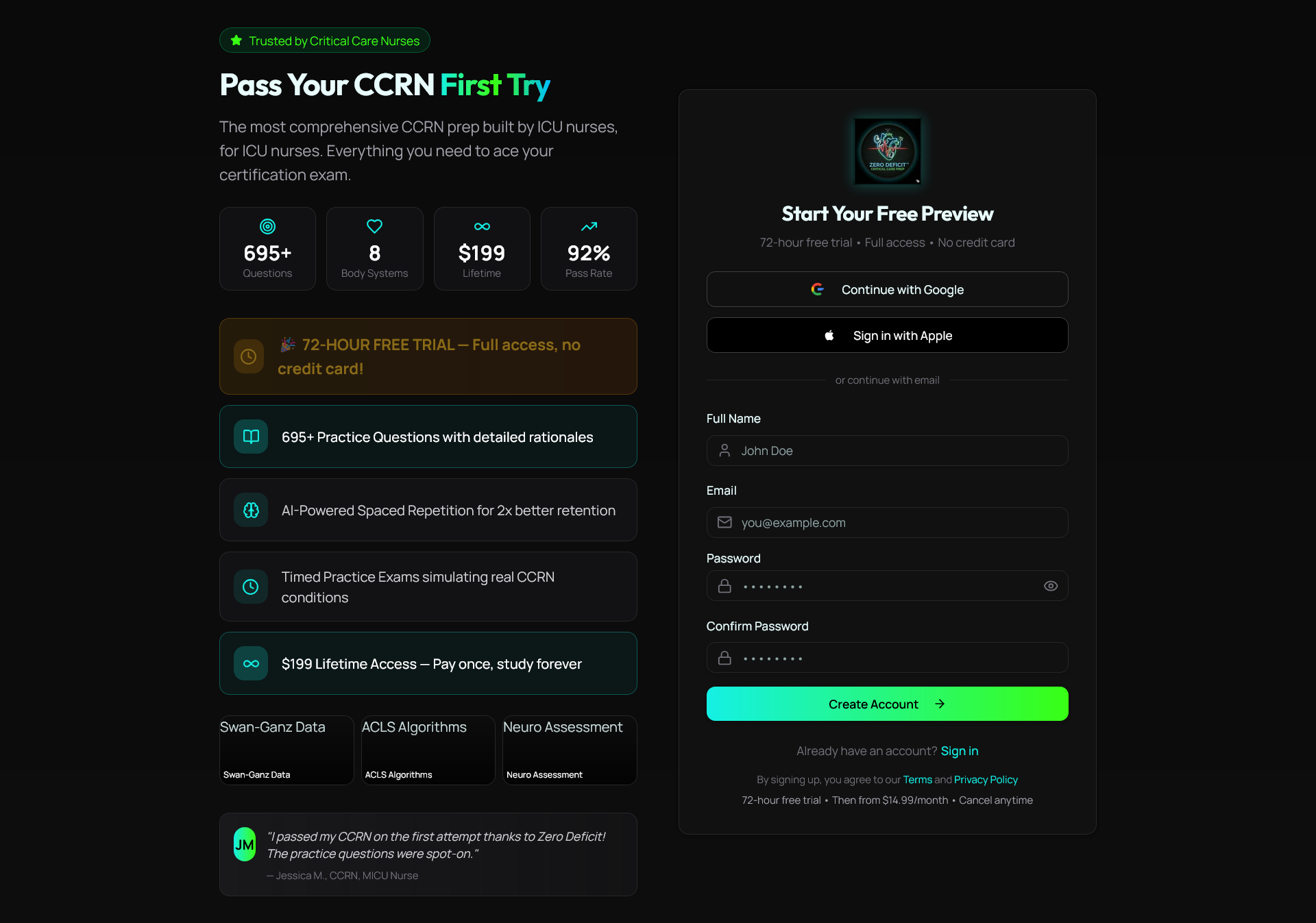
If you want to start with the questions themselves, the 695+ CCRN practice questions page is the place to begin, and our practice tests by body system let you target one category at a time.
Our perspective
Most nurses ask us whether a bank is “current.” We would rather you ask a sharper question: does this practice make me better at the decisions the exam tests?
The Nov. 12, 2025 change was a reminder that the exam follows what critical care nurses actually do. The test plan comes from a practice analysis, and the exam rewards clinical judgment far more than memorized lists. That is why we build around rationales. Each of our 695+ questions explains the reasoning, because when you understand why a map target or a vent change makes sense, you can answer a question you have never seen.
We also built spaced repetition, progress tracking, and AI-powered review into the platform because ICU nurses study in fragments: twenty minutes before a shift, an hour after. Missed concepts should come back to you without you having to remember to chase them. Our study guides, written by ICU nurses, give you a place to go when a rationale reveals a gap.
Use the blueprint as your map, the rationales as your teacher, and your own miss log as your honest feedback. That combination is how a candidate walks in with no deficit left to close.
Zero
FAQ
How often should a CCRN question bank be updated?
There is no fixed schedule. The meaningful trigger is a new test plan, like the one AACN launched on Nov. 12, 2025. Between those, banks add or revise questions as references and guidelines change. Rather than counting update dates, check that the bank matches the current weights and uses current references.
Do I need to throw out my old CCRN study materials?
No. AACN states that current CCRN study materials remain relevant and useful for candidates testing on or after Nov. 12, 2025. Keep your notes, then rebalance practice to the new weights, add Professional Caring and Ethical Practice questions, and practice with generic drug names.
How many questions are on the Adult CCRN exam?
The exam has 150 multiple-choice items over 3 hours. Of those, 125 are scored and 25 are unscored pretest items, and you will not know which are which. Treat every question as if it counts.
Where do I find the official CCRN test plan?
The test plan, with its content-area percentages, is in the AACN CCRN Exam Handbook. AACN also publishes an Exam Bibliography listing the references used to validate correct answers. Use the handbook to set study time and a current critical care textbook for lab values and medications.
Ready to put the blueprint into practice? Start with the Zero Deficit™ CCRN practice questions and review every rationale.
Sources
- Revised CCRN Certification Exams Launch Nov. 12, 2025 (AACN)
- CCRN Exam Handbook, Direct Care (AACN)
- 2024 National Practice Analysis of Critical Care Nurses (AACN)
- How to Prepare for the CCRN Exam (AACN)
Recommended
Take a Hematology practice quiz
Test your DIC, transfusion, anticoagulation, and coagulopathy skills.
Get Your Free 20-Question CCRN Diagnostic
20 high-yield CCRN-style questions across every body system, with detailed rationales — emailed to you instantly.
No spam. One email + a couple of helpful follow-ups. Unsubscribe anytime.
Ready to pass your CCRN?
Join 12,000+ nurses using Zero Deficit — 695+ practice questions with rationales, AI-powered weak-area drilling, and spaced-repetition flashcards.
Start Free Trial →