CCRN Shock: Master Every Type for the 2026 Exam
TL;DR:
- Shock is described as sudden circulatory failure leading to insufficient tissue perfusion and oxygen delivery. The CCRN exam emphasizes identifying shock types through hemodynamic patterns and selecting appropriate interventions promptly. Mastery involves understanding hemodynamic profiles, matching treatments to each shock, and practicing pattern recognition to improve crucial decision-making skills.
Shock is defined as acute circulatory failure resulting in inadequate tissue perfusion and oxygen delivery to meet cellular metabolic demands. On the CCRN exam, shock content spans the cardiovascular and multisystem domains, which together account for roughly 31% of scored questions. The cardiovascular domain alone covers 17% of exam content, making shock one of the highest-yield topics you will face. Mastering CCRN shock means more than memorizing definitions. You need to read hemodynamic patterns, select the right vasoactive agent, and prioritize interventions under time pressure. This guide gives you exactly that.
What types of shock are tested on the CCRN exam?
The CCRN exam tests four shock classifications: hypovolemic, cardiogenic, distributive, and obstructive. Each has a distinct pathophysiology and a recognizable hemodynamic fingerprint. Your job is to identify which type you are dealing with before you select an intervention.

Hypovolemic shock results from volume loss, whether from hemorrhage, burns, or severe dehydration. The body compensates by increasing heart rate and SVR, but preload falls. Cardiogenic shock is pump failure. The heart cannot generate adequate output despite adequate or elevated filling pressures. This is the shock type most associated with acute MI, severe cardiomyopathy, and acute valvular dysfunction.
Distributive shock covers three subtypes. Septic shock is the most common ICU presentation. Neurogenic shock follows spinal cord injury above T6 and presents with bradycardia alongside hypotension, which distinguishes it from every other shock type. Anaphylactic shock triggers massive histamine release, causing vasodilation and increased capillary permeability. Obstructive shock blocks forward flow mechanically. Tension pneumothorax, cardiac tamponade, and massive pulmonary embolism are the three causes you must know cold.
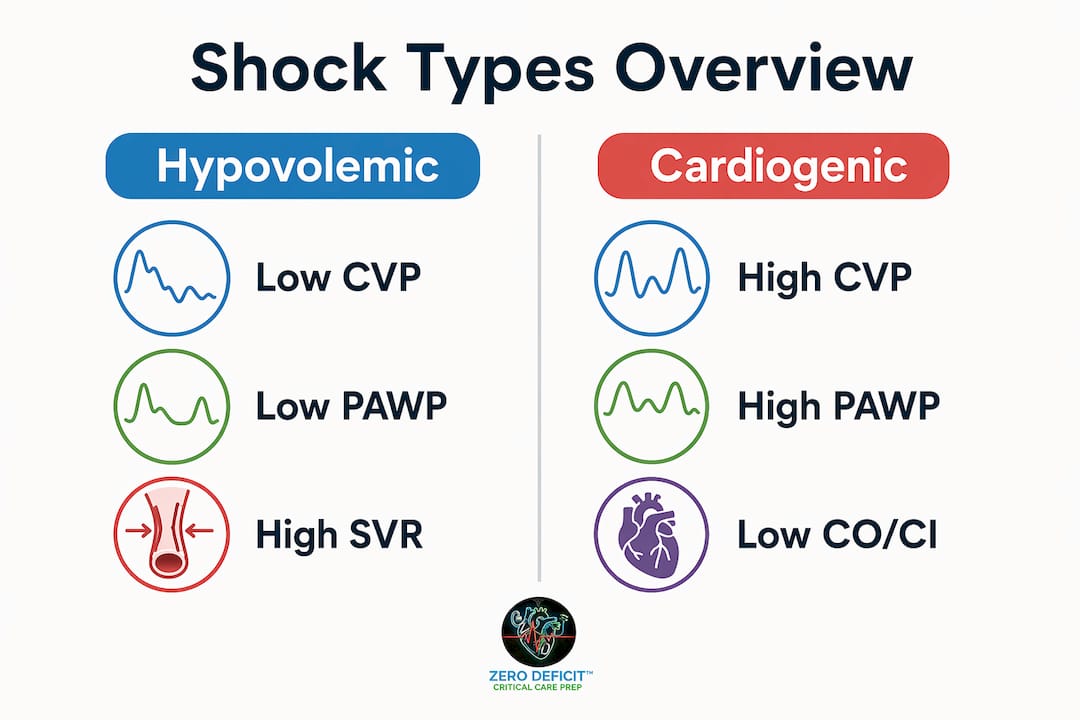
The table below summarizes the hemodynamic profiles that separate these shock states:
| Shock Type | CVP | PAWP | CO/CI | SVR | Key Cause |
|---|---|---|---|---|---|
| Hypovolemic | Low | Low | Low | High | Hemorrhage, burns |
| Cardiogenic | High | High | Low | High | Acute MI, cardiomyopathy |
| Septic (distributive) | Low | Low | High | Low | Gram-negative bacteremia |
| Neurogenic (distributive) | Low | Low | Low/Normal | Low | Spinal cord injury above T6 |
| Obstructive | High | Variable | Low | High | Tamponade, tension pneumothorax |
Pro Tip: Focus on the pattern of values, not individual numbers. A low CVP with low PAWP and high SVR tells a story. A high CVP with high PAWP and low CO tells a completely different one. Train your eye to read the whole picture.
How do you interpret hemodynamic parameters for shock?
Hemodynamic normal ranges form the baseline you compare every patient against. CVP runs 2–8 mmHg, PAWP 8–12 mmHg, CO 4–8 L/min, CI 2.5–4.0 L/min/m², and SVR 800–1,200 dyn·s/cm⁵. Deviations from these ranges, read together, define the shock state.
Consider this example: CVP of 2 mmHg, PAWP of 4 mmHg, CI of 1.9 L/min/m², and SVR of 1,800 dyn·s/cm⁵. Every preload marker is low, output is depressed, and the body has cranked up resistance to compensate. That is hypovolemic shock requiring volume. Now shift one variable: keep the low CO but raise the PAWP to 22 mmHg and the CVP to 14 mmHg. The pump is failing against a full tank. That is cardiogenic shock, and fluid is contraindicated.
Trend analysis matters as much as absolute values. A CVP rising from 4 to 10 mmHg over two hours while CO falls tells you the patient is not responding to resuscitation and may be developing tamponade or right heart failure. Single data points mislead. Serial values reveal the clinical trajectory.
The most common pitfall on the CCRN exam is overweighting one parameter. Candidates see a low CVP and immediately select fluid resuscitation without checking CO or SVR. In septic shock, CO is often elevated and SVR is low. Giving more fluid to a patient with a CI of 5.0 and SVR of 500 does not fix the problem. The vasculature is the problem.
Pro Tip: Practice interpreting sets of four values together: CVP, PAWP, CO/CI, and SVR. Zerodeficitccrnprep builds hemodynamic scenario questions that force you to synthesize all four before selecting an answer. That skill transfers directly to the exam.
What are the first-line treatments for each shock type?
Treatment selection follows directly from shock classification. Getting the type wrong means selecting the wrong intervention, which costs you points on the exam and harms patients at the bedside.
For hypovolemic shock, the priority is volume replacement. Isotonic crystalloids such as normal saline or lactated Ringer’s are first-line for non-hemorrhagic causes. Massive hemorrhage requires packed red blood cells and a balanced resuscitation strategy. Vasopressors are a bridge only, not a substitute for volume.
For septic shock, the Surviving Sepsis Campaign one-hour bundle defines the standard of care: measure lactate, obtain blood cultures before antibiotics, administer broad-spectrum antibiotics, give 30 mL/kg crystalloid for hypotension or lactate ≥4 mmol/L, and start vasopressors if MAP stays below 65 mmHg. Norepinephrine is first-line for septic shock vasopressor support. Dopamine carries a significantly higher risk of arrhythmias and is no longer preferred. Vasopressin is added as an adjunct to reduce norepinephrine requirements, not as a replacement.
For cardiogenic shock, the approach flips. Fluid loading worsens pulmonary edema when PAWP is already elevated. Dobutamine is the preferred inotrope when systolic BP is adequate, typically above 90 mmHg. It increases contractility and reduces afterload modestly. Dopamine may be used when hypotension is severe, but its arrhythmia risk remains a concern. Nitroglycerin reduces preload and afterload depending on dose, but it can worsen hypotension if used without adequate pressure support. The intra-aortic balloon pump (IABP) augments diastolic perfusion and reduces afterload mechanically, making it a key adjunct for cardiogenic shock refractory to medications.
For obstructive shock, the intervention is mechanical and immediate. Tension pneumothorax requires needle decompression followed by chest tube. Cardiac tamponade requires pericardiocentesis. Massive PE may require systemic thrombolytics or catheter-directed therapy. No vasopressor corrects a mechanical obstruction.
The prioritization sequence for any shock scenario follows this order:
- Confirm the shock type using hemodynamic data and clinical presentation.
- Address the underlying cause directly (volume, pump support, obstruction relief, source control).
- Start vasopressors or inotropes based on the hemodynamic profile, not habit.
- Reassess response within 30–60 minutes using serial hemodynamic values and clinical markers such as urine output and mental status.
- Escalate to device support (IABP, mechanical ventilation, CRRT) when first-line measures fail.
How do you prioritize interventions in CCRN shock scenarios?
The CCRN exam tests clinical judgment, not just recall. Exam distractors are designed to look clinically reasonable while steering you away from the most immediately life-threatening problem. Recognizing that pattern is a skill you build through practice.
The core rule is this: stabilize before you diagnose. A patient in cardiogenic shock with a BP of 70/40 mmHg needs dobutamine and hemodynamic support before you order an echocardiogram. The echo confirms what you already suspect. The vasopressor keeps the patient alive long enough to get it.
Common clinical judgment traps on shock questions include:
- Choosing a diagnostic test (CT scan, echo, Swan-Ganz insertion) before addressing hemodynamic instability
- Selecting fluid bolus for a patient with elevated PAWP and low CO
- Choosing dopamine over norepinephrine for septic shock without a specific indication
- Treating neurogenic shock with aggressive fluid resuscitation instead of vasopressors, which worsens bradycardia-driven hypotension
- Missing obstructive shock because breath sounds are present bilaterally (early tension pneumothorax can be subtle)
When you read a CCRN question, identify the most life-threatening problem in the stem first. Then eliminate answers that address secondary concerns. The correct answer almost always addresses circulation, airway, or the primary cause of hemodynamic collapse before anything else.
Pro Tip: Use the question breakdown method to strip each stem down to its core clinical problem. Identify the shock type, the hemodynamic pattern, and the most urgent threat. Then select your answer.
How do you build shock into your CCRN study plan?
A structured 10–12 week study plan aligned with the AACN blueprint gives shock content the proportionate attention it deserves. Cardiovascular and multisystem topics together represent nearly a third of your exam. Spreading that content across multiple weeks prevents overload and builds retention.
Here is how to integrate shock effectively:
- Weeks 1–2: Build your hemodynamic foundation. Memorize normal ranges for CVP, PAWP, CO, CI, and SVR. Practice reading four-value sets and naming the shock type.
- Weeks 3–4: Work through each shock classification with a flowchart. Zerodeficitccrnprep offers an interactive shock flowchart that maps hemodynamic patterns to interventions.
- Weeks 5–6: Focus on vasoactive drug indications. Know norepinephrine, dobutamine, dopamine, vasopressin, and nitroglycerin by mechanism, indication, and contraindication.
- Weeks 7–8: Add the Surviving Sepsis Campaign bundle and obstructive shock management. Practice applying these protocols in timed question sets.
- Weeks 9–12: Shift to full-length practice tests. Scoring 80% or above on timed practice tests is a reliable predictor of exam success. Review every missed shock question for the reasoning error, not just the correct answer.
Consistent, blueprint-aligned study outperforms cramming every time. Shock is a topic where synthesis matters more than memorization. You need to recognize patterns under pressure, and that only comes from repeated exposure to well-written practice questions with detailed rationales.
Key takeaways
Mastering CCRN shock requires integrating hemodynamic patterns, matching interventions to shock type, and prioritizing stabilization over diagnostics under exam pressure.
| Point | Details |
|---|---|
| Know all four shock types | Hypovolemic, cardiogenic, distributive, and obstructive each have distinct hemodynamic profiles. |
| Read values as a set | CVP, PAWP, CO/CI, and SVR together define the shock state; single values mislead. |
| Match the drug to the shock | Norepinephrine leads in septic shock; dobutamine leads in cardiogenic shock with adequate BP. |
| Stabilize before diagnosing | On the exam and at the bedside, hemodynamic support precedes confirmatory testing. |
| Study with a structured plan | A 10–12 week blueprint-aligned schedule builds the synthesis skills shock questions demand. |
What i’ve learned watching nurses struggle with shock questions
I have reviewed thousands of CCRN practice attempts, and shock questions reveal a consistent pattern. Nurses who struggle are not struggling because they lack knowledge. They struggle because they try to answer shock questions the same way they answer pharmacology questions: by matching a drug to a condition from memory.
Shock questions are pattern recognition questions. The exam gives you a hemodynamic set and a clinical picture, and it expects you to synthesize both before acting. The candidate who memorized “norepinephrine for septic shock” without understanding why will miss the question that presents septic shock with a CI of 5.5 and asks what to address first. The answer is not the vasopressor. It is the source.
The other mistake I see constantly is treating the IABP and dobutamine as interchangeable in cardiogenic shock. They are not. Dobutamine increases contractility chemically and works best when BP is adequate. The IABP augments coronary perfusion mechanically and reduces afterload without increasing myocardial oxygen demand. Knowing the mechanism tells you which to choose when the question gives you a BP of 78/50 mmHg.
My honest advice: stop studying shock as a list of facts. Study it as a clinical decision tree. Build the tree yourself on paper. Map each shock type to its hemodynamic profile, its first-line treatment, and its most common exam trap. Then test that tree with targeted practice questions until the pattern recognition becomes automatic. That is what separates a 78% score from a 90%.
— Zero
Practice shock questions that match the real exam
Shock content is where CCRN candidates gain or lose the most points. Zerodeficitccrnprep is built specifically to close that gap.
The platform’s 695+ practice questions include high-yield shock and hemodynamic scenarios with detailed rationales that explain the reasoning behind every answer. You will not just see what is correct. You will understand why the other three options are wrong. The shock, vasopressors, and sepsis topic guides give you focused review exactly where the exam blueprint puts the most weight. Start studying free at Zero Deficit CCRN Prep today, no credit card required, and find out exactly where your shock knowledge stands before exam day.
FAQ
What is shock on the CCRN exam?
Shock on the CCRN exam is defined as acute circulatory failure causing inadequate tissue perfusion. The exam tests your ability to identify shock type from hemodynamic data and select the correct intervention.
How many shock types does the CCRN exam cover?
The CCRN exam covers four shock classifications: hypovolemic, cardiogenic, distributive (septic, neurogenic, anaphylactic), and obstructive. Each type has a distinct hemodynamic profile and treatment approach.
What hemodynamic values should i know for CCRN shock questions?
Normal ranges are CVP 2–8 mmHg, PAWP 8–12 mmHg, CO 4–8 L/min, CI 2.5–4.0 L/min/m², and SVR 800–1,200 dyn·s/cm⁵. Deviations from these ranges, read together, identify the shock state.
Which vasopressor is first-line for septic shock on the CCRN exam?
Norepinephrine is the first-line vasopressor for septic shock according to the Surviving Sepsis Campaign guidelines. Dopamine is avoided due to its higher arrhythmia risk.
How do i avoid common mistakes on CCRN shock questions?
The most common error is choosing a diagnostic test before stabilizing the patient. Always address the most immediate hemodynamic threat first, then confirm the diagnosis with testing once the patient is stable.
Recommended
Take a Multisystem practice quiz
Master sepsis, shock, MODS, and multi-organ failure scenarios.
Get Your Free 20-Question CCRN Diagnostic
20 high-yield CCRN-style questions across every body system, with detailed rationales — emailed to you instantly.
No spam. One email + a couple of helpful follow-ups. Unsubscribe anytime.
Ready to pass your CCRN?
Join 12,000+ nurses using Zero Deficit — 695+ practice questions with rationales, AI-powered weak-area drilling, and spaced-repetition flashcards.
Start Free Trial →