High-Yield Topics for CCRN Exam Prep: 2026 Guide
High-yield topics are the content areas that appear most frequently on certification exams and deliver the greatest return on your study time. For the Adult CCRN, that means cardiovascular hemodynamics, pulmonary mechanics, neurological emergencies, sepsis, and the AACN Synergy Model carry far more exam weight than obscure pharmacology details you might spend hours memorizing. Knowing which topics to prioritize is not a shortcut. It is a clinical decision about where to invest limited prep time for maximum impact.
How do you identify them? Three criteria matter most:
- Exam frequency: Topics that appear repeatedly across the AACN CCRN blueprint by system weighting
- Clinical relevance: Concepts you apply at the bedside daily, such as interpreting a PA catheter waveform or titrating a vasopressor
- Multidisciplinary integration: Topics that connect multiple body systems, like sepsis-induced MODS, which tests cardiovascular, renal, and pulmonary knowledge simultaneously
Two common pitfalls derail even experienced nurses. The first is spending hours on low-frequency details while skimming the cardiovascular section. The second is passive review: rereading notes and highlighting text creates a feeling of familiarity, not actual mastery. Passive review leads to familiarity rather than true mastery, which directly decreases exam performance.

What are the top high-yield topics by CCRN domain?
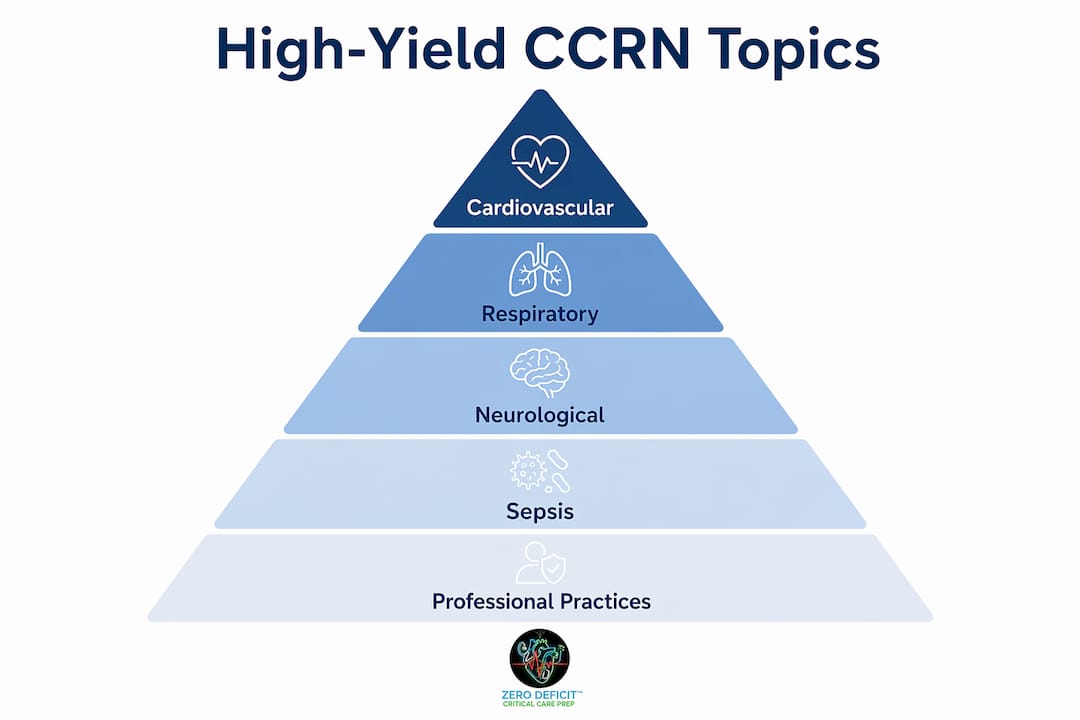
The AACN Adult CCRN exam weights content by body system and professional caring practices. The table below maps the highest-priority domains to their core testable concepts.

| Domain | Top High-Yield Concepts |
|---|---|
| Cardiovascular | Hemodynamic monitoring, shock states, ACS management, vasopressors/inotropes, dysrhythmias |
| Pulmonary | ARDS, mechanical ventilation modes, ABG interpretation, weaning criteria, pneumothorax |
| Neurological | ICP management, stroke (ischemic vs. hemorrhagic), status epilepticus, sedation scales |
| Sepsis/MODS | Sepsis-3 criteria, fluid resuscitation, vasopressor selection, organ failure progression |
| Renal | AKI staging (KDIGO criteria), CRRT indications and troubleshooting, electrolyte emergencies |
| Endocrine | DKA vs. HHS, thyroid storm, adrenal crisis, glucose management in critical illness |
| Synergy Model & Ethics | Patient advocacy, moral distress, end-of-life decision-making, family-centered care |
A few of these domains deserve extra attention because they integrate multiple systems. Sepsis is the clearest example: a single CCRN question on septic shock can simultaneously test your knowledge of MAP targets, lactate clearance, norepinephrine dosing, and renal perfusion. That cross-disciplinary integration is exactly what makes a topic high-yield.
Key concepts within each priority domain:
- Hemodynamics: Normal PCWP, CVP, CO, and SVR ranges important for assessment
- ARDS: Berlin Definition criteria, P/F ratio indicating impaired oxygenation, lung-protective ventilation parameters
- ICP: Normal ICP range, CPP targets, and use of hyperosmolar therapy with mannitol or hypertonic saline
- Sepsis-3: SOFA score components, qSOFA criteria, norepinephrine as first-line vasopressor per guidelines
- DKA: Diagnostic criteria including anion gap, glucose levels, bicarbonate levels, and insulin protocol
Topics like basic anatomy or isolated pharmacology mnemonics rarely appear as standalone questions. Your time is better spent on the integrated clinical scenarios above.
Which study strategies actually work for high-yield content?
Practice testing and distributed practice received the highest utility ratings in cognitive psychology meta-analyses, outperforming every passive technique studied. That finding holds directly for high-stakes certification exams like the CCRN.
Here is what the evidence supports:
- Active recall: Close your notes and write out everything you know about, say, cardiogenic shock. This “blurting” technique forces retrieval and immediately shows you what you actually know versus what you think you know.
- Spaced repetition: Reviewing CCRN content at intervals rather than in one marathon session produces far more durable memory. Apps like Anki automate the spacing schedule.
- Interleaved practice: Mix cardiovascular questions with pulmonary and neuro questions in the same session. It feels harder than blocked practice, but that difficulty is the point. Interleaving trains your brain to discriminate between similar presentations, which is exactly what CCRN questions demand.
- The Feynman Technique: Pick a concept like ARDS pathophysiology and explain it out loud as if you are teaching a new grad. Where you stumble is where your knowledge has gaps.
- Self-explanation: After answering a practice question, explain why each wrong answer is wrong. This goes beyond memorizing the right answer and builds the clinical reasoning the CCRN tests.
Statistic callout: Distributed practice is one of the most replicated findings in cognitive psychology. Spacing your study sessions over weeks rather than cramming the night before consistently produces better retention on high-stakes exams.
What does not work: rereading your notes three times, highlighting entire paragraphs, and watching video lectures without pausing to self-test. These methods feel productive but build recognition, not retrieval. On exam day, the CCRN does not ask you to recognize a concept. It asks you to apply it under pressure.
Pro Tip: After every practice session, sort your wrong answers by domain. If you miss three consecutive questions on mechanical ventilation, that is your next high-yield study target, not a topic you already scored well on.
A quick note on common exam prep misconceptions: many nurses assume that more hours studying equals better results. The research says otherwise. Focused, active sessions of 45–60 minutes with deliberate retrieval practice outperform three-hour passive review blocks every time.
What resources support high-yield CCRN mastery?
The right resources do more than cover content. They force you to retrieve it, apply it, and confront your weak spots before exam day does.
- Question banks with detailed rationales: A question bank is only as good as its explanations. You need to understand why the correct answer is correct and why the distractors are wrong. Zerodeficitccrnprep offers over 695 practice questions with rationales written by expert ICU nurses, aligned directly to the AACN exam blueprint.
- Curated high-yield topic guides: Broad textbooks cover everything. High-yield guides cover what the exam actually tests. Zerodeficitccrnprep’s topic guides for shock, vasopressors, and sepsis are built around AACN content weighting, not general critical care education.
- Spaced repetition apps: Anki is the most widely used free option. Build decks by domain, use images of waveforms and rhythm strips, and let the algorithm schedule your reviews.
- Annotated study guides: A good study guide is not a textbook summary. It connects pathophysiology to clinical presentation to nursing intervention in one place. Zerodeficitccrnprep’s system-based study guides are structured this way, covering all eight body systems tested on the Adult CCRN.
- Expert video tutorials: Short, focused videos work best when you pause and self-test after each segment rather than watching passively. Pair any video with a follow-up question set on the same topic.
Balancing resources matters. Spending the majority of your prep time on cardiovascular content because it is the largest blueprint section makes sense. Ignoring endocrine emergencies entirely because they feel low-yield does not. DKA and thyroid storm appear on the exam, and a single missed question in a tight score range costs you. Use a structured exam readiness workflow to allocate time proportionally across all domains, not just the ones you feel confident about.
Ready to test your high-yield knowledge?
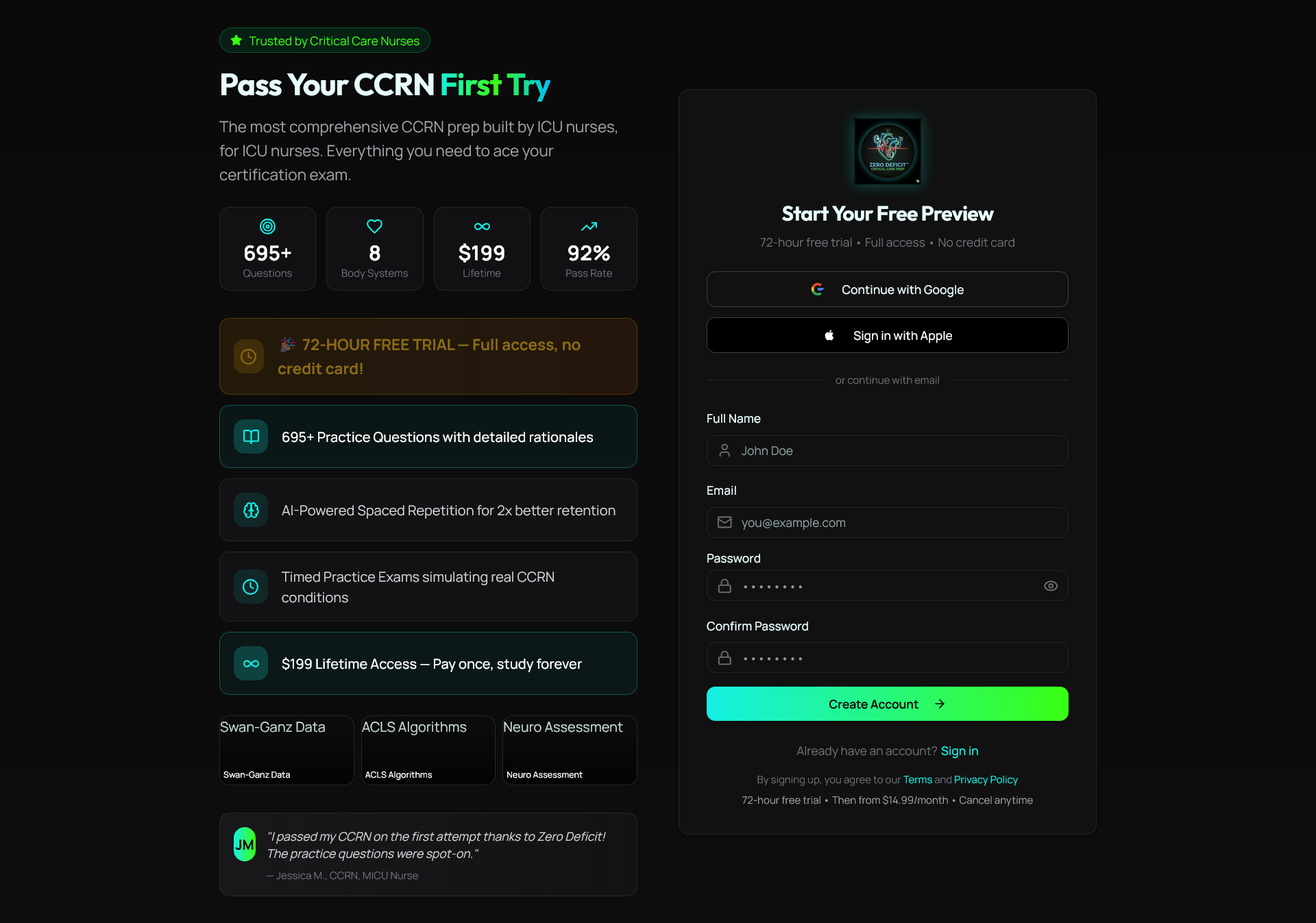
You have the framework. Now put it to work. Zerodeficitccrnprep’s CCRN practice tests cover all eight body systems with questions built around the exact high-yield concepts this guide covers: hemodynamics, ARDS, ICP, sepsis, CRRT, and the Synergy Model. Every question includes a detailed rationale so you are not just checking answers. You are building the clinical reasoning the CCRN demands. Start your practice session today at ZeroDeficitCCRNPrep.com.
Key Takeaways
High-yield topics are the highest-frequency, highest-impact content areas on the CCRN, and mastering them through active recall and spaced repetition is the most evidence-backed path to passing.
| Point | Details |
|---|---|
| Define high-yield correctly | High-yield topics appear most frequently on exams and offer the greatest return on study time. |
| Prioritize by blueprint weight | Cardiovascular, pulmonary, sepsis, and neuro carry the most CCRN exam weight per the AACN blueprint. |
| Active recall beats passive review | Practice testing and distributed practice outperform rereading and highlighting for long-term retention. |
| Use rationale-based question banks | Explaining why wrong answers are wrong builds clinical reasoning, not just answer recognition. |
| Balance depth with breadth | High-yield focus guides your time, but ignoring lower-weight domains entirely creates gaps that cost points. |
FAQ
What does “high-yield” mean for exam prep?
High-yield topics are content areas that appear most frequently on an exam and deliver the greatest return on study time. Focusing on them lets you allocate effort where it has the most impact on your score.
What are the most high-yield topics on the Adult CCRN?
Cardiovascular hemodynamics, ARDS and mechanical ventilation, sepsis management, neurological emergencies (ICP and stroke), and the AACN Synergy Model consistently represent the largest portions of the CCRN blueprint.
What does high-yield really mean in practice?
It means a topic is both frequently tested and clinically integrated, appearing across multiple question types rather than in isolation. Sepsis, for example, tests cardiovascular, renal, and pulmonary knowledge in a single scenario.
How should you study high-yield topics most effectively?
Practice testing and distributed practice are the two highest-utility techniques identified in cognitive psychology research. Use question banks daily, space your review sessions over weeks, and self-test before re-reading notes.
Can you focus only on high-yield topics and skip the rest?
No. High-yield lists are roadmaps, not the complete territory. Ignoring lower-frequency domains entirely creates knowledge gaps that surface on integrated clinical questions, where a single scenario may draw from three or four body systems at once.
Recommended
- CCRN High-Yield Topic Guides | Shock, Vasopressors, Sepsis | Zero Deficit™
- Top CCRN study topics to master for exam success | Zero Deficit CCRN Prep
- Step by Step Exam Review for the CCRN: 2026 Guide | Zero Deficit CCRN Prep
- 2026 Trends in Critical Care Certification You Must Know | Zero Deficit CCRN Prep
Take a Multisystem practice quiz
Master sepsis, shock, MODS, and multi-organ failure scenarios.
Get Your Free 20-Question CCRN Diagnostic
20 high-yield CCRN-style questions across every body system, with detailed rationales — emailed to you instantly.
No spam. One email + a couple of helpful follow-ups. Unsubscribe anytime.
Ready to pass your CCRN?
Join 12,000+ nurses using Zero Deficit — 695+ practice questions with rationales, AI-powered weak-area drilling, and spaced-repetition flashcards.
Start Free Trial →