How to Retain Nursing Concepts: 12 Proven Methods
TL;DR:
- Mastering active recall and spaced repetition is crucial for passing nursing exams on the first try, as passive rereading does not promote long-term memory. Consistent, focused study sessions and clinical frameworks like ABCs and ADPIE help nurses prioritize and retain critical care concepts effectively. Using visual aids, mnemonics, simulation, and peer teaching further deepens understanding and prepares students for real-world clinical decision-making.
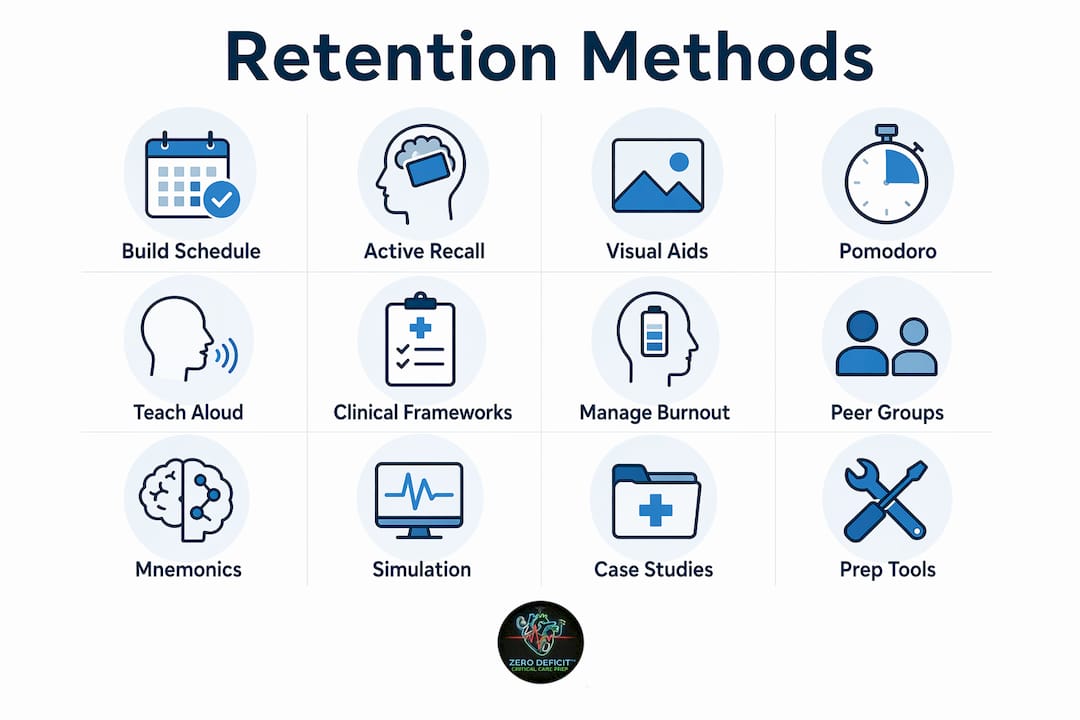
Knowing how to retain nursing concepts separates nurses who pass on the first attempt from those who keep rereading the same pages without progress. The most effective methods are active recall, spaced repetition, concept mapping, the Feynman Technique, the Pomodoro Technique, clinical frameworks like ABCs and ADPIE, mnemonics, peer study groups, and simulation practice. Passive rereading builds familiarity, not memory. Your brain needs to retrieve information under pressure, not just recognize it on a page.
Quick-reference methods that actually work:
- Active recall: Close your notes and test yourself out loud or on paper
- Spaced repetition: Review material at increasing intervals (Day 1, 3, 7, 14, 30)
- Concept maps: Link diagnoses to symptoms, interventions, and medications visually
- Feynman Technique: Teach the concept aloud; where you stumble is where you study next
- Pomodoro Technique: 25 minutes focused, 5 minutes off, longer break after four cycles
- Clinical frameworks: ABCs and ADPIE as lenses for every prioritization question
- Peer study groups: Structured discussion with application-based questions
- Mnemonics: Tailored memory cues for high-yield critical care content
1. Build a consistent study schedule
Consistent daily sessions of 1–2 hours outperform infrequent marathon blocks for long-term retention. Quality and regularity matter more than total hours logged.
- Time-block by subject: cardiovascular one day, pulmonary the next
- Start reviewing 5–7 days before each exam, not the night before
- Reserve one day per week to revisit older material
- Tackle the hardest topics early in the week when focus is sharpest
Pro Tip: Assign Monday and Tuesday to high-yield CCRN topics like hemodynamics and sepsis, then use Friday for spaced review of the previous week’s content.
2. Use active recall and spaced repetition
Active recall and spaced repetition significantly improve retention compared to passive rereading. Forcing your brain to retrieve information strengthens the neural pathways you need during a high-stakes exam.
- Close your notes and write everything you remember from scratch
- Use flashcard apps like Anki or Quizlet with spaced intervals built in
- Practice NCLEX-style questions throughout your prep, not just before finals
- Review rationales for every question, including the ones you got right
3. Apply visual aids to complex material
Concept maps engage elaborative encoding, connecting new clinical knowledge to existing mental frameworks and making retention more durable. Start with a central diagnosis like heart failure, then branch outward to pathophysiology, assessment findings, medications, and patient education.
- Use color-coded charts for cardiac rhythms and pharmacology classes
- Draw flowcharts for physiological processes like the renin-angiotensin-aldosterone system
- Animated videos and color-coded visuals improve engagement and memory, especially for complex topics
- Redraw diagrams from memory to test visual recall
4. Use the Pomodoro Technique for focused sessions
The Pomodoro Technique prevents mental fatigue by breaking study into 25-minute focused intervals followed by 5-minute breaks. After four cycles, take a longer break to restore cognitive endurance.
- Set one topic per Pomodoro block: one round for ABGs, one for vasopressors
- Use the break to stand, hydrate, or do a quick stretch
- Avoid checking your phone during the 25-minute window
- Track completed cycles to gauge daily output honestly
5. Teach concepts aloud using the Feynman Technique
Teaching a concept out loud exposes gaps that rereading never reveals. If you cannot explain why dopamine causes vasoconstriction at high doses without looking at your notes, you do not know it well enough yet.
- Record yourself explaining a topic, then listen back for hesitations
- Explain concepts to a study partner as if they are a new grad
- Use simple language; if you reach for jargon to fill a gap, that is the gap
- Structured peer teaching moments in group sessions reinforce both sides of the explanation
6. Prioritize clinical frameworks for critical care retention
Frameworks like ABCs and ADPIE help you select the safest clinical option on exam questions and in practice. The AACN and ANA both emphasize these safety-first priorities as the foundation for clinical decision-making.
- Apply ABCs to every prioritization question before choosing an answer
- Use ADPIE to sequence nursing actions: assess before you intervene
- Recognize exam keywords: “priority,” “initial,” “best,” “most appropriate”
- Practice critical thinking in nursing by running clinical scenarios through these frameworks
7. Manage cognitive load and avoid burnout
Studying eight hours straight does not build retention. It builds fatigue. Distributed, focused sessions protect your working memory and keep information moving into long-term storage.
- Cap individual study blocks at 2 hours before a real break
- Sleep 7–8 hours per night; your brain consolidates memory during sleep
- Protect at least one low-intensity day per week
- Watch for signs of burnout: declining quiz scores, inability to concentrate, dread before opening your notes
8. Use peer study groups strategically
A structured study group accelerates retention because explaining your reasoning to another nurse forces you to organize what you know. The ANA notes that peer support and study groups are part of a healthy approach to nursing school success.
- Set a clear agenda before every session (“Tonight: sepsis bundle and vasopressors”)
- Quiz each other with application-based questions, not definitions
- Groups of 3–4 give everyone enough time to participate and explain reasoning
- Rotate who teaches each topic so everyone practices retrieval
9. Use mnemonics tailored to nursing concepts
Mnemonics work best when they are tied to clinical action, not just recall. A mnemonic that reminds you of the order of interventions is more useful than one that just lists symptoms.
- Use MONA (Morphine, Oxygen, Nitrates, Aspirin) for early MI management
- Apply the “ROME” rule for acid-base: Respiratory Opposite, Metabolic Equal
- Build your own mnemonics for high-yield CCRN topics like CCRN nursing mnemonics for vasopressors and drip titration
- Pair each mnemonic with a clinical scenario so the memory has context
10. Apply simulation-based learning and practice
Simulation puts concepts into clinical context, which is exactly how the CCRN exam tests them. Reviewing case studies and real-life scenarios cements the kind of pattern recognition the exam demands.
- Work through case-based questions: “This patient has a CI of 1.8 L/min/m² and a wedge of 22 mmHg. What is your first intervention?”
- Debrief every simulation by tracing your clinical reasoning step by step
- Use adaptive exam prep tools that adjust question difficulty based on your performance
- Treat each practice question set as a mini simulation, not a score to chase
11. Integrate case studies into your review
Case-based learning connects pathophysiology to clinical presentation in a way that isolated facts never do. A student who studies heart failure as a case, not a list, remembers crackles, S3, BNP elevation, and diuretic management as one connected picture.
- Pull cases from your ICU experience and map them to exam content
- Ask: What did the labs show? What was the intervention? What changed?
- Spaced repetition principles apply to case review too: revisit the same case days later and test your recall
12. How Zerodeficitccrnprep helps you retain critical care concepts
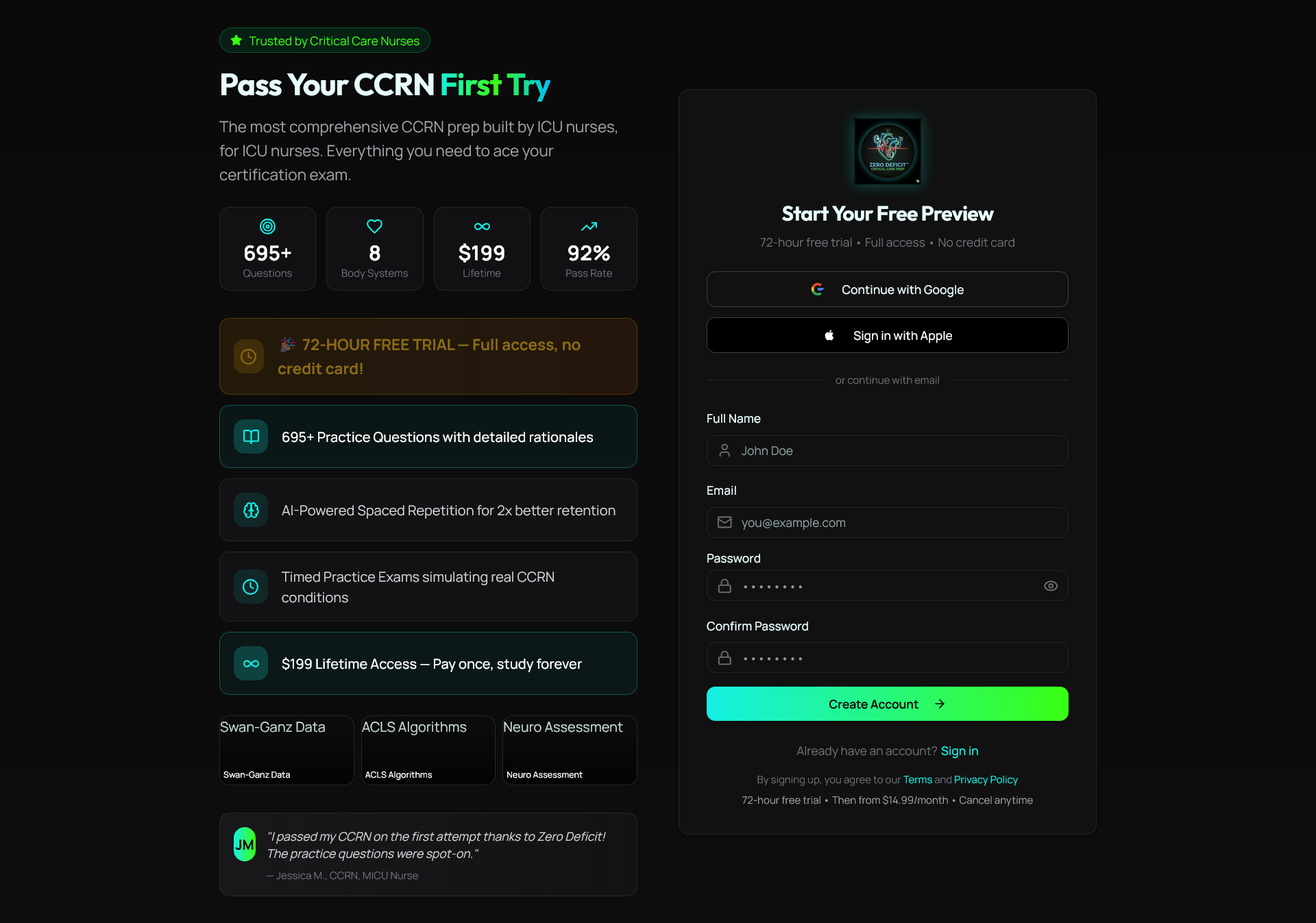
Zero Deficit™ CCRN Exam Prep is built specifically for ICU nurses preparing for the Adult CCRN. Every resource reflects how critical care nurses actually think, not how textbooks present information.
- Over 695 CCRN practice questions with detailed rationales that explain the clinical reasoning behind every answer
- AI-driven quizzes that identify weak areas and route you back to them using spaced repetition
- System-based study guides covering all eight body systems on the CCRN blueprint
- Mnemonics, visual aids, and clinical frameworks integrated throughout the content
- Built by experienced ICU nurse educators who know what the exam actually tests
Ready to lock in what you know and pass on your first attempt? Start with Zerodeficitccrnprep’s CCRN practice tests and find out exactly where your gaps are before exam day.

Key Takeaways
Active recall paired with spaced repetition is the single most effective combination for retaining nursing concepts, outperforming passive rereading in every measure of long-term memory.
| Point | Details |
|---|---|
| Active recall beats rereading | Testing yourself without notes builds the retrieval pathways exams demand. |
| Spaced repetition prevents forgetting | Review on Day 1, 3, 7, 14, and 30 to move content into long-term memory. |
| Clinical frameworks anchor reasoning | ABCs and ADPIE turn isolated facts into prioritized clinical decisions. |
| Consistent short sessions win | Daily 1–2 hour focused sessions outperform infrequent marathon study blocks. |
| Teaching exposes real gaps | Explaining a concept aloud reveals what you actually know versus what feels familiar. |
FAQ
How do you remember nursing concepts more effectively?
Active recall and spaced repetition are the most reliable methods. Test yourself without looking at your notes, then review the same material at increasing intervals over days and weeks.
What are the four key concepts of nursing?
The four metaparadigm concepts in nursing are person, environment, health, and nursing. These form the theoretical foundation that connects clinical practice to patient-centered care.
How do you study nursing concepts efficiently?
Study by system and clinical context, not by isolated facts. Use NCLEX-style practice questions daily, build concept maps for complex topics, and review rationales for every answer, right or wrong.
How often should I practice active recall for nursing exams?
Short sessions 3–5 days per week produce stronger retention than one long weekly session. Even brief self-quizzing per day builds the retrieval strength the CCRN and NCLEX require.
Recommended
- What Is Retention in Test Prep for CCRN Success | Zero Deficit CCRN Prep
- Why Certification Retention Matters for Critical Care Nurses | Zero Deficit CCRN Prep
- Nursing Mnemonics for CCRN: Top Picks That Actually Work | Zero Deficit CCRN Prep
- Body System Organization in Nursing Guides: 2026 Edition | Zero Deficit Blog
Take a Cardiovascular practice quiz
Test your mastery of hemodynamics, ACLS, MI, arrhythmias, and heart failure.
Get Your Free 20-Question CCRN Diagnostic
20 high-yield CCRN-style questions across every body system, with detailed rationales — emailed to you instantly.
No spam. One email + a couple of helpful follow-ups. Unsubscribe anytime.
Ready to pass your CCRN?
Join 12,000+ nurses using Zero Deficit — 695+ practice questions with rationales, AI-powered weak-area drilling, and spaced-repetition flashcards.
Start Free Trial →