What Is a Question Bank? A Guide for Exam Prep
TL;DR:
- A question bank is a structured collection of validated assessment items organized by topic, difficulty, and format.
- It enhances exam preparation by providing targeted, blueprint-aligned practice with detailed rationales and metadata.
A question bank is defined as a centralized, structured repository of pre-written and validated assessment items, categorized by topic, difficulty level, and question type. For ICU nurses preparing for the AACN Adult CCRN certification, understanding what a question bank is gives you a real edge. The best study tools are not random collections of questions. They are organized systems built to mirror exam blueprints, test specific cognitive skills, and give you reliable feedback on where you stand before test day.

What is a question bank and how is it structured?
A question bank is a structured repository that organizes every item by topic, subtopic, difficulty, cognitive skill level, and question format. That structure is what separates a useful study tool from a disorganized pile of practice items. Without it, you cannot target your weakest areas or confirm you have covered the full exam blueprint.
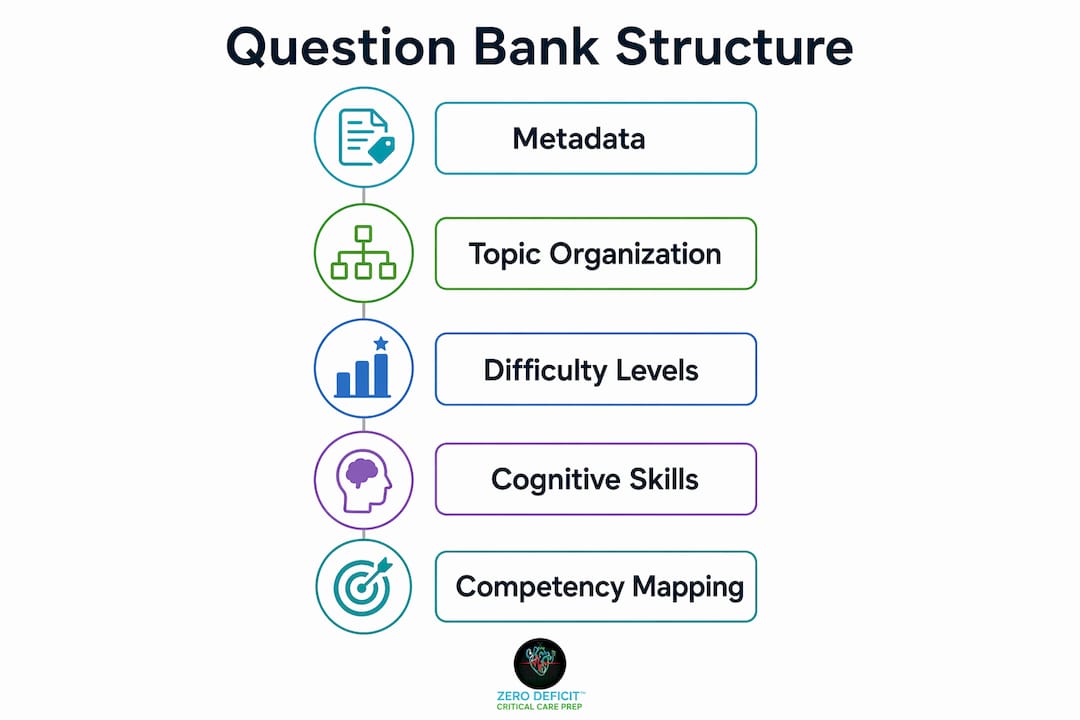
Each item in a well-built question bank carries metadata. That metadata includes the competency domain, learning objective, cognitive level (recall, application, analysis), and item difficulty. Metadata-tagged items enable sophisticated exam assembly with balanced content and valid outcomes. For CCRN prep, that means you can pull questions specifically on hemodynamics, vasopressors, or the Synergy Model without manually sorting through hundreds of items.
Naming conventions and hierarchical organization are just as critical as the tags themselves. Consistent naming codes for subjects, subtopics, and difficulty levels improve searchability and prevent large banks from becoming unmanageable. A question bank without clear taxonomy becomes a data graveyard fast.
Here is what a well-organized question bank structure includes:
- Topic and subtopic labels (e.g., Cardiovascular > Shock > Distributive)
- Cognitive level tags (recall, application, analysis, synthesis)
- Difficulty ratings (easy, moderate, hard)
- Question format identifiers (MCQ, true/false, case study)
- Competency domain alignment (mapped to AACN exam blueprint categories)
Pro Tip: When choosing a question bank for CCRN prep, confirm it maps directly to the current AACN Adult CCRN exam blueprint. A bank organized around the eight body systems tested on the exam saves you hours of guesswork.
What question formats and features do question banks include?
Question banks support multiple formats because different formats test different cognitive skills. A multiple choice question (MCQ) tests recognition and recall. A case study tests application and clinical reasoning. Using only one format leaves gaps in your preparation.
The most common formats found in question banks are:
- Multiple choice questions (MCQs): The dominant format on the CCRN exam, testing recall and application
- True/false items: Useful for reinforcing foundational concepts quickly
- Short answer questions: Test recall without answer choices to guide you
- Case studies: Present a clinical scenario and require multi-step reasoning
- Essay questions: Used in academic settings to assess synthesis and communication
Multimedia content such as videos, images, and clinical vignettes enhances engagement and simulates real clinical scenarios better than text-only questions. That matters for ICU nurses because the CCRN tests your ability to apply knowledge, not just memorize it. A question that shows you a waveform or a ventilator screen forces you to think the way you would at the bedside.
Advanced question bank platforms also support automated scoring and immediate feedback. That feedback loop is where real learning happens. You do not just see that you got a question wrong. You see why, with a rationale that explains the correct answer and the clinical reasoning behind it.
Pro Tip: Prioritize question banks that include detailed rationales for every answer choice, not just the correct one. Understanding why a wrong answer is wrong is often more valuable than confirming why the right answer is right.
How do question banks support certification exam integrity?
Question banks are the backbone of fair, secure, high-stakes certification exams. The AACN Adult CCRN exam draws from a large, validated item pool to generate unique question combinations for each candidate. Randomized exam generation assures exam security and proportional coverage of competency domains per the exam blueprint. No two candidates see the exact same exam, which reduces the risk of question sharing and cheating.
Exam integrity depends on four core practices:
- Randomized item selection: Each exam draws from the full bank to create a unique test for every candidate.
- Blueprint alignment: Questions are selected to match the percentage weighting of each competency domain on the official exam blueprint.
- Item retirement: Questions answered correctly by nearly all candidates, or missed by nearly all, are flagged for revision or removal.
- Audit trail documentation: Every question is mapped to a competency, creating a legally defensible record of exam validity.
Periodic item retirement based on performance data maintains content quality and exam validity over time. An item that everyone gets right is not measuring anything useful. An item that everyone gets wrong may be poorly written. Both need to go.
Question banks also provide legal defensibility by mapping questions to competencies and documenting validation processes. If a candidate disputes an exam result, that documentation supports the institution’s position. For AACN and similar certifying bodies, that accountability is non-negotiable.
Question banks range from simple spreadsheets to advanced platforms incorporating psychometric analysis and adaptive testing capabilities. The most sophisticated systems simulate the actual test interface and generate performance reports by domain. That level of analysis tells you exactly which CCRN content areas need more of your time.
How to use a question bank effectively for exam prep
Using a question bank well requires a plan. Sitting down and answering questions randomly is better than nothing, but it is not the most efficient path to passing the CCRN. Targeted, structured practice produces better results.
Here is how to get the most from a question bank:
- Start with a diagnostic pass. Answer 50–100 questions across all topics to identify your weakest domains before you build a study schedule.
- Practice by topic first. Focus on one content area at a time (e.g., cardiovascular, pulmonary) until you reach consistent accuracy before mixing topics.
- Simulate exam conditions. Use timed, randomized quizzes to replicate the pressure and pacing of the actual CCRN exam.
- Read every rationale. Even when you answer correctly, read the explanation. The reasoning behind the answer reinforces clinical understanding, not just test-taking skill.
- Track your performance by domain. Review your accuracy rates across AACN blueprint categories weekly and adjust your study focus accordingly.
Integrating practice question strategies into your weekly routine builds the kind of pattern recognition the CCRN rewards. The exam does not just ask what you know. It asks what you would do, and why. Regular question bank practice trains that clinical decision-making reflex.
Modern question banks for medical education are also moving toward professor-specific and specialty-specific designs, which means the questions you practice are increasingly aligned with the exact content and reasoning style of your target exam. For CCRN candidates, that specificity is a significant advantage over generic study tools.
Pro Tip: Schedule two to three question bank sessions per week, each 30–45 minutes long, rather than one long cramming session. Spaced repetition improves retention far more than volume alone.
Key Takeaways
A question bank is the most reliable study tool for certification exam prep when it is organized, metadata-tagged, and aligned with the official exam blueprint.
| Point | Details |
|---|---|
| Definition of question bank | A structured repository of validated assessment items organized by topic, difficulty, and format. |
| Metadata drives quality | Tags for cognitive level, competency domain, and difficulty enable targeted, blueprint-aligned practice. |
| Exam integrity depends on banks | Randomized item selection and periodic retirement keep certification exams fair and legally defensible. |
| Rationales accelerate learning | Reading explanations for every answer choice builds clinical reasoning, not just test-taking skill. |
| Structured practice beats volume | Targeted, domain-specific sessions with performance tracking outperform random question marathons. |
Why question banks changed how I think about CCRN prep
The first time I worked through a well-built question bank for CCRN prep, I realized something that most study guides do not tell you. The questions themselves are not the product. The rationales and the metadata are. A question that tells you the answer is “B” teaches you nothing. A question that explains why distributive shock produces a low SVR, a high CO, and a warm, flushed patient. That teaches you to think at the bedside.
I have seen ICU nurses with years of experience fail the CCRN because they studied the wrong content in the wrong proportion. The AACN blueprint weights cardiovascular at roughly 17% and pulmonary at roughly 15%. If your question bank does not reflect those weights, you are preparing for a different exam. Blueprint alignment is not a bonus feature. It is the baseline requirement.
The future of question banks in critical care education is moving toward adaptive testing, where the platform adjusts question difficulty in real time based on your performance. That technology already exists in high-stakes medical licensing exams. For CCRN prep, it means you will spend less time on content you already know and more time on the gaps that could cost you points on exam day.
My honest advice: treat your question bank as a diagnostic tool, not a scorecard. A low accuracy rate in a specific domain is not a failure. It is a map. It tells you exactly where to focus next. The nurses who pass on their first attempt are not the ones who answered the most questions. They are the ones who used their results to study smarter.
— Zero
Zerodeficitccrnprep: question bank-powered CCRN practice
Zerodeficitccrnprep was built by expert ICU nurses who know the AACN Adult CCRN blueprint inside and out. Every practice question is organized by body system, tagged by cognitive level, and paired with a detailed rationale that explains the clinical reasoning behind each answer.
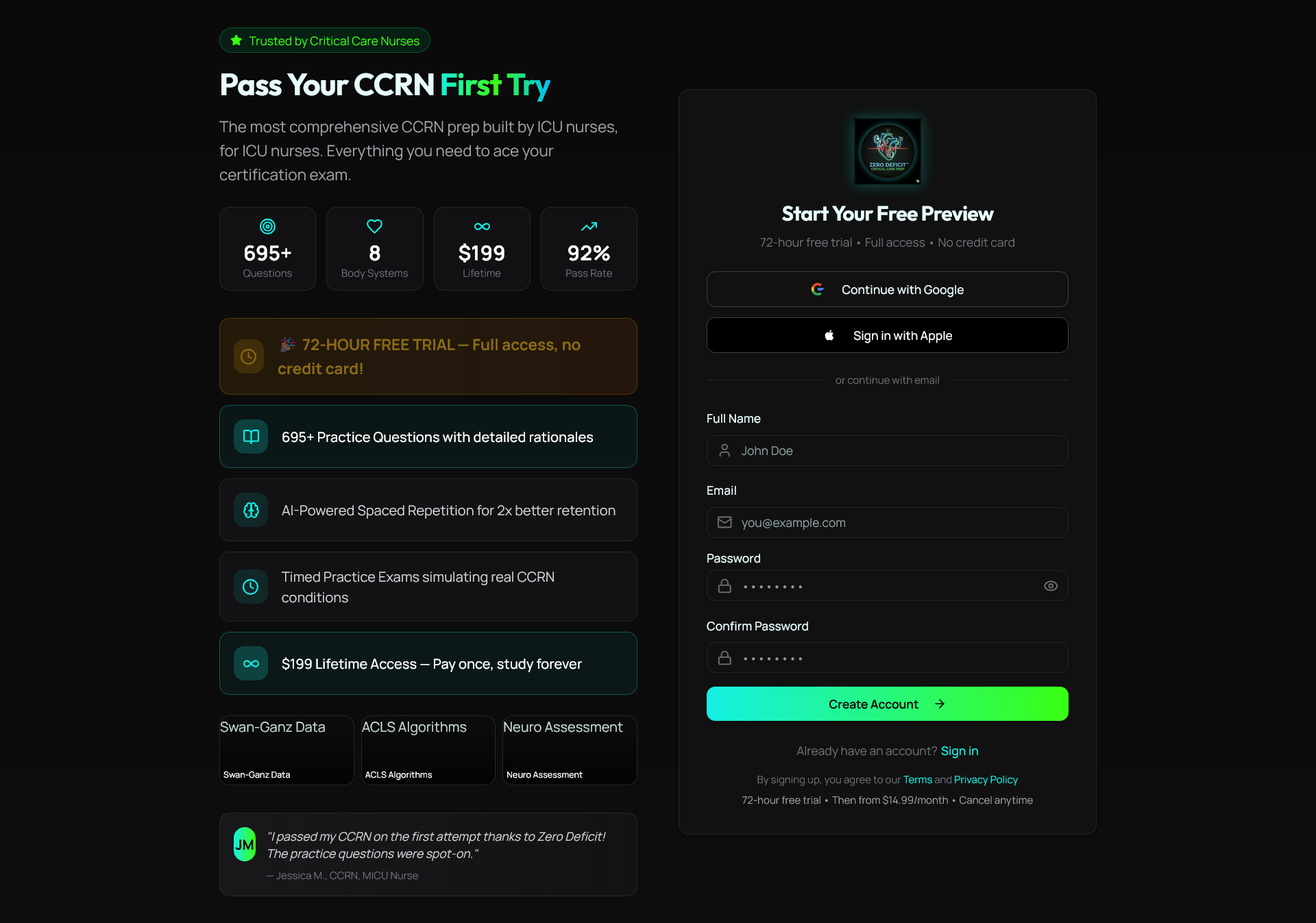
The platform’s 695+ CCRN practice questions cover all eight body systems tested on the exam, from cardiovascular hemodynamics and shock to renal, neuro, and the Synergy Model. Each session mirrors real exam conditions with timed, randomized question sets. You can also access CCRN study guides aligned with the same blueprint categories to reinforce what your practice results reveal. If you are serious about passing the CCRN on your first attempt, this is where you start.
FAQ
What is the definition of a question bank?
A question bank is a centralized repository of pre-written, validated assessment items organized by topic, difficulty, cognitive level, and question format. It is used to build exams efficiently and consistently.
What are question banks used for in healthcare certification?
Question banks power randomized, blueprint-aligned exams for certifications like the AACN Adult CCRN, ensuring each candidate receives a unique, fair assessment that covers all required competency domains.
What types of questions are found in a question bank?
Question banks include multiple choice questions, true/false items, short answer questions, case studies, and essay prompts, along with multimedia content like clinical images and scenario videos.
How does a question bank improve exam security?
Randomized item selection from a large validated pool means no two candidates see the same exam. Periodic item retirement based on performance data keeps the bank current and legally defensible.
How should students use a question bank for CCRN prep?
Start with a diagnostic quiz across all domains, then practice by topic using timed sessions. Read every rationale, track accuracy by AACN blueprint category, and adjust your study focus weekly based on your results. You can also review nursing certification exam formats to understand how question banks map to the actual test structure.
Recommended
Take a Multisystem practice quiz
Master sepsis, shock, MODS, and multi-organ failure scenarios.
Get Your Free 20-Question CCRN Diagnostic
20 high-yield CCRN-style questions across every body system, with detailed rationales — emailed to you instantly.
No spam. One email + a couple of helpful follow-ups. Unsubscribe anytime.
Ready to pass your CCRN?
Join 12,000+ nurses using Zero Deficit — 695+ practice questions with rationales, AI-powered weak-area drilling, and spaced-repetition flashcards.
Start Free Trial →