Adult CCRN Clinical Practice Certification Requirements 2026
TL;DR:
- The Adult CCRN requires extensive bedside clinical hours in high-acuity settings and an unencumbered RN license. The exam tests real-world ICU skills, focusing on multisystem and clinical reasoning domains through scenario-based questions. Effective preparation includes studying the AACN outline, practicing questions with rationales, and documenting hours accurately.
What are the clinical practice certification requirements for the Adult CCRN?
The Adult CCRN is administered by the American Association of Critical-Care Nurses (AACN) and is the gold standard credential for bedside ICU nurses in the United States. Before you schedule your exam, you need to confirm you meet every eligibility threshold. Here is what the certification prerequisites for clinicians actually look like:
- Clinical hours: A substantial amount of direct care hours caring for acutely or critically ill patients, including a significant portion completed within the years immediately before application
- Role requirement: Hours must be earned at the bedside providing direct patient care, not in management, education, or administrative roles
- Acceptable settings: Medical ICU, surgical ICU, cardiac ICU, neuro ICU, trauma ICU, step-down units caring for acutely ill patients, and similar high-acuity environments
- What does NOT count: Orientation hours, residency rotations counted separately from your primary role, and academic or simulation credits
- RN licensure: A current, unencumbered RN license in the United States is required at the time of application
- Application process: Submit through the AACN certification portal; once approved, you schedule your exam through a Pearson VUE testing center
- Exam format: A computer-based exam consisting of multiple questions with some unscored pretest items and a timed duration
- Exam fee: A fee for members and a higher fee for non-members (verify current fees at aacn.org before applying)
- Recertification: At regular intervals, either by earning continuing education (CE) points or by retaking the exam; a portion of the CE points must be in clinical practice
- Recertification fee: A fee required for recertification that differs for members and non-members
Document your hours with specificity. Generic employment records often lack the unit-level detail AACN needs to verify eligibility, so maintain a running log that captures your unit type, patient population, and primary duties.
Table of Contents
- What knowledge areas and job tasks does the Adult CCRN exam actually test?
- How to prepare for the Adult CCRN exam effectively
- Why ethical and regulatory standards matter for your CCRN certification
- Zerodeficitccrnprep: built by ICU nurses, for ICU nurses
- Key Takeaways
- FAQ
What knowledge areas and job tasks does the Adult CCRN exam actually test?
The exam is built from a job-task analysis, meaning every question maps to something a real ICU nurse does at the bedside. AACN’s Exam Content Outline drives the blueprint, and candidates who study that outline outperform those who rely on a single textbook. The tested domains cover key body systems and clinical areas frequently encountered in critical care, with prioritization reflecting clinical relevance.
Clinical competency standards in focus: The multisystem domain carries the heaviest weight at 24%, which reflects how often sepsis, MODS, and trauma drive ICU admissions. If you are spending equal time across all domains, you are misallocating your prep hours.
The exam tests clinical reasoning, not recall. You will see scenarios requiring you to interpret a PA catheter waveform, titrate a norepinephrine drip, or recognize early signs of transfusion-associated circulatory overload. That is bedside thinking, not textbook definitions.

How to prepare for the Adult CCRN exam effectively
Preparation that mirrors the exam’s job-task structure is what separates first-attempt passers from retakers. Here is a practical approach:
- Start with the AACN Exam Content Outline (ECO): Download it free from aacn.org. Rate your confidence in each domain and build your study schedule around your weakest areas first.
- Use the ECO as your syllabus, not a single textbook: No one resource covers everything. Pair a core review book with targeted topic guides for high-yield areas like hemodynamics and sepsis management.
- Practice questions with rationales, not just answer keys: Understanding why a distractor is wrong is as valuable as knowing the correct answer. Aim for at least 500–700 practice questions before exam day.
- Log your clinical hours accurately: Verify your hours with unit-level detail. Orientation and residency hours do not count toward the 1,750-hour threshold. You must document 1,750 hours of direct care of acutely or critically ill patients, with at least 875 of those hours completed in the 2 years immediately before your application date.
- Incorporate ethical and regulatory standards: The Synergy Model, AACN’s ethical standards, and documentation integrity are tested. These are not soft topics you can skip.
- Study the 2021 Surviving Sepsis Campaign guidelines and AHA 2020+ cardiac arrest protocols: AACN expects you to apply current evidence, not outdated protocols.
- Use spaced repetition for lab values and drip calculations: Normal CVP (2–6 mmHg), PCWP (6–12 mmHg), CI (2.4–4.0 L/min/m²), and vasopressor dosing ranges appear repeatedly in clinical scenarios.
- Take timed practice exams: Simulate the 3-hour, 150-question format at least twice before your test date to build pacing and stamina.
- Consider supplemental nursing exam practice resources to reinforce foundational clinical reasoning skills that transfer directly to CCRN-style questions.
Pro Tip: Study with a peer group of two or three ICU colleagues. Teaching a concept aloud, like explaining the difference between distributive and cardiogenic shock to a coworker, is one of the fastest ways to identify gaps in your own understanding.
For a structured approach to your CCRN certification workflow, a step-by-step prep plan built specifically for ICU nurses can help you stay on track from application to exam day.
Why ethical and regulatory standards matter for your CCRN certification
Ethical competency is not a checkbox on the Adult CCRN. It is woven into the exam content and into the professional accountability that certification represents.
- Good Clinical Practice (GCP): The FDA’s GCP framework establishes that every clinical decision must align with approved protocols and ethical guidelines. For ICU nurses, this translates directly to documentation integrity, informed consent processes, and protocol adherence.
- Documentation integrity: Charting errors in the ICU are not just compliance issues; they are patient safety events. The CCRN exam reflects this by testing your ability to recognize when documentation practices compromise care quality.
- AACN’s Synergy Model: This framework aligns nurse competencies with patient needs and is the ethical backbone of the exam’s behavioral and psychosocial domain. Understanding it is non-optional.
- Continuing education on standards: NIH’s GCP training requirements reinforce that maintaining certification means staying current with evolving regulatory standards, not just clinical knowledge.
- NCCA accreditation: The AACN CCRN holds NCCA accreditation, which means the exam has been independently validated for psychometric soundness and alignment with contemporary clinical practice. That accreditation is what makes the CCRN credential recognized and respected across US health systems.
- Professional accountability: Certification signals to your institution, your patients, and your colleagues that you meet a defined standard of clinical and ethical competence. That accountability does not end at the exam; it carries through every recertification cycle.
Zerodeficitccrnprep: built by ICU nurses, for ICU nurses
You have the eligibility. You know the domains. Now you need a prep platform that matches how you actually think at the bedside.
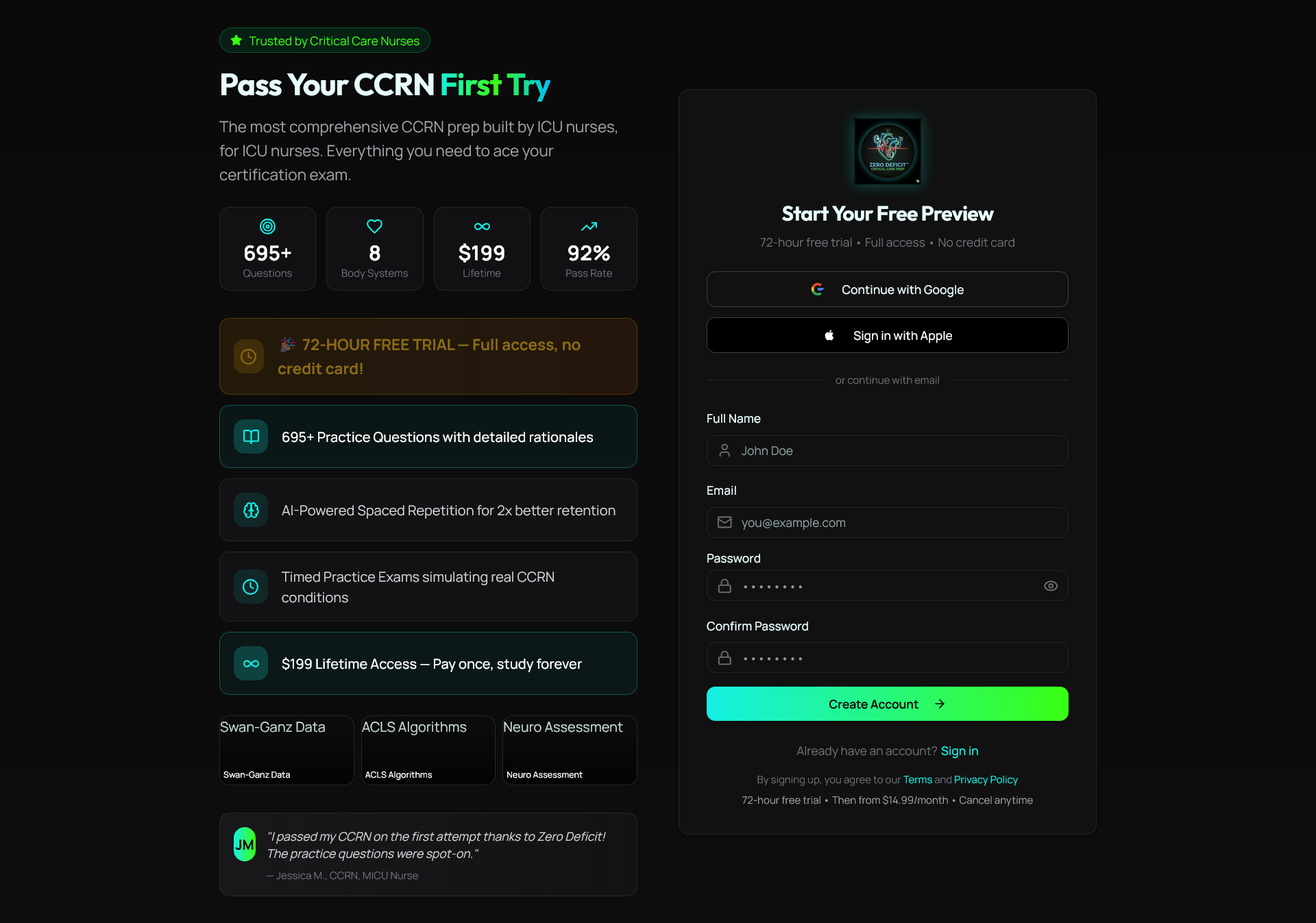
Zerodeficitccrnprep was built by expert ICU nurses who have sat in your seat, charted through a night shift, and passed the CCRN. The platform covers all eight CCRN body systems with comprehensive study guides that go deeper than surface-level review, pairing each concept with the clinical rationale you need to apply it under exam pressure. The AI-powered review tools adapt to your performance, so your study time targets the gaps that actually cost you points. With over 695 practice questions written to mirror the exam’s job-task structure, detailed rationales for every answer, and topic-specific quizzes covering high-yield areas like shock, vasopressors, and sepsis, Zerodeficitccrnprep gives you the preparation depth the CCRN demands. Many nurses who used the platform report passing on their first attempt. Start with the CCRN practice tests today and see exactly where you stand.
Key Takeaways
To earn the Adult CCRN, you need 1,750 direct-care hours—at least 875 of which must be in the 2 years before application—a current RN license, and a study strategy built around the AACN Exam Content Outline and current clinical guidelines.
| Point | Details |
|---|---|
| Clinical hours threshold | 1,750 total direct-care hours required, with 875 earned in the 2 years before application. |
| Exam structure | 150 questions, computer-based, 3-hour limit at a Pearson VUE center. |
| Heaviest exam domain | Multisystem (24%) covers sepsis, MODS, and trauma, making it the highest-priority study area. |
| Recertification cycle | Every 3 years; earn 100 CE points (at least 50 in clinical practice) or retake the exam. |
| Zerodeficitccrnprep | Offers over 695 practice questions with rationales and AI-powered review across all CCRN body systems. |
FAQ
How many clinical hours do you need for the Adult CCRN?
You need 1,750 hours of direct care of acutely or critically ill patients, with at least 875 of those hours completed in the 2 years immediately before your application date.
Do orientation or residency hours count toward CCRN eligibility?
No. Orientation hours, residency rotations, and academic or simulation credits do not count. Only direct bedside clinical practice hours in qualifying high-acuity settings apply.
What is the Adult CCRN exam fee in 2026?
AACN charges a fee for members and a higher fee for non-members; verify current fees at aacn.org before submitting your application, as fees are subject to change.
How often do you need to recertify the CCRN?
Every 3 years. You can recertify by earning 100 CE points (minimum 50 in clinical practice) or by retaking and passing the exam within your certification window.
What is the best way to prepare for the Adult CCRN exam?
Start with the AACN Exam Content Outline to identify your weakest domains, then use targeted CCRN practice questions with detailed rationales to build clinical reasoning, not just recall.
Recommended
Take a Multisystem practice quiz
Master sepsis, shock, MODS, and multi-organ failure scenarios.
Get Your Free 20-Question CCRN Diagnostic
20 high-yield CCRN-style questions across every body system, with detailed rationales — emailed to you instantly.
No spam. One email + a couple of helpful follow-ups. Unsubscribe anytime.
Ready to pass your CCRN?
Join 12,000+ nurses using Zero Deficit — 695+ practice questions with rationales, AI-powered weak-area drilling, and spaced-repetition flashcards.
Start Free Trial →