Retention Strategies in Nursing Education for CCRN Success
TL;DR:
- Effective CCRN exam preparation combines proactive enrichment, psychosocial support, and active retrieval practice. Building a strong foundation early and addressing emotional factors improves retention and reduces dropout risks among critical care nurses.
Mastering complex clinical concepts for the CCRN exam is not just about studying harder. It requires a deliberate, evidence-based approach to retention that addresses both academic and psychosocial barriers. The most effective nursing education retention techniques combine proactive enrichment, structured peer support, aggressive academic advising, and personalized practice testing. For critical care nurses, retention in CCRN prep means moving beyond passive review and building durable memory for hemodynamics, sepsis management, ventilator settings, and the Synergy Model.
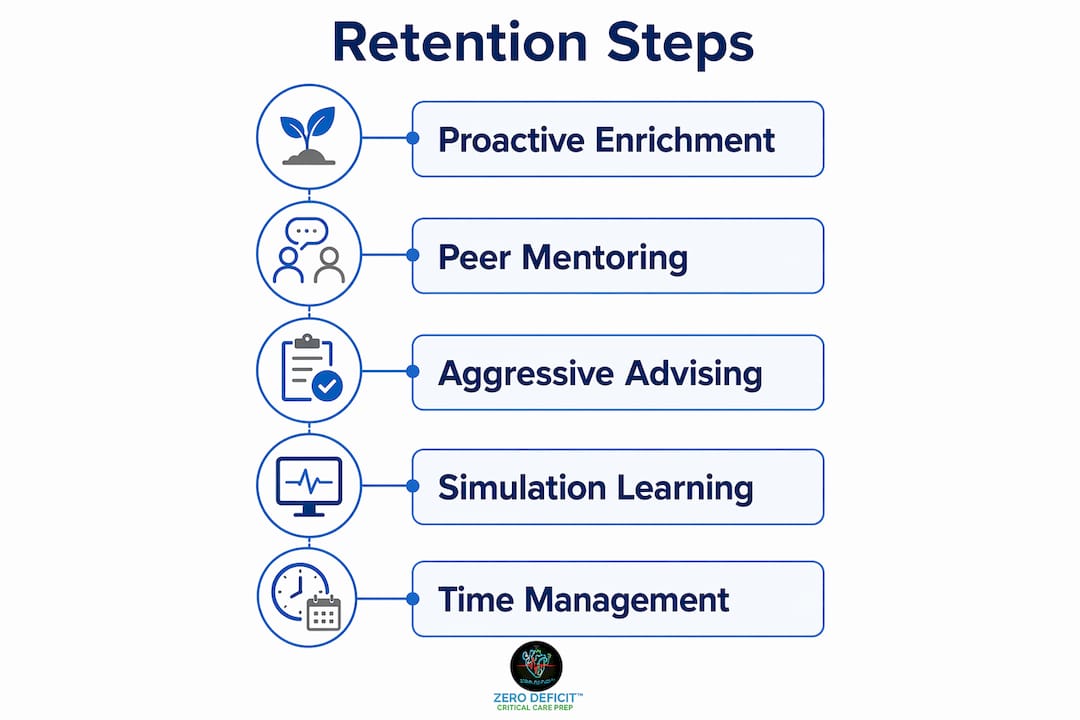
Key strategies that drive retention and CCRN success:
- Proactive Inclusive Enrichment (PIE): Enrichment for every learner, not just those at risk
- Psychosocial support: Addressing belonging, confidence, and stress resilience
- Aggressive academic advising: Early identification of stressors and tailored intervention
- Online preparatory programs: Tools like LNAR that improve first-semester readiness
- Personalized practice testing: Active retrieval with detailed rationales
- Spaced repetition and active recall: Replacing passive re-reading with retrieval-based study
- Simulation-based learning: Applying clinical reasoning in realistic scenarios
- Time management systems: Structured scheduling built around ICU shift work
A large-scale study of 4,472 undergraduate nursing students found that those who used academic support services were significantly more likely to persist in their programs. A large-scale study of 4,472 undergraduate nursing students found that those who used academic support services were over seven times more likely to persist in their programs. That figure alone makes the case for building support structures into your prep from day one.
Table of Contents
- 1. What is Proactive Inclusive Enrichment and why does it matter?
- 2. How psychosocial factors shape your ability to retain clinical concepts
- 3. Why aggressive academic advising changes retention outcomes
- 4. Online preparatory programs and personalized practice for CCRN success
- 5. How to build clinical reasoning and critical thinking for the CCRN
- 6. Simulation-based learning as a retention tool
- 7. Time management strategies built for ICU nurses
- Key Takeaways
- FAQ
1. What is Proactive Inclusive Enrichment and why does it matter?
Proactive Inclusive Enrichment (PIE) shifts the focus from fixing struggling students to enriching every learner from the start. Traditional remediation waits for failure. PIE anticipates it and builds a stronger baseline before problems appear.
Guided by Jeffreys’ Nursing Undergraduate Retention and Success (NURS) model, PIE structures enrichment activities before the first course begins, then scaffolds them throughout the curriculum. Pre-course preparation, orientation programs, and ongoing learner-centered activities all fall under this model. The goal is professional integration, not just academic survival.
“Optimization focuses on enrichment for everyone that begins with PIE and avoids an ER approach.” — Jeffreys, 2012
For CCRN candidates, PIE thinking translates directly: start your prep with a full content audit, not a crisis response two weeks before your exam date. Build enrichment into your schedule from week one.
- Map your knowledge gaps across all eight body systems before you start
- Use pre-course or pre-exam orientation materials to calibrate your baseline
- Treat every study session as enrichment, not remediation
2. How psychosocial factors shape your ability to retain clinical concepts
Psychosocial factors like belonging, confidence, and motivation are as critical to retention as raw academic ability. Many nursing students leave programs not because they lack intelligence, but because they lack sufficient social and professional integration. The same dynamic plays out in CCRN prep.

Stress, isolation, and self-doubt suppress memory consolidation. When you are managing a full ICU schedule and studying for a high-stakes certification, your cognitive load is already near its ceiling. Psychosocial strain pushes it over.
Methods that address this directly:
- Peer mentoring: Near-peer support from nurses who recently passed the CCRN offers practical, experience-based guidance that textbooks cannot replicate
- Study accountability groups: Linked study partners create natural accountability and reduce dropout from prep programs
- Resilience training: Structured stress management, including mindfulness and deliberate recovery, protects working memory during high-pressure study periods
- Family and social support: Involving your support network in your prep timeline reduces conflict and reinforces persistence
Peer mentoring and learning communities specifically enhance critical thinking and support retention in nursing education. For CCRN prep, that means finding at least one study partner who is also sitting the exam.
3. Why aggressive academic advising changes retention outcomes
Aggressive academic advising goes well beyond scheduling courses. It means proactively identifying stressors, providing emotional support, and connecting students to resources before a crisis forces the issue. Faculty engagement and proactive advising significantly improve persistence in nursing programs.
Faculty-student connectedness is a powerful predictor of persistence. Meaningful dialogue, empathy, and consistent check-ins create the psychological safety students need to ask for help early rather than quietly falling behind.
For CCRN candidates studying independently, this principle applies to how you structure accountability:
- Identify a mentor, educator, or experienced colleague who can provide regular feedback
- Schedule weekly self-assessments to catch knowledge gaps before they compound
- Use counseling or peer support resources if exam anxiety is affecting your study quality
- Treat emotional readiness as part of your prep, not separate from it
The University of Pittsburgh School of Nursing demonstrated this concretely: over a nine-year period, personalized advising and at-risk identification improved freshman retention rates substantially.
4. Online preparatory programs and personalized practice for CCRN success
Online preparatory programs like LNAR have shown statistically significant improvements in first-semester nursing student assessment scores and retention. The mechanism is straightforward: structured pre-exposure to content reduces cognitive overload when the real material arrives.
For CCRN candidates, the equivalent is a personalized practice testing platform that mirrors exam conditions and provides detailed rationales. Passive reading does not build the kind of durable memory the CCRN demands. Active retrieval does.
Nursing students must transition from memorization to active application using spaced repetition and retrieval practice to succeed on high-stakes exams.
Zerodeficitccrnprep applies this directly. The platform’s 695+ CCRN practice questions are built by expert ICU nurses and include detailed rationales that explain not just the correct answer, but why the wrong answers fail. That distinction is what builds clinical reasoning, not just test-taking skill.
- Use AI-powered review tools to identify your weakest content areas by body system
- Practice under timed conditions to simulate real exam pressure
- Review every rationale, including for questions you answered correctly
- Track your performance trends with study analytics to guide your next session
5. How to build clinical reasoning and critical thinking for the CCRN
The CCRN does not test recall. It tests your ability to apply clinical knowledge to complex, ambiguous patient scenarios. Building that skill requires deliberate practice with case-based questions, not repeated memorization of normal lab values.
Effective techniques for developing clinical reasoning:
- Concept mapping: Connect pathophysiology to clinical presentation to nursing intervention, building a web of understanding rather than isolated facts
- Think-aloud practice: Verbalize your reasoning as you work through practice questions to expose faulty assumptions
- Case-based discussion: Work through ARDS, sepsis, or ACS scenarios with a peer, defending your clinical decisions
- Targeted learning by system: Use a body-system approach to build depth in cardiovascular, pulmonary, and neuro content before moving to integrated cases
Critical thinking in critical care means recognizing that a MAP of 58 mmHg in a septic patient on norepinephrine is not just a number. It is a decision point. Your prep should train that instinct, not just your ability to recall the normal MAP range (70–100 mmHg).
6. Simulation-based learning as a retention tool
Simulation places you inside a clinical scenario without patient risk, which makes it one of the most effective retention methods available. The act of performing a skill or working through a deteriorating patient case encodes memory more durably than reading about it.
For CCRN prep, simulation does not require a high-fidelity mannequin. It requires realistic, scenario-driven practice:
- Work through virtual patient cases that replicate ICU deterioration patterns (rising ICP, worsening ARDS, cardiogenic shock)
- Use practice questions structured as clinical vignettes rather than isolated recall items
- Debrief after each scenario by identifying what you knew, what you missed, and why
- Pair simulation with targeted topic guides on high-yield areas like shock, vasopressors, and sepsis to reinforce the content immediately after the scenario
Linked coursework with peers naturally creates study groups that reduce dropout better than isolated study. Applying that to simulation means debriefing with a partner, not alone.
7. Time management strategies built for ICU nurses
Twelve-hour shifts, night rotations, and post-shift fatigue make standard study schedules unworkable for most CCRN candidates. You need a system designed around your actual schedule, not a generic student calendar.
Practical time management strategies for critical care nurses:
- Block scheduling: Assign specific study topics to specific days of the week, aligned with your shift pattern. Study cardiovascular on your post-night-shift recovery day when you have protected time.
- Micro-sessions: Twenty focused minutes of spaced repetition practice beats two hours of unfocused reading. Use your commute, lunch break, or pre-shift time.
- Spaced repetition systems: Review content at increasing intervals (day 1, day 3, day 7, day 14) to move knowledge from short-term to long-term memory. This is the single most evidence-supported technique for retaining complex clinical content.
- Weekly self-audit: Every Sunday, review your practice test scores by body system and adjust the following week’s focus. Don’t spend equal time on your strongest and weakest areas.
- Exam date commitment: Set your AACN exam date before you start studying. A fixed deadline converts vague intention into structured preparation.
Poor time management is one of the most commonly cited reasons nursing students drop out of programs and why CCRN candidates delay or fail their exam. Structure is not optional when the content load is this high.
Key Takeaways
Effective retention in nursing education and CCRN prep requires combining proactive enrichment, psychosocial support, and personalized active practice rather than relying on any single strategy.
| Point | Details |
|---|---|
| PIE over remediation | Proactive Inclusive Enrichment builds a stronger baseline for all learners before problems appear. |
| Psychosocial factors matter | Belonging, confidence, and peer support are as critical to retention as academic ability. |
| Sevenfold persistence boost | Nursing students who used academic support were significantly more likely to persist in their programs. |
| Active retrieval beats re-reading | Spaced repetition and practice testing with rationales build durable clinical memory for the CCRN. |
| Time management is clinical | Structuring study around ICU shift patterns prevents burnout and keeps prep consistent. |
FAQ
What are the most effective retention strategies in nursing education?
The most effective strategies combine proactive enrichment, peer mentoring, aggressive academic advising, and active retrieval practice. A large-scale study found nursing students using academic support were over seven times more likely to persist.
Why do nursing students drop out before graduation?
Attrition is driven by academic overload, poor time management, financial stress, and insufficient social integration, not intellectual deficits alone. Addressing psychosocial factors alongside academic support is key to improving retention.
How does spaced repetition help with CCRN exam prep?
Spaced repetition schedules review at increasing intervals, moving content from short-term to long-term memory. It is the most evidence-supported technique for retaining complex clinical concepts like hemodynamics, ABG interpretation, and sepsis management.
What role does simulation play in retaining clinical knowledge?
Simulation encodes memory more durably than passive reading by placing you inside realistic clinical scenarios. For CCRN prep, scenario-based practice questions and virtual case debriefs replicate this effect without requiring a simulation lab.
How can Zero Deficit™ CCRN Prep support my retention strategy?
Zerodeficitccrnprep provides over 695 practice questions with detailed rationales, AI-powered review tools, and system-based CCRN study guides built by expert ICU nurses to support active retrieval and personalized learning.
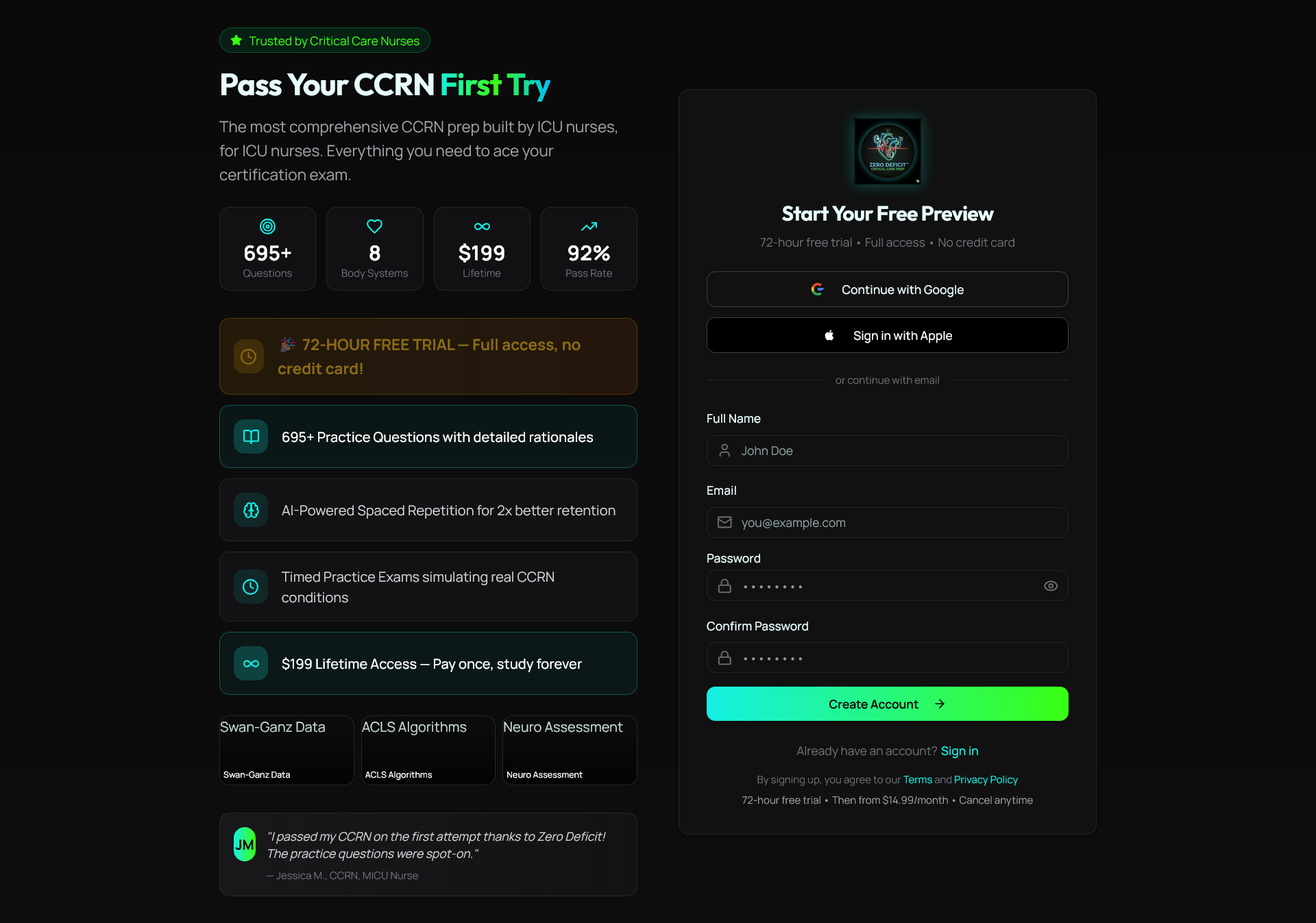
You have the strategies. Now put them to work. Start with Zerodeficitccrnprep’s CCRN practice tests covering all eight body systems, complete with rationales that build the clinical reasoning the exam actually tests. Your exam date is a fixed point. Your preparation starts now.
Recommended
- Targeted Learning for Nurses: What It Is and Why It Works | Zero Deficit CCRN Prep
- How educators boost CCRN certification success for nurses | Zero Deficit CCRN Prep
- What Is Retention in Test Prep for CCRN Success | Zero Deficit CCRN Prep
- Why Certification Retention Matters for Critical Care Nurses | Zero Deficit CCRN Prep
Take a Neurological practice quiz
Test your knowledge of stroke, ICP, seizures, and neuro assessment.
Get Your Free 20-Question CCRN Diagnostic
20 high-yield CCRN-style questions across every body system, with detailed rationales — emailed to you instantly.
No spam. One email + a couple of helpful follow-ups. Unsubscribe anytime.
Ready to pass your CCRN?
Join 12,000+ nurses using Zero Deficit — 695+ practice questions with rationales, AI-powered weak-area drilling, and spaced-repetition flashcards.
Start Free Trial →