8 Week 10 Hour Weekly Plan For 2026 AACN CCRN Changes (US ICU Nurses)
AACN’s revised CCRN test plan took effect on November 12, 2025, and if you’re testing anytime in 2026, you’re being measured against it. Your first move isn’t buying a new book. It’s pulling the current AACN test plan and handbook, then reallocating your study hours to match the new percentages before you touch another practice question.
TL;DR:
- The revised CCRN test plan shifts focus toward multisystem, neurological, and behavioral health scenarios, increasing their exam weighting to reflect current ICU practice.
- Candidates must update their study strategies to match the new domain percentages, emphasizing clinical judgment and applying case-based practice in timed conditions.
- The certification still relies on the modified Angoff scoring method, so candidates cannot determine their exact score or required percentage but must focus on content mastery.
- Eligibility requirements for the direct care pathway remain unchanged, with strict documentation of hours worked, especially when pulling records from different healthcare systems.
- Practice questions are now aligned with the 2025 blueprint, making recent preparation resources essential to avoid undertraining for the current exam content.
Table of Contents
- What Changed in the CCRN Test Plan and Why
- Eligibility and How to Apply for the Direct Care Pathway
- Exam Format, Scoring, and Test-Day Logistics
- Domain Weightings for the Revised 2026 Test Plan
- Your Step-by-Step Prep Plan for the New Blueprint
- Renewal Pathways and the Mistakes That Cost Nurses Their Certification
- What ICU Nurse Educators Bring to This Guide
- What High-Performing 2026 Candidates Actually Prioritize
- Get Practice Questions Built Around the Revised Blueprint
- Sources
- FAQ
What Changed in the CCRN Test Plan and Why
AACN doesn’t rewrite the CCRN blueprint on a whim. Every few years, the organization runs a Study of Practice, a large-scale survey of practicing critical care nurses asking what they actually do at the bedside and how often. The 2024 Study of Practice fed directly into the test plan revision that launched November 12, 2025, and it reflects real shifts in ICU practice, not a random reshuffle. Multisystem patients, behavioral health crises overlapping with critical illness, and neurological emergencies have become a bigger share of what bedside nurses manage day to day. The test plan caught up to that reality.
Here’s what stayed exactly the same, so you don’t waste energy worrying about it:
- 150 total items on the exam
- 125 scored questions, plus 25 unscored pretest items you can’t identify
- A 3-hour testing window
- The 80/20 split between Clinical Judgment and the Professional Caring and Ethical Practice domains
The passing standard didn’t change either, in the sense that AACN still uses a modified Angoff method rather than a fixed percentage cutoff. A panel of content experts and a psychometrician review every item, estimate how a minimally competent candidate would perform on it, and set the pass point from that analysis. That means you’ll never see an official “you need 72% to pass” number published anywhere, and any study guide claiming otherwise is guessing. What you can control is content coverage, and that’s where the 2025 revision actually matters for your prep.
Eligibility and How to Apply for the Direct Care Pathway
The eligibility math for CCRN (Adult) Direct Care didn’t move with this revision. If you’re wondering whether the hour requirements changed alongside the content, they didn’t. Here’s what you need:
- Hold a current, unencumbered U.S. RN or APRN license. No exceptions, no provisional workarounds.
- Log 1,750 hours of direct bedside care of acutely or critically ill adult patients within the previous two years, with at least 875 of those hours in the most recent year. This is the faster path if you’ve been consistently in the ICU.
- Or log 2,000 hours within the previous five years, with at least 144 hours in the most recent year. This route fits nurses who’ve had a gap, moved between units, or taken leave.
- Gather your documentation before you apply. Staffing records, unit transfer dates, and any per diem or float hours need clear paper trails, since eligibility audits commonly stall on incomplete hour logs.
- Check current application fees directly with AACN, since certification pricing changes independently of test content and isn’t something this article can quote reliably.
The most common pitfall isn’t misunderstanding the hours. It’s underestimating how long it takes to pull documentation from a previous employer, especially if you’ve switched hospital systems. Start that paperwork the same week you commit to a test date.
Exam Format, Scoring, and Test-Day Logistics
You’ll sit for 150 multiple-choice items in a 3-hour block, 125 of which count toward your score and 25 of which are unscored pretest questions AACN uses to validate future exam content. You won’t know which 25 those are, so treat every question as if it counts.
Scoring runs through the modified Angoff method described above, which means your results come back as pass or fail with a scaled score, not a raw percentage. On retakes, current AACN policy governs how soon you can sit again and how many attempts you get in a rolling window. Retake limits have historically run around four attempts per 12-month period, but confirm the exact current rule on AACN’s site before you schedule, since these details are the kind that shift between handbook editions.
A few practical notes for test day:
- Bring government-issued photo ID that matches your registration exactly.
- Schedule during an open testing window well ahead of any renewal deadline, since slots fill faster close to expiration dates.
- If you’re using a practice exam product to gauge readiness, run it under real timing conditions, not paused or split across days.
Domain Weightings for the Revised 2026 Test Plan
This is the part that should actually reshape your calendar. AACN’s revision moved percentage points between domains, and if you’re studying from an older guide, you’re likely overweighting the wrong content.

It doesn’t anymore. The growth in Multisystem and Neuro/Behavioral weighting reflects how often ICU nurses now manage patients with overlapping diagnoses: a septic patient with new-onset delirium, a stroke patient developing cardiogenic complications, a trauma admission with a comorbid psychiatric crisis.
Here’s a sample 8-week allocation built around 10 weekly study hours, scaled to the new percentages:
- Weeks 1 to 2: 2 hours Cardiovascular, 1.5 hours Respiratory, 2 hours Endocrine/Renal/GI, 2.5 hours Neuro/Behavioral, 2 hours Multisystem
- Weeks 3 to 6: Same ratio, rotating case-based practice through each domain in 2-week sprints
- Weeks 7 to 8: Full-length timed simulations, one per week, with rationale review immediately after
Pro Tip: Don’t rebuild your entire drug list around brand names. AACN is transitioning exam materials to generic medication names only, so if you’ve been studying with trade names out of habit, retrain yourself on drug class and mechanism instead. A nurse who knows “beta-1 selective agonist” cold will answer correctly regardless of which name the question uses.
Your Step-by-Step Prep Plan for the New Blueprint
Start with the source document, not a secondhand summary. Download the current AACN test plan and exam bibliography and map every reference title to a study block on your calendar. AACN built the bibliography specifically to match what the revised exam tests, so treat it as your syllabus, not a suggestion.
- Week 1: Baseline simulation. Take one full-length timed practice exam before you study anything new. This tells you where you actually stand against the new weighting, not where you assume you stand.
- Weeks 2 through 6: Domain sprints. Work through mixed-case practice blocks in timed conditions, prioritizing case scenarios that force clinical judgment over recall. Since Clinical Judgment accounts for 80% of the exam’s overall weight, practicing isolated fact recall without applying it to a patient scenario wastes study time.
- Debrief every session. Never move on from a missed question without reading the full rationale. If a question breakdown method helps you slow down and reason through distractors systematically, structured question breakdown is worth building into your routine.
- Run daily spaced repetition. Fifteen to twenty minutes a day on high-yield lab values and drug classes beats a single four-hour cram session. Know your normal ranges cold: potassium 3.5 to 5.0 mEq/L, lactate under 2 mmol/L, ICP under 20 mmHg, and the components of the Glasgow Coma Scale. A spaced repetition schedule built around labs, drugs, and AHA and SCCM algorithms keeps this material sticky instead of forgotten by exam day.
- Simulate a full 3-hour exam weekly starting week 4. Timing pressure is a skill, not a given. Practicing under a clock exposes pacing problems before they cost you on test day.
- Weeks 7 and 8: Targeted repair. Go back to your weakest domains from the week 1 baseline and hit them with focused case practice, not broad review.
If you’re retaking the exam, your first two weeks look different. Pull your score report and identify your lowest-performing domains specifically. Retakers who treat remediation as a targeted sprint against known weak spots, rather than restudying everything evenly, tend to close gaps faster than those who start over from zero.
Pro Tip: If your last attempt predates November 2025, don’t assume your old weak areas are still your weak areas. The domain weights shifted under you. Rerun a baseline simulation on the current blueprint before deciding where to focus.
Round out your resource list with the CCRN Exam Handbook for policy details, an AACN-aligned practice exam, and a practice question bank that reflects the current weighting rather than a pre-2025 version.

Renewal Pathways and the Mistakes That Cost Nurses Their Certification
You’ve got three ways to stay certified: renew through Synergy CERPs, renew by exam, or move to inactive status if you’re stepping away from direct care temporarily. Most nurses renew through CERPs, which requires 100 total credits spread across categories tied to direct care, advancing the profession, and self-care during your 3-year certification period.
The detail that trips people up most is the 90-day grace period. It sounds like extra time, but it isn’t extra time to finish requirements.
- The 90-day grace period only covers submitting your renewal application after your certification expires.
- CERPs and practice hours must be completed before your expiration date, not during the grace window.
- Earning credits after your certification lapses doesn’t count toward that renewal cycle, no matter how close to the deadline you finish them.
- Duplicate AACN accounts and inconsistent name records between your license and certification profile are among the most common documentation issues flagged during audit.
- Keep certificates of completion for every CERP activity for at least the length of your current certification cycle plus one renewal period.
Build your renewal timeline backward from your expiration date, not forward from today. That single habit prevents most of the last-minute scrambling nurses run into.
What ICU Nurse Educators Bring to This Guide
This guide comes from Zero Deficit™ CCRN Prep, built specifically around the AACN Adult CCRN blueprint by nurses who’ve worked critical care units and know what the exam is actually testing for. Every recommendation above traces back to the revised test plan and the official handbook, not to guesswork about what “usually” shows up.
The practice bank includes a large set of practice questions with detailed rationales, mapped to the revised domain percentages rather than an outdated cardiovascular-heavy split. Here’s how each core feature supports prep under the new blueprint:
- Review tools help identify your weakest domains automatically, so you’re not guessing where to focus your next study block.
- Spaced repetition helps keep high-yield labs, drug classes, and algorithm steps in long-term memory instead of fading after a few days.
- Exam simulations run on realistic timing, matching the 150-item, 3-hour format candidates face on test day.
- Generic drug naming is used across practice items, reflecting transitions away from trade names.
If you want to see how a question bank built around the current blueprint actually feels, working through a handful of sample items is the fastest way to find out.
What High-Performing 2026 Candidates Actually Prioritize
The candidates who pass on the first attempt this cycle aren’t the ones who studied the most hours. They’re the ones who studied the right proportions. Download the current test plan this week, run one full timed simulation to get an honest baseline, and let that score report, not your gut feeling, decide where your hours go next.
From there, the habit that separates strong performers from everyone else is consistency over intensity: 30 to 60 minutes of targeted review daily, one 3-hour full simulation weekly, and spaced repetition running quietly in the background the whole time. If you’re retaking, resist the urge to restudy everything. Your last score report already told you where the gaps are. Treat those specific domains as short, aggressive sprints instead of a second full pass through material you’ve already mastered.
— Zero
Get Practice Questions Built Around the Revised Blueprint
Studying from a guide that hasn’t caught up to the November 2025 revision means spending hours on content that’s shrunk in weight while under preparing for what actually grew. Zero Deficit™ built its question bank around the current AACN test plan, so your practice time maps to what the exam actually tests in 2026, not what it tested three years ago.
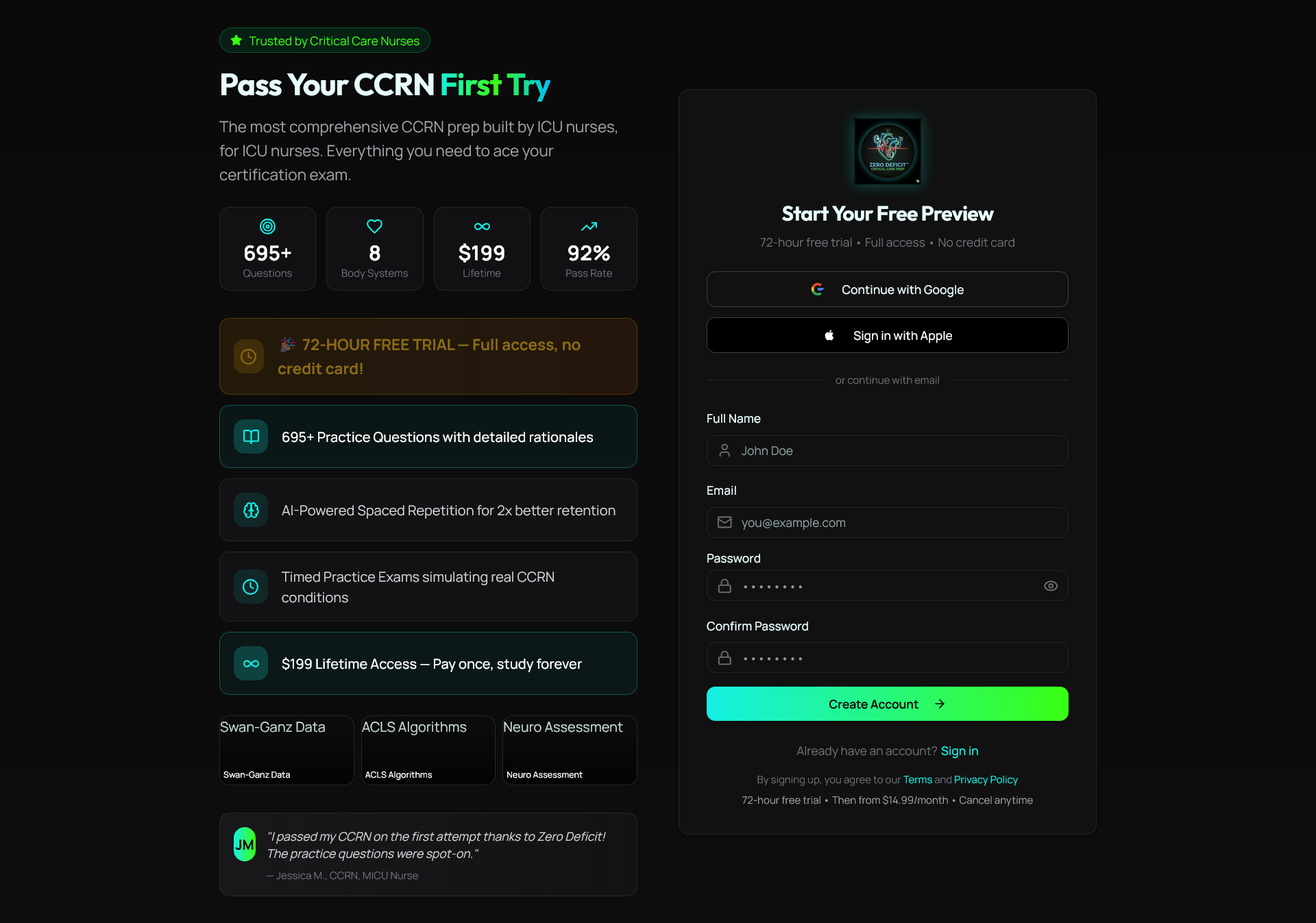
Three ways to access it, depending on where you are in your prep timeline: Premium Monthly at $14.99 per month fits candidates testing soon who want full access without a long commitment. Yearly Access at $84.99 per year suits nurses building toward certification over several months, including new grads accumulating hours toward eligibility. Lifetime Mastery fits retakers who want ongoing access through multiple attempts without repeat subscription costs. All three plans are listed on the subscription page.
If you’re not sure which fits, start with a handful of free sample questions and see how the rationale style matches how you actually learn before committing to a plan.
Sources
FAQ
What Are the Main Changes in the 2026 CCRN Test Plan?
The revised test plan, effective November 12, 2025, lowered Cardiovascular weighting to roughly 13% and Respiratory to about 12%, while raising Musculoskeletal/Neurological/Behavioral to around 18% and Multisystem to roughly 16%. Exam format stayed the same at 150 items, 125 scored, over a 3-hour window.
What Is the Passing Score for the CCRN Exam in 2026?
AACN doesn’t publish a fixed percentage pass mark. The organization uses a modified Angoff method, where a panel of experts and a psychometrician set the passing standard based on item difficulty, and your results come back as pass or fail with a scaled score.
Is There Still a Nursing Shortage Affecting ICU Roles in 2026?
Critical care units across the U.S. continue reporting staffing pressure, which is part of why AACN’s revised blueprint leans more heavily into multisystem and behavioral overlap scenarios nurses face on understaffed floors. Certification remains one of the clearest ways to strengthen your standing and mobility within critical care nursing.
How Many Candidates Fail the CCRN Exam?
AACN doesn’t publish a single universal fail rate, since pass rates vary by candidate preparation, experience level, and test date cohort. What consistently correlates with failing is studying an outdated content split. Candidates who don’t rebalance their study time to the November 2025 domain weight changes risk being undertrained on Multisystem and Neuro/Behavioral content that now carries more weight.
Do I Need to Relearn Drug Names for the Revised Exam?
You don’t need to relearn medications from scratch, but you do need to shift how you study them. AACN is transitioning exam materials to generic medication names only, so focus on drug class and mechanism rather than memorizing brand names you might recognize from unit practice.
Did the CCRN Eligibility Hour Requirements Change in 2026?
No. The Direct Care pathway still requires either 1,750 hours in the previous two years with 875 in the most recent year, or 2,000 hours in the previous five years with 144 in the most recent year. Only the exam content weighting changed, not the eligibility math.
Recommended
Take a Neurological practice quiz
Test your knowledge of stroke, ICP, seizures, and neuro assessment.
Get Your Free 20-Question CCRN Diagnostic
20 high-yield CCRN-style questions across every body system, with detailed rationales — emailed to you instantly.
No spam. One email + a couple of helpful follow-ups. Unsubscribe anytime.
Ready to pass your CCRN?
Join 12,000+ nurses using Zero Deficit — 695+ practice questions with rationales, AI-powered weak-area drilling, and spaced-repetition flashcards.
Start Free Trial →