Adult CCRN Tops 72% Pass Rate: What It Means for U.S. ICU Nurses

Adult CCRN posted the highest first-time pass rate of any CCRN specialty in the American Association of Critical-Care Nurses’ 2025 statistics: 72.02% among 17,151 candidates, ahead of Pediatric CCRN (68.72%) and Neonatal CCRN (60.29%). That number tells you how the exam performed as a system last year. It does not predict how you’ll do. Your prep, your clinical reps, and how well you match study time to the test blueprint matter more than any national average.
TL;DR:
- The adult CCRN first-time pass rate is 72.02%, but success depends more on matching study content to the exam blueprint than on national averages.
- Only 125 of the 150 exam questions are scored, with a cut score of 83 for adult and pediatric certifications and 84 for neonatal, which are recalibrated through equating.
- Study focus should prioritize cardiovascular and pulmonary topics, with regular timed practice and rationales to build exam stamina and application skills.
- Preparation methods combining active practice, blueprint alignment, and rationales lead to higher confidence and more reliable success than passive reading or reliance on last-minute cramming.
Table of Contents
- What Are the Current CCRN Pass Rates?
- What Does a 72% Pass Rate Actually Mean for You?
- How Is the CCRN Exam Scored?
- Where Should You Actually Spend Your Study Time?
- How Zero Deficit™ Supports Blueprint-Aligned Study
- How Do Different Prep Methods Compare on Pass Rates?
- Why Do Candidates Fail the CCRN, and How Do You Avoid It?
- Does More Clinical Experience Mean a Higher Pass Rate?
- Do CCRN Pass Rates Vary by Region?
- What’s the Best Timeline for a CCRN Retake?
- A Nurse-to-Nurse Take on Pass-Rate Headlines
- Put the Blueprint Approach to Work
- Sources
- FAQ
What Are the Current CCRN Pass Rates?
Those gaps aren’t random. Neonatal and Pediatric CCRN draw from smaller, more specialized candidate pools, which means their pass rates may vary more year to year.
Adult CCRN pass rates have moved over the last few cycles. That’s a meaningful shift, and it likely reflects test-plan updates, changes in who’s sitting for the exam, and normal equating adjustments between exam forms rather than the exam suddenly getting harder in a vacuum.
A few distinctions matter when you read these numbers:
- First-time pass rate measures only candidates sitting for the exam for the first time, not retakers.
- New certificants counts everyone who passed in that period, including repeat test-takers.
- Total certificants (Adult CCRN sits above 100,000) reflects everyone currently holding the credential, active or not.
| Specialty | First-Time Pass Rate (2025) | Candidates Tested |
|---|---|---|
| Adult CCRN | 72.02% | 17,151 |
| Pediatric CCRN | 68.72% | Smaller cohort |
| Neonatal CCRN | 60.29% | Smallest cohort |
If you’re comparing CCRN pass rates across specialties to gauge difficulty, Adult CCRN’s larger candidate pool makes its percentage the most statistically stable of the three.
What Does a 72% Pass Rate Actually Mean for You?
A pass rate is not the same thing as the passing standard. The pass rate is a retrospective statistic. The cut score is set beforehand, independent of who happens to test that year. Confusing the two leads candidates to either panic over a dropping percentage or get overconfident about a rising one, when neither movement necessarily says anything about how hard your individual exam will feel.
Several factors shift the national pass rate without changing the difficulty of the material itself:
- Test-plan revisions that reweight domains
- The mix of first-time test-takers versus retakers in a given cycle
- Whether candidates are US-educated or internationally educated
- Regional differences in ICU exposure and orientation length
- How recently a candidate worked in a high-acuity unit versus a lower-acuity step-down role
Your actual odds depend on how closely your study time matches the exam’s blueprint weighting, not on a headline percentage from last year’s cohort.
Pro Tip: Don’t chase the pass rate. Chase your own score report data if you’re a retaker, and chase blueprint alignment if you’re a first-timer. Both are better predictors of your outcome than any national average.
How Is the CCRN Exam Scored?
The CCRN exam runs 150 items over three hours, but only 125 are scored. The other 25 are unscored pretest items AACN uses to evaluate future questions, and you won’t know which is which.
AACN sets the passing point using a modified Angoff method. Panels of practicing critical care nurses and psychometricians estimate, item by item, what proportion of minimally competent candidates should answer correctly. That process produces a raw cut score, not a percentage.
Current cut scores, effective November 12, 2025: Adult and Pediatric CCRN require a raw score of 83 out of 125 scored items. Neonatal CCRN requires 84.
Cut scores can shift slightly between exam forms through a statistical process called equating, which adjusts for small differences in difficulty across versions of the test. A cut score of 83 on one form is calibrated to represent the same competency level as 83 on another, even if the specific items differ. That’s why a moving cut score doesn’t mean the standard changed. It means the measurement got recalibrated.
Where Should You Actually Spend Your Study Time?

Your study plan should mirror the 2024 National Practice Analysis that underlies the current test plan, not just your own unit’s case mix. If your ICU rarely sees neuro emergencies but the blueprint weights neuro heavily, skipping it because “we don’t see much of that here” is exactly the gap that costs candidates points.
Within Clinical Judgment’s 80% share, cardiovascular and respiratory content carry the heaviest individual weighting, with multisystem, neuro, and endocrine/renal content filling out the remainder based on current review course syllabi. Here’s how to structure your weeks around that:
- Map your calendar to weight, not comfort. Give cardiovascular (hemodynamics, shock states, ACS, vasoactive drips) and pulmonary (ARDS, vent modes, ABG interpretation) the largest blocks, since together they anchor a large share of scored items.
- Layer in neuro and sepsis/MODS next. ICP management, stroke recognition, and sepsis bundles per current SCCM and AHA guidance round out the high-yield middle tier.
- Run timed, full-length simulations every one to two weeks. Timed practice under exam conditions builds the stamina a three-hour exam demands, not just the knowledge.
- Review rationales actively, not passively. Explain out loud why the correct answer is correct and why each distractor is wrong. Practice questions with detailed rationales build this skill faster than re-reading notes.
- If you’re retaking, start with your score report. AACN’s own preparation guidance points retakers toward their lowest-scoring domains first. Don’t re-study everything evenly. Fix the weak spot, then confirm with a fresh practice set before you rebook.
Pro Tip: If your last score report showed you below the cut in two or more domains, delay your retake date until targeted remediation moves the needle in practice tests. Rebooking too fast on the same weak foundation is the single most common retake mistake.
How Zero Deficit™ Supports Blueprint-Aligned Study
Matching your study time to blueprint weighting only works if your materials are organized the same way. Zero Deficit™ CCRN Exam Prep structures its question bank and study guides by system and topic, which maps directly onto the domains AACN weights most heavily.
- Over 695 practice questions with detailed rationales, built by ICU nurses, for active review rather than passive reading
- AI-powered review tools that surface weak areas as you work, similar to how a printed score report flags gaps for retakers
- Spaced repetition to keep high-weight cardiovascular and pulmonary content fresh instead of front-loaded and forgotten
- Full-length exam simulations for the timed practice that builds three-hour stamina
How Do Different Prep Methods Compare on Pass Rates?
Candidates generally choose among a few broad prep approaches: self-study with AACN’s own handbook and free resources, in-person or live-online review courses, and structured digital question banks with adaptive review. Each has a different strength profile rather than a clean hierarchy.
Self-study alone tends to work best for experienced nurses who already have strong pathophysiology recall and mainly need exam-format familiarity. Live review courses compress content into a short window, which helps candidates who need structure and a fixed deadline, but they rarely offer the volume of practice repetition a candidate needs to build timed-test stamina. Structured digital question banks with rationales tend to close knowledge gaps faster for candidates who need repeated exposure and active recall, since every wrong answer becomes a targeted mini-lesson instead of a dead end.
No public, controlled study isolates pass rates by prep method alone, since AACN’s statistics track outcomes by specialty, not by study approach. What the practical evidence supports is this: candidates who combine content review with substantial timed practice and rationale-based correction consistently report more confidence going into test day than those who rely on passive reading. If you’re choosing a method, weigh how much active practice it actually generates, not just how much content it covers.
Why Do Candidates Fail the CCRN, and How Do You Avoid It?
Most CCRN failures trace back to a handful of repeatable patterns, not bad luck. Studying by unit familiarity instead of blueprint weighting is the biggest one. If your ICU is cardiac-heavy, you might feel ready everywhere else and get blindsided by a neuro or endocrine section you skimmed.
Under-practicing timed conditions is another common trap. Reading review guides builds recognition, but the CCRN tests application under time pressure. Candidates who never simulate the full three-hour format often run out of stamina in the final third of the exam, where careless errors spike.
It’s a smaller slice, but skipping it entirely leaves points on the table that are often easier to earn than the toughest hemodynamics questions.
To counter these patterns: build a study calendar around domain weighting first, schedule at least three to four full timed simulations before your test date, and dedicate real review time to ethics and the Synergy Model even though it feels less clinically urgent than a septic shock drip calculation. Small, consistent corrections to these three habits move more candidates from “close” to “passed” than any single content deep dive.
Does More Clinical Experience Mean a Higher Pass Rate?
Clinical experience helps, but it’s not a straight line. A nurse with five years in a high-acuity cardiovascular ICU may walk in strong on hemodynamics and shock but underprepared on neuro or endocrine emergencies they rarely see. A newer grad with eighteen months of broad-based ICU exposure across multiple systems can sometimes outperform a specialist with far more years, simply because their case exposure happens to track closer to the test blueprint.
What correlates more reliably with passing is preparation time invested against blueprint-weighted content, not years on the unit alone. AACN’s eligibility pathways require a set number of practice hours before you can even sit for the exam, but hours worked and hours studied strategically are two different variables. Candidates who log four to eight weeks of structured, blueprint-aligned review tend to outperform equally experienced peers who cram in the final two weeks, regardless of how many years of ICU time they’re carrying into the test.
If you’re a newer ICU nurse eyeing the one-to-two-year eligibility window, don’t assume you need to wait for more bedside years before you’ll be ready. Structured study time can close experience gaps that unit exposure alone would take years to fill.
Do CCRN Pass Rates Vary by Region?
AACN’s published statistics report pass rates at the national specialty level. They don’t break results out by state or region in public reporting. That means there’s no official data showing, for example, that ICU nurses in the Northeast pass at different rates than those in the Southwest.
What likely does vary regionally, even without a published breakdown, is access to preparation resources and ICU case mix. Nurses working in large academic medical centers often see a broader range of high-acuity presentations, from ECMO to complex post-cardiac-surgery management, than nurses in smaller community ICUs. That difference in exposure could plausibly affect readiness for blueprint areas like advanced hemodynamics, even though it wouldn’t show up as a labeled “regional pass rate” anywhere in AACN’s tables.
The practical takeaway: don’t assume your region’s typical case mix equals full blueprint coverage. Whether you work in a 600-bed trauma center or a 12-bed rural ICU, cross-check your exposure against the national test plan, not against what’s typical in your local market.
What’s the Best Timeline for a CCRN Retake?
If you don’t pass, you’ll receive a score report broken down by content area. That report is your most valuable retake tool. It’s more useful than any anecdote about how hard the exam felt, because it tells you exactly which domains pulled your score down.
AACN sets a mandatory waiting period before you can retest, so check current eligibility rules before you rebook. Use that window deliberately. Don’t just repeat your first study plan hoping for a different outcome. Instead, spend the first week reviewing your score report line by line, identify the one or two domains where you scored lowest relative to the rest, and rebuild your next four to six weeks around targeted practice questions and rationale review in those specific areas.

Resist the urge to rebook immediately out of anxiety to “get it over with.” A retake scheduled before you’ve closed your weakest domain gaps usually just reproduces the same result. Give yourself enough runway. For most retakers, that’s four to six weeks of focused remediation, confirmed by improved scores on fresh practice sets before locking in a new test date.
A Nurse-to-Nurse Take on Pass-Rate Headlines
Pass-rate percentages make for a tidy headline, but they’ve never told you anything about your own exam day. I’d rather see you build your prep calendar around your score report and blueprint weighting than around last year’s national average. Sleep the night before matters more than people admit. Time yourself on practice sets from week one, not week eleven. And tackle cardiovascular and pulmonary content early, since they carry the heaviest weight and the most room for careless review mistakes.
— Zero
Put the Blueprint Approach to Work
Everything above points to one conclusion: pass-rate percentages are context, but blueprint-weighted, rationale-driven practice is what actually moves your score. Zero Deficit™ CCRN Exam Prep builds its entire question bank and study guide structure around that same system-by-system weighting AACN uses to write the exam, so you’re never guessing which domain deserves more of your week.
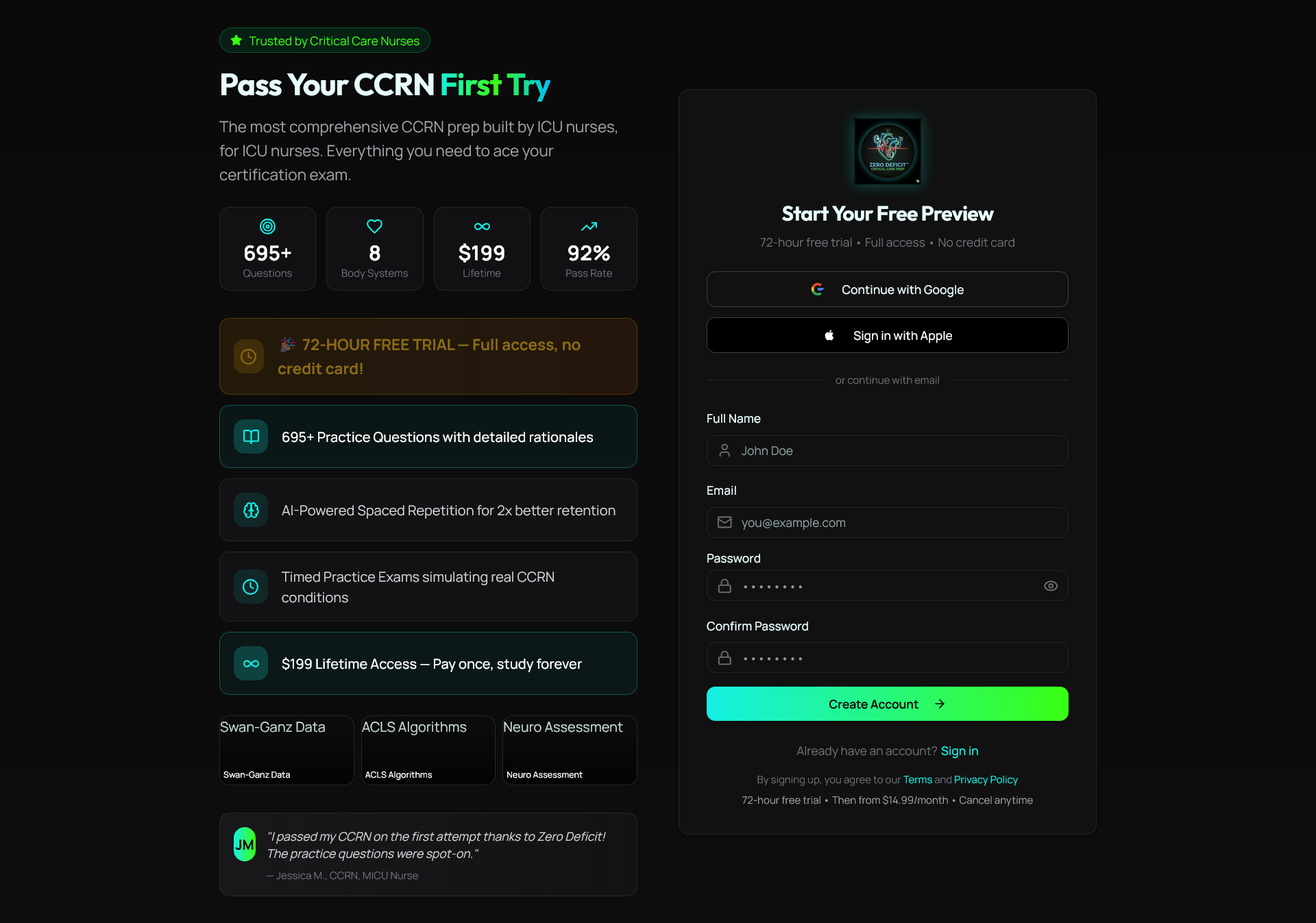
If you’re ready to put a plan behind the numbers, start with the 695+ CCRN practice questions, each with detailed rationales built by ICU nurses. Full access runs $14.99 per month, $84.99 per year, or as a one-time Lifetime Mastery purchase with pricing details on the subscription page. Pick a plan, load your weak domains into targeted practice sets, and start closing gaps this week instead of the week before your test date.
Sources
FAQ
How Many People Fail the CCRN Exam?
Based on AACN’s 2025 statistics, about 72% of first-time Adult CCRN candidates passed, since the first-time pass rate was 72.02%.
Is the CCRN or the NCLEX Harder?
They test different things, so “harder” depends on what you’re comparing. The NCLEX is an entry-to-practice exam covering the full scope of general nursing, while the CCRN assumes you’re already a working RN and tests deep critical care judgment, so most nurses find the CCRN harder in content depth even though the NCLEX has its own adaptive-format challenges.
What Is the CCRN Pass Rate Right Now?
The most recent AACN data puts the Adult CCRN first-time pass rate at 72.02%, the highest among the three CCRN specialties. That figure reflects first-time test-takers only and can shift year to year based on test-plan updates and who’s sitting for the exam.
What Is the Hardest RN Certification to Get?
There’s no single official ranking of certification difficulty, but among AACN’s own credentials, Neonatal CCRN currently carries the lowest first-time pass rate at 60.29%, partly reflecting its smaller, highly specialized candidate pool. Difficulty is also personal: a certification aligned tightly with your daily clinical practice will almost always feel more manageable than one further from your unit’s case mix.
Does Zero Deficit™ Guarantee I’ll Pass the CCRN?
No prep resource can honestly guarantee a pass, and Zero Deficit™ doesn’t make that claim. What it offers is a study system, over 695 practice questions with rationales, AI-powered review, and exam simulations, built around the same blueprint weighting AACN uses to construct the actual exam.
Recommended
Take a Neurological practice quiz
Test your knowledge of stroke, ICP, seizures, and neuro assessment.
Get Your Free 20-Question CCRN Diagnostic
20 high-yield CCRN-style questions across every body system, with detailed rationales — emailed to you instantly.
No spam. One email + a couple of helpful follow-ups. Unsubscribe anytime.
Ready to pass your CCRN?
Join 12,000+ nurses using Zero Deficit — 695+ practice questions with rationales, AI-powered weak-area drilling, and spaced-repetition flashcards.
Start Free Trial →