How to Build Exam Confidence for CCRN Success
TL;DR:
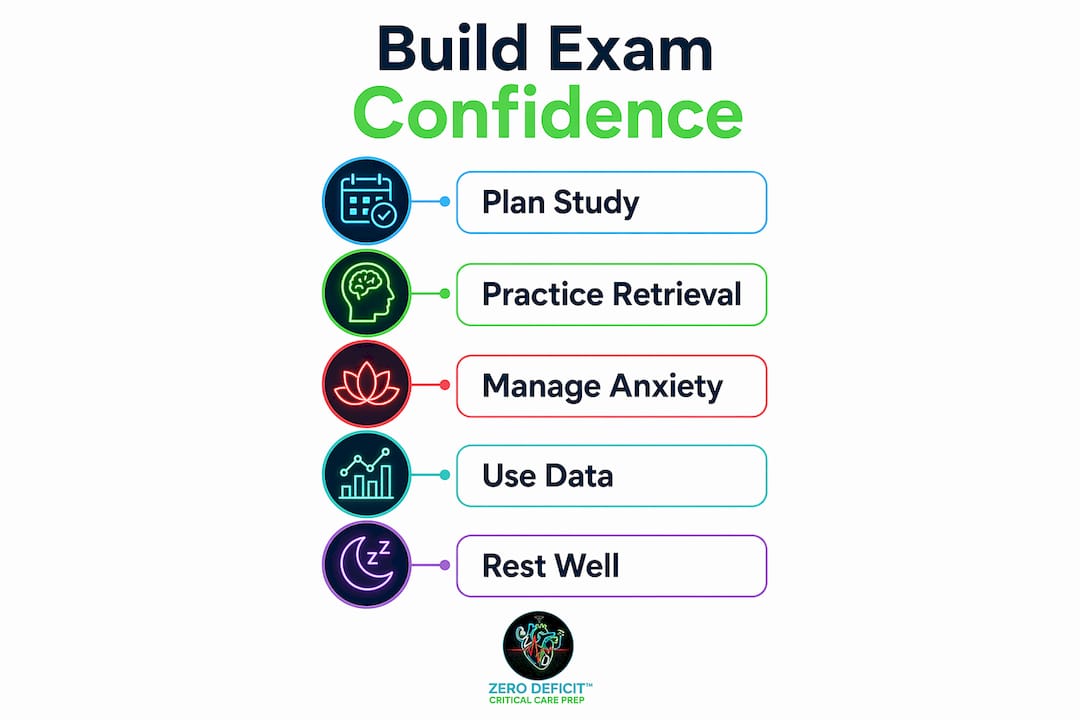
- Building exam confidence relies on structured preparation, active retrieval practice, and daily anxiety management. Tracking performance helps target weak areas and develop genuine clinical judgment under pressure. Consistent effort over 12 weeks fosters calm, focused exam performance and lasting confidence.
Exam confidence is defined as the ability to stay calm, focused, and assured during high-stakes testing. It develops through deliberate preparation, not luck or natural ability. For critical care nurses preparing for the AACN Adult CCRN certification, knowing how to build exam confidence is as clinically relevant as knowing your hemodynamic parameters. The strategies covered here combine evidence-based study planning, retrieval practice, anxiety management, and targeted feedback loops. Each one is grounded in what actually works for ICU nurses sitting for certification.
How to build exam confidence with a structured study plan
A structured study plan is the single most effective tool for reducing pre-exam uncertainty. The University of Sydney advises clarifying exam format, question types, duration, and coverage before building your schedule. For the CCRN, that means knowing you face 150 multiple-choice questions weighted heavily toward cardiovascular, pulmonary, and multisystem content per the AACN blueprint.

Build your plan around your real life, not an idealized version of it. Account for 12-hour shifts, sleep, meals, and recovery time. Deakin University research confirms that balancing study with sleep and healthy activities supports both wellbeing and exam performance. Skipping sleep to squeeze in extra content review is counterproductive.
Use a layered revision approach. Start with a broad overview of all eight body systems, then return to your weakest areas for deeper study. A 12-week CCRN study plan structures this progression so you are not cramming vasopressors and CRRT the night before your exam. Update your daily plan at the end of each session based on what you actually covered.
Key elements of a confidence-building study plan:
- Know the exam format. Confirm question count, time limit, and content weighting from the AACN website before week one.
- Schedule weak topics early. Hemodynamics, ARDS, and sepsis/MODS need more repetition than topics you already know well.
- Use spaced repetition. Reviewing content at increasing intervals strengthens long-term retention far better than massed review. Zerodeficitccrnprep covers spaced repetition techniques specifically for CCRN prep.
- Cap daily study sessions. Two to three focused hours beats six unfocused hours every time.
- End each session with a recap. Write three key points you learned. This doubles as retrieval practice.
Pro Tip: Set a hard stop time for studying each day. Overpreparation without recovery leads to burnout, not better scores. Confidence comes from consistent, sustainable effort.
Why retrieval practice is the fastest way to boost exam confidence
Passive rereading feels productive but does not build the memory access you need under pressure. Active retrieval, pulling information from memory without looking at notes, is the mechanism that actually prepares you for test conditions. A meta-analysis published in Swiss Psychology Open found that retrieval practice produces better memory performance under stress compared to restudy. That finding matters directly for CCRN candidates who experience anxiety on test day.
Here is how to apply retrieval practice systematically:
- Close the notes and answer from memory. After reading about cardiogenic shock management, close the material and write out the hemodynamic profile, vasopressor choices, and nursing priorities without looking.
- Use timed practice questions. The CCRN allows roughly one minute per question. Practice at that pace from the start, not just in the final week.
- Run full mock exams. Mock tests simulate real exam conditions and expose timing weaknesses and content gaps before test day. Treat each mock as a real exam, same environment, same time limit.
- Review every wrong answer with rationale. Understanding why an answer is wrong builds deeper knowledge than simply noting the correct choice.
- Repeat weak-area questions within 48 hours. Immediate re-exposure to missed content accelerates retention.
The table below shows the difference in preparation approach between passive and active study methods:
| Study Method | Mechanism | Outcome Under Exam Stress |
|---|---|---|
| Passive rereading | Recognition memory | Fragile; fails under pressure |
| Flashcard review | Cued recall | Moderate; depends on cue match |
| Timed practice questions | Active retrieval | Strong; mirrors real exam conditions |
| Full mock exam | Full retrieval simulation | Strongest; builds timing and confidence |
Zerodeficitccrnprep offers over 695 CCRN practice questions with detailed rationales written by expert ICU nurses. That volume of deliberate retrieval practice is what separates candidates who feel ready from those who feel like they are guessing.
Pro Tip: After each practice session, flag every question that made you hesitate, even if you got it right. Hesitation signals a knowledge gap worth closing before exam day.
What techniques help manage anxiety on exam day?
Test anxiety is a physiological and cognitive response, not a character flaw. Deakin University research confirms that exam confidence builds through combining study strategies with daily relaxation practice and active positive thinking. The key word is daily. Relaxation practiced only on exam morning does not produce the on-demand calm you need.
Practical techniques for overcoming exam anxiety include:
- Daily diaphragmatic breathing. Practice four counts in, hold four, out four. Do this every morning for two weeks before your exam. Your nervous system learns to downregulate faster with repetition.
- Challenge specific negative thoughts. Replacing “I will fail” with a concrete, evidence-based statement like “I have completed 400 practice questions and scored above passing threshold” is more effective than vague reassurance. Identifying specific negative thoughts and replacing them with factual ones is the mechanism that works.
- Use visualization before sleep. Picture yourself reading a question calmly, working through the clinical scenario, and selecting the correct answer. This primes your brain for the real experience.
- Avoid negative pre-exam conversations. Peers who catastrophize before the exam raise everyone’s cortisol. Step away from that conversation.
- Pack your bag the night before. Your exam day checklist should include ID, snacks, water, and arrival time with buffer. Logistical stress on exam morning compounds cognitive anxiety.
If your mind blanks during the exam, stop and run a micro-comprehension check. Read one sentence of the question and summarize it in your own words. This short circuit breaks the anxiety loop and restores working memory access. It sounds simple because it is, and it works.
Pro Tip: Arrive at the testing center 20 minutes early. Rushing to the exam is one of the most preventable anxiety triggers. Treat arrival time as part of your exam strategy.
How does performance data turn anxiety into competence?
Test anxiety decreases with repetition and targeted improvement, not with reassurance. The AMA confirms that using performance data to address weak areas is the mechanism that reduces anxiety over time. Anxiety is information. It tells you exactly where your knowledge gaps are.
Follow this four-step feedback loop:
- Track your anxiety triggers by topic. After each practice session, note which content areas caused hesitation or wrong answers. For CCRN candidates, common triggers include pulmonary artery catheter interpretation, CRRT troubleshooting, and Synergy Model application.
- Convert triggers into practice targets. Do not avoid the topics that make you anxious. Schedule deliberate re-practice on those exact areas under timed conditions.
- Repeat until hesitation disappears. The goal is not to eliminate all anxiety. The goal is to replace uncertainty with competence on specific content. Nursing candidates who track anxiety-triggering topics and practice them systematically build genuine confidence, not false optimism.
- Adjust your study focus weekly. Review your performance data every Sunday. Shift time toward topics where your accuracy is still below your target threshold.
Total elimination of test anxiety is unrealistic. The goal is a managed, productive level of arousal that sharpens focus rather than shutting it down. Competence built through deliberate practice is the only reliable source of lasting exam confidence.
Key takeaways
Building exam confidence for the CCRN requires combining structured preparation, active retrieval practice, daily anxiety management, and a performance-driven feedback loop.
| Point | Details |
|---|---|
| Structure your study plan | Know the CCRN format early and build a realistic schedule around your shifts and recovery time. |
| Prioritize retrieval practice | Timed practice questions and mock exams build stronger memory access than passive rereading. |
| Practice relaxation daily | Daily breathing and positive thinking exercises create on-demand calm for exam day. |
| Use anxiety as feedback | Track which topics trigger hesitation and target those areas with deliberate timed practice. |
| Avoid overpreparation | Sustainable study with adequate sleep and recovery produces better outcomes than cramming. |
What I have learned about confidence and the CCRN
Most nurses I work with come in thinking confidence is something you either have or you do not. That belief is the first thing worth correcting. Confidence for the CCRN is a skill you build the same way you built clinical competence in the ICU. You did not walk into your first shift knowing how to titrate a norepinephrine drip. You learned it through repetition, feedback, and time.
The biggest mistake I see is nurses who overprepare content and underprepare their nervous system. They read every hemodynamic chapter twice but never practice breathing under pressure or challenge the thought “I am not smart enough for this exam.” Both matter. The CCRN tests clinical judgment under time pressure, and anxiety directly degrades the judgment you have already built.
The second mistake is avoiding weak topics. If pulmonary artery catheter waveforms make you anxious, that anxiety is a signal, not a verdict. Work through those questions with rationale until the hesitation is gone. That is how you convert a liability into a strength.
Confidence built on real preparation does not waver when a question is hard. You read it, apply the clinical framework, and trust the work you put in. That is the goal. You can get there.
— Zero
Zerodeficitccrnprep resources built for CCRN confidence
Critical care nurses preparing for the CCRN need more than a textbook. They need resources that mirror the real exam and give immediate, specific feedback.
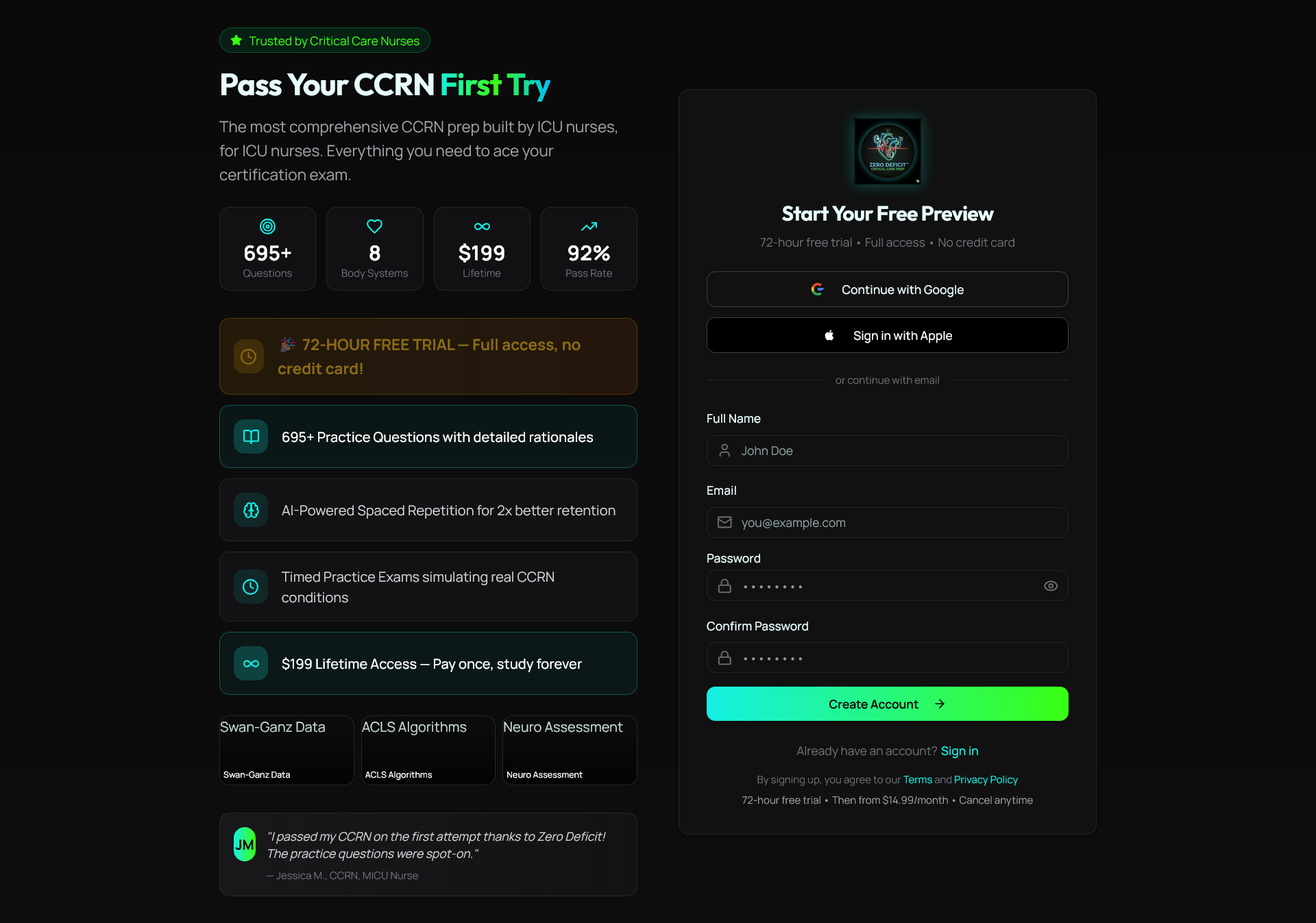
Zerodeficitccrnprep offers CCRN practice tests covering all eight body systems, written by expert ICU nurses with detailed rationales for every question. The 695+ question bank lets you drill by system, track your accuracy over time, and target the exact content gaps driving your anxiety. Pair the practice tests with the CCRN study guides for a complete prep system that builds both knowledge and confidence before test day.
FAQ
What is exam confidence for nursing certification?
Exam confidence is the ability to stay calm, focused, and assured during a high-stakes test. It develops through preparation, daily relaxation practice, and active management of negative thoughts, not through natural ability alone.
How long does it take to build exam confidence for the CCRN?
A structured 12-week study plan gives most candidates enough time to build both content mastery and test-taking confidence. Consistency matters more than total hours.
Does retrieval practice really reduce test anxiety?
Yes. Research published in Swiss Psychology Open shows retrieval practice produces better memory performance under stress compared to passive restudy. Regular timed practice questions are the most direct way to build confidence under exam conditions.
What should I do if my mind goes blank during the exam?
Stop, read one sentence of the question, and summarize it in your own words. This micro-comprehension check breaks the anxiety loop and restores working memory access, as recommended by Deakin University counseling research.
How do I know which topics to focus on for the CCRN?
Track which topics cause hesitation or wrong answers during practice sessions. Common high-anxiety areas for CCRN candidates include hemodynamic monitoring, ARDS management, and the Synergy Model. Use that data to direct your study time each week.
Recommended
- Why Is Confidence Important in Exams: A Nurse’s Guide | Zero Deficit CCRN Prep
- How educators boost CCRN certification success for nurses | Zero Deficit CCRN Prep
- Pass the CCRN Exam: Proven Guide for Critical Care Nurses | Zero Deficit CCRN Prep
- Step by Step Exam Review for the CCRN: 2026 Guide | Zero Deficit CCRN Prep
Take a Cardiovascular practice quiz
Test your mastery of hemodynamics, ACLS, MI, arrhythmias, and heart failure.
Get Your Free 20-Question CCRN Diagnostic
20 high-yield CCRN-style questions across every body system, with detailed rationales — emailed to you instantly.
No spam. One email + a couple of helpful follow-ups. Unsubscribe anytime.
Ready to pass your CCRN?
Join 12,000+ nurses using Zero Deficit — 695+ practice questions with rationales, AI-powered weak-area drilling, and spaced-repetition flashcards.
Start Free Trial →