Best Neuro CCRN Review: How to Choose in 2026

The best neuro CCRN review is the one that makes you reason through a patient, not recite a fact. That means scenario questions with a full rationale for every answer option, a study guide organized by neuro problem, and a way to track which topics keep costing you points. For most ICU nurses, Zero Deficit™ neurology practice questions with rationales cover all three in one place. Below is how the main options compare, what the neuro section of the exam asks of you, and how to build a plan around it.
TL;DR
- Neuro is a content area where the exam tests prioritization: what you do first, what you check next, and what you stop doing.
- A strong neuro review pairs a study guide organized by problem with scenario questions that explain every option, right and wrong.
- Flashcards and printed books are useful for vocabulary and facts. Rationale-driven questions are what build the judgment the exam rewards.
- Zero Deficit™ offers a neurology study guide, neurology practice questions, spaced repetition, AI-powered review tools and progress tracking, from $14.99 per month or $84.99 per year.
- Pick your review against the current test plan, then spend your time where your own results show gaps.
Table of Contents
- What the neuro section of the adult CCRN actually asks
- How to compare neuro CCRN review options
- What a good neuro review should include
- The neuro topics that deserve the most time
- A four-week neuro plan
- Why rationales matter more than question count
- Our perspective on neuro review
- Start with the neurology set
- FAQ
- Sources
What the neuro section of the adult CCRN actually asks
Before you compare resources, know the target. The adult CCRN test plan lists 15 neurological problems: acute spinal cord injury, brain death, encephalopathy, stroke, hydrocephalus, neurogenic shock, neurologic infectious disease, neurological storming, neuromuscular disorders, neurosurgery, neurovascular abnormalities, seizure disorders, space-occupying lesions, spinal surgeries, and traumatic brain injury. That list applies to exams taken on or after November 12, 2025. Always confirm the current version on the AACN certification page before you commit to a plan.
Two things stand out in that list.
First, it is broad. A nurse on a dedicated neuro ICU may have seen most of these. A nurse from a cardiac or medical ICU may rarely have managed neuromuscular disorders, neurological storming or neurogenic shock. Your review needs to cover your blind spots, not just reinforce what you already do well.
Second, many of these problems overlap with other systems. Neurogenic shock is a hemodynamics question. Encephalopathy shows up with sepsis, liver failure and renal failure. Seizures connect to electrolytes and endocrine emergencies. A good neuro review teaches the connections, because the exam does not announce which body system a question belongs to.
Question types you should expect
The CCRN is built on clinical judgment. In neuro that usually looks like:
- Recognition: a patient’s change in exam or monitor trend, and what it most likely means.
- Prioritization: several reasonable actions, one of which should happen first.
- Intervention and response: you act, then the stem tells you what happened and asks what comes next.
- Safety and ethics: brain death evaluation, family communication, organ donation processes and advocacy for the patient.
A review resource that only tests recall of facts leaves you short on three of those four.
How to compare neuro CCRN review options
You will find four kinds of resources when you search for neuro CCRN review material. Here is how they compare on the criteria that matter once you are studying.
| Criterion | Zero Deficit™ | Printed prep books | Free flashcard decks | Broad generic question banks |
|---|---|---|---|---|
| Neuro-specific study guide | Yes, neurology study guide organized by topic | One chapter within a full-exam book | Terms and short facts | Rarely a separate guide |
| Neuro practice questions | Yes, neurology practice questions | A limited set at the chapter end | Mostly recall prompts | Varies by product |
| Detailed rationales | Detailed rationales for practice questions | Varies by book | Usually none | Varies |
| Personalized review | AI-powered review tools, spaced repetition, progress tracking | None | Self-managed | Varies |
| Exam simulations | Yes | Usually one or two practice exams | No | Varies |
| Published pricing | $14.99 per month, $84.99 per year, lifetime plan listed | One-time book purchase | Free | Varies |
The table shows the pattern. Books and flashcards are static: they give you the same content in the same order no matter what you miss. A platform that tracks your answers can send you back to cerebral perfusion pressure on Tuesday and seizure management on Friday, based on what you got wrong. That is the practical difference between reading about neuro and being drilled on it.
Printed prep books
A printed book gives you a single, portable review of the whole exam, including a neuro chapter. It is a reasonable way to see the full scope of the test. The limitation is depth: one chapter has to cover fifteen neuro problems, and a fixed set of questions cannot adapt to you. If you use a book, treat it as a first pass, then move to scenario questions with full rationales to test whether the material actually stuck.
Free flashcard decks
Community flashcard sets are quick for cranial nerves, Glasgow Coma Scale components and drug names. They work for memorizing facts. They do not show you how to apply those facts to a deteriorating patient, and nobody checks that the content matches the current test plan. Use them for odd minutes on your phone, and let your main review do the reasoning work.
Broad question banks
Large general question banks cover every system, which helps late in your prep. For a neuro-specific review, the problem is filtering: you may have to wade through cardiac and pulmonary questions to reach the neuro set, and rationales may stop at the correct answer without explaining why the others fail. Look for a bank that lets you work one system at a time and explains every option.
Zero Deficit™ neuro review
Zero Deficit™ is built for the adult CCRN and organized by body system. For neuro, you get a study guide by topic and a neurology question set with rationales, part of a bank of over 695 practice questions written by expert ICU nurses. Detailed rationales explain each answer, AI-powered review tools help personalize what you revisit, and spaced repetition brings missed concepts back before you forget them. For a nurse who wants one system to study, drill and track, it is the best fit of the four.
What a good neuro review should include
Use this checklist to judge any resource, ours included.
- It matches the adult CCRN. Pediatric and neonatal content has no place in your adult prep.
- It follows the current test plan. Check that the topics match the 15 neuro problems above.
- Every option is explained. You learn as much from why the distractor is wrong as from why the key is right. Our guide on how to review CCRN rationales walks through the habit.
- Questions are clinical scenarios. Look for stems with a patient, a trend and a decision.
- It lets you isolate one system. You should be able to drill neuro alone, then mix systems later.
- It tracks your results. Without data, you study what you like instead of what you miss.
- It includes full-length simulation. Stamina and pacing matter on a long exam.
The neuro topics that deserve the most time
All 15 problems are fair game, but some deserve extra hours because they combine several skills.
Intracranial pressure and traumatic brain injury
Expect questions on interpreting ICP and cerebral perfusion pressure trends, positioning, sedation and osmotic therapy, and recognizing herniation signs. The trap is treating a number without checking the patient. Practice reading the stem for the trend, the exam findings and what the team has already tried.
Stroke and neurovascular abnormalities
Stroke questions combine time-sensitive decisions, blood pressure targets, and complication recognition. Work through ischemic and hemorrhagic scenarios separately, because the priorities differ. Use current AHA/ASA stroke guidance as your reference for treatment windows and thresholds, and confirm that your question bank reflects guidelines published from 2020 on. Subarachnoid hemorrhage, aneurysm management and vasospasm belong here too.
Seizures and neurological storming
Seizure questions test first-line response, airway and safety, and what to do when seizures do not stop. Storming is easy to overlook: practice telling it apart from sepsis or withdrawal in a patient with severe brain injury.
Brain death and ethics
This area tests process, prerequisites, communication with families, and your role as an advocate. It overlaps with the Synergy Model and professional caring and ethical practice, so study them together.
Spinal cord injury, neurogenic shock and spinal surgery
Neurogenic shock sits between neuro and cardiovascular, so read the hemodynamic pattern carefully and compare it with other shock states. Our interactive shock flowchart helps you sort these. For a refresher on the very first response to a suspected spinal injury, this emergency care for suspected spinal injury course outline is a clear reference on the principles of immobilization.
Neuromuscular disorders, encephalopathy, infections and space-occupying lesions
These are the topics many ICU nurses meet least often. Guillain-Barré, myasthenic crisis, meningitis and encephalitis, hepatic and septic encephalopathy, and tumors with mass effect all appear in the list. Give them scheduled time rather than leaving them for the end.
A four-week neuro plan
You do not need to finish neuro in one weekend. A short, repeating cycle works better.
Week 1: Baseline. Take a set of neurology questions cold. Do not look anything up. Record your score by topic, because this is your map. Then read the neuro study guide for your two weakest problems.
Week 2: Learn and apply. Read the guide section, then immediately answer questions on the same topic. Read every rationale, including those for questions you got right. Write one line for each miss: what you assumed, and what the stem actually said.
Week 3: Mix and connect. Combine neuro with cardiovascular and pulmonary questions. Neurogenic shock, ICP with mechanical ventilation and seizure with metabolic derangement all need cross-system thinking. A case study practice plan can structure those sessions.
Week 4: Test and tighten. Take a timed set, review misses, and let spaced repetition resurface weak concepts. Use practice question strategies to work on pacing and elimination.
If you also use mnemonics for neuro assessment, keep them short and test them against scenarios; our list of nursing mnemonics for CCRN can help.
Why rationales matter more than question count
A big question count looks impressive, but what you take away depends on the explanation. A rationale shows the reasoning chain: what the stem is really asking, which finding drives the decision, and why the tempting wrong answer fails. Reading that chain over and over is how you build the habit the exam rewards. If you want to see what that looks like, read 695+ CCRN questions with rationales and the role of exam rationales in certification success.

This is also why we recommend working through neuro by system rather than in random mixed sets early on. When you see ten stroke and bleed scenarios in a row, you notice the patterns that separate them.
Our perspective on neuro review
Neuro is where many strong ICU nurses lose points, not because they lack skill at the bedside, but because the exam asks them to name their reasoning. We built Zero Deficit™ around that gap.
Our study guides and over 695 practice questions are written by expert ICU nurses, and every question comes with a detailed rationale. We want you to finish a neuro set knowing why each option was right or wrong, not just which letter to pick.
Our AI-powered review tools and spaced repetition are designed to bring back the concepts you miss, so your time goes where your results say it should. The goal in the name is simple: no gaps in your preparation, and the confidence to walk into the exam ready.
Zero
Start with the neurology set
If you are ready to begin, open the neurology practice questions and take a baseline set. When you want the full bank, simulations and tracking, Zero Deficit™ plans are $14.99 per month or $84.99 per year, and a Lifetime Mastery plan is also offered on the subscription page. A free trial is available.
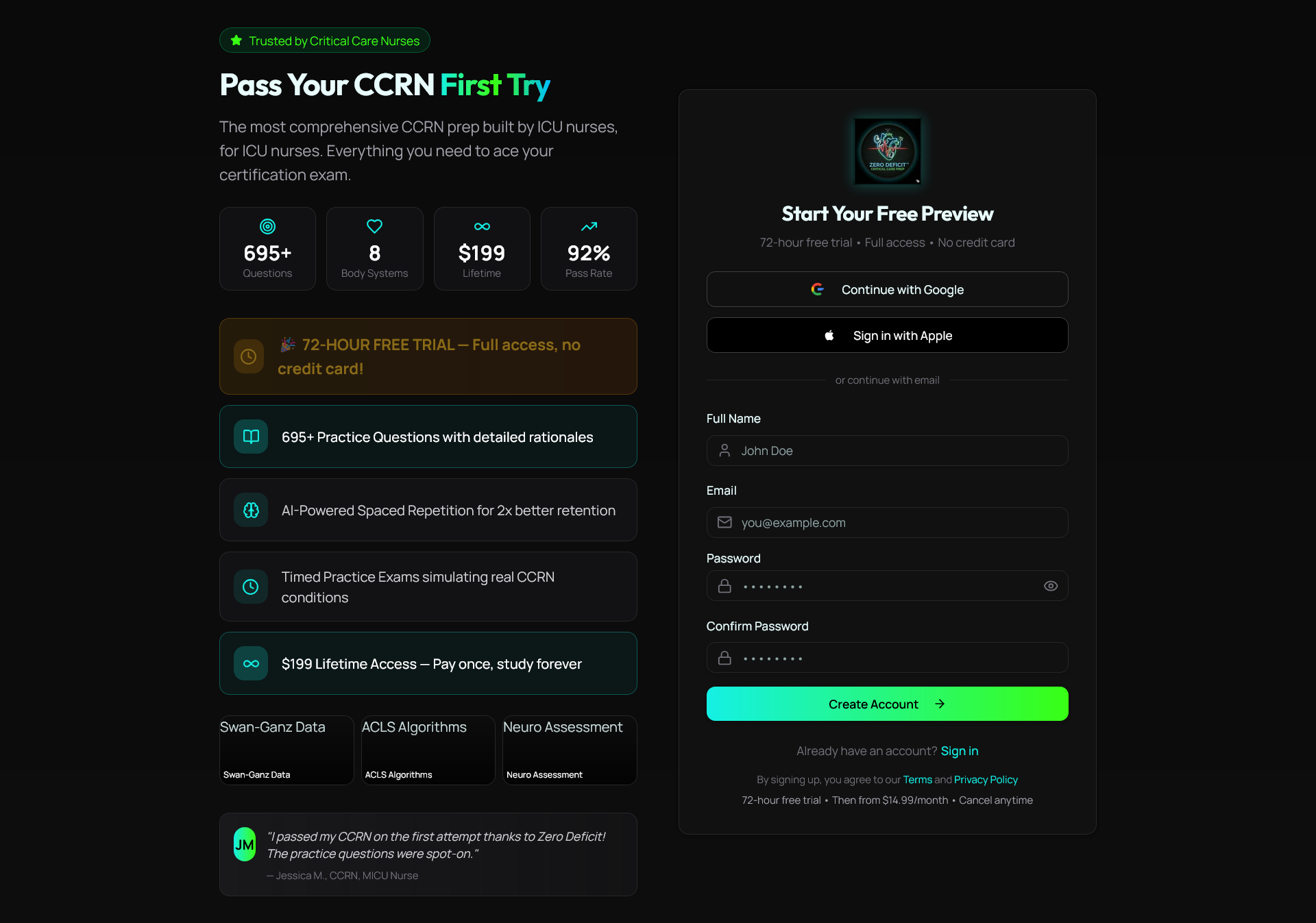
If your exam is months away, the annual plan fits a steady, spaced schedule. If you are closing in on test day, monthly access keeps the commitment short while you cover the full body-system list.
FAQ
Is there a neuro-only CCRN review?
Yes. Zero Deficit™ offers a neurology study guide and a neurology practice question set that you can work through on their own. They sit inside a larger bank covering every body system, so you can move to mixed sets when you are ready.
How many neuro questions should I do before the exam?
There is no official number. Aim to cover every problem on the test plan at least twice: once to find gaps, and once after studying them. Count quality over quantity, and read every rationale. Your results by topic tell you when to move on.
Should I study neuro first or last?
Start with the system you find hardest. If you work in a cardiac or medical ICU, that is often neuro. Take a baseline set, study your weakest topics early, and revisit them with spaced repetition until test day.
Can I use the same review if I am retaking the CCRN?
Yes, and your score report is a useful starting point. Focus your neuro time on the areas where you scored lowest, then use scenario questions with rationales to correct the reasoning that cost you points. Ready to start? Try the Zero Deficit™ CCRN practice questions today.
Sources
Recommended
Take a Neurological practice quiz
Test your knowledge of stroke, ICP, seizures, and neuro assessment.
Get Your Free 20-Question CCRN Diagnostic
20 high-yield CCRN-style questions across every body system, with detailed rationales — emailed to you instantly.
No spam. One email + a couple of helpful follow-ups. Unsubscribe anytime.
Ready to pass your CCRN?
Join 12,000+ nurses using Zero Deficit — 695+ practice questions with rationales, AI-powered weak-area drilling, and spaced-repetition flashcards.
Start Free Trial →