How to Earn CCRN Achievement Badges: 2026 Guide
TL;DR:
- CCRN achievement badges are digital credentials that verify critical care nursing expertise issued by the AACN.
- Earning the badge involves meeting eligibility requirements, passing a 150-question exam, and claiming the badge through Credly.
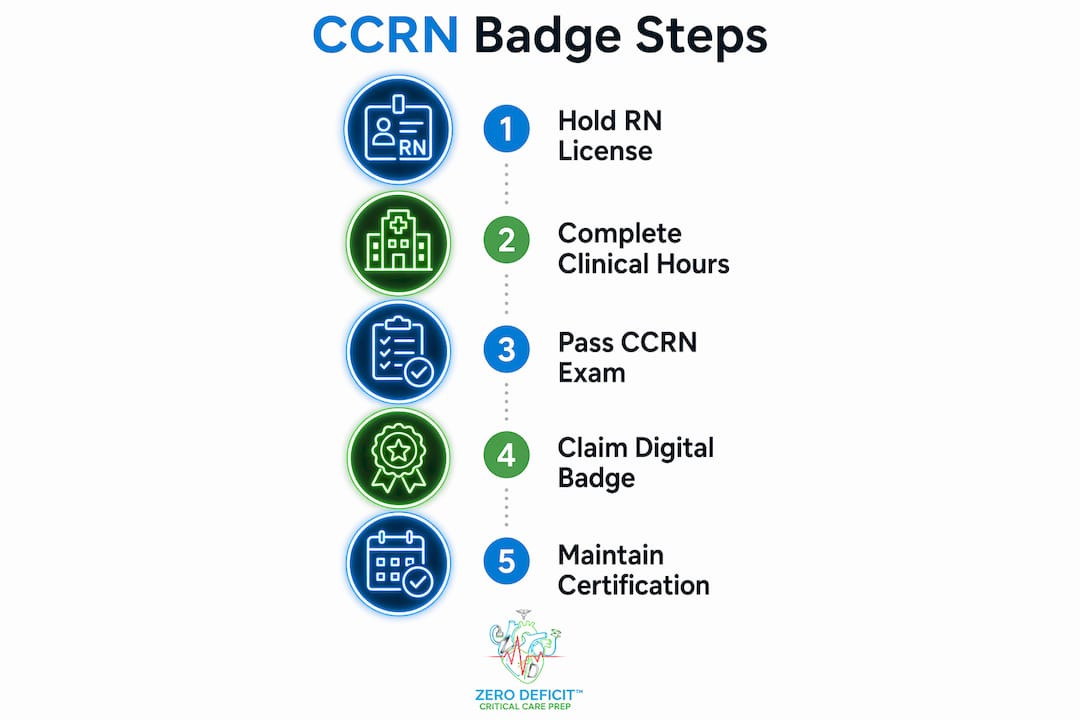
CCRN achievement badges are digital credentials issued by the American Association of Critical-Care Nurses (AACN) that verify your expertise in adult critical care nursing. Knowing how to earn CCRN achievement badges means understanding three sequential steps: meeting eligibility requirements, passing the CCRN exam, and claiming your digital badge through the AACN’s credentialing platform. Each step has specific requirements, and skipping or misunderstanding any one of them delays your credential. This guide walks you through every stage, including renewal, so you can earn and keep your badge without surprises.
What are the eligibility requirements for earning CCRN achievement badges?
Eligibility is the first gate, and the AACN enforces it strictly. You must hold a current, unencumbered U.S. RN or APRN license before you can apply. No provisional licenses and no licenses under investigation qualify.

Clinical hours are the second requirement, and the AACN offers two pathways.
| Pathway | Total Hours Required | Minimum Recent Hours |
|---|---|---|
| 2-year pathway | 1,750 hours | 875 hours in the most recent year |
| 5-year pathway | 2,000 hours | 875 hours in the most recent 2 years |
The 2-year pathway suits nurses who have been working full-time in a critical care setting recently. The 5-year pathway accommodates nurses who stepped away from bedside practice for a period but still have a strong cumulative clinical background.
Hours must come from direct care of acutely or critically ill patients. Charge nurse time counts if you provided direct patient care during that shift. Administrative-only roles do not count. A supervisor or manager must verify your hours on the application, so keep your own records current rather than relying on HR to reconstruct them later.
Pro Tip: Start a simple spreadsheet the day you begin tracking hours. Log the date, unit, shift length, and patient acuity. Reconstructing two years of hours from memory is one of the most common application delays.
How to prepare for and pass the CCRN exam
The CCRN exam contains 150 multiple-choice questions completed within a 3-hour time limit. Of those, 125 questions are scored and 25 are unscored pretest items. You will not know which questions are pretest, so treat every question as if it counts.
Results appear on screen immediately after you finish. The AACN delivers your official certificate and digital badge within 2–4 weeks of passing. That window is when your badge claiming process begins.
Master the exam content domains
The AACN exam blueprint weights content by clinical category. Cardiovascular questions make up the largest portion, covering hemodynamics, shock states, ACS management, and vasoactive drips. Pulmonary follows, with ARDS, mechanical ventilation, and ABG interpretation as core topics. Neuro, sepsis and MODS, endocrine emergencies, and renal/CRRT round out the clinical content. Knowing the top CCRN study topics before you open a review book saves weeks of unfocused reading.
The Synergy Model and professional/ethical content account for roughly 20% of the exam. Nurses who focus only on clinical content and ignore Synergy Model questions often fall short of passing by a narrow margin.
Build your study plan around practice questions
Practice questions are the most efficient study method for the CCRN. They expose gaps in your knowledge faster than passive reading. Work through questions by content domain, review every rationale whether you answered correctly or not, and track your accuracy by category. A structured question strategy tells you exactly where to spend your remaining study time.
Aim to complete at least one full timed practice set before exam day. Timing yourself matters because 3 hours feels long until you hit a cluster of complex hemodynamic scenarios back to back.
Prepare for exam day logistics
Arrive at the testing center with two valid forms of ID. The name on your ID must match your AACN application exactly. Use the CCRN exam day checklist to confirm your authorization to test number, testing center address, and what you cannot bring into the room.
Pro Tip: Schedule your exam for mid-morning if possible. Most nurses report sharper focus between 9:00 AM and 11:00 AM compared to early morning or late afternoon slots.
How to claim and display your CCRN digital badge
After passing, the AACN sends an email with instructions and a link to the Credly platform. Credly is the third-party digital credentialing service the AACN uses to issue and manage all CCRN badges. The process is straightforward.
- Create a free Credly account using the email address on file with the AACN.
- Click “Accept” on the badge notification to add it to your Credly profile.
- Download the badge image or copy the shareable badge URL.
- Add the badge to your LinkedIn profile under “Licenses & Certifications.”
- Include the badge link or image in your professional email signature.
- Display the badge on your nursing portfolio or hospital ID badge holder card.
Credly badges contain embedded metadata that verifies your credential in real time. Any employer or recruiter who clicks your badge link sees your name, credential level, issue date, and expiration date instantly.
Compliance rules are non-negotiable. You may only display the CCRN designation after you receive official confirmation from the AACN. Using “CCRN” in your title, email signature, or resume before your badge is officially issued violates AACN policy. The same rule applies during any lapse in certification status.
Pro Tip: Set your Credly profile to public. Recruiters and Magnet program coordinators actively search Credly to verify credentials, and a private profile defeats the purpose of earning a digital badge.
How to maintain and renew your CCRN achievement badges
CCRN certification requires renewal every 3 years. The AACN offers two renewal pathways: retake the exam or earn 100 Continuing Education Recognition Points (CERPs). Most nurses choose the CERP pathway because it integrates naturally with ongoing professional development.
The AACN Synergy Model organizes CERPs into three categories, each with required minimums.
| CERP Category | Description | Required Points |
|---|---|---|
| Category A | Clinical judgment and patient care | 60–80 points |
| Category B | Advocacy, ethics, and professionalism | 10–25 points |
| Category C | Systems thinking and research | 10–25 points |
Category A carries the heaviest weight because it maps directly to bedside clinical competency. Category B and C requirements push you to engage with ethics education and quality improvement work, which are areas many bedside nurses undervalue until renewal time.
Renewal fees differ by membership status. AACN members pay approximately $170 for renewal, while non-members pay approximately $270. That fee difference alone often justifies the cost of AACN membership, especially when you factor in the free continuing education available to members.
AACN members can access approximately 70 or more free Category A CERPs annually through eLearning modules, journal articles, and recorded conference sessions. That volume covers most of your Category A requirement at no additional cost.
“Keeping an organized CERP record throughout the renewal cycle is vital to avoid lapses and credential suspension. Most renewal errors come from late CERP reconstruction, not from a genuine lack of continuing education.” — CCRN Renewal Expert Advice
A 90-day grace period exists after your certification expiration date. You can renew during this window, but you must pay a late fee and you cannot display the CCRN designation during the lapse. Using the CCRN credential during inactive status can trigger professional disciplinary action from your employer or the AACN. Treat your expiration date like a patient medication deadline: do not miss it.
Tracking CERPs throughout the cycle with a dedicated log prevents the most common renewal error. Record the course title, completion date, CERP count, and category for every activity. Auditing your totals six months before your expiration date gives you time to fill any gaps without rushing.
Key Takeaways
Earning and maintaining CCRN achievement badges requires meeting AACN eligibility criteria, passing a 150-question exam, claiming your Credly badge promptly, and renewing every 3 years with 100 CERPs across three Synergy categories.
| Point | Details |
|---|---|
| Eligibility comes first | You need a valid U.S. RN license and 1,750 hours in 2 years or 2,000 hours in 5 years. |
| Exam format is fixed | The CCRN has 150 questions, 125 scored, completed in 3 hours with immediate results. |
| Badge claiming requires Credly | Accept your AACN badge via Credly and display it only after official confirmation. |
| Renewal is every 3 years | Earn 100 CERPs across Categories A, B, and C, or retake the exam to stay certified. |
| CERP tracking prevents lapses | Log every continuing education activity by date, category, and point value throughout the cycle. |
What earning the CCRN badge actually does for your career
The CCRN badge is not a participation trophy. It is a market signal that tells Magnet hospitals, travel nursing agencies, and charge nurse hiring managers that you have validated clinical knowledge at a level most bedside nurses have not formally tested. Certified nurses at Magnet facilities often receive pay premiums of $1–$3 per hour or lump-sum bonuses ranging from $1,500 to $5,000. That is real money, and it compounds over a career.
What I find more valuable than the pay bump is what the certification process does to your clinical thinking. Preparing for the CCRN forces you to systematically review hemodynamics, vent management, and sepsis protocols in a way that years of bedside experience alone does not. You start connecting pathophysiology to your drip titrations more deliberately. That sharpens your practice in ways your patients benefit from directly.
My honest advice on renewal: do not treat CERPs as a checkbox exercise. Choose Category B and C activities that genuinely interest you, whether that is an ethics case study or a quality improvement project on your unit. Nurses who engage with renewal as professional growth rather than administrative burden stay sharper and renew on time without the last-minute scramble.
The badge on your LinkedIn profile and email signature does one more thing that nurses rarely talk about: it signals to your colleagues and your patients’ families that you chose to be held to a higher standard. That matters in a profession where trust is everything.
— Zero
Zerodeficitccrnprep can help you pass and earn your badge
Passing the CCRN exam is the critical step between eligibility and your digital badge. Zerodeficitccrnprep is built by expert ICU nurses who know exactly what the exam tests and how to prepare for it efficiently.
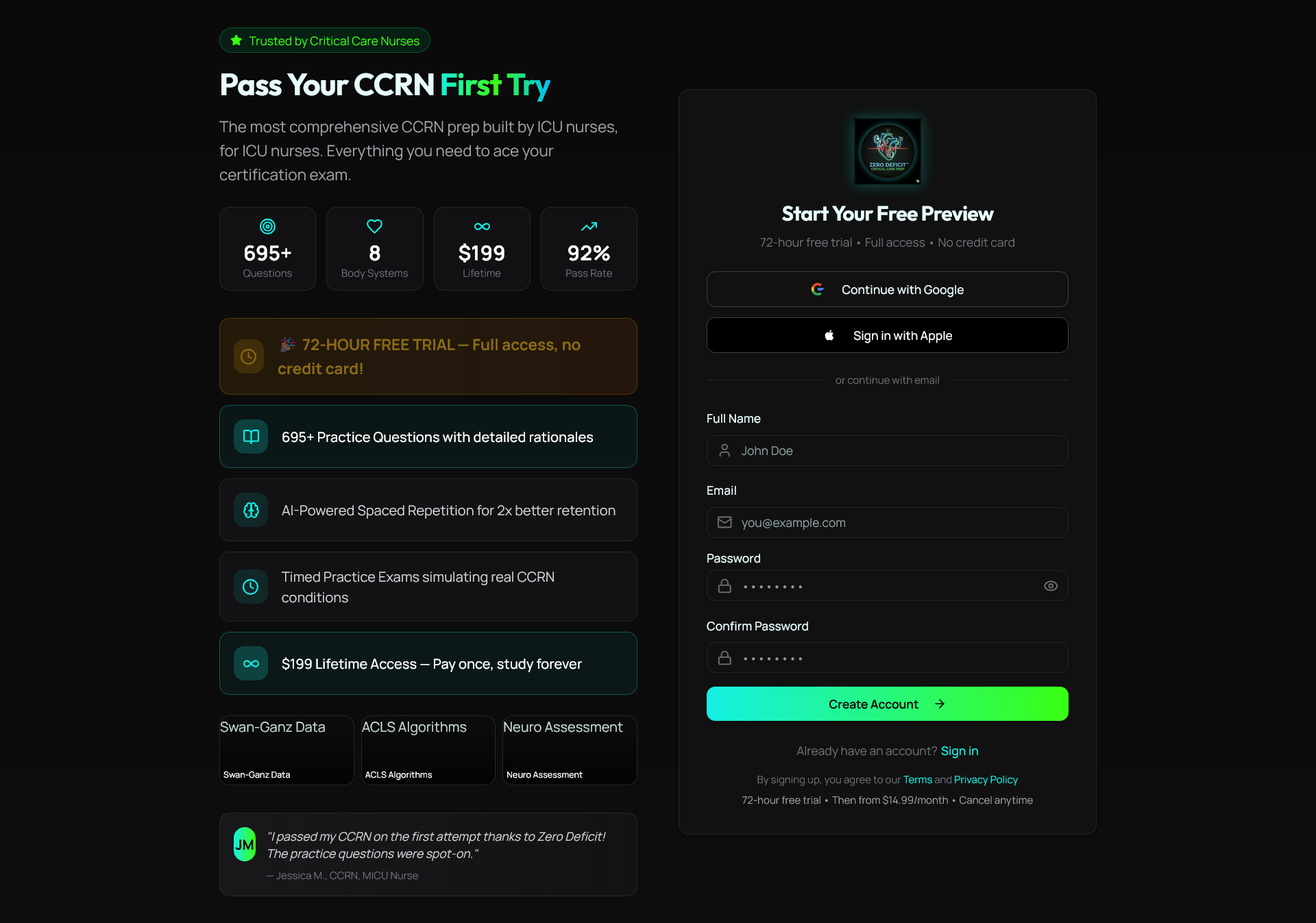
The platform includes over 695 practice questions with detailed rationales, question breakdown methods that teach you how to think through complex critical care scenarios, and CCRN study guides covering all 8 body systems on the exam blueprint. AI-powered review tools identify your weak content domains so you study what actually needs work. Nurses who use Zerodeficitccrnprep report passing on their first attempt with confidence built from deliberate, targeted preparation. Your badge is within reach.
FAQ
What are the CCRN badge requirements for clinical hours?
You need either 1,750 hours of direct critical care practice within the past 2 years or 2,000 hours within the past 5 years, with a minimum of 875 recent hours in both pathways.
How long does it take to receive your CCRN digital badge after passing?
The AACN delivers your official certificate and digital badge within 2–4 weeks of passing the exam, after which you claim it through the Credly platform.
Can you display the CCRN credential before your badge arrives?
No. Using the CCRN designation before receiving official confirmation from the AACN violates compliance rules and can result in disciplinary action.
How many CERPs do you need to renew your CCRN certification?
Renewal requires 100 total CERPs every 3 years, distributed across Category A (60–80 points), Category B (10–25 points), and Category C (10–25 points) per the AACN Synergy Model.
What happens if you miss your CCRN renewal deadline?
A 90-day grace period allows late renewal with additional fees, but you cannot display the CCRN credential during that lapse period without risking professional compliance violations.
Recommended
- How to track CCRN progress: a critical care nurse’s guide | Zero Deficit CCRN Prep
- Types of Critical Care Certifications: Your 2026 Guide | Zero Deficit CCRN Prep
- Pass the CCRN Exam: Proven Guide for Critical Care Nurses | Zero Deficit CCRN Prep
- Step by Step Exam Review for the CCRN: 2026 Guide | Zero Deficit CCRN Prep
Take a Cardiovascular practice quiz
Test your mastery of hemodynamics, ACLS, MI, arrhythmias, and heart failure.
Get Your Free 20-Question CCRN Diagnostic
20 high-yield CCRN-style questions across every body system, with detailed rationales — emailed to you instantly.
No spam. One email + a couple of helpful follow-ups. Unsubscribe anytime.
Ready to pass your CCRN?
Join 12,000+ nurses using Zero Deficit — 695+ practice questions with rationales, AI-powered weak-area drilling, and spaced-repetition flashcards.
Start Free Trial →