How to Review Body Systems Content for the Adult CCRN Exam
The most effective way to review body systems content is to prioritize by AACN test-plan weight, run every case through the Synergy Model instead of memorizing systems in isolation, and convert each concept into a timed practice question. That’s the whole method. Everything else is execution.
Start here, today:
- Pull the current test-plan weights and rank the six content blocks by percentage.
- Time yourself on 20 mixed practice questions to find your weakest block.
- Block two 45-minute study sessions this week for your lowest-confidence system.
- Self-assess your weak systems tonight.
- Schedule your first timed question block within 48 hours.
- Start a rationale log for every miss, using Zero Deficit™ questions if you need a bank that already maps to the blueprint.
Key Takeaways
Reviewing body systems well means studying by test-plan weight, applying clinical judgment across systems instead of in isolation, and drilling exam-style questions with rationales daily.
| Point | Details |
|---|---|
| Use the test plan as a budget | Allocate study hours by content weight, starting with Endocrine/Heme/GI/Renal/Integ at 21%. |
| Apply the Synergy Model | Link every patient problem to nursing competencies instead of memorizing isolated facts. |
| Prioritize practice questions | Daily timed drills with rationale review build clinical judgment faster than passive reading. |
| Track errors by type | Label misses as knowledge, interpretation, or prioritization to target remediation precisely. |
| Use Zero Deficit™ for structure | Over 695 practice questions and system-based guides align directly with current test-plan weights. |
Table of Contents
- How Do You Use the AACN Test Plan to Prioritize Study Time?
- What Clinical-Judgment Framework Should You Use for Every System?
- What Should Your System-by-System Study Checklist Include?
- Which Active Study Methods Actually Improve Exam Performance?
- How Do You Build a Study Plan From a Quick Self-Assessment?
- What Do ICU Nurses Get Wrong When Reviewing Body Systems?
- How Zero Deficit™ Supports This Exact Study Plan
- Where to Read More
- Sources
- FAQ
How Do You Use the AACN Test Plan to Prioritize Study Time?
Treat the test plan as a budget, not a syllabus. The current syllabus groups content into blocks including Endocrine/Hematology/GI/Renal/Integumentary as the largest content block, followed by Professional Caring and Ethical Practice, Musculoskeletal/Neurologic/Behavioral, Multisystem, Cardiovascular, and Respiratory in descending order of exam weight.
For a six-week plan, that translates roughly to:
- Weeks 1 to 2: Endocrine/Heme/GI/Renal/Integ and Professional Caring (highest combined weight).
- Weeks 3 to 4: Musculoskeletal/Neuro/Behavioral and Multisystem.
- Weeks 5 to 6: Cardiovascular and Respiratory, plus full remediation drills.
Two triage rules keep you honest: study high-weight blocks first to bank scored points early, and add extra drill time to anything that’s high-difficulty even if its weight is modest. Hemodynamics and ventilator reasoning fall into that second category more often than any other topic, according to OpenExamPrep’s breakdown of post-reweight study order.
What Clinical-Judgment Framework Should You Use for Every System?
Study each system through the lens of clinical judgment, not fact recall. The Synergy Model asks you to match nursing competencies to patient needs, and that’s exactly how AACN builds its clinical-judgment items rather than testing isolated trivia. Use this five-step checklist on every patient problem you review:
- Presentation: what does the patient look like at the bedside?
- Pathophysiology: what’s actually happening at the cellular or organ level?
- Key labs and vitals: what numbers confirm or rule out the diagnosis?
- Immediate bedside actions: what do you do in the first five minutes?
- Expected procedures and medications: what’s ordered next, and what side effects do you watch for?
Take an AKI patient with hyperkalemia at 6.8 mEq/L. Presentation might be vague, peaked T-waves on the monitor. Pathophysiology: reduced renal clearance. Key labs: potassium, creatinine, and an ECG. Immediate action: calcium gluconate for cardiac membrane stabilization, then insulin/dextrose and possibly dialysis. Turn each line into a flashcard prompt and a practice question stem.
Pro Tip: Write your flashcards as questions, not statements. “What’s the first action for peaked T-waves with hyperkalemia?” trains retrieval better than “Calcium gluconate stabilizes the myocardium.”
What Should Your System-by-System Study Checklist Include?
Every high-yield system needs the same skeleton: what to recognize, what to do first, and which numbers you have to know cold.
Cardiovascular. Know your hemodynamic targets: MAP at or above the minimum level to maintain perfusion, cardiac index within a normal functional range, and a passive leg raise test indicating fluid responsiveness by stroke volume increase, per PharmacyFreak’s hemodynamics review. Differentiate shock types by their hemodynamic fingerprint, know your vasoactive drip titration parameters (norepinephrine, vasopressin, dobutamine), and expect post-cardiac-surgery complications like tamponade and low cardiac output syndrome.

Respiratory. Master ventilator modes, ARDS diagnostic criteria, and how PEEP affects venous return and cardiac output. Apply ABG interpretation in a fixed order every time: check pH, then determine respiratory versus metabolic, then check compensation.
Neurologic. Know ICP thresholds (treat above 20 mmHg), stroke recognition windows for thrombolytics, brain death confirmation basics, and status epilepticus first-line management.
Endocrine/Heme/GI/Renal/Integumentary. Run DKA and HHS protocols by heart, apply KDIGO staging for AKI, recognize transfusion reaction red flags fast, and prioritize GI bleed resuscitation sequencing.
Multisystem/sepsis/MODS. Recognize early sepsis signals before hypotension develops, know initial bundle components, and understand organ-support technology basics: ECMO, CRRT, and targeted temperature management.
| Parameter | Target/Normal Value |
|---|---|
| MAP | minimum MAP |
| Lactate | ≤2 mmol/L |
| Cardiac index | normal cardiac index range |
| Fluid responsiveness (PLR) | stroke volume increase indicating fluid responsiveness |
ABG quick rule: pH abnormal plus matching CO2 direction means respiratory; pH abnormal plus matching HCO3 direction means metabolic. Check compensation last, never first.
Pro Tip: Build one mnemonic per system instead of ten. “MAP, Lactate, CI” as your cardiovascular anchor beats a page of scattered facts you’ll forget by exam day.
Endocrine/Heme/GI/Renal/Integumentary is the largest content block on the current syllabus, which justifies its prioritization in study schedules.
Which Active Study Methods Actually Improve Exam Performance?
Exam-style questions with rationales are your highest-yield activity, because they force clinical judgment under time pressure and expose reasoning gaps that flashcards alone never will.
- Do 20 to 30 mixed practice questions daily, reviewing every rationale immediately, right or wrong.
- Run one 60 to 90 minute timed block weekly that mimics real exam pacing.
- Re-test every missed question within 72 hours, not at the end of the week.
- Add a short case-based simulation or written walkthrough twice a week to practice synthesizing across systems instead of one at a time.
Keep an error log with three labels: knowledge gap, misinterpretation, or prioritization error. That single habit tells you whether you need more facts, more practice reading stems, or more repetition under pressure.
- Use spaced-repetition flashcards for labs, drips, and diagnostic criteria.
- Use full-length practice questions for mixed timed blocks and stamina building.
- Use progress tracking to redirect study time toward your worst-performing categories weekly.
Pro Tip: Log your misses by cause, not by topic. “Prioritization error” shows up across systems, and fixing that pattern raises your score faster than re-reading any single chapter.
How Do You Build a Study Plan From a Quick Self-Assessment?
Rate your confidence (1 to 5) across six areas: hemodynamics/shock, ventilator/ABGs, neuro emergencies, endocrine/renal crises, GI/heme, and sepsis/MODS. Your three lowest scores become weeks one and two of your plan.
- Weeks 1 to 2: deep review plus daily practice questions on your two weakest areas.
- Weeks 3 to 5: move through remaining systems by test-plan weight, heaviest first.
- Weeks 6 to 7: full-length timed practice exams, two per week.
- Week 8: light review, error-log cleanup, and one rest day between each remaining session.
Retakers on a compressed four-week plan should skip straight to weighted remediation: one week for the two lowest self-assessment scores, one week for the next two, one week for mixed timed blocks, and one final week combining a full practice exam with a two-day rest window before test day. Burnout kills retention faster than any content gap does, so protect that recovery time.
What Do ICU Nurses Get Wrong When Reviewing Body Systems?
The candidates who struggle usually memorize isolated facts and never practice applying them under a clock. The ones who pass consistently treat every review session as a rehearsal for clinical reasoning, not a vocabulary drill.
- Do practice mixed timed blocks weekly, even when you feel behind on content.
- Do build your error log from day one instead of “starting review” once you feel ready.
- Don’t study systems in strict isolation. Real patients present with overlapping pathology, and so does the exam.
- Don’t skip normal lab values because you “know them from the unit.” Exam stems test the number, not the vibe.
Two quick habits from nurses who passed on retake: rewrite every missed rationale in your own words before moving on, and review your weakest system first thing in the morning, when recall is sharpest.
How Zero Deficit™ Supports This Exact Study Plan
Every task above maps to a specific tool. Use exam-aligned practice sets for your mixed timed blocks, spaced-repetition flashcards for labs and drips, and progress analytics to redirect remediation toward whichever system your error log flags as weak.
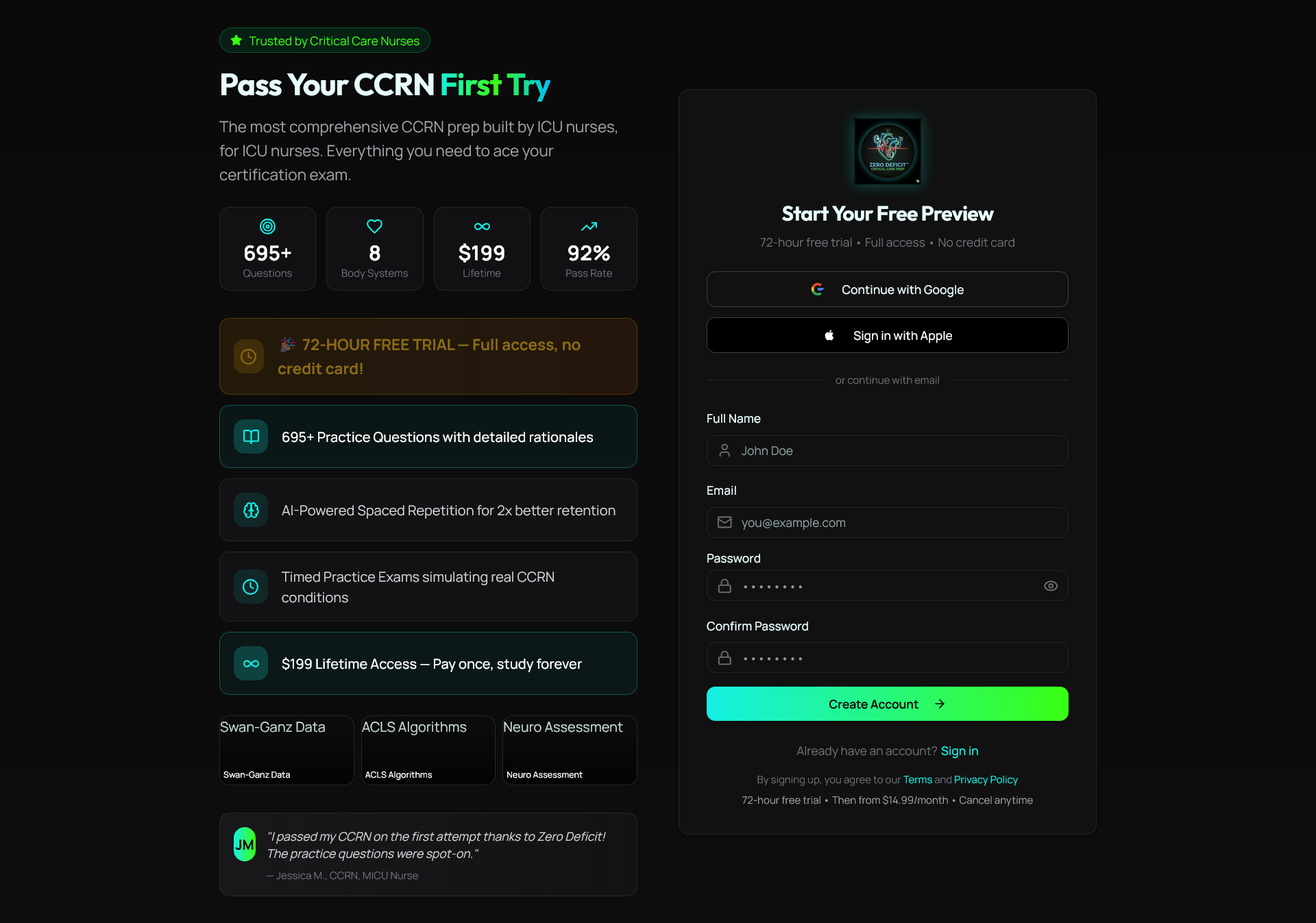
Zero Deficit™ gives you what a generic question bank can’t: content built specifically around the AACN Adult CCRN test-plan weights, with over 695 practice questions and rationales written by expert ICU nurses rather than generic test-writers. That means your practice time targets the same six content blocks that determine your score, not a random spread of nursing trivia.
Here’s what’s built in:
- System-based study guides mapped to current test-plan weighting.
- Practice tests with detailed rationales for every answer choice.
- Spaced-repetition flashcards for labs, drips, and diagnostic thresholds.
- Progress tracking that flags your weakest categories automatically.
- High-yield topic guides for shock, sepsis, and vasopressor management.
Start with a free trial or go straight to the practice question bank and run your first timed block today.
Where to Read More
For test-plan details, see the CCRN Exam Handbook and how-to-prepare guidance from AACN.
- Adult CCRN Review Course for module-level content alignment.
- Zero Deficit body-system study guides for topic-by-topic review.
- Bedside assessment refresher for vital signs and GCS scoring.
This article is general information, not a substitute for advice from a qualified doctor. Consult a qualified healthcare professional about your own circumstances before acting on anything here.
Sources
- CCRN Exam Handbook - Knowledge Professional
- How to Prepare for the CCRN Exam - AACN
- CCRN Hardest Topics + 8-Week Study Plan (FREE 2026) | OpenExamPrep
FAQ
What’s the fastest way to review body systems for the CCRN?
Prioritize by AACN test-plan weight, apply the Synergy Model to link physiology with nursing actions, then drill exam-style practice questions daily with rationale review.
How many practice questions should I do per day?
Aim for 20 to 30 daily, reviewing every rationale immediately, plus one longer timed block weekly to build exam stamina.
Which body system carries the most weight on the exam?
Should I study systems separately or together?
Study them together through clinical-judgment cases, since the Synergy Model and real patients rarely isolate one system at a time.
Does Zero Deficit™ cover all CCRN body systems?

Yes. Zero Deficit™ offers over 695 practice questions and study guides across all major content blocks, built by expert ICU nurses and mapped to current AACN test-plan weights.
Recommended
Take a Respiratory practice quiz
Master ARDS, ventilation, ABGs, oxygenation, and pulmonary emergencies.
Get Your Free 20-Question CCRN Diagnostic
20 high-yield CCRN-style questions across every body system, with detailed rationales — emailed to you instantly.
No spam. One email + a couple of helpful follow-ups. Unsubscribe anytime.
Ready to pass your CCRN?
Join 12,000+ nurses using Zero Deficit — 695+ practice questions with rationales, AI-powered weak-area drilling, and spaced-repetition flashcards.
Start Free Trial →