Three ICU Nursing Books to Buy First for CCRN Prep and Bedside Care

If you can only buy three ICU nursing books, get the AACN Core Curriculum for Progressive and Critical Care Nursing, AACN Essentials of Critical Care Nursing, and a concise bedside survival guide. The Core Curriculum is your CCRN study anchor, Essentials works as your quick-reference companion, and a pocket survival guide earns its place at your station. Check edition year before you buy: older editions drift from current CCRN blueprint content.
TL;DR:
- The CCRN test plan assigns 80% of its weighting to clinical judgment, so start question practice in week one and review every rationale.
- Keep a printed pocket guide for instant bedside checks, but use a searchable ebook for fuller drug information; hospital protocol governs dosing.
- New ICU nurses can begin with Essentials for baseline pattern recognition, while experienced candidates should use Core Curriculum chapters to target weak domains.
- Choose a focused specialty book only when practice questions expose a recurring gap, and check edition years because outdated guidance can conflict with exam content.
Table of Contents
- Essential CCRN Textbooks and Why They Matter
- Bedside Quick References and Pocket Guides
- Procedure and Skills Manuals You Should Keep Accessible
- Topic-Specific Books Worth Adding to Your Shelf
- How to Use Books Effectively for CCRN Exam Prep
- Buying, Formats, and Practical Tips
- Books for Building Critical Thinking, Not Just Recall
- Print Versus Digital ICU Resources: Which Fits You
- Supplementary Online Resources and Apps Worth Adding
- Choosing Books by Experience Level
- A Nurse-to-Nurse Take on Building Your Reading Stack
- Build Your Reading Stack Into Real Exam Readiness
- FAQ
Essential CCRN Textbooks and Why They Matter
Your CCRN exam tests clinical judgment across body systems, and the textbooks you choose should mirror that structure rather than fight it. Three titles do this well, each for a different reason.
The AACN Core Curriculum for Progressive and Critical Care Nursing (8th ed., 2022) runs about 950 pages and maps directly to the CCRN exam blueprint. This is the textbook AACN itself builds its certification content around, which makes it the closest thing to a syllabus you will find. It covers every system the exam tests: cardiovascular, pulmonary, neuro, renal, endocrine, and the Synergy Model that shapes the professional caring and ethical practice questions. You will not read this cover to cover in a weekend, and you should not try. Treat it as your reference text: when a practice question exposes a gap in your ACS management knowledge or your understanding of ICP waveforms, you open the Core Curriculum to that chapter and read with purpose.

AACN Essentials of Critical Care Nursing (5th ed., 2023) is a shorter, 635-page companion organized for faster retrieval. Where the Core Curriculum goes deep, Essentials gives you the practical, exam-relevant version of the same content with quick reference sections built in. Many ICU RNs use Essentials for their first pass through a system and the Core Curriculum when they need the full explanation behind a drug mechanism or a hemodynamic pattern.
Comprehensive Critical Care: Adult earns a spot when you want broader clinical depth beyond exam mapping, particularly if you are newer to the ICU and still building baseline pattern recognition across shock states, respiratory failure, and multisystem complications. It works best as a supplementary read rather than your primary study text, since it is not blueprint-organized the way AACN’s own titles are.
To extract exam-relevant material from any long textbook without losing weeks to it:
- Read by system, not cover to cover: match each chapter to a CCRN blueprint category before you open the book.
- Skim the chapter objectives first, then read only the sections tied to concepts you missed on a practice quiz.
- Write a one-paragraph summary after each chapter in your own words. If you cannot summarize it, you have not learned it yet.
- Cross-reference drug doses and lab values against your pocket guide so you are not memorizing two slightly different numbers from two sources.
Full textbooks give you the “why” behind clinical decisions. The CCRN rewards nurses who can apply that reasoning under pressure, not nurses who memorized a chapter.
Bedside Quick References and Pocket Guides
Textbooks live in your bag or your locker. Pocket guides live in your scrub pocket, and the difference matters when you need an answer in thirty seconds, not after your shift.
The Critical Care Survival Guide is built for exactly that situation: a concise, algorithm-driven bedside reference that is commonly recommended for new ICU clinicians who need fast answers without flipping through a 900-page text. It is organized around the decisions you actually make at 3 a.m., not around exam domains, which is precisely why it belongs at your station rather than in your study pile.
AACN also publishes pocket handbooks alongside other condensed references covering rhythm recognition, lab interpretation, and drug dosing ranges. These are not substitutes for your textbook study. They are speed tools.
A practical approach to choosing between a pocket guide and an e-book at the bedside:
- Use a printed pocket guide when you need a hands-free, instant-glance answer during a procedure or a rapid response.
- Use a searchable e-book or institutional app when you have thirty seconds to type a drug name and want the fuller monograph.
- Keep both synced: if your pocket guide lists a dose range that differs from your hospital’s protocol or your e-book’s current edition, flag it and confirm with pharmacy or your unit’s reference, since your hospital’s protocol always governs bedside practice.
- Replace a pocket guide when a new edition changes a dosing range or algorithm you rely on daily.
Pro Tip: Build a single index card for your top five drips (norepinephrine, propofol, insulin, heparin, amiodarone) with your unit’s standard concentration and dose range, and tape it inside your badge holder. It beats flipping through any guide mid-crisis.
What belongs in a well-built pocket reference: normal lab ranges (sodium generally between the mid-130s and mid-140s mEq/L, potassium typically ranging from the mid-3s to the low 5s mEq/L, lactate usually below 2 mmol/L), common vasoactive drip ranges, and a ventilator quick-check sheet covering appropriate tidal volume, PEEP, and plateau pressure targets for ARDS management. These three categories cover most of what you will reach for between report and lunch.
Procedure and Skills Manuals You Should Keep Accessible
A procedure manual answers a different question than a textbook. A textbook tells you why a central line infection risk rises with dwell time. A procedure manual tells you the steps to prep, drape, and dress the site correctly, in order, every time.
The AACN Procedure Manual for Progressive and Critical Care (8th ed., 2024) runs 1,236 pages and is organized as an illustrated, stepwise reference rather than a narrative text. It includes QR-code quick links and is available in e-book and institutional license formats, which makes it practical to pull up on a unit computer or tablet mid-procedure rather than hunting for a print copy. According to library discovery sources cataloging critical care references, experienced ICU nurses treat procedure manuals as the bedside how-to reference, keeping textbooks in the locker for deeper study instead.
Priority procedures worth having one tap away:
- Central line insertion assistance and dressing change protocol, including sterile field setup and infection prevention checkpoints.
- Ventilator initiation basics and troubleshooting steps for high-pressure or low-volume alarms.
- Code team role assignments and the sequence of actions during the first two minutes of a rapid response.
- Arterial line setup, zeroing, and waveform troubleshooting for accurate hemodynamic monitoring.
Use the procedure manual during the procedure, not after. If your unit has site-license access through AACN, that e-book version is worth bookmarking on every workstation before your next shift starts.
Topic-Specific Books Worth Adding to Your Shelf
Once your foundational textbook and procedure manual are in place, focused reading on the CCRN’s highest-weighted systems closes the gaps that broad textbooks sometimes skim.
- Ventilation and ARDS: a dedicated mechanical ventilation text helps you move past memorizing modes and into understanding why a patient with ARDS needs lower tidal volumes and permissive hypercapnia.
- Hemodynamics and shock: a focused hemodynamics guide pays off if waveform interpretation, cardiac output calculations, or vasopressor titration still feel shaky under time pressure.
- Sepsis and MODS: pairing your textbook chapter with current SCCM and ASPEN nutrition guidance keeps your sepsis knowledge aligned with guideline-level recommendations rather than outdated protocol memory.
- Renal and CRRT: a short CRRT-specific reference clarifies anticoagulation strategies and fluid balance targets that broad textbooks often compress into a page or two.
- Neurocritical care: a focused neuro text sharpens your ICP management and stroke recognition timing, both high-yield CCRN domains.
A simple decision rule: buy a focused title when a system consistently trips you up on practice questions, and lean on textbook chapters or current society guidelines when you just need a refresher. Buying five specialty books before you have even opened your Core Curriculum is a common and expensive mistake.
How to Use Books Effectively for CCRN Exam Prep
Pair an AACN textbook for conceptual depth, the procedure manual for skills verification, and a high-volume question bank for clinical judgment practice. Reading alone will not get you there: the CCRN weighs clinical judgment heavily across its scenarios, and AACN’s own review materials emphasize that an 80% clinical judgment weighting runs through the test plan. That weighting is exactly why question practice has to run alongside your reading from week one, not after it.
An 8 to 12 week workflow that pairs reading with active recall:
- Weeks 1 to 3: Build conceptual frameworks. Read Core Curriculum chapters for cardiovascular, pulmonary, and neuro, cross-referencing Essentials for the condensed version. Quiz yourself on each system immediately after reading.
- Weeks 4 to 6: Shift to sepsis, renal, endocrine, and the Synergy Model. Start building spaced-repetition flashcards for drug doses, lab values, and hemodynamic formulas as you go.
- Weeks 7 to 9: Run full-length practice question sets by system, using wrong answers to send you back to the specific textbook chapter, not the whole book. This is where a 6-week case study practice plan can tighten your weakest domains.
- Weeks 10 to 12: Run timed simulation tests that mimic exam pacing, review rationales for every miss, and revisit your one-page system summaries daily.
Pro Tip: Make a single-page cheat sheet per body system during your reading weeks, built only from what you got wrong on practice questions. By week 12, those pages become your entire review, not your textbooks.
Annotation matters more than volume. Highlight only what you would forget under stress: dosing ranges, diagnostic criteria, and anything you got wrong twice. If your hospital offers e-book access through VitalSource or a similar platform, use the search function to jump straight to a term instead of flipping pages, especially during a focused review week. For a structured walkthrough of this pairing strategy, a step-by-step CCRN exam guide breaks down timing in more detail.
Buying, Formats, and Practical Tips
Check the edition year before buying: AACN titles update on a multi-year cycle, and a guideline-driven field like critical care shifts fast enough that a stale edition can cost you points on current practice questions.
- Searchable e-books win for study sessions where you need to jump between topics quickly.
- Print pocket guides win for bedside speed when you cannot type a search query mid-procedure.
- Check your hospital library or nursing school portal for institutional site licenses before buying, since many units already carry AACN e-book access.
- Used copies work fine for background reading (Comprehensive Critical Care, older Manual of Critical Care Nursing editions) but stick to the current edition for your primary CCRN study text.
- A new edition is worth the purchase when it changes guideline-aligned content you are actively being tested on, not for cosmetic updates.
Books for Building Critical Thinking, Not Just Recall
The CCRN does not reward nurses who memorized facts in isolation. It rewards nurses who can connect a patient’s trend over four hours into a coherent clinical picture. Texts organized around clinical reasoning, case-based scenarios, and the Synergy Model’s emphasis on nurse characteristics matched to patient needs build that skill more directly than a straight review guide.
Look for chapters or supplementary texts that present a case, ask you to predict the next step, and then explain the reasoning behind the correct action rather than just stating it. This mirrors how CCRN scenario questions are built: a patient presentation, a set of findings, and a judgment call. Reading the Core Curriculum’s case-based sections with this mindset, rather than skimming for buzzwords, trains the pattern recognition the exam actually tests. Pair this reading with scenario-based practice questions rather than straight recall quizzes whenever you have the choice. The goal is not recognizing the right answer. It is understanding why the other three are wrong.
Print Versus Digital ICU Resources: Which Fits You
Neither format wins outright. The right choice depends on how you study and where you need the information.
Print textbooks and pocket guides work well if you retain information better by writing in margins, flipping back to compare pages, or if you study in locations without reliable device access. They also hold up better physically in a wet, busy ICU environment than a tablet does.
Digital and e-book formats win on speed and search. A searchable PDF or VitalSource library lets you jump from “ARDS” to the exact page in seconds, which matters during a focused review session the week before your exam. Digital formats also update more easily: an institutional license often gives you the current edition without a new purchase.
A practical split many ICU RNs land on: digital for your primary study textbook, where search speed and portability matter most during weeks of review, and print for your bedside pocket guide, where you need instant access without unlocking a device mid-procedure.
Supplementary Online Resources and Apps Worth Adding
Books build your knowledge base. Apps and online tools keep that knowledge sharp between reading sessions and convert it into exam-ready recall.
Spaced-repetition flashcard apps work well for drug doses, lab values, and hemodynamic formulas, since those details fade fastest without regular review. A CCRN practice test platform organized by body system lets you target exactly the domain your textbook reading just covered, turning passive reading into active recall within the same study session. Pairing topic-organized study guides with your textbook reading keeps your review aligned to the blueprint instead of wandering through chapters in whatever order the book presents them.
AACN’s own site also hosts certification resources and review materials that outline current exam content and priority areas, worth checking directly before you finalize a study plan built entirely around secondhand summaries.
Choosing Books by Experience Level
A new ICU grad and a five-year ICU nurse retaking the CCRN need different starting points, even if they end up buying the same core titles.
If you are newer to the ICU, start with Essentials of Critical Care Nursing before the full Core Curriculum. The condensed format keeps you from drowning in detail while you are still building baseline pattern recognition. Add a bedside survival guide immediately. You will reach for it daily, not just during CCRN prep.
If you have several years of ICU experience and are studying for CCRN directly, the Core Curriculum should be your primary text from week one, since you already have the clinical context to absorb its depth. Spend less time on foundational chapters you already know cold and more time on question practice in your weaker domains.
If you are retaking the exam, skip straight to targeted review: pull your score report, identify your lowest-scoring domains, and read only the Core Curriculum chapters and procedure manual sections tied to those gaps. Retakers lose time rereading material they already know instead of drilling what actually cost them points.
A Nurse-to-Nurse Take on Building Your Reading Stack
We curate a reading stack the same way most working ICU nurses do: by shift type and by what is actually failing on practice questions, not by what looks impressive on a shelf. A dayshift nurse with structured study blocks can work through Core Curriculum chapters methodically. A nightshift nurse grabbing twenty minutes between admissions needs Essentials and a pocket guide within reach, not a 950-page text.
Balancing patient care time with study time is the real constraint, and no book solves that for you, so consider applying evidence backed exam anxiety strategies to optimize your study approach. What works is small, consistent blocks tied to specific weak spots rather than long sessions you cannot sustain. Build your stack around that reality, pair it with focused question practice, and track what moves your scores. That is what turns a shelf of books into an actual pass.
— Zero
Build Your Reading Stack Into Real Exam Readiness
Books give you the knowledge base. Converting that knowledge into a passing CCRN score takes repeated, rationale-backed question practice, which is exactly what we built Zero Deficit™ CCRN Prep to deliver.
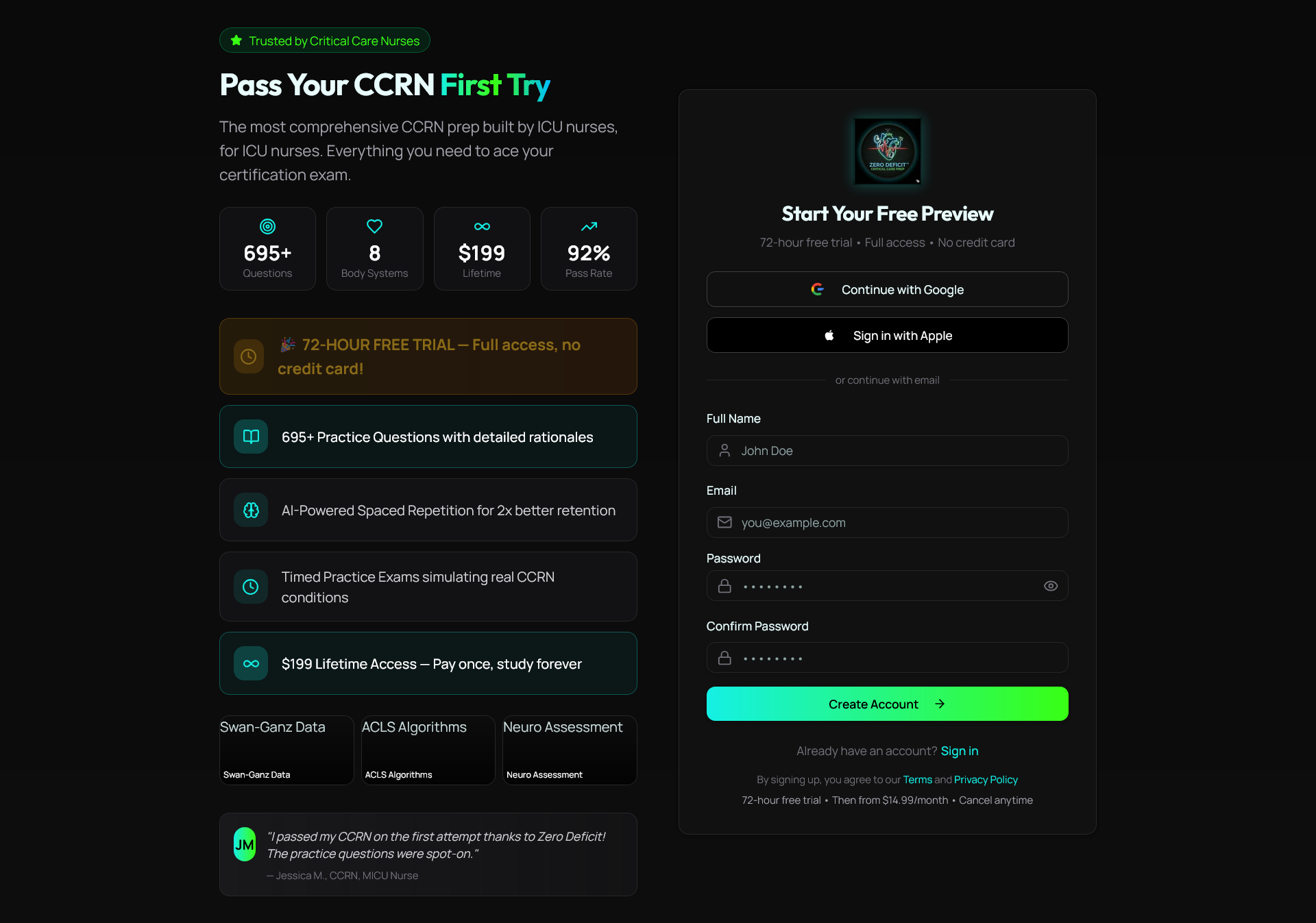
- A large number of practice questions with detailed rationales covering every CCRN blueprint domain.
- Review tools that adjust to your weak areas instead of quizzing you randomly.
- Topic guides and study guides organized by body system to pair directly with your textbook reading.
Start with Premium Monthly, Yearly Access, or Lifetime Mastery and turn your reading stack into exam-day confidence.
FAQ
What is the best book for CCRN exam prep?
The AACN Core Curriculum for Progressive and Critical Care Nursing (8th ed., 2022) is the primary authoritative resource because it maps directly to the CCRN exam blueprint. Pair it with AACN Essentials of Critical Care Nursing for faster review and a high-volume practice question bank for clinical judgment practice.
Do I need a pocket guide if I already have a full textbook?
Yes, because a pocket guide and a textbook serve different purposes. Your textbook builds conceptual understanding, while a pocket guide or Critical Care Survival Guide gives you rapid answers at the bedside during a procedure or a rapid response.
Should I buy print or digital ICU nursing books?
It depends on how and where you study. Digital formats work best for searchable primary study texts, while print works best for bedside pocket references you need without unlocking a device.
How many CCRN practice questions should I complete before my exam?
There is no single universal number, but pairing textbook review with a high-volume question bank, like the 695+ practice questions available through Zero Deficit™ CCRN Prep, builds the clinical judgment the exam weighs heavily. Focus on reviewing rationales for every missed question rather than just the total count.
Is the newest edition of a textbook always worth buying?
A new edition is worth buying when it updates guideline-aligned content tied to current exam material, not for minor cosmetic changes. Always check the publication year against current AACN or SCCM guidance before assuming an older edition is outdated.
Recommended
Take a Respiratory practice quiz
Master ARDS, ventilation, ABGs, oxygenation, and pulmonary emergencies.
Get Your Free 20-Question CCRN Diagnostic
20 high-yield CCRN-style questions across every body system, with detailed rationales — emailed to you instantly.
No spam. One email + a couple of helpful follow-ups. Unsubscribe anytime.
Ready to pass your CCRN?
Join 12,000+ nurses using Zero Deficit — 695+ practice questions with rationales, AI-powered weak-area drilling, and spaced-repetition flashcards.
Start Free Trial →