Importance of Content Review for CCRN Exam Success
TL;DR:
- Content review ensures clinical accuracy and prepares critical care nurses for the CCRN exam.
- Structured review improves retention, reduces factual errors, and builds confidence through verification.
Content review is the systematic evaluation of study material to verify clinical accuracy, consistency, and effectiveness in exam preparation. For critical care nurses preparing for the AACN Adult CCRN certification, skipping this step is not a minor oversight. Unreviewed study content produces 3–5 times more factual errors within 90 days. That error rate directly threatens your exam performance and, more critically, the clinical reasoning you carry into the ICU. The importance of content review goes beyond catching typos. It is the process that separates passive reading from verified, exam-ready knowledge.
What measurable benefits does content review provide for CCRN performance?
Structured content review produces concrete, measurable gains in both knowledge retention and exam scores. Rigorous review processes improve engagement and retention by 40%, even when the total volume of material studied is reduced. That finding matters for CCRN candidates who feel pressure to read everything. Reviewing less material more thoroughly outperforms reading more material passively.

The professional stakes are equally high. 76% of learners disengage from sources after encountering inaccurate or misleading content. In critical care nursing, a single incorrect fact about vasopressor dosing or ARDS ventilation targets does not just cost you a question. It can shape a clinical habit you carry to the bedside.
The benefits of content evaluation also show up in how you process information under pressure. Reviewed material is organized around verified clinical evidence, which means your brain retrieves it faster during a timed exam. The table below summarizes the key performance metrics linked to structured review.
| Metric | Without structured review | With structured review |
|---|---|---|
| Factual error rate | 3–5x higher within 90 days | Significantly reduced |
| Retention and engagement | Baseline | Up to 40% improvement |
| Learner trust in material | Drops after first inaccuracy | Maintained through verification |
| Exam readiness | Inconsistent | Aligned with AACN standards |
Pro Tip: When you finish a study session, close your notes and write down three clinical facts you just reviewed. If you cannot recall them accurately, that section needs another pass before you move on.
How does content review prevent cognitive overload during CCRN study?
Cognitive overload is the primary reason CCRN candidates hit a wall six weeks before their exam. They have read everything, but nothing feels solid. Structured review reduces cognitive load and rework fatigue by replacing vague re-reading cycles with defined checkpoints. You stop second-guessing what you know because you have already verified it.
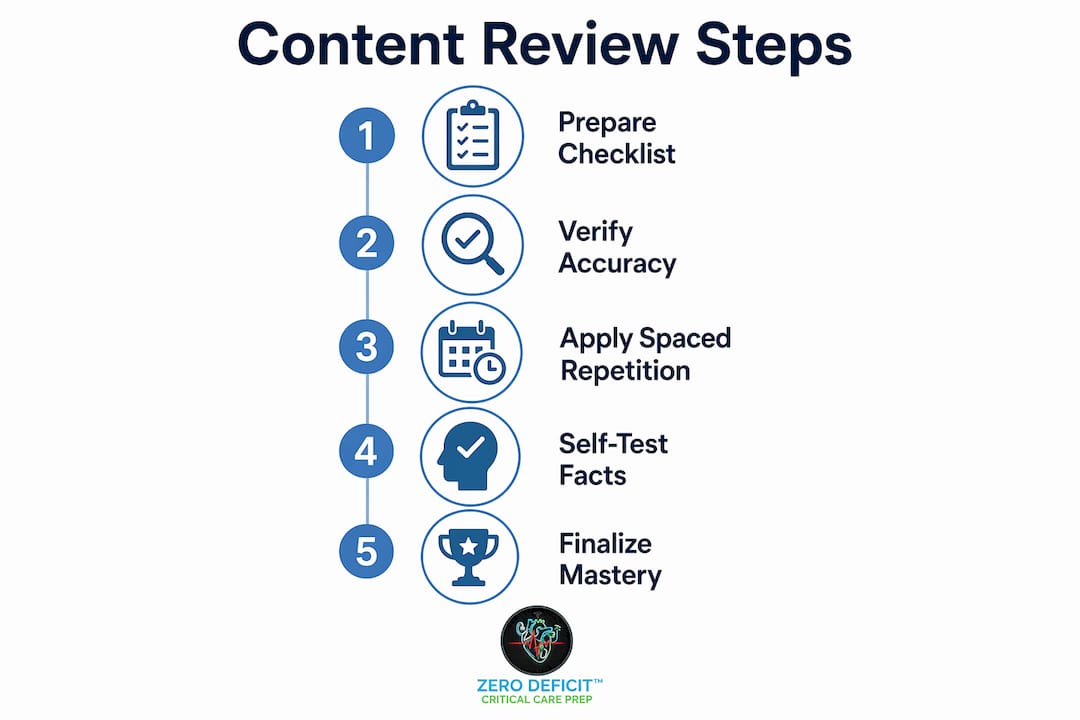
The concept of “rework fatigue” is worth naming directly. It is the mental exhaustion that comes from returning to the same material repeatedly without a clear standard for when it is mastered. A review checklist with clinical metrics prevents this by giving you a finish line for each topic. Once hemodynamic parameters, shock classifications, and AACN Synergy Model criteria meet your checklist criteria, you move on with confidence.
Structured review also protects your study schedule from collapsing under last-minute cramming. When you build review into each study block rather than saving it for the final week, you distribute the cognitive work evenly. This approach aligns with spaced repetition principles that reinforce long-term retention.
Best practices for structuring your review sessions:
- Set a specific clinical accuracy standard before you start. For example: “I can state the AACN-defined normal range for cardiac index (2.2–4.0 L/min/m²) without reference.”
- Review one body system per session rather than mixing cardiovascular and pulmonary content in the same block.
- Use a written checklist that includes guideline source, evidence level, and whether you can apply the concept to a clinical scenario.
- Test yourself at the end of each session using practice questions, not re-reading.
- Flag any item you cannot answer correctly for a second review pass within 48 hours.
Pro Tip: Build your review checklist before you start studying a topic, not after. Defining what “mastered” looks like in advance removes the temptation to keep reading indefinitely.
What steps should critical care nurses follow for effective content review?
Effective content review follows a sequence. Skipping steps or reversing the order reduces the benefit. The process below is adapted for CCRN exam prep, where clinical accuracy and AACN guideline alignment are non-negotiable standards.
- Initial read for comprehension. Read the material once without stopping to verify facts. Your goal is to understand the structure and identify which concepts feel unfamiliar.
- Fact verification against primary sources. Check every clinical claim against AACN, SCCM, or AHA guidelines. This is where you catch outdated drug doses, incorrect normal ranges, and misattributed protocols.
- Alignment check with the CCRN exam blueprint. Confirm the content maps to the AACN Adult CCRN test plan. If a topic is not on the blueprint, deprioritize it regardless of how interesting it is.
- Active recall testing. Close the material and answer practice questions on the topic. Active recall methods prevent the illusion of competence that comes from passive re-reading.
- Human verification of AI-assisted content. If you used AI tools to summarize or generate study notes, treat that output as a draft requiring fact-checking. Expert reviewers serve as a risk-management layer validating high-stakes clinical data. You are that expert reviewer.
- Final checklist sign-off. Mark each topic complete only when you can answer practice questions correctly and state the relevant clinical standard from memory.
The role of AI in exam preparation is real and useful, but it does not replace this sequence. AI tools accelerate the first step. They do not replace steps two through six. A content quality assessment that skips human verification is incomplete by definition.
Understanding what a comprehensive review actually requires helps you build this process into your weekly study plan rather than treating it as a one-time event.
What pitfalls must CCRN candidates avoid in content review?
The most common misconception in content review is that fluency equals accuracy. If a study resource reads smoothly and sounds authoritative, candidates often accept it without verification. AI fluency does not equal factual truth. A well-written sentence about sepsis management can still cite outdated Surviving Sepsis Campaign thresholds or misstate the SOFA score criteria.
Automation bias is the second major pitfall. This is the tendency to trust AI-generated summaries without checking them against primary clinical guidelines. Automation bias leads learners to accept AI outputs as verified facts. The counter is straightforward: treat every AI-generated study note as a first draft, not a final answer.
A third pitfall is skipping the human final approval step entirely. Some candidates build elaborate review checklists but never actually test their knowledge against practice questions. A checklist that ends at “re-read and feel confident” is not a content quality assessment. It is a false finish line. The impact of reviewing content only becomes real when you test what you have reviewed under exam conditions.
Managing exam anxiety is also part of this picture. Candidates who skip structured review often feel more anxious, not less, because they cannot distinguish what they know from what they have merely read.
Key Takeaways
Structured content review is the single most effective method for reducing factual errors, improving retention, and building exam-ready clinical knowledge for the CCRN.
| Point | Details |
|---|---|
| Review reduces errors significantly | Skipping structured review produces 3–5x more factual errors within 90 days. |
| Retention improves with rigorous review | Thorough review of less material improves retention by up to 40% over passive reading. |
| Active recall beats re-reading | Testing knowledge after review prevents the illusion of competence and builds real mastery. |
| AI content requires human verification | Treat AI-generated study notes as drafts; verify every clinical claim against AACN or SCCM guidelines. |
| Checklists prevent cognitive overload | A review checklist with clinical metrics distributes study effort evenly and eliminates last-minute cramming. |
Why I stopped re-reading and started verifying
Early in my own CCRN prep, I spent weeks re-reading the same cardiovascular content. I felt like I knew it. Then I sat down with practice questions and missed three hemodynamics items in a row. The material was not wrong. My process was.
The shift that changed everything was treating each study session as a verification exercise, not a reading exercise. I stopped asking “Did I read this?” and started asking “Can I state this accurately without looking?” That one change made my study time shorter and my practice scores higher.
What I see most often with CCRN candidates is the same trap. They accumulate hours of reading and mistake that volume for preparation. Review is not about reading more. It is about confirming what you actually know versus what you have only seen before. Those are two very different things, and the CCRN exam will find the gap between them.
The candidates who pass on their first attempt are not the ones who read the most. They are the ones who verified the most. Build your review process around that standard and your confidence on exam day will be grounded in something real.
— Zero
Zerodeficitccrnprep is built around verified, exam-ready content
Every study resource at Zerodeficitccrnprep goes through the same verification process described in this article. The practice questions are written by expert ICU nurses and aligned with the current AACN Adult CCRN exam blueprint. Each question includes a detailed rationale that explains not just the correct answer, but why the other options are wrong.
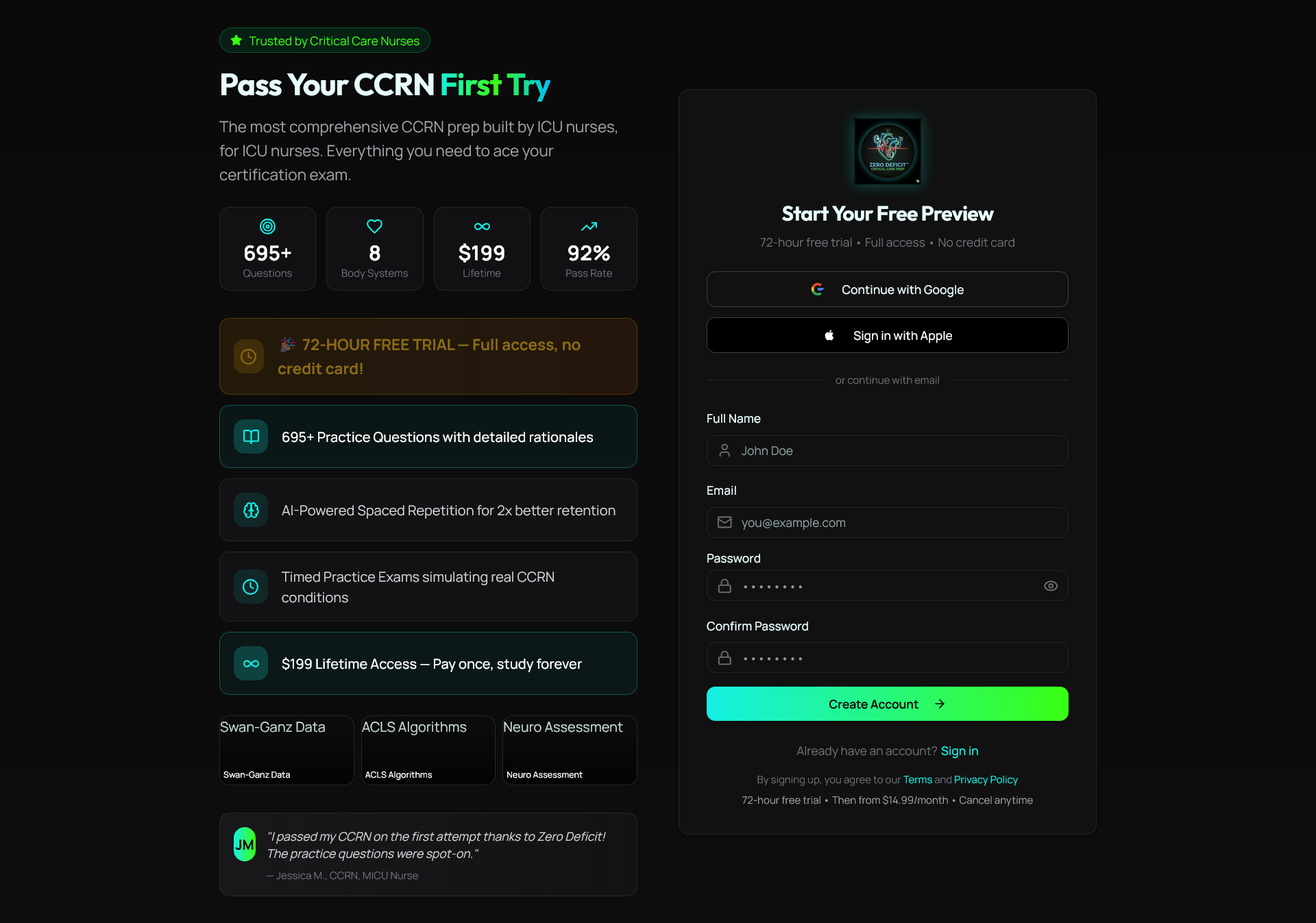
The CCRN practice tests cover all 8 body systems tested on the exam, giving you a structured way to test your knowledge after each review session. The 695+ practice questions are organized to support the stepwise review process outlined here. You review a topic, verify your knowledge, and then test it immediately. That sequence is built into the platform by design.
FAQ
What is content review in CCRN exam preparation?
Content review is the systematic process of verifying that study material is clinically accurate, aligned with AACN standards, and effective for building exam-ready knowledge. It goes beyond re-reading to include active testing and guideline verification.
How does content review improve exam scores?
Rigorous review processes improve retention by up to 40% compared to passive reading alone. Verified, well-organized material is retrieved faster under timed exam conditions.
Why does fluent content still need review?
AI-generated or well-written content can sound authoritative while containing outdated or incorrect clinical facts. Fluency does not equal accuracy, so every claim requires verification against primary sources like AACN or SCCM guidelines.
How often should CCRN candidates review their study material?
Review should be built into every study session, not saved for the final week. Using a checklist and spaced repetition distributes cognitive work evenly and prevents last-minute burnout.
What is the biggest mistake in content review?
The most common mistake is confusing re-reading with verification. Passive re-reading creates a feeling of familiarity without confirming accurate recall. Active recall testing after review is the only reliable way to confirm mastery.
Recommended
- Top CCRN study topics to master for exam success | Zero Deficit CCRN Prep
- Step by Step Exam Review for the CCRN: 2026 Guide | Zero Deficit CCRN Prep
- Pass the CCRN Exam: Proven Guide for Critical Care Nurses | Zero Deficit CCRN Prep
- How educators boost CCRN certification success for nurses | Zero Deficit CCRN Prep
Take a Respiratory practice quiz
Master ARDS, ventilation, ABGs, oxygenation, and pulmonary emergencies.
Get Your Free 20-Question CCRN Diagnostic
20 high-yield CCRN-style questions across every body system, with detailed rationales — emailed to you instantly.
No spam. One email + a couple of helpful follow-ups. Unsubscribe anytime.
Ready to pass your CCRN?
Join 12,000+ nurses using Zero Deficit — 695+ practice questions with rationales, AI-powered weak-area drilling, and spaced-repetition flashcards.
Start Free Trial →