Nursing Certification Terminology Explained for ICU Nurses
TL;DR:
- Nursing licenses are mandatory state-issued legal permits, while certifications like CCRN validate specialty expertise voluntarily.
- Understanding certification acronyms, renewal requirements, and terminology clarifies exam prep and professional advancement in critical care nursing.
If you’ve ever stared at your hospital badge and wondered exactly what CCRN, RN-BC, or PCCN actually signals to the world, you’re not alone. Nursing certification terminology explained clearly is something most nursing programs skip entirely, leaving critical care nurses to figure it out on the fly. Getting this right matters. It shapes how you prep for the CCRN exam, how you list credentials on your resume, and how confidently you advocate for your professional value in an ICU setting.
Table of Contents
- Key takeaways
- Nursing certification terminology explained: core definitions
- Common CCRN and critical care certification acronyms
- CCRN certification process and renewal terminology
- Licenses vs. certifications in your critical care career
- My perspective on why this vocabulary changes everything
- Start your CCRN prep with the right foundation
- FAQ
Key takeaways
| Point | Details |
|---|---|
| License vs. certification | A license is a legal state requirement to practice; a certification validates specialty expertise voluntarily. |
| CCRN renewal is structured | Renewal requires 100 CERPs in 3 years plus documented clinical hours — not just continuing education. |
| Acronyms evolve constantly | ANCC retired generic titles like RN-BC in favor of specialty-specific suffixes; using outdated acronyms signals stagnation. |
| Stackable credentials pay off | Combining CCRN with CMC or CSC strengthens your resume and recruiter confidence significantly. |
| Terminology clarity sharpens exam prep | Knowing what each certification term means helps you interpret CCRN exam questions with more precision. |
Nursing certification terminology explained: core definitions
Before anything else, you need a clean mental model of three words that nurses use interchangeably but that mean very different things: license, certification, and credential.
A license is the legal permission granted by your state board of nursing to practice as a registered nurse. Without it, you cannot legally work. It is mandatory, state-regulated, and renewed on a fixed schedule regardless of your specialty. Your RN license does not tell an employer what you specialize in. It only confirms you are legally authorized to practice nursing.
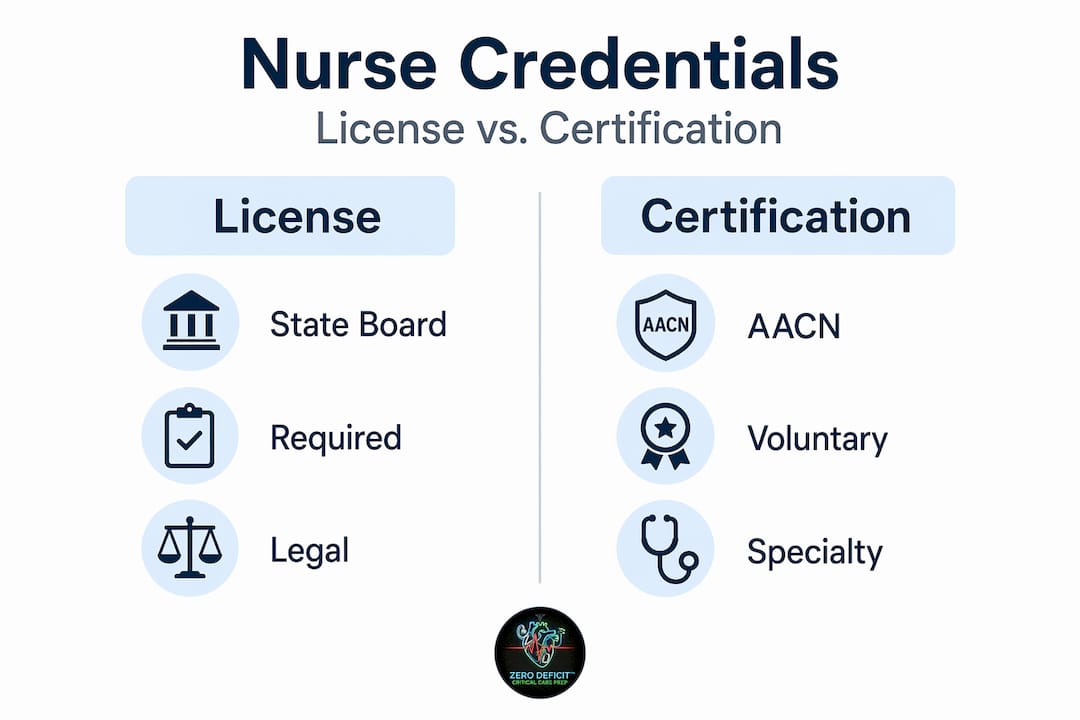
A certification is voluntary. It signals that you have demonstrated specialty expertise beyond the minimum requirements of your license. The CCRN, for example, is issued by the American Association of Critical-Care Nurses (AACN) and confirms advanced knowledge in critical care. Licenses are state-regulated and mandatory, while certifications validate specialty expertise and are issued by professional societies. That distinction is not academic. It matters when you negotiate pay, apply for Magnet-designated facilities, or explain your qualifications during a job interview.
A credential is the broadest of the three terms. It refers to any documented proof of your qualifications, including your nursing degree, your RN license, your CCRN, and any other certifications you hold. Think of credentials as your professional portfolio. Your license is one item in that portfolio. Your certifications are others.
Here is a side-by-side comparison to anchor these definitions:
| Term | Definition | Governing body | Legal status | Renewal |
|---|---|---|---|---|
| License (RN) | Legal authority to practice nursing | State Board of Nursing | Mandatory | Every 2 years (varies by state) |
| Certification (CCRN) | Voluntary specialty credential | AACN | Voluntary | Every 3 years |
| Credential | Broad term for all qualifications | Multiple (AACN, ANCC, etc.) | Varies | Varies by type |
| CNA certification | State-mandated training credential | State Registry | Mandatory in most states | Varies by state |
Pro Tip: When listing credentials after your name, always place your RN license first, then your highest nursing degree, then certifications in order of relevance to the position. For example: Jane Smith, RN, MSN, CCRN.
Common CCRN and critical care certification acronyms
The AACN offers a specific family of certifications that every ICU nurse should recognize. Knowing what each acronym means gives you a vocabulary for your career path and for interpreting CCRN exam questions accurately.
- CCRN: The flagship credential for acute and critical care nurses working with acutely or critically ill adult patients. Requires 1,750 hours of direct critical care in the past 2 years, with 875 of those hours in the most recent year before applying.
- PCCN: Progressive Care Certified Nurse, for nurses working with acutely ill patients who are not at the full critical care level.
- CCRN-K: For nurses in leadership, education, or research roles within critical care. Clinical practice hours are replaced by knowledge-based criteria.
- CCRN-E: For critical care nurses working via telehealth or electronic monitoring in settings like eICU.
- CEN: Certified Emergency Nurse, issued by the Board of Certification for Emergency Nursing (BCEN).
- CTRN: Certified Transport Registered Nurse, which validates expertise in critical care ground transport. CTRN certification has grown 185% since 2020 and is both nationally accredited and Magnet accepted.
- CFRN: Certified Flight Registered Nurse, for nurses in air medical transport.
One acronym to understand in context is the old “RN-BC” designation used by the American Nurses Credentialing Center (ANCC). The ANCC retired the generic RN-BC title in favor of specialty-specific acronyms like PMH-BC (Psychiatric Mental Health) to improve clarity and signal current expertise more precisely. If you still see RN-BC on older resumes or badges without a specialty prefix, it tells you that nurse has not refreshed their credential presentation in years.
Pro Tip: Before listing any certification acronym on a resume or cover letter, verify the current official abbreviation directly on the certifying body’s website. Certifying organizations update these more often than most nurses realize.
CCRN certification process and renewal terminology
Understanding the CCRN specifically requires fluency in a handful of terms that the AACN uses throughout its eligibility and renewal documentation.
Eligibility terminology:
- Direct care hours: Time spent at the bedside providing hands-on care to critically ill patients. Charge nurse time may count if you are also providing direct care.
- Practice requirement: You must complete 1,750 hours of direct critical care within the 2 years before applying, with at least 875 hours in the most recent year.
- Application period: The window during which you submit your application, documentation, and exam fees to AACN before scheduling your test.
The CCRN exam uses a practice analysis every 5 years to stay current with evolving clinical evidence and technology. That process keeps the exam grounded in real critical care practice, which means studying outdated material is a genuine risk.
Renewal terminology:
Once you pass the CCRN, you hold it for 3 years. After that, you must renew. CCRN renewal requires 100 CERPs within 3 years, including 48 Category A clinical CE hours and 432 clinical practice hours, with at least 144 of those hours in the most recent year.

Here is what those terms actually mean:
| Term | Definition | Requirement |
|---|---|---|
| CERPs | Continuing Education Recognition Points | 100 total within 3-year cycle |
| Category A CE | Directly related to specialty nursing content | 48 of the 100 CERPs |
| Category B CE | Broader professional development (leadership, ethics, etc.) | Remaining CERPs |
| Clinical practice hours | Direct patient care in critical care setting | 432 hours (144 in final year) |
| Renewal pathway option | Retaking full CCRN exam | Alternative to CERPs path |
If your certification expires, AACN does offer reinstatement options, but the window and requirements become more demanding. Do not let it lapse. Mark your renewal date at the start of every cycle, not the end.
Licenses vs. certifications in your critical care career
The practical difference between a license and a certification shows up every time you apply for a job, negotiate a raise, or walk into a Magnet facility. Your RN license establishes that you can practice. Your CCRN tells the employer how well you practice and in what context.
Several misconceptions are worth addressing directly:
- CNA certification is not a nursing license. CNA certification is a state-mandated credential authorizing specific care tasks under nurse delegation. CNA holders are professionals, but they do not hold nursing license authority. This confusion appears in nursing documentation and hiring forms more often than it should.
- Specialty certifications do not replace your RN license. They layer on top of it. If your RN license lapses, your CCRN cannot protect you legally.
- Certifications are voluntary, but that does not mean optional. Magnet designation and patient outcomes correlate directly with certified nursing staff. If you are pursuing or working in a Magnet hospital, certification is an institutional expectation even if it is technically your personal choice.
Credential stacking is a real career strategy. Stackable credentials like CCRN plus CMC or CSC signal progressive specialization and build recruiter confidence. When a hiring manager sees CCRN, CSC listed after your name, they understand you have not just passed one exam. You have demonstrated sustained expertise across cardiovascular critical care.
Pro Tip: Use your certifications strategically when applying. If a position is cardiac ICU specific, list your CSC before CCRN in your credential signature to lead with the most relevant specialty.
My perspective on why this vocabulary changes everything
I’ve seen nurses walk into CCRN exam prep completely overwhelmed, not because they lack clinical knowledge but because the terminology itself trips them up before the content even starts. When you sit down with a CCRN practice question about renewing your credential or categorizing a CE activity, not knowing what a CERP is versus a clinical hour turns a straightforward recall question into a guessing game.
What I’ve learned from watching nurses prep for this exam is that the ones who build a clear vocabulary foundation early move through exam content faster and with more confidence. They are not second-guessing definitions while also trying to recall normal pulmonary artery wedge pressure values (8 to 12 mmHg, for reference).
The harder truth is that nursing certification is not a finish line. Your credential is a living document of your professional identity. The nurses who treat it that way, keeping acronyms current, stacking credentials deliberately, and tracking their exam readiness, tend to be the ones still certified 10 years into their ICU career. The ones who treat it as a box to check tend to scramble at renewal time.
Start with the vocabulary. Everything else builds from there.
— Zero
Start your CCRN prep with the right foundation
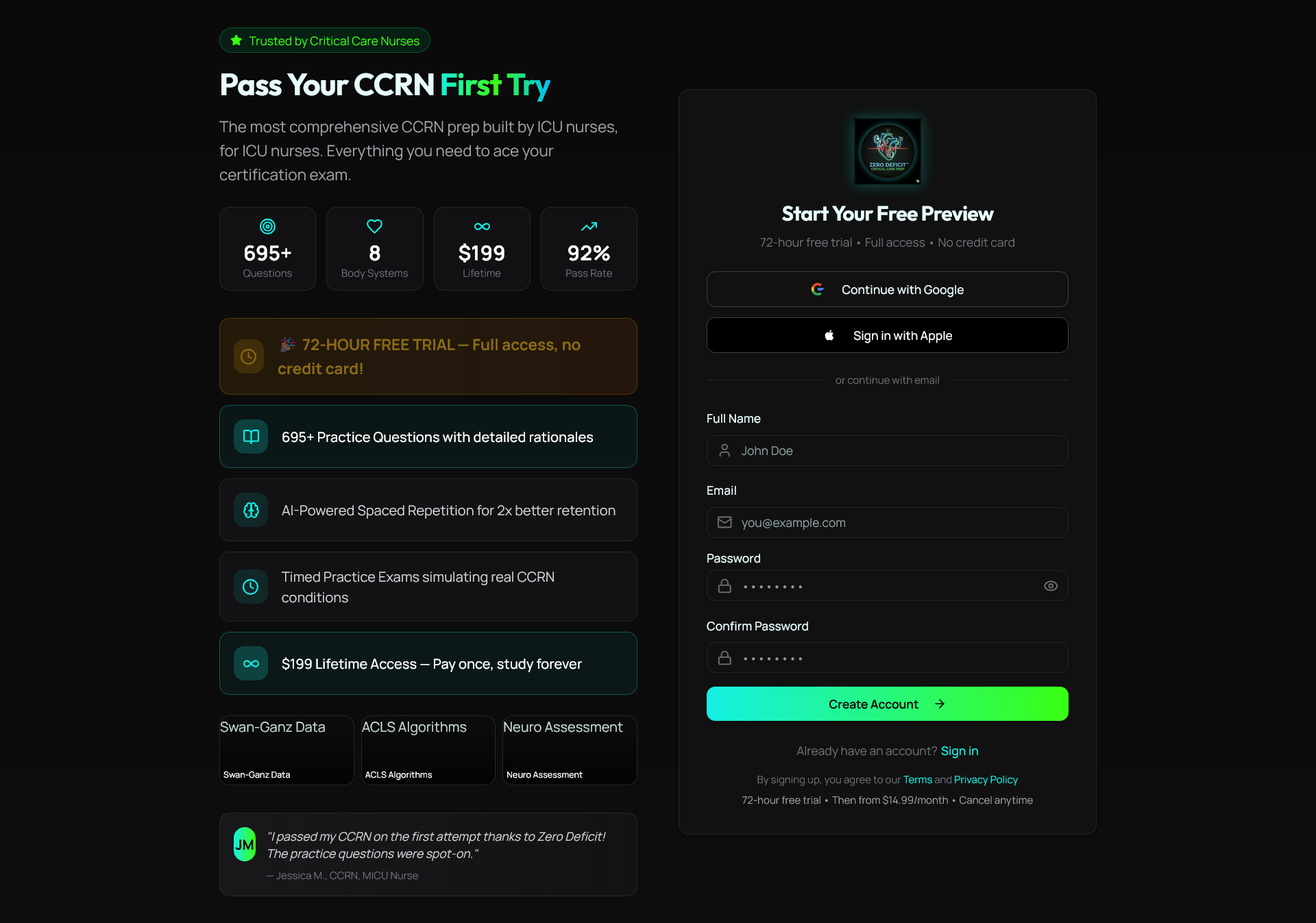
Clear on the terminology? Good. Now put that knowledge to work. Zerodeficitccrnprep is built specifically for critical care nurses who want to pass the CCRN on their first attempt, without spending months sifting through generic study materials. The platform offers over 695 practice questions organized by body system, detailed rationales that reinforce exactly the kind of terminology clarity you just built here, and AI-powered review tools that adapt to where you need the most work.
Every question on Zerodeficitccrnprep reflects real CCRN exam format and current AACN clinical standards. You can start with the question breakdown methods to learn how to read and interpret CCRN questions strategically, or go straight into the full practice test library covering all 8 body systems. A subscription plan gives you complete access, and the free version requires no credit card. Your certification is worth the preparation. Start where the pass rates are.
FAQ
What is the difference between a nursing license and a certification?
A nursing license is a state-issued legal requirement that permits you to practice as an RN. A certification, like the CCRN, is a voluntary specialty credential issued by a professional body such as AACN that validates expertise in a specific area of practice.
What does CCRN stand for and who can earn it?
CCRN stands for Certified Critical Care Registered Nurse. It is awarded by the AACN to RNs who complete 1,750 hours of direct critical care practice within 2 years and pass a comprehensive specialty exam.
How do you renew a CCRN certification?
CCRN renewal requires completing 100 CERPs over a 3-year cycle, including 48 Category A clinical CE hours, along with 432 clinical practice hours. The alternative is retaking the full CCRN exam.
What are CERPs in nursing certification terminology?
CERPs are Continuing Education Recognition Points used by the AACN to track professional development activities toward certification renewal. They are divided into Category A (specialty clinical content) and Category B (broader professional development).
Why do nursing certification acronyms change over time?
Certifying bodies like ANCC update acronyms to reflect specialty specificity and current practice. The generic RN-BC designation was retired in favor of specialty suffixes to help employers and colleagues immediately identify a nurse’s area of expertise.
Take a Neurological practice quiz
Test your knowledge of stroke, ICP, seizures, and neuro assessment.
Ready to pass your CCRN?
Join 12,000+ nurses using Zero Deficit — 695+ practice questions with rationales, AI-powered weak-area drilling, and spaced-repetition flashcards.
Start Free Trial →