Progress Tracking in Exam Prep: A CCRN Nurse's Guide
TL;DR:
- Progress tracking in CCRN exam prep involves systematically recording practice scores, accuracy, and timing to guide study decisions. Nurses must review this data weekly and adjust their study focus accordingly to improve weak areas and pacing issues. Consistent tracking boosts motivation and prevents overconfidence, ultimately increasing the chances of passing on the first attempt.
Progress tracking in exam prep is the systematic measurement and documentation of your study performance data to make your preparation visible, objective, and adjustable. For critical care nurses preparing for the AACN Adult CCRN certification, this process is not optional. Subjective confidence is unreliable. Most learners overestimate their preparedness without objective data, and that gap shows up as a failed attempt on exam day. Tracking converts your study hours into evidence, giving you a clear picture of where you stand across all CCRN blueprint domains including hemodynamics, ARDS, sepsis, and neuro.
What core metrics should you track during CCRN exam preparation?
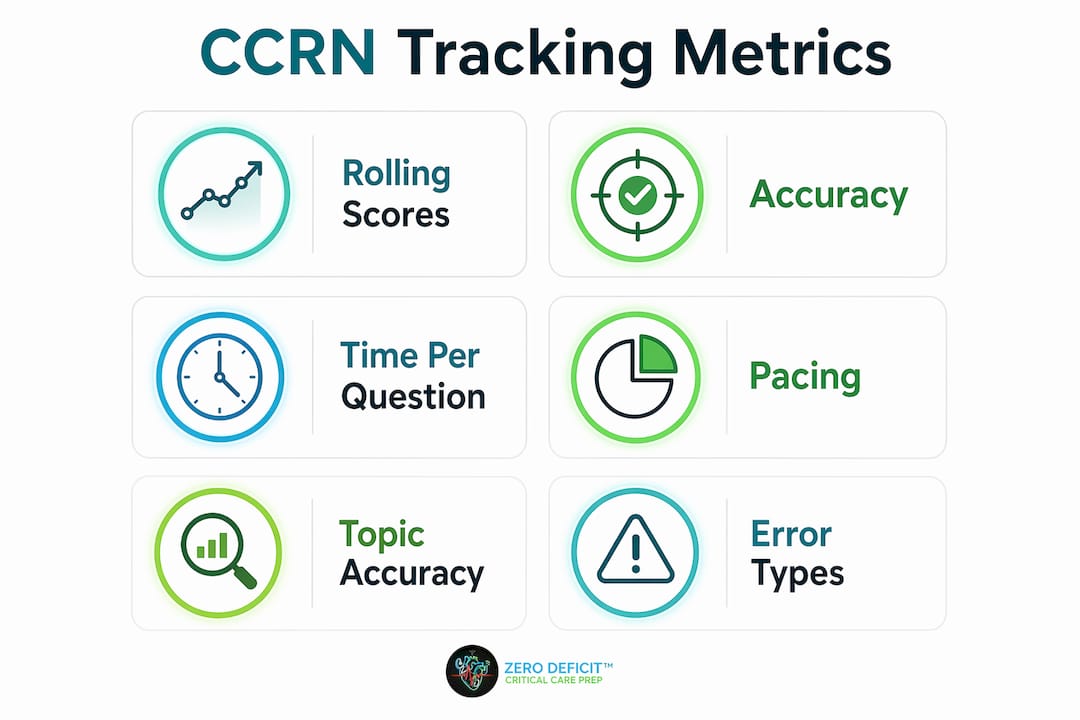
Effective progress tracking requires monitoring practice test score trends, accuracy by topic and subtopic, time per question, and skill mastery over time. A single practice score tells you almost nothing. A trend across five attempts tells you everything.
These are the metrics that matter most for CCRN exam preparation tracking:
- Practice score trends. Record every practice test score in sequence. A rising trend over three to four weeks signals real learning. A flat or declining trend signals a study strategy problem, not just a bad day.
- Topic-level accuracy. Break scores down by CCRN blueprint categories: cardiovascular, pulmonary, neuro, renal, endocrine, multisystem, and behavioral. A 75% overall score can hide a 45% accuracy rate in hemodynamics.
- Time per question. The CCRN gives you roughly 80 seconds per question. Pacing issues are frequently misdiagnosed as content weaknesses. Tracking time separately tells you whether slow retrieval or a knowledge gap is causing errors.
- Error categorization. Label every wrong answer by root cause: conceptual gap, misread question, or time pressure. This is the most powerful single habit in exam preparation tracking.
- Process metrics. Log study session duration and the number of practice questions attempted each day. These inputs predict outcome scores more reliably than gut feeling does.
Tracking beyond simple scores identifies weak areas 20–30% faster than relying on subjective feelings. That speed advantage matters when you have a set exam date.
Pro Tip: Use rolling averages of your last three practice attempts rather than reacting to any single score. Rolling averages filter out bad-day volatility and show you the actual direction of your progress.
How do you implement a practical progress tracking system?
A tracking system works only if you use it consistently. The structure below is built for nurses with limited time between shifts.
-
Set up a simple tracking template. Use a spreadsheet or a printed log with columns for date, topic tested, score, time per question average, and error category. Simple, consistent templates turn raw scores into a learning plan. Complexity kills consistency, so keep the format to one page.
-
Run a daily mini-check. After every practice session, spend five minutes logging your score, flagging the two or three questions that surprised you, and noting the error type. This takes less time than a post-shift nursing note.
-
Schedule a weekly formal review. Dedicating 30–60 minutes weekly to analyze your progress data is the highest-leverage activity in sustained certification prep. Pull your rolling averages, compare topic accuracy across the week, and identify the one domain that needs the most attention next week.
-
Add reflection prompts. After each weekly review, answer two questions in writing: “What pattern do I see in my errors?” and “What is the one thing I will do differently this week?” Written reflection converts data into direction.
-
Link findings to specific study actions. A conceptual gap in ARDS management means you return to your CCRN study guide on pulmonary mechanics and ventilator settings. A pacing error means you practice timed question sets. The tracking data tells you exactly where to go next.
-
Conduct a monthly milestone assessment. At the end of each month, compare your current topic accuracy scores to your baseline. This is your exam readiness checkpoint. If cardiovascular accuracy has moved from 52% to 71%, that is a milestone worth recording.
Pro Tip: Keep an error log with a root cause column. Categorizing mistakes by root cause tells you whether you need content review, a better test-taking strategy, or simply more timed practice.
What are the psychological benefits and common pitfalls in progress monitoring?
Progress monitoring in studying does more than measure knowledge. It manages motivation across a preparation timeline that can span three to six months.
Tracking process metrics alongside outcome metrics maintains motivation by showing incremental progress even when scores plateau. When your cardiovascular accuracy holds steady for two weeks, your log still shows that you completed 200 practice questions and four study sessions. That documented effort is real progress, even if the score has not moved yet.
Framing tracking as curiosity rather than judgment improves consistency and reduces the dropout that comes from perfectionism. You are running an experiment on your own learning, not grading yourself as a nurse.
“Tracking is not about perfection. It is about direction. Every data point you collect converts your study time into an ongoing experiment that shows you what works.”
Common pitfalls to avoid:
- Overestimating readiness. Objective data prevents the overconfidence that leads to exam day surprises. If your rolling average sits at 68% and the CCRN passing standard requires strong performance across all domains, your data is telling you something your confidence is not.
- Neglecting review cadence. Logging scores without reviewing them weekly is the equivalent of charting vitals and never reading the trend. The review is where the value lives.
- Ignoring pacing data. Many nurses focus entirely on accuracy and miss the fact that they are spending 120 seconds per question on neuro cases. That pacing problem will cost points on exam day regardless of content knowledge.
- Reacting to single results. One bad practice test is noise. Three consecutive declining scores are a signal. Treat them differently.
When you hit a plateau, your error log is the first place to look. A plateau in cardiovascular scores often reveals a specific gap, such as interpreting mixed venous oxygen saturation trends or titrating vasopressors per SCCM Surviving Sepsis guidelines, rather than a broad knowledge failure.
How can progress tracking integrate with your CCRN study resources?
Progress tracking reaches its full potential when it connects directly to your study materials. Data without a response is just a number.
The table below shows how specific tracking findings map to targeted study actions using CCRN-aligned resources.
| Tracking finding | Targeted study action |
|---|---|
| Cardiovascular accuracy below 65% | Review hemodynamics, shock states, and ACS management in your CCRN study guide |
| ARDS/vent questions wrong 40%+ of the time | Return to pulmonary mechanics, ARDS Berlin criteria, and lung-protective ventilation per AHA/SCCM guidelines |
| Neuro errors categorized as conceptual gaps | Study ICP management, stroke protocols, and cerebral perfusion pressure calculations |
| Time per question above 90 seconds | Run timed question sets of 25 questions; track pace separately from accuracy |
| Sepsis/MODS accuracy stagnant | Review SCCM Surviving Sepsis Campaign 2021 bundle elements and MODS pathophysiology |
Using CCRN practice questions as benchmarking tools is the most direct way to generate tracking data. Each question set gives you topic-level accuracy, and the detailed rationales explain why wrong answers are wrong, which feeds directly into your error log.
Zerodeficitccrnprep covers all eight body systems in its study guides, aligned with the AACN Adult CCRN exam blueprint. When your tracking data flags a weak area in renal or endocrine content, you have a specific guide to open rather than re-reading everything from scratch. That targeted approach is what separates efficient prep from exhausting prep.
The advantages of practice tests extend beyond score generation. They create the performance data your tracking system needs to function. Without regular practice testing, you are tracking study time alone, which is a process metric without the outcome data to validate it.
Key Takeaways
Progress tracking in CCRN exam prep works because it replaces subjective confidence with objective performance data, allowing you to study smarter, adjust faster, and pass with less wasted time.
| Point | Details |
|---|---|
| Track the right metrics | Monitor score trends, topic accuracy, time per question, and error categories, not just overall scores. |
| Review weekly without fail | A 30–60 minute weekly review is the single highest-leverage habit in certification prep. |
| Use rolling averages | Average your last three practice scores to filter out noise and see your true progress direction. |
| Connect data to actions | Every tracking finding should trigger a specific study response, such as targeted review or timed practice. |
| Frame tracking as curiosity | Treating your data as an experiment rather than a judgment keeps you consistent over a long prep timeline. |
What I have learned from tracking CCRN prep data
I have watched nurses study for months and still feel blindsided on exam day. Almost every time, the pattern is the same. They logged hours but never reviewed the data. They knew they were weak in hemodynamics but kept studying what felt comfortable instead of what the numbers demanded.
The shift that changes everything is treating your tracking log the way you treat a patient’s trending vitals. You do not ignore a MAP that has been drifting down for six hours. You do not ignore a cardiovascular accuracy score that has been stuck at 58% for three weeks either. Both require a response.
What I find most useful is separating pacing errors from knowledge errors early in prep. Nurses who spend 110 seconds on every neuro question are not necessarily weak in neuro. They may just need to practice faster retrieval. That distinction changes the entire study plan, and you only see it if you are tracking time per question.
The other thing I will say directly: do not wait until four weeks before your exam to start reviewing your data. The nurses who pass on their first attempt are the ones who started tracking from week one and adjusted continuously. The ones who retake are usually the ones who studied hard but reviewed their data late. Your tracking system is not the reward at the end of prep. It is the engine that runs the whole thing.
— Zero
Zerodeficitccrnprep and your progress tracking plan
Knowing what to track is only half the work. Having the right resources to act on your data is the other half.
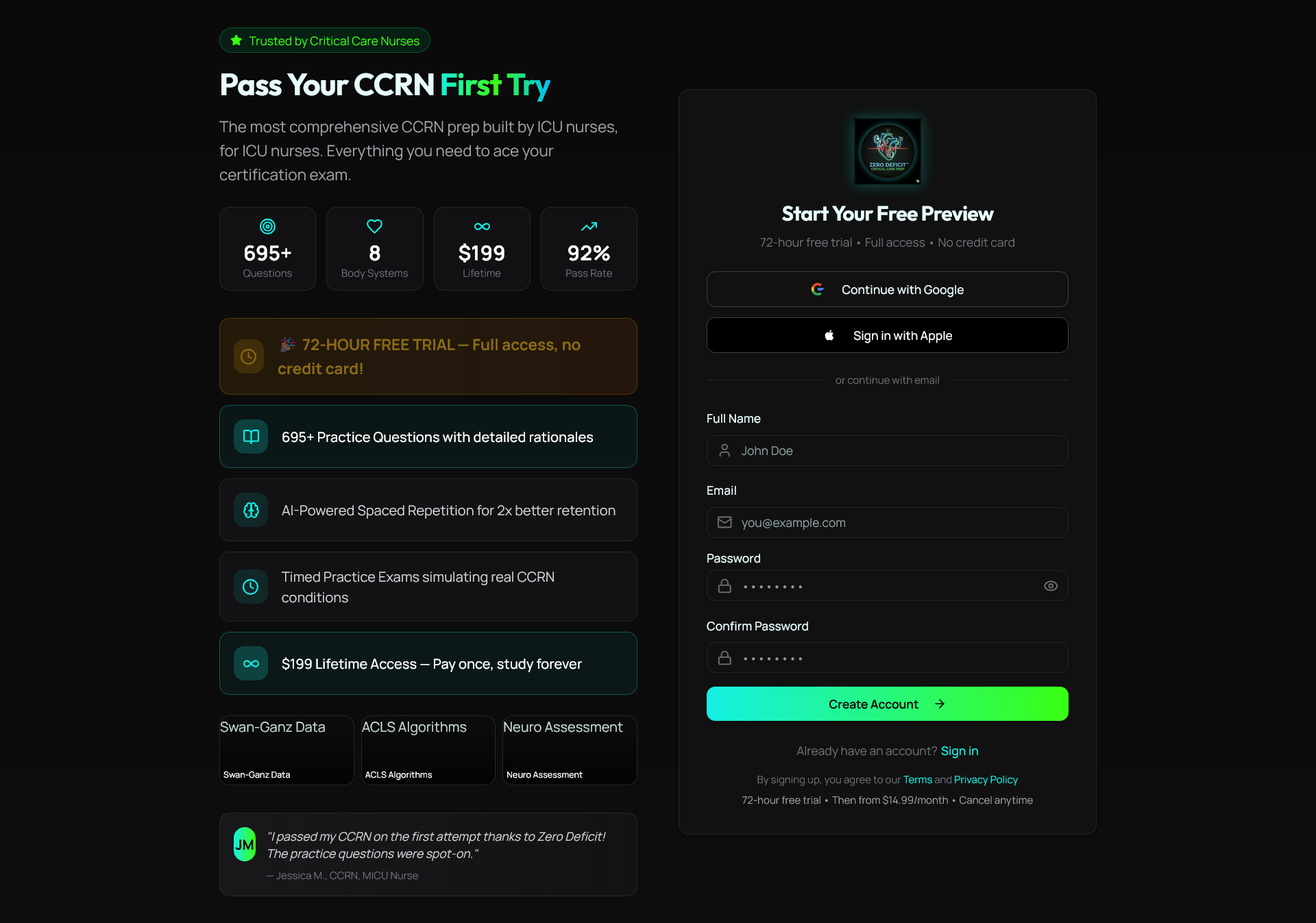
Zerodeficitccrnprep is built specifically for ICU nurses preparing for the AACN Adult CCRN exam. The platform includes over 695 CCRN practice questions with detailed rationales written by expert ICU nurses, giving you the performance data your tracking system needs. When your error log points to a gap in shock management, vasopressors, or ARDS, the CCRN study guides covering all eight body systems are ready to close it. Start with a practice test, log your topic accuracy, and let the data tell you exactly where to go next.
FAQ
What is progress tracking in exam prep?
Progress tracking in exam prep is the systematic recording and review of your study performance data, including practice scores, topic accuracy, and time per question, to guide your preparation decisions objectively.
How often should I review my CCRN exam progress?
A formal weekly review of 30–60 minutes is the most effective cadence. Daily mini-checks after each practice session add granular data between weekly reviews.
What metrics matter most for CCRN prep tracking?
Topic-level accuracy, rolling score averages, time per question, and error root cause categories are the four metrics that most directly predict CCRN exam readiness.
How do I use an error log for CCRN study?
Label each wrong answer as a conceptual gap, a misread question, or a pacing error. This categorization tells you whether to review content, adjust your test-taking strategy, or practice under timed conditions.
Can progress tracking reduce exam anxiety?
Tracking process metrics alongside outcome scores keeps motivation high during plateaus and reduces anxiety by replacing vague worry with concrete, data-driven study focus. Objective data shows you exactly where you stand, which is less stressful than guessing.
Recommended
- How educators boost CCRN certification success for nurses | Zero Deficit CCRN Prep
- Pass the CCRN Exam: Proven Guide for Critical Care Nurses | Zero Deficit CCRN Prep
- Top CCRN study topics to master for exam success | Zero Deficit CCRN Prep
- CCRN Spaced Repetition: Study Smarter for Certification | Zero Deficit CCRN Prep
Take a Respiratory practice quiz
Master ARDS, ventilation, ABGs, oxygenation, and pulmonary emergencies.
Get Your Free 20-Question CCRN Diagnostic
20 high-yield CCRN-style questions across every body system, with detailed rationales — emailed to you instantly.
No spam. One email + a couple of helpful follow-ups. Unsubscribe anytime.
Ready to pass your CCRN?
Join 12,000+ nurses using Zero Deficit — 695+ practice questions with rationales, AI-powered weak-area drilling, and spaced-repetition flashcards.
Start Free Trial →