The Role of Leadership in Nursing: An ICU Guide
TL;DR:
- Effective nursing leadership influences team performance and patient safety by promoting styles like transformational and authentic approaches. Strong nurse leaders build trust, reduce burnout, and improve communication to enhance ICU care quality. Developing leadership skills involves mentorship, shared governance, and applying clinical strategies, not just holding titles.
The role of leadership in nursing is defined as the capacity to influence, motivate, and guide healthcare teams toward delivering safe, high-quality patient care, particularly in critical care environments. A 2026 meta-analysis of 57 studies found a correlation of r = 0.39 between leadership style and nurse job satisfaction. That number matters because satisfaction directly predicts retention, team stability, and patient safety in ICUs. The AACN’s Synergy Model frames nurse competency around matching patient needs to nurse skills, and leadership sits at the center of that match. Whether you are a new ICU graduate or a retaker preparing for the CCRN, understanding how nurse leaders shape clinical outcomes gives you a sharper lens for both the exam and the bedside.
What are the most effective leadership styles in nursing?
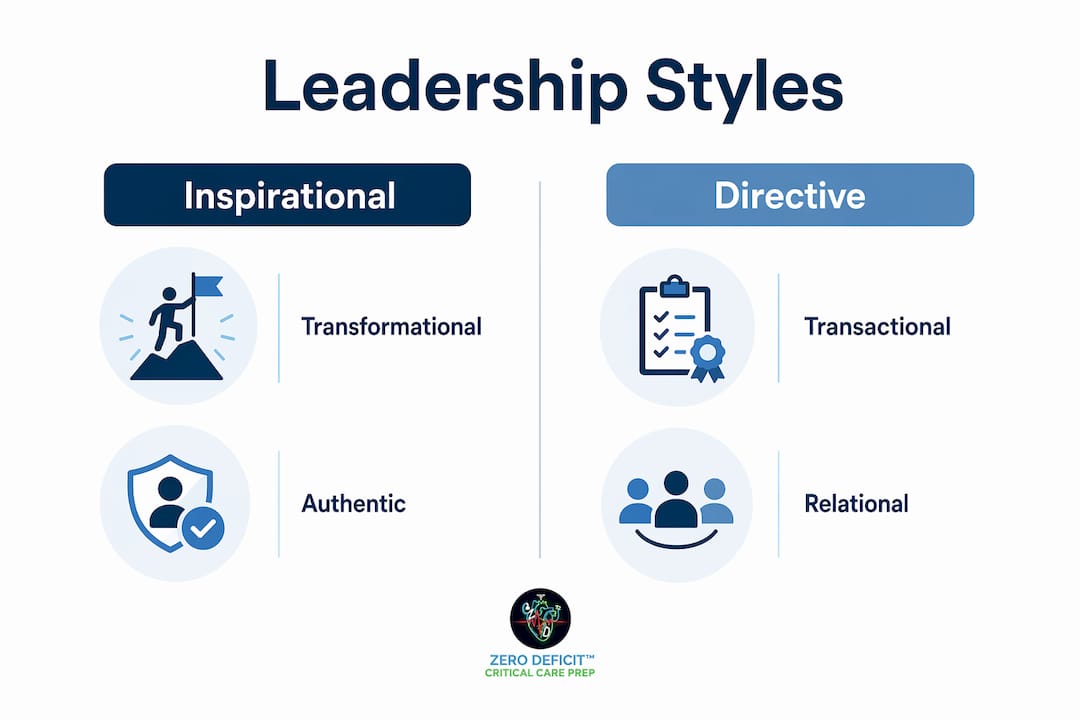
Nursing leadership styles fall into four evidence-based categories: transformational, transactional, authentic, and relational. Each produces measurably different outcomes in ICU settings, and choosing the right one for the right moment separates good leaders from great ones.

Transformational leadership centers on inspiring teams through shared vision and intrinsic motivation. An integrative review covering 1,944 nurses and 1,209 patients confirmed that transformational leadership reduces adverse events and increases patient satisfaction in hospitals, including ICUs. That finding means a charge nurse who mentors staff through a code rather than just directing tasks is actively reducing harm.
Transactional leadership focuses on clear expectations, protocols, and reward-and-consequence structures. A 2026 study of 68 ICU professionals found that transactional and transformational styles both correlate with care quality, depending on the clinical context. Transactional approaches work well for compliance-heavy tasks like medication reconciliation and ventilator bundle adherence.
Authentic leadership builds trust through self-awareness and transparency. The 2026 meta-analysis identified authentic leadership as one of the most beneficial styles for nurse job satisfaction, alongside transformational. Nurses who see their leaders act consistently under pressure report higher psychological safety and lower burnout rates.
| Leadership style | Primary mechanism | Key ICU outcome |
|---|---|---|
| Transformational | Vision and intrinsic motivation | Reduced adverse events, higher patient satisfaction |
| Transactional | Protocols and accountability | Compliance with safety bundles and care standards |
| Authentic | Transparency and self-awareness | Higher nurse job satisfaction and psychological safety |
| Relational | Team connection and communication | Improved collaboration and reduced conflict |
Pro Tip: To develop a transformational approach in your own practice, start by naming one clinical value you want your team to embody each shift, then model it yourself before asking it of others.
How does nursing leadership affect team dynamics and nurse well-being?
Leadership style is the single strongest predictor of team culture in critical care units. The r = 0.39 correlation between leadership and nurse job satisfaction, drawn from 57 studies, represents a moderate but clinically meaningful effect. In a unit where staff turnover costs hospitals tens of thousands of dollars per nurse, that effect translates directly to budget, continuity, and patient safety.
People-oriented leadership styles, specifically transformational and authentic approaches, reduce burnout by giving nurses a sense of purpose and autonomy. Laissez-faire leadership, by contrast, creates role confusion and increases the risk of errors in high-acuity settings. Situational leadership guidelines specifically recommend avoiding laissez-faire styles in units with high staff turnover, where clear direction is non-negotiable.
Effective ICU leaders also build psychological safety, the condition where nurses feel safe raising concerns without fear of retaliation. Psychological safety is not a soft concept. It is the mechanism behind near-miss reporting, early escalation, and honest handoff communication. A charge nurse who responds to a medication concern with curiosity rather than dismissal creates a unit where errors surface before they reach the patient.
Key behaviors that nurse leaders use to protect team well-being include:
- Conducting brief, structured debriefs after high-acuity events to normalize emotional processing
- Rotating high-burden assignments to prevent compassion fatigue in individual nurses
- Using the feedback culture framework to give real-time, specific performance input
- Advocating for staffing ratios that reflect patient acuity, not just census numbers
- Recognizing clinical competence publicly to reinforce professional identity
Pro Tip: When you have both a new graduate and a 10-year veteran on the same shift, adapt your leadership approach to each. The new grad needs clear structure; the veteran needs autonomy and trust.
What practical leadership strategies improve ICU care quality?
Effective leadership in critical care is not a title. It is a set of repeatable behaviors that any nurse can apply regardless of whether they hold a formal management role. The AACN’s Synergy Model explicitly identifies advocacy and moral agency as core nurse competencies, both of which are leadership functions.
The following strategies produce measurable improvements in ICU care quality:
-
Practice dynamic delegation. Dynamic delegation means continuously reassessing patient acuity and team competencies to redistribute tasks in real time. A nurse managing a septic patient on vasopressors should not also be the one running a family meeting. Matching task complexity to nurse skill level is a leadership decision made every hour in a functioning ICU.
-
Advocate at every level. Nurse advocacy extends beyond the bedside. It includes pushing back on unsafe staffing ratios during huddles, documenting care gaps in incident reports, and presenting clinical data in multidisciplinary rounds. Nursing leadership within healthcare systems is most effective when clinical realities reach organizational decision-makers through nurse voices.
-
Use shared governance structures. Shared governance gives bedside nurses formal input into policy, scheduling, and protocol development. Units with active shared governance councils report higher nurse engagement and lower rates of protocol deviation.
-
Apply critical thinking to every handoff. Leadership shows up in the quality of your SBAR. A structured, prioritized handoff that flags trending hemodynamics or a rising lactate is a leadership act. Sharpening critical thinking in nursing directly improves the quality of every clinical decision you make as a leader.
-
Toggle leadership styles by situation. Expert guidance confirms that effective nurse leaders use transactional approaches for safety protocols and transformational approaches to rebuild team morale after a difficult shift or patient loss. Rigidity in style is a leadership liability in the ICU.
What are the main barriers to effective nursing leadership in critical care?
Role ambiguity is the most common barrier nurse leaders face in multidisciplinary ICU teams. Research highlights that ambiguity of authority limits nurses’ ability to provide trusted input in team-based decisions, even when their clinical knowledge is superior to that of other team members. That gap costs patients.
Organizational structure compounds the problem. Many hospitals separate clinical leadership from managerial leadership, creating a situation where the nurse with the deepest bedside knowledge has no seat at the table when staffing or protocol decisions are made. The result is policy built without clinical context.
“Nurse leaders must seek mentorship, clarify their roles, and advocate for nursing representation in strategic forums. Without that representation, patient-centered care insights never reach the decisions that shape care delivery at scale.”
Strategies that overcome these barriers include:
- Seeking formal mentorship from experienced nurse managers or clinical nurse specialists
- Joining unit-based councils or hospital-wide nursing leadership committees
- Pursuing CCRN certification to establish clinical credibility in multidisciplinary settings
- Requesting role clarity conversations with nurse managers to define scope and authority
- Using certification retention as a framework for ongoing leadership development, not just a credential renewal
The nurses who break through these barriers share one trait: they treat leadership development as a clinical skill, not a personality trait. You build it the same way you build your vasopressor knowledge. You study it, practice it, and get feedback on it.
Key Takeaways
Effective nursing leadership directly determines ICU team performance, nurse well-being, and patient safety, with transformational and authentic styles producing the strongest evidence-based outcomes.
| Point | Details |
|---|---|
| Leadership style drives outcomes | A 2026 meta-analysis links leadership style to nurse job satisfaction with r = 0.39 across 57 studies. |
| Transformational leadership reduces harm | Reviews covering nearly 2,000 nurses confirm transformational leadership lowers adverse events and raises patient satisfaction. |
| Dynamic delegation is a core ICU skill | Continuously matching task complexity to nurse competency improves safety and prevents overload in high-acuity settings. |
| Role ambiguity limits nurse leaders | Lack of formal authority in multidisciplinary teams is the top barrier to effective nursing leadership in critical care. |
| Leadership is a learnable clinical skill | Mentorship, shared governance, and CCRN certification build the credibility and competency nurse leaders need to influence care. |
What I have learned about leadership in the ICU
The nurses who struggle most with leadership are the ones waiting for a title before they start leading. That is the wrong frame entirely. In the ICU, you are already leading every time you escalate a deteriorating patient before the attending notices, every time you restructure a chaotic handoff, and every time you speak up in rounds when the plan does not match what you are seeing at the bedside.
What I have found in critical care is that clinical competence and leadership competence are not separate tracks. The nurse who understands hemodynamics deeply enough to question a fluid order is also the nurse whose team trusts their judgment at 3:00 AM. That trust is leadership. The CCRN exam tests both dimensions, and the nurses who pass on their first attempt tend to be the ones who have already started thinking like leaders, not just clinicians.
If you are preparing for the CCRN, treat leadership content as clinical content. The Synergy Model, advocacy, moral agency, and collaboration are not soft topics. They are scored domains. Study them with the same rigor you bring to ARDS management or vasopressor titration. And if you are transitioning into a formal leadership role, know that the gap between a good bedside nurse and a good charge nurse is mostly about communication and adaptability, not authority. You already have more leadership experience than you think.
— Zero
Zerodeficitccrnprep and your leadership prep for the CCRN
Leadership competency is a tested domain on the AACN Adult CCRN exam, and knowing the theory is not enough. You need to practice applying it under exam conditions.
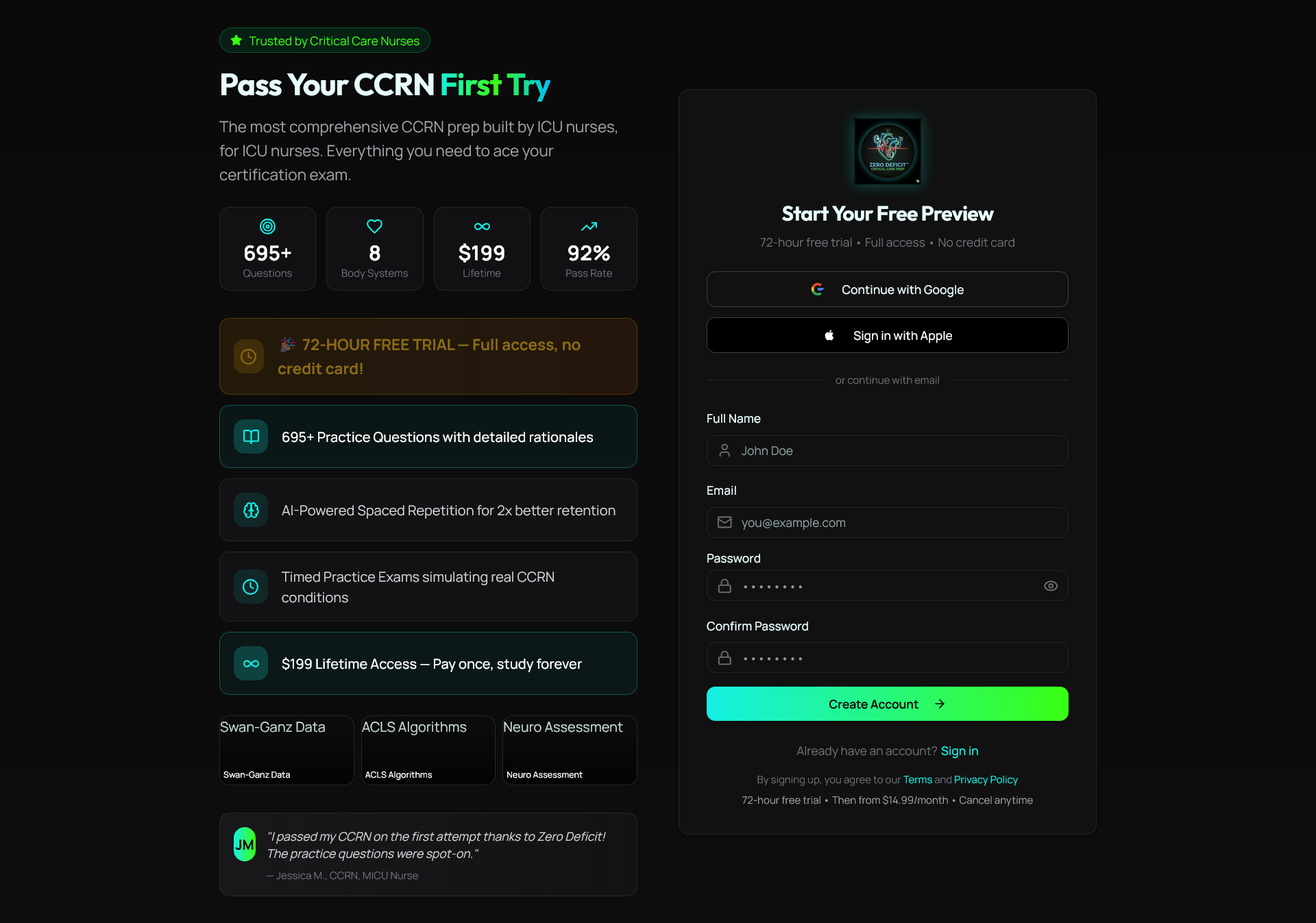
Zerodeficitccrnprep gives you over 695 CCRN practice questions with detailed rationales written by expert ICU nurses, including questions that cover the Synergy Model, advocacy, and team dynamics. The CCRN study guides cover all 8 body systems and the professional caring and ethical practice domains where leadership content lives on the exam. If you want to walk into your CCRN with confidence in both clinical and leadership content, this is where you build that confidence.
FAQ
What is the role of leadership in nursing?
The role of leadership in nursing is to influence, guide, and motivate healthcare teams to deliver safe, high-quality patient care. In critical care settings, this includes dynamic delegation, advocacy, and building team psychological safety.
Which nursing leadership style is most effective in the ICU?
Transformational leadership produces the strongest outcomes in ICU settings, reducing adverse events and increasing patient satisfaction, as confirmed by an integrative review covering 1,944 nurses and 1,209 patients from 2010 to 2025.
How does nurse leadership affect patient outcomes?
Strong nurse leadership reduces adverse events, improves care consistency, and increases patient satisfaction. A 2026 study of 68 ICU professionals confirmed that leadership style directly correlates with the quality of nursing services delivered.
What are the biggest challenges facing nurse leaders in critical care?
Role ambiguity and lack of formal authority within multidisciplinary teams are the primary barriers. Research identifies these gaps as the leading reasons nurse leaders struggle to influence care decisions at the organizational level.
Is leadership content tested on the CCRN exam?
Yes. The AACN Adult CCRN exam includes the professional caring and ethical practice domain, which covers the Synergy Model, advocacy, collaboration, and clinical judgment, all of which are core leadership competencies.
Recommended
- The Role of Ethics in Critical Care: 2026 ICU Guide | Zero Deficit CCRN Prep
- CCRN Infection Control Review Topics: ICU Nurse Guide | Zero Deficit CCRN Prep
- Types of Critical Care Certifications: Your 2026 Guide | Zero Deficit CCRN Prep
- What Is Critical Thinking in Nursing? A Clinical Guide | Zero Deficit CCRN Prep
Take a Cardiovascular practice quiz
Test your mastery of hemodynamics, ACLS, MI, arrhythmias, and heart failure.
Get Your Free 20-Question CCRN Diagnostic
20 high-yield CCRN-style questions across every body system, with detailed rationales — emailed to you instantly.
No spam. One email + a couple of helpful follow-ups. Unsubscribe anytime.
Ready to pass your CCRN?
Join 12,000+ nurses using Zero Deficit — 695+ practice questions with rationales, AI-powered weak-area drilling, and spaced-repetition flashcards.
Start Free Trial →