Top CCRN study topics to master for exam success

TL;DR:
- The CCRN exam emphasizes clinical judgment over content quantity, with focused preparation on high-impact body systems. Strategies should prioritize cardiovascular, respiratory, and multisystem topics, integrating practice questions that develop clinical reasoning. Organized system-based study modules and scenario-driven practice are essential for efficient, targeted exam success.
The CCRN exam doesn’t reward nurses who study everything equally. With more than a dozen body systems, complex ethical scenarios, and clinical reasoning questions all packed into 150 items, the biggest mistake candidates make is treating every topic as equally important. Knowing what to study, how much to study it, and in what order is the real difference between passing on your first attempt and having to reschedule. This guide gives you a ranked, blueprint-aligned breakdown of the highest-yield CCRN study topics so you can study smarter, not longer.
Table of Contents
- Understanding the CCRN exam structure and topic weights
- High-yield CCRN study topics ranked by impact
- System-based modules: Organizing your CCRN study efficiently
- Practice questions and clinical reasoning: Essential for real exam success
- Often overlooked: Professional caring and ethical practice
- Our take: The most efficient path to mastering CCRN topics
- Jumpstart your CCRN success: Top resources to supercharge your prep
- Frequently asked questions
Key Takeaways
| Point | Details |
|---|---|
| Prioritize top-weighted domains | Focus your study on cardiovascular, respiratory, and multisystem topics to maximize scoring potential. |
| Use system-based study modules | Studying by body system covers the exam blueprint efficiently and helps build core knowledge step by step. |
| Practice application, not just recall | Scenario-based questions and reasoning exercises best prepare you for the actual exam format and complexity. |
| Don’t neglect ethical/professional content | Allocate focused time to the Professional Caring & Ethical Practice domain, as it is heavily weighted and often overlooked. |
| Align with current exam updates | Check that your study materials match the latest CCRN blueprint for test dates after November 2025. |
Understanding the CCRN exam structure and topic weights
Before you open a single study guide, you need to understand how the exam is actually built. The AACN CCRN exam blueprint is organized by domain and topic weights, and this structure should directly shape your study priorities. Skipping this step means you risk spending hours on low-weight topics while under-preparing for the sections that make or break your score.
The exam divides into two major domains:
- Clinical Judgment (80% of scored questions): This is the core of the exam. It tests your ability to use data, make decisions, and apply critical care knowledge across all body systems.
- Professional Caring & Ethical Practice (20% of scored questions): This domain covers collaboration, advocacy, ethical decision-making, and the AACN Synergy Model.
Within the Clinical Judgment domain, body systems are not weighted equally. Here is how the current blueprint breaks down:
| Body system/category | Approximate exam weight |
|---|---|
| Cardiovascular | 17% |
| Respiratory | 15% |
| Endocrine, hematology, GI, renal, integumentary | 20% |
| Musculoskeletal, neurology, psychosocial | 14% |
| Multisystem | 14% |
| Professional caring & ethical practice | 20% |
This table tells you something important: nearly one-third of your exam is cardiovascular and respiratory content alone. If you ignore those two systems, you’re essentially giving up points on a third of the test. The revised CCRN exams launched in November 2025 reflect updated practice analyses, so make sure any study materials you use are aligned with the current blueprint.

To match your study efforts to these weights, explore the body system study guides that walk you through each section in order of exam impact.
High-yield CCRN study topics ranked by impact
Now that you know the overall domain weights, here’s how each high-yield topic stacks up for your study plan. Ranking these by impact helps you build your schedule around the areas that return the most points per study hour.
Tier 1: Must-master topics (highest exam impact)
-
Cardiovascular (17%): Dysrhythmias, heart failure, acute coronary syndrome, hemodynamic monitoring, cardiogenic shock, and mechanical circulatory support are all fair game. You must know how to read rhythm strips, interpret hemodynamic values, and choose the safest intervention. This is where most points are won or lost.
-
Respiratory (15%): Acute respiratory distress syndrome (ARDS), mechanical ventilation management, ventilator weaning, pneumothorax, and pulmonary embolism are central here. You need to be comfortable with ventilator settings including FiO2, PEEP, and tidal volume adjustments.
-
Professional caring & ethical practice (20%): Many candidates underestimate this domain because it doesn’t feel like “clinical” content. But it is weighted equally with the combined endocrine/hematology/GI/renal/integumentary category. Expect questions on the AACN Synergy Model, family-centered care, moral distress, end-of-life advocacy, and ethics consultation.
Tier 2: High-impact topics (significant exam presence)
-
Multisystem (14%): Sepsis, MODS (multiple organ dysfunction syndrome), trauma, and toxicology fall here. These questions often integrate multiple systems, making them some of the most complex on the exam.
-
Endocrine, hematology, GI, renal, integumentary (20% combined): Diabetic ketoacidosis (DKA), thyroid storm, disseminated intravascular coagulation (DIC), acute liver failure, acute kidney injury (AKI), and burn care are key subtopics. Though each subarea is smaller individually, together they represent a fifth of your scored items.
-
Musculoskeletal, neurology, psychosocial (14%): Traumatic brain injury (TBI), intracranial pressure management, stroke, Guillain-Barré syndrome, and delirium in the ICU setting are tested here.
Pro Tip: A practical CCRN topic map is to prioritize cardiovascular, respiratory, and multisystem first, then rotate through the remaining systems in order of personal weakness. Use your practice question scores to identify which system modules need the most reinforcement.
According to the official exam handbook, cardiovascular at 17%, respiratory at 15%, multisystem at 14%, and professional caring at 20% together make up over 65% of your total exam. Getting these right is the fastest path to a passing score.
“Success on the CCRN comes from knowing why an answer is right, not just memorizing what the answer is. The exam tests clinical reasoning at every step.”
Use the respiratory study guide to nail ventilator concepts, and review assessment strategies for CCRN to build the kind of systematic thinking the exam rewards.
System-based modules: Organizing your CCRN study efficiently
Once you know which topics are most important, here’s how to organize your study using modular, system-based guides. The key insight here is that structure matters as much as content. A scattered approach leads to gaps. A modular approach builds knowledge cumulatively, with each system reinforcing the next.
The AACN Adult CCRN Certification Review syllabus breaks study into modules that mirror the exam body systems, which is the most logical way to prepare. When your study format matches the exam format, recall is faster and more reliable under test conditions.
Here is a practical checklist of core modules to cover for complete, blueprint-aligned prep:
- Cardiovascular module: Dysrhythmias, hemodynamics, heart failure, shock states, and interventional care
- Respiratory module: Ventilator management, oxygenation strategies, airway emergencies, and pulmonary conditions
- Neurology module: ICP management, stroke, seizures, and sedation/analgesia protocols
- Endocrine module: DKA, HHS (hyperosmolar hyperglycemic state), thyroid emergencies, and adrenal crises
- Renal module: AKI, electrolyte disturbances, and renal replacement therapy
- Hematology/GI module: DIC, coagulation disorders, GI bleeding, and hepatic failure
- Multisystem module: Sepsis bundles, trauma, burns, and toxicology
- Professional caring & ethical practice module: AACN Synergy Model, ethical frameworks, advocacy, and legal considerations
Pro Tip: Don’t study every module at the same depth. Spend roughly 1.5 to 2 times longer on cardiovascular and respiratory than on any single subarea within the endocrine/hematology/GI/renal/integumentary category. Weight your time the way the exam weights its questions.
Browse the comprehensive CCRN study guides to see how each body system module is built for exam-aligned review. You can also explore how educator-led exam prep can strengthen your module-by-module approach with guided structure. For additional reference material on critical care fundamentals, the intensive care curriculum resource provides a solid clinical background for complex ICU concepts.
Practice questions and clinical reasoning: Essential for real exam success
With your study organized by system, let’s see how practice and clinical scenarios turn knowledge into exam-ready skills. Reading study guides builds a knowledge base. Practice questions build the ability to use that knowledge under pressure, which is exactly what the CCRN demands.
The CCRN exam features 150 questions in 3 hours, with 125 scored and 25 trial items. That gives you roughly 72 seconds per question. There is no time to debate terminology or recall isolated facts. You need to recognize clinical patterns and reason through the correct action instantly.
Scenario-based practice questions should focus on synthesis, especially shock management and ventilator decisions. These question types integrate multiple concepts simultaneously, which is exactly how real exam items are written. A question might give you a patient in septic shock with worsening ARDS and ask you to identify the priority intervention. That requires you to link hemodynamics, oxygenation, fluid management, and clinical judgment all at once.
Question stems require application, evaluation, and analysis, not just recall. This means memorizing drug names or normal lab values isn’t enough. You must know when to use a drug, why, and what to watch for next.
Key strategies for practice question success:
- Do questions by system first. Practice cardiovascular questions while studying cardiovascular content so you solidify knowledge immediately.
- Analyze every wrong answer. Understand why the wrong options are wrong, not just why the right answer is right. This doubles your learning from every question.
- Move to mixed-system practice sets. Once individual system scores are strong, switch to randomized question sets that mirror the actual exam format.
- Time yourself. Practice within a 72-second-per-question limit. Speed under pressure is a skill that must be trained.
- Simulate full-length tests. Sitting through 125 to 150 questions in a timed environment builds the mental stamina the exam requires.
“The nurses who pass on their first attempt are not always the most knowledgeable. They are the ones who practiced thinking through tough scenarios until it became automatic.”
Access the CCRN practice questions bank to work through scenario-based items organized by system and difficulty. Then refine your test-taking approach with question breakdown strategies that teach you how to dissect complex stems efficiently.
Often overlooked: Professional caring and ethical practice
Not all critical care knowledge is clinical. Here’s how the exam measures your care and professionalism, and why this domain deserves serious dedicated study time.
Professional Caring & Ethical Practice is 20% of your CCRN score and directly aligns with AACN core values around patient advocacy, ethical practice, and professional accountability. That is the same weight as the entire combined endocrine, hematology, GI, renal, and integumentary category. Underestimating it is a costly mistake that many first-time candidates regret.
What does this domain actually test? Here are the core subtopics you need to review:
- AACN Synergy Model: Patient characteristics (resiliency, vulnerability, complexity, resource availability) matched with nurse competencies. Questions often ask which nursing action best supports a specific patient characteristic.
- Clinical judgment and advocacy: Questions may present a scenario where a physician’s order conflicts with patient wishes or evidence-based practice. You need to know the appropriate escalation pathway.
- Ethical principles: Beneficence, nonmaleficence, autonomy, and justice all appear in clinical scenarios. You must be able to apply these, not just name them.
- End-of-life care and comfort measures: Recognizing when to shift goals of care and how to support families through that transition is directly tested.
- Moral distress: This is a real ICU experience, and AACN includes it because it affects quality of care. Recognizing moral distress and appropriate responses is fair game.
- Collaboration and communication: Interdisciplinary teamwork, handoff communication, and conflict resolution all appear in this domain.
Pro Tip: Create a set of practice questions specifically from this domain during your final two weeks of prep. Many candidates front-load clinical content and only skim professional practice material in the last few days. By then, there isn’t enough time to retain it. Build it into your routine early.
Stay current with evolving CCRN exam prep insights and use your progress tracking tools to monitor whether this domain is keeping pace with your clinical system scores.
Our take: The most efficient path to mastering CCRN topics
Here’s something most prep resources won’t tell you directly: coverage anxiety is one of the biggest threats to passing the CCRN. Coverage anxiety is the feeling that you must review every single topic at the same depth before you’re “ready.” It leads to shallow studying across the full blueprint rather than deep mastery of the areas that actually drive your score.
The nurses who pass on their first attempt are not the ones who read every chapter in every textbook. They are the ones who studied strategically, practiced relentlessly, and built genuine clinical reasoning skills around the highest-weight systems.
Here’s what that actually looks like in practice. You spend your first three weeks building deep knowledge in cardiovascular, respiratory, and multisystem topics, paired with daily practice questions in those areas. You track your scores by system and adjust your focus based on real data, not gut feeling. Then in your final two weeks, you rotate through remaining systems and give dedicated time to professional caring and ethics, which is frequently studied last but accounts for a full fifth of your score.
The other shift worth making is moving away from passive reading toward active practice. Reviewing a study guide once is passive. Doing 20 questions on that content, analyzing your wrong answers, then reviewing the guide again is active. Active repetition is what moves information from short-term familiarity to long-term retrieval under exam pressure.
Use a practice question repository that gives you detailed rationales, not just answer keys. Knowing the right answer matters less than understanding the reasoning chain that gets you there. That reasoning chain is what carries you through novel question stems you’ve never seen before.
The most efficient path is not the longest one. It’s the most targeted one.
Jumpstart your CCRN success: Top resources to supercharge your prep
You now have a clear map of what to study, how to rank it, and how to organize your approach. The next step is putting that plan into motion with resources built specifically for CCRN candidates.
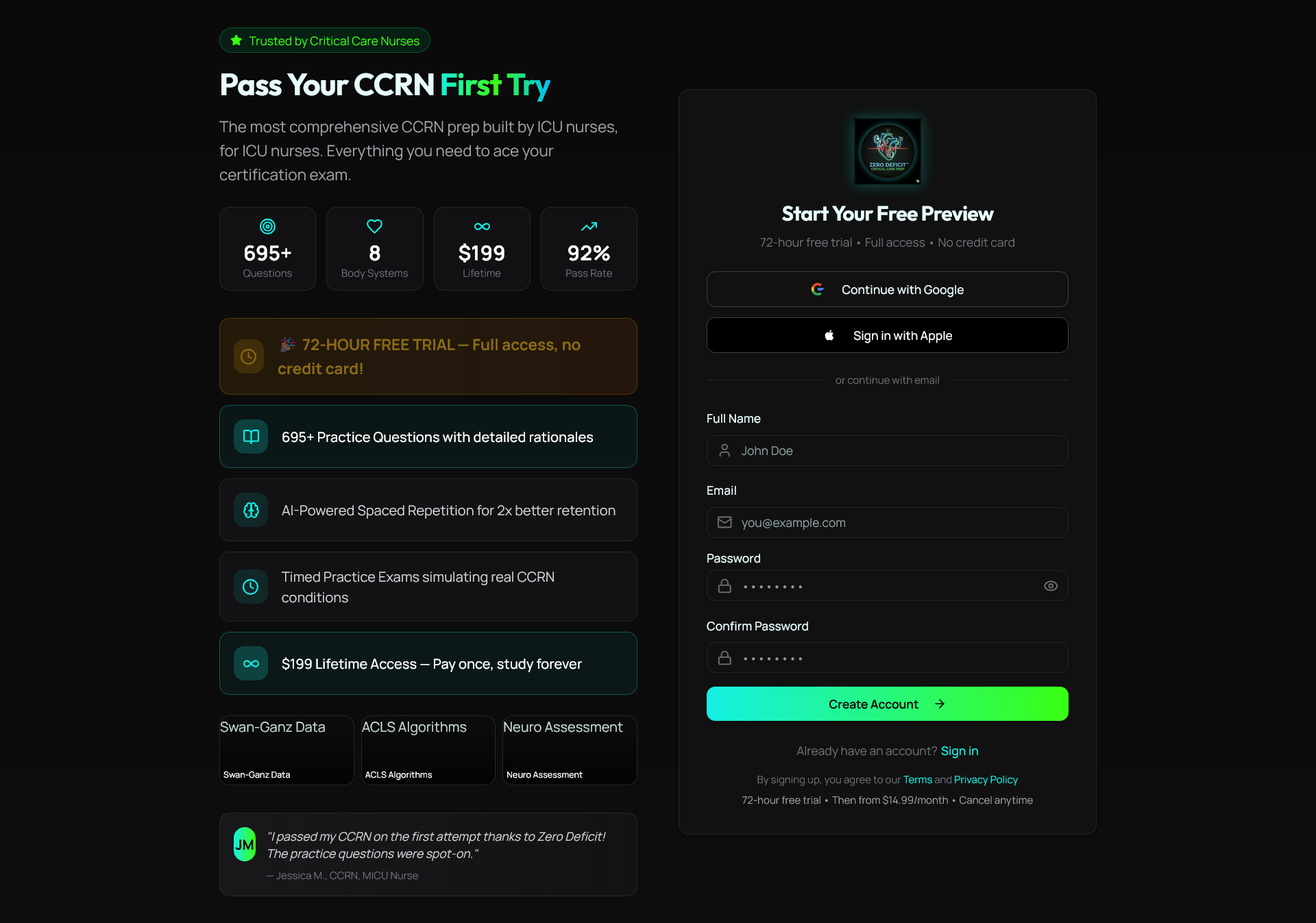
Zero Deficit™ CCRN Exam Prep gives you everything you need in one place: system-based study guides aligned to the current AACN blueprint, a question bank with over 695 practice items, and AI-powered review tools that adapt to your individual performance. Browse the full CCRN study guide library to work through each system module at your own pace. Build your test-taking stamina with the practice test banks that mirror real exam conditions. When you’re ready to commit, explore flexible subscription options with a free version that requires no credit card to start. Your first-attempt pass starts here.
Frequently asked questions
How is the CCRN exam content divided by topic?
The CCRN exam blueprint allocates 80% to clinical judgment across body systems and 20% to professional caring and ethical practice, with cardiovascular and respiratory carrying the highest individual system weights.
What are the highest priority topics to study for CCRN success?
Cardiovascular, respiratory, and multisystem topics carry the most exam weight, making them the best starting points; according to current CCRN study plans, mastering these three areas first delivers the greatest return on study time.
How many questions are on the CCRN exam and how is it timed?
The CCRN exam structure includes 150 total questions delivered in 3 hours, with 125 items scored and 25 unscored trial items used for future test development.
What is the newest update to the CCRN exam structure?
The 2025 revised CCRN exams launched November 12, 2025, incorporating a current national practice analysis and updated expert consensus to reflect the evolving responsibilities of critical care nurses.
Why are scenario-based practice questions important for CCRN exam prep?
Scenario-based questions build the clinical reasoning skills required for the application, evaluation, and analysis levels of thinking that the CCRN specifically targets, moving you well beyond simple recall.
Recommended
Take a Respiratory practice quiz
Master ARDS, ventilation, ABGs, oxygenation, and pulmonary emergencies.
Get Your Free 20-Question CCRN Diagnostic
20 high-yield CCRN-style questions across every body system, with detailed rationales — emailed to you instantly.
No spam. One email + a couple of helpful follow-ups. Unsubscribe anytime.
Ready to pass your CCRN?
Join 12,000+ nurses using Zero Deficit — 695+ practice questions with rationales, AI-powered weak-area drilling, and spaced-repetition flashcards.
Start Free Trial →