Best CCRN Crash Course: How to Choose in 2026

By Zero Deficit Critical Care Prep
The best CCRN crash course is the one that matches your exam date, your weak systems and the way you learn. For most ICU nurses that means a question bank with real rationales, a review that follows the AACN blueprint, and a way to see which topics keep costing you points. Below we compare the main options US nurses use, including ours, and show you how to pick in about ten minutes.
TL;DR
- A crash course works best when you already have ICU experience and need to organize it around the AACN test plan, not learn critical care from scratch.
- The options differ mainly in format (video course, question bank, or both), question count, contact hours and tools like AI coaching or diagnostics.
- Choose by your weakest systems, your weeks until the exam and whether you need contact hours.
- Zero Deficit™ gives you 695+ practice questions with detailed rationales, study guides by system, spaced repetition, AI-powered review and exam simulations, from $14.99 per month.
- Whatever you choose, spend most of your time on questions, then review every rationale, right answers included.
Table of Contents
- What a CCRN crash course should do for you
- The main CCRN crash course options for US nurses
- Side-by-side comparison
- How to choose for your situation
- What the content should cover
- A five-point checklist before you pay
- Our perspective
- Try Zero Deficit™ before you commit
- A simple plan that works with any course
- Common mistakes with crash courses
- FAQ
- Sources
What a CCRN crash course should do for you
A crash course is not a replacement for bedside experience. It is a way to turn what you already do on shift into answers on a computer-based test. The exam is a 3-hour test with 150 multiple-choice items, 125 scored and 25 unscored, and about 80% of it is clinical judgment, with 20% on professional caring and ethical practice. That split tells you what to look for.
A good course should:
- Teach to clinical judgment. Questions that only test recall of a number are not enough. You need scenarios where you decide what to do first and why.
- Cover every body system on the Adult CCRN blueprint, plus the Synergy Model and ethics content.
- Explain every answer. The rationale is where the learning happens.
- Show you where you are weak so your remaining weeks go to the right place.
- Fit your calendar. A course you cannot finish before test day does nothing for you.
This article is about the Adult CCRN only. If you are not sure which credential fits your unit, our guide to types of critical care certifications walks through the differences.
The main CCRN crash course options for US nurses
US nurses searching for a CCRN review usually land on the same handful of providers. Here is how they present themselves. Details such as pricing change, so confirm the current offer on each provider’s own site before you buy.
AACN Adult CCRN Certification Review Course
AACN is the organization that owns the credential, and its online review course is built to help you prepare for the acute and critical care certification exam. Nurses who want instruction straight from the certifying body tend to start here. It is an instructional course format, so you will likely want to pair it with a separate question bank for volume practice.
Archer Review
Archer Review’s CCRN program pairs an ANCC-accredited video library with a QBank of more than 1,000 questions. Its listing mentions roughly 13 hours of video and 13.75 contact hours, along with webinars and CE certificates. It suits nurses who want video teaching and a large question pool in one place and who value CE credit.

Critical Care Academy
Critical Care Academy offers a self-paced Adult CCRN review aligned to the current test plan. The listing describes video lessons, practice questions, an AI Coach, a final exam with a diagnostic report, and a pass guarantee. Nurses who like structured video lessons followed by a diagnostic tend to look here.
Self-paced video courses with contact hours
Some online providers sell a self-paced video course of around 1,000 minutes that is approved for 17 contact hours. These fit nurses who learn well by watching lectures and want CE credit in the bargain.
Pass CCRN and other question banks
Nurses in online forums often recommend Pass CCRN for harder questions that push you to learn the material instead of memorizing it. That is user opinion, so treat it as one data point and judge the questions yourself.
Zero Deficit™ CCRN Exam Prep
Our platform is built for critical care nurses preparing for the Adult CCRN. You get 695+ practice questions with detailed rationales, study guides by system and topic, flashcards, spaced repetition, progress tracking, exam simulations, personalized question generation and AI-powered review tools. Our content was created by expert ICU nurses.
Side-by-side comparison
| Option | Format | Question bank | Contact hours | Standout features |
|---|---|---|---|---|
| AACN Adult CCRN Review Course | Online review course | See AACN’s page | See AACN’s page | Offered by the certifying organization |
| Archer Review | Video library plus QBank | 1,000+ questions | 13.75 | Webinars, CE certificates |
| Critical Care Academy | Self-paced video course | Practice questions plus final exam | See provider’s page | AI Coach, diagnostic report, pass guarantee |
| Self-paced video course (about 1,015 minutes) | Video | See provider’s page | 17 | Longest video runtime of the group |
| Zero Deficit™ | Question bank, study guides, flashcards | 695+ with detailed rationales | Not a CE program | AI-powered review, spaced repetition, exam simulations, progress tracking |
The table shows a real trade-off. Video-first courses give you lectures and CE credit. Question-first platforms give you repetition and feedback. Most passing nurses end up doing both in some proportion, so ask yourself which half you are missing.
How to choose for your situation
If your exam is 2 to 4 weeks away
You do not have time to watch 17 hours of lectures and also do hundreds of questions. Put question volume first. Do timed sets by system, read every rationale, and use study guides only for the topics you miss. Our last-minute review built on AACN weighting lays out the final 72 hours.
If you have 8 to 12 weeks
You can afford a hybrid. Use video or a study guide to learn a system, then do questions on it within a day or two, then revisit missed concepts with spaced repetition. We describe this approach in our 8 to 12 week CCRN plan.
If you are a new ICU grad
You may have less bedside exposure to some topics, such as CRRT or hemodynamic monitoring. Look for a course with strong explanations, not just a large question count. Study guides organized by system help you fill those gaps. Our study guides by body system cover all eight systems.
If you are retaking the exam
Your best asset is data about what went wrong. Pick a tool with progress tracking so you can see which systems drag your score down, then spend your time there instead of rereading what you already know.
If you need contact hours
Then a CE-approved video course matters, and you should confirm the hours and accreditation on the provider’s page. A question bank alone will not give you CE credit.
What the content should cover
Whatever you buy, check that it covers the heavy hitters of the Adult CCRN blueprint:
- Cardiovascular: hemodynamics, shock, ACS and vasoactive drips.
- Pulmonary: ARDS, ventilator management and ABG interpretation.
- Neurology: ICP management and stroke.
- Sepsis and multisystem organ dysfunction.
- Endocrine emergencies such as DKA and HHS.
- Renal and CRRT.
- The Synergy Model and ethics.
A good question bank will also teach you reference points, not just ask for them. For example, you should be able to recall that normal arterial pH is 7.35 to 7.45, PaCO2 is 35 to 45 mmHg and bicarbonate is 22 to 26 mEq/L, then use them under pressure to decide whether you are looking at respiratory or metabolic acidosis. If a course never makes you apply those values in scenarios, it is teaching trivia. Our top CCRN study topics guide shows how to prioritize.
A five-point checklist before you pay
- Sample the questions. Are they scenario-based? Do they ask what to do first, not just what a value means?
- Read a rationale. Does it explain why each wrong answer is wrong?
- Check blueprint alignment. The provider should say which test plan it follows.
- Look at the feedback tools. Diagnostics, progress tracking and weak-area reports tell you where to spend your last weeks.
- Do the math on cost against your timeline. A monthly plan can be cheaper than an annual one if you test in six weeks.
Budget for the exam fee too. Our CCRN exam cost breakdown shows what to plan for besides your prep.
Our perspective
We built Zero Deficit™ because most CCRN prep treats the exam as a memory test. It is not. Four out of five items ask you to use clinical judgment, so the way you practice has to look like that.
That is why every one of our 695+ questions comes with a detailed rationale written by ICU nurses. We want you to understand why the priority action is the priority, so you can handle a version of the question you have never seen.
We also think repetition beats rereading. Spaced repetition brings back the concepts you miss at the right moments, and AI-powered review helps you target your weak systems instead of grinding through what you already know. Progress tracking makes the picture visible, and exam simulations let you rehearse the 3-hour format.
If you have a few months, you can learn each system properly. If you have a few weeks, you can focus on the questions that matter most. Either way, our goal is the same: no gaps on test day.
Zero
Try Zero Deficit™ before you commit
If you want a question-first approach, start with our free trial and see how the rationales read. The premium plans unlock the full question bank, study guides, flashcards, spaced repetition and exam simulations. Premium Monthly is $14.99 per month and Yearly Access is $84.99 per year, and there is also a Lifetime Mastery option. Check the subscription page for current details.
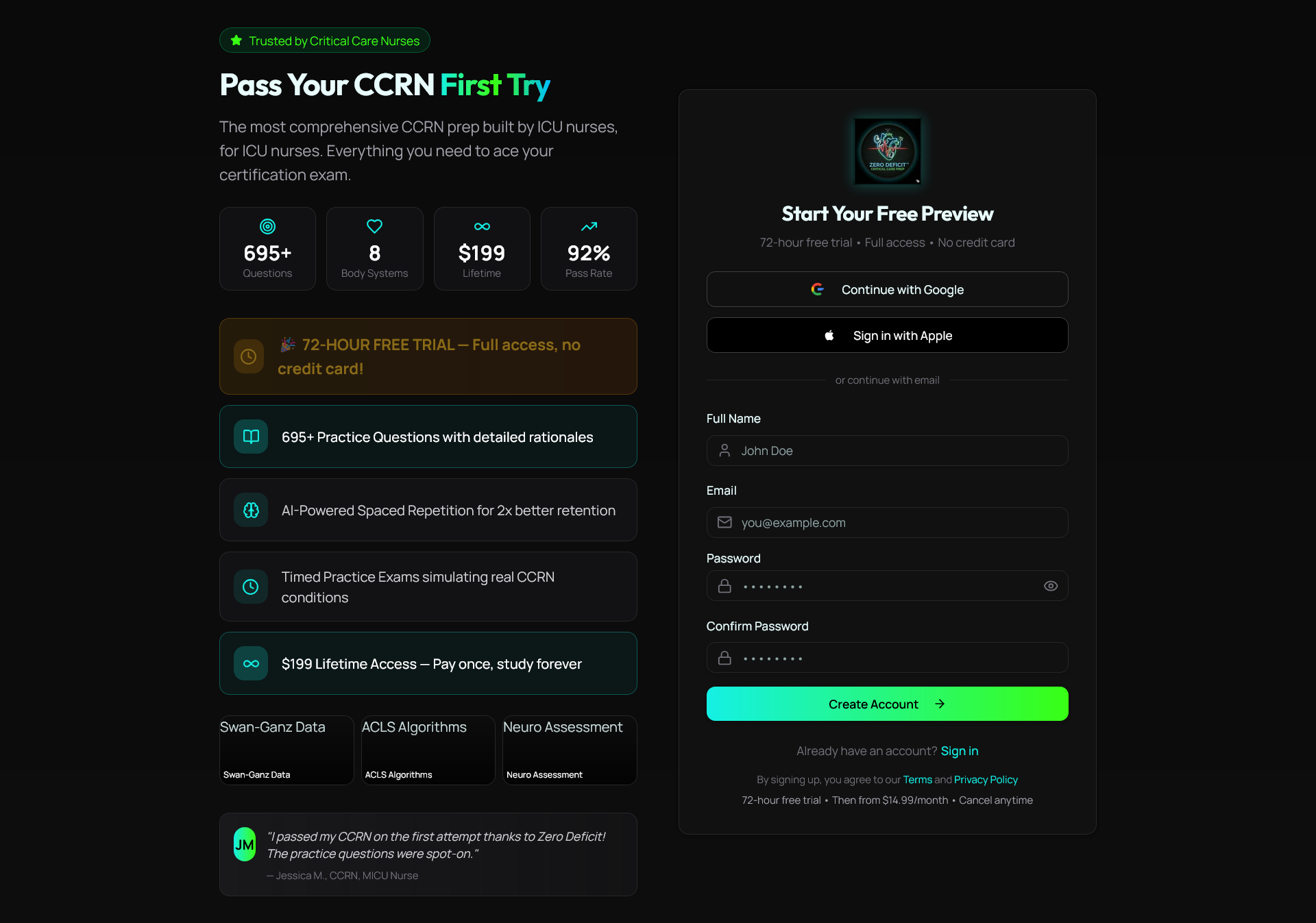
You can also browse practice tests by body system or take a look at our shock flowchart to see how we teach a high-yield topic.
A simple plan that works with any course
Whichever provider you pick, the habits below matter more than the brand.
- Take a baseline set first. Do 50 mixed questions cold. Note your score by system, not the total.
- Rank your systems. Your lowest two get the most time in week one.
- Learn, then test. Read or watch one topic, then answer questions on it the same day.
- Review every rationale. Spend more time reading explanations than answering. Write down the principle you missed, not the fact.
- Repeat missed concepts. Bring them back after a few days, then after a week.
- Simulate the exam. In your last two weeks, do at least two full-length timed sessions to build stamina for the 3-hour test.
- Taper the last 72 hours. Review your weak list, sleep and avoid new material. Our exam readiness workflow can help you structure it.
For the full picture of how we approach passing, read our proven guide to passing the CCRN.
Common mistakes with crash courses
Buying the longest course. More video hours do not equal more points. If you have worked in the ICU for a few years, you may need less lecture and more applied practice.
Skipping the ethics and Synergy Model content. It is the smaller slice of the exam, but it is also where nurses lose easy points because they assumed it was common sense.
Only reviewing wrong answers. Questions you guessed right are just as dangerous. Mark every guess and review it.
Doing questions untimed forever. The exam gives you 3 hours for 150 items. Practice pacing early enough that it feels normal.
Cramming a new resource in the last week. Switching tools late splits your attention. Stick with one main resource and fill gaps from there.

FAQ
Is a CCRN crash course enough to pass?
For many nurses with solid ICU experience, a focused course plus plenty of practice questions is the core of their prep. What counts is how you use it: answering questions, reading rationales and revisiting weak areas. Nurses with less bedside exposure may want more weeks and a system-by-system study guide.
How long should I study with a crash course?
It depends on your experience and your starting scores. Many nurses plan somewhere in the range of 8 to 12 weeks, while a compressed review can work if you already score well on baseline questions. Take a baseline quiz first and let your results set the timeline.
Do I need a course with contact hours?
Only if you want CE credit for your employer or license. Video courses from providers such as Archer Review list contact hours on their pages. A question bank like ours is designed for practice and feedback, not CE credit, so some nurses combine the two.
Should I choose a video course or a question bank?
If you learn by listening and need an overview, start with video. If you already know the material and need to apply it, start with questions. Since the exam is built around clinical judgment, most nurses spend the majority of their time on questions with rationales.
Can I try Zero Deficit™ before paying?
Yes, we offer a free trial, and you can upgrade to a premium plan when you are ready. Plans are listed on our subscription page.
Sources
Ready to practice like the exam? Start with our 695+ CCRN practice questions with detailed rationales and find your gaps before test day.
Recommended
Take a Neurological practice quiz
Test your knowledge of stroke, ICP, seizures, and neuro assessment.
Get Your Free 20-Question CCRN Diagnostic
20 high-yield CCRN-style questions across every body system, with detailed rationales — emailed to you instantly.
No spam. One email + a couple of helpful follow-ups. Unsubscribe anytime.
Ready to pass your CCRN?
Join 12,000+ nurses using Zero Deficit — 695+ practice questions with rationales, AI-powered weak-area drilling, and spaced-repetition flashcards.
Start Free Trial →