Adult vs Pediatric CCRN: Key Differences to Pick Your Exam
Pick the CCRN that matches the patient population you actually provide direct care to, most of the time. That single rule decides more applications than anything else in the process, and it comes straight from AACN’s own eligibility policy, not from unit signage on a hospital wall.
Here’s the quick snapshot before you go further:
- Eligibility hours: Same math for both exams. 1,750 hours in two years (875 in the most recent year) or 2,000 hours in five years (144 in the most recent year), all in direct care of your chosen population.
- Exam format: Identical structure both directions. 150 items, 125 scored, three hours on the clock.
- Content emphasis: Adult leans into ACS, ventilator management, and adult sepsis presentations. Pediatric leans into congenital cardiac defects, pediatric shock physiology, and weight-based dosing.
- Next step: Pull your last three shifts’ worth of patient assignments and confirm the population mix with your manager before you register.
Pro Tip: If you float between an adult ICU and a PICU, count hours by population served, not by which unit posted your name on the schedule. The CCRN Exam Handbook is the definitive source for these numbers, and it’s worth reading before you spend money on an application.
Key Takeaways
The patient population you provide the majority of direct-care hours to should determine whether you sit for adult or pediatric CCRN, since eligibility rules and content emphasis both hinge on that single factor.
| Point | Details |
|---|---|
| Population decides the exam | Choose based on which patient population makes up most of your direct-care hours, not your unit’s name. |
| Format is identical both ways | Every CCRN exam runs 150 items (125 scored), three hours, weighted 80% clinical judgment and 20% professional caring. |
| Hours must be documented | Track 1,750 hours in two years or 2,000 in five years, with recent shift logs ready for supervisor verification. |
| Content emphasis shifts by system | Adult favors ACS and adult sepsis; pediatric favors congenital cardiac defects and weight-based dosing. |
| Study time should match your caseload | Allocate review hours in proportion to your actual population exposure, not an even split. |
Table of Contents
- What Adult and Pediatric CCRN Exams Have in Common
- What Are the Exact Eligibility Hour Requirements?
- How Does Test Content Differ Between Adult and Pediatric CCRN?
- How Do You Decide Which CCRN Exam Fits You?
- What’s the Best Way to Study Once You’ve Picked an Exam?
- How Zero Deficit™ Supports Adult CCRN Preparation
- Which CCRN Path Actually Deserves Your Attention
- FAQ
What Adult and Pediatric CCRN Exams Have in Common
Before you weigh adult vs pediatric CCRN, know what doesn’t change. Every CCRN exam, regardless of population, runs on the same skeleton.
You’ll sit for 150 multiple-choice items, 125 of them scored and 25 unscored field-test questions you can’t identify during the exam. You get three hours. That’s true whether you’re testing on adults, pediatrics, or neonates.
The scoring weight is also fixed across populations: 80% of your exam tests clinical judgment, organized by body systems, and 20% tests Professional Caring and Ethical Practice, the piece built on AACN’s Synergy Model. That model treats nursing competency and patient needs as linked, not separate, which is why ethics and advocacy questions show up alongside hemodynamics questions on the same exam.
AACN also offers three eligibility pathways: Direct Care, Tele Critical Care, and a Knowledge Professional pathway for nurses who’ve moved into education or leadership. This guide focuses on Direct Care, since it covers the vast majority of bedside ICU nurses deciding between adult and pediatric. Both the CCRN Exam Handbook and the population-specific test plans spell out exactly what’s fair game.
What Are the Exact Eligibility Hour Requirements?
The hour requirements don’t change based on which population you choose. What changes is which hours count.
- Two-year pathway: 1,750 hours providing direct care to your chosen population within the past two years, with at least 875 of those hours in the most recent year.
- Five-year pathway: 2,000 hours in the past five years, with at least 144 hours in the most recent year. This route suits nurses who took time off or shifted specialties temporarily.
- License status: You need an unencumbered U.S. RN or APRN license, meaning no active restrictions, suspensions, or disciplinary actions tied to your ability to practice.
Here’s where candidates trip up. Your eligibility ties to the patient population you cared for, not the name printed on your badge or unit directory. A nurse floating between a mixed ICU and a PICU counts hours by who was in the bed, not by which department signed her paycheck. Orientation shifts generally don’t count unless you were the assigned nurse of record, and AACN can request documentation your supervisor or a professional colleague verifies.
Pro Tip: Keep a running log with dates, patient ages, primary diagnoses, and your role for each shift. If AACN audits your application, that log turns a stressful phone call into a five-minute confirmation.

Tele critical care hours and knowledge professional pathways exist for nurses working outside a traditional bedside role, but they carry separate hour thresholds worth confirming directly with AACN before you assume they apply to you.
How Does Test Content Differ Between Adult and Pediatric CCRN?
The shared 80/20 split hides real differences in what “clinical judgment” actually tests once you get into a body system.
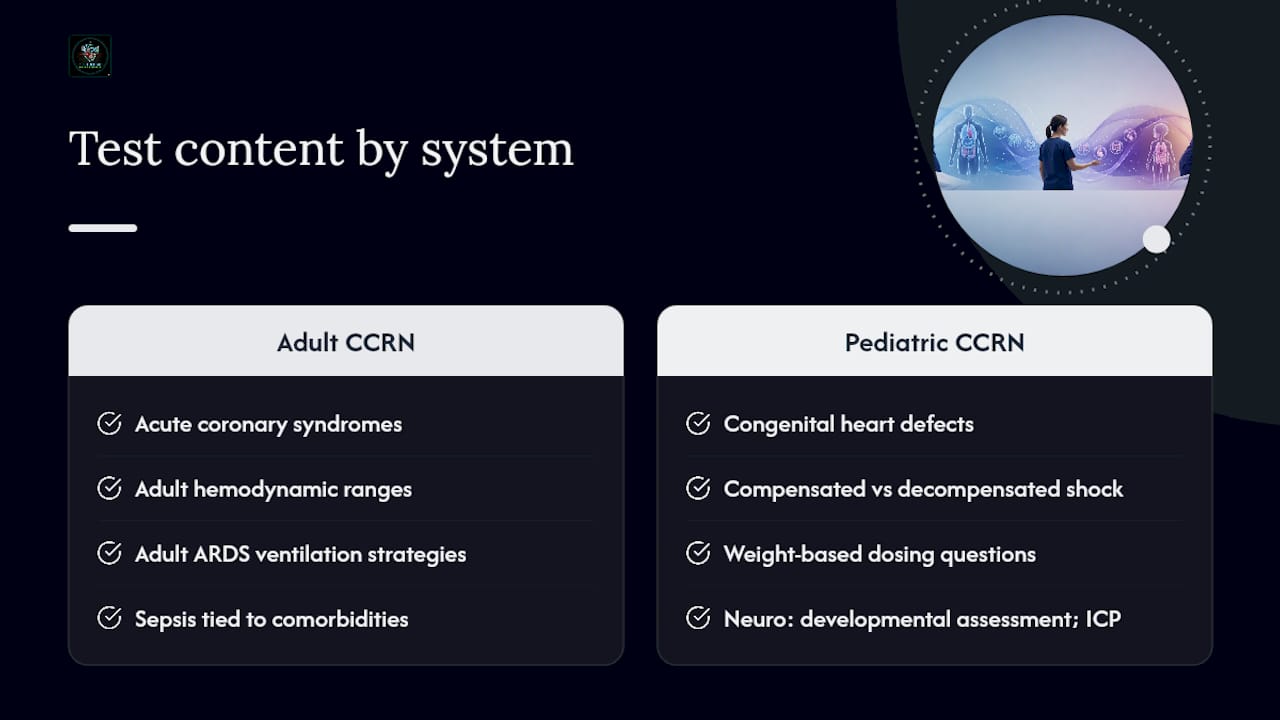
On the adult CCRN test plan, expect heavier emphasis on acute coronary syndromes, mechanical ventilation strategies for adult ARDS, and sepsis etiologies tied to comorbidities like diabetes or chronic kidney disease. Cardiovascular questions assume adult hemodynamic ranges and adult-typical presentations of shock.

Pediatric CCRN shifts that same cardiovascular category toward congenital heart defects, since structural cardiac anomalies dominate pediatric critical care in a way they rarely do in adult units. Shock presentations skew toward compensated versus decompensated pediatric shock, and dosing questions require weight-based calculations that don’t appear on the adult exam at all.

Both test plans cover the same priority systems: cardiovascular, pulmonary, neurologic, sepsis/multisystem, endocrine, renal, and psychosocial/ethical practice. What changes is the testable nursing action inside each system. Adult neuro questions might center on stroke window timing and ICP management in an adult with a traumatic brain injury. Pediatric neuro questions weight developmental assessment alongside ICP management, since a toddler’s baseline neuro exam looks nothing like an adult’s.
Don’t split hours 50/50 between populations when your actual clinical exposure runs closer to 90/10.
How Do You Decide Which CCRN Exam Fits You?
Run the numbers before you run the application. Here’s the checklist.
- Calculate your population ratio. Pull the last 6 to 12 months of shifts and tally what percentage involved primarily adult patients versus pediatric patients. Whichever population clears roughly 60% or more of your direct-care hours is usually your answer.
- Review three representative recent shifts. Note the date, patient ages and primary diagnoses, and your specific assignment for each. This becomes your backup documentation if AACN ever requests verification.
- Confirm with your manager or preceptor. Ask them directly: “Can you verify I provided direct care to [population] for at least [X] hours in the past [timeframe]? Can you or another charge nurse confirm this in writing if AACN requests it?”
- Weigh career direction. If you’re aiming toward a PICU leadership role, pediatric CCRN signals that intent to employers even if your current unit is mixed.
- Check employer incentives. Some hospital systems fund certification exams or pay differentials only for specific population credentials, worth confirming with HR before you commit.
Pro Tip: When in doubt about a borderline hour count, contact AACN’s certification department directly rather than guessing. A five-minute email now beats a rejected application later.
What’s the Best Way to Study Once You’ve Picked an Exam?
Treat the official AACN test plan and handbook as your syllabus, not a reference you skim once. It tells you exactly what percentage of the exam covers each system, and that percentage should drive how you allocate study hours.
Prioritize your highest-yield systems first: cardiovascular, pulmonary, neuro, sepsis/MODS, endocrine, and renal/CRRT consistently carry the heaviest weight on both population exams. Within each, focus on scenario-based questions that test clinical judgment rather than isolated fact recall, since that mirrors how AACN actually writes items.
A few tactics that move the needle:
- Run timed practice blocks that simulate the real three-hour session, not 20-minute study snippets.
- Read every rationale, including for questions you got right, since half the value is understanding why the wrong answers are wrong.
- Space repetition across weeks rather than cramming a single system in one sitting.
- Log missed items by category, assessment, interpretation, or intervention, so your review targets weak spots instead of re-covering strengths.
Pro Tip: Simulate the full three-hour block at least twice before your real exam date. Stamina matters as much as knowledge when you’re 120 questions deep.
One renewal note worth knowing early: CCRN certification lasts three years, renewable through continuing education requirements (CERPs) or by retaking the exam, and renewal by CERPs still requires documented direct-care hours during that period. For a deeper walk through study sequencing, see our proven guide for critical care nurses.
How Zero Deficit™ Supports Adult CCRN Preparation
You get access to over 695 practice questions organized by body system, matched to the exam’s actual emphasis on cardiovascular, pulmonary, neuro, and sepsis/MODS content.
Every question comes with a detailed rationale, and the AI-powered review tools flag which systems you’re weakest in so you’re not guessing where to focus next. If you’re evaluating any prep resource, adult or pediatric, ask three questions: does it map to the current AACN test plan, does it reflect 2020 and later AHA and SCCM guidelines, and does it show you measurable practice exam performance over time? A tool that can’t answer those isn’t worth your subscription. Whatever you choose, cross-check it against the official AACN handbook before you trust it as your only source.
Which CCRN Path Actually Deserves Your Attention
Most advice on adult vs pediatric CCRN treats the decision like a coin flip between two equally weighted options. It isn’t. Your patient population ratio already answered the question for most of you, and the real work is documenting it well enough to survive an audit, not agonizing over which exam sounds more prestigious.
The conventional wisdom oversells the content gap between the two exams. Yes, pediatric leans into congenital cardiac defects and weight-based dosing, and adult leans into ACS and adult ventilator strategies. But the underlying clinical judgment skills, prioritization, recognizing decompensation early, and applying the Synergy Model to patient advocacy, transfer almost entirely between populations. Nurses who float between adult and pediatric units sometimes overthink this choice for months when a simple hour count would have settled it in an afternoon.
What deserves more attention than it usually gets: the verification step. I’ve seen more application delays caused by fuzzy documentation than by nurses genuinely lacking the hours. Build your three-shift log now, before you need it. Then pick the population your daily practice already points to, and spend your study energy on system-based practice questions rather than second-guessing the exam title on your certificate.
— Zero
FAQ
Is There a Separate Pediatric CCRN Exam?
Yes. AACN offers CCRN (Pediatric) as a distinct credential from CCRN (Adult), with its own test plan and eligibility page, though both share the same 150-item, three-hour format.
What Is the Pass Rate for the CCRN Pediatric Exam?
AACN doesn’t publish a standalone public pass rate breakdown by population on its general materials, so treat any specific number you see elsewhere with caution and rely on your own practice exam performance as your best predictor.
What Changes Are Coming to the CCRN Test Plan?
AACN periodically updates test plans to reflect current AHA and SCCM guidelines; always check the current handbook directly rather than relying on older summaries, since content weighting can shift between revisions.
Is the CEN or the CCRN Harder?
Difficulty is subjective and depends on your clinical background, the CEN (Certified Emergency Nurse) tests emergency-specific content while CCRN tests critical care judgment across body systems, so the “harder” exam is usually whichever one covers content further from your daily practice.
Ready to turn your population decision into an exam pass? Start working through 695+ CCRN practice questions built around the same body-system weighting AACN uses, or dig into system-specific practice tests to target the areas your shift ratio says matter most.
Recommended
Take a Neurological practice quiz
Test your knowledge of stroke, ICP, seizures, and neuro assessment.
Get Your Free 20-Question CCRN Diagnostic
20 high-yield CCRN-style questions across every body system, with detailed rationales — emailed to you instantly.
No spam. One email + a couple of helpful follow-ups. Unsubscribe anytime.
Ready to pass your CCRN?
Join 12,000+ nurses using Zero Deficit — 695+ practice questions with rationales, AI-powered weak-area drilling, and spaced-repetition flashcards.
Start Free Trial →