BoardVitals vs Pocket Prep for PMHNPs: 150 Items, Daily Practice

Use BoardVitals as your primary tool for timed, exam-style simulation, and use Pocket Prep for short daily reinforcement on your phone. If you can only buy one, pick by study stage: Pocket Prep while you build habits early, BoardVitals once you need test-day realism. Pairing the two can help you combine timed simulation with short daily reinforcement.
TL;DR:
- The AANPCB exam has 150 multiple choice items; save full simulations until content review is mostly complete, because early tests can discourage without teaching much.
- BoardVitals rationales confirm answers but may not teach unfamiliar concepts, so pair missed question review with a lecture or course when foundational knowledge is weak.
- Track misses by blueprint domain: Assess accounts for 33% and Plan 26%, compared with Diagnose at 21% and Evaluate at 20%.
- Before paying for a course, verify its practice question offering and sample materials; also check vendors’ update schedules, trial terms, and refund policies.
Table of Contents
- Which PMHNP review options are worth a trial?
- What does BoardVitals offer PMHNP candidates?
- What does Pocket Prep offer PMHNP candidates?
- What does the Fitzgerald Colibri Healthcare PMHNP Review Course offer?
- What does the Mometrix PMHNP Review Course Online offer?
- Which features matter most when you compare these platforms?
- How do you choose the right option for your situation?
- What does a realistic study plan look like?
- Why does explanation quality matter more than question volume?
- Studying for the CCRN instead? Here is where we fit
- FAQ
- Sources
- Where can you find the official PMHNP exam references?
Which PMHNP review options are worth a trial?
Several options come up when PMHNP candidates compare notes. Each one solves a different problem, so the right first trial depends on how you study and where you are in your timeline.
- BoardVitals: best for timed, high-volume question practice that mimics the pressure of the real exam. Try it first if you already have the clinical knowledge and need reps.
- Pocket Prep: best for short, consistent daily sessions on your phone. Try it first if your schedule is chopped into short pockets of time between tasks.
- Fitzgerald Colibri Healthcare PMHNP Review Course: best for learners who want structured, instructor-led lectures with supplemental printed materials. Try it first if you retain more from listening than from reading explanations.
- Mometrix PMHNP Review Course Online: best for self-directed learners who want a structured, self-paced course packaged for independent pacing without a live commitment. Try it first if you want structure and a lighter commitment.
A quick rule for choosing your first trial: if your exam is still some time away, start with the format that builds the habit (Pocket Prep or a lecture course). If your exam is approaching, start with the one that simulates the exam (BoardVitals). Whatever you start with, finish the trial with a baseline score so you know where your weak domains are.
What does BoardVitals offer PMHNP candidates?
BoardVitals is a question bank with timed-exam simulation. Its job is to put you under test-day conditions: long blocks of multiple-choice items, a running clock, and the mental fatigue that comes with both. Practitioner commentary describes it as a high-fidelity tool for candidates who already carry the clinical knowledge and need realistic repetitions rather than a first pass through the content.
That framing matters because the real exam is long. The AANPCB PMHNP exam has 150 multiple-choice items, and stamina is a real variable. Practicing in short bursts alone will not train you to stay sharp deep into a long sitting. A tool built around timed blocks does.
What BoardVitals does well
- Exam-style framing: items are written to look and feel like the real thing, which helps you practice reading the stem carefully and eliminating distractors.
- High-volume exposure: large item pools mean you can keep seeing fresh questions instead of memorizing a small set.
- Timed simulation modes: you can rehearse pacing, which is a skill separate from knowing the content.
- Performance tracking: seeing which domains drag your scores down lets you aim your remaining study time.
How deep are the explanations?
Expert commentary characterizes the explanations as competent but not deeply pedagogical. In practice, that means rationales are good for confirming why an answer is right and why the distractors are wrong, but they will not replace a lecture or a textbook when a whole concept is missing. If you miss an item on, say, the pharmacokinetics of a mood stabilizer and you do not understand the underlying idea, you will likely need a second source to fill the gap.
Think of it this way: BoardVitals is a checking tool and a conditioning tool. It tells you what you do not know and trains you to perform. It is less of a teaching tool for building knowledge from scratch.
Who benefits most
BoardVitals fits you best if you are in your final weeks and need to simulate the exam, if you already completed a first pass through the content, or if your main risk is pacing and test fatigue rather than a total lack of knowledge. It is a weaker first choice if you are still learning core material, because you will burn through questions before you have the foundation to learn from the rationales.
How to get more from the rationales
A habit that pays off with any question bank: after a block, write one sentence for every miss, stating the concept you did not know. Then sort those sentences by exam domain. The AANPCB blueprint spreads items across four domains, with Assess at 33%, Diagnose at 21%, Plan at 26%, and Evaluate at 20%, so a cluster of misses in Assess or Plan may matter more because those domains account for a larger share of items than Evaluate.

Use that sorted list to drive your next study block. Do not just keep firing off new questions. The point of a question bank is to find holes, and the point of the next week is to fill them.
A note on timing
Candidates tend to use BoardVitals most heavily in the last third of their prep, when full-length simulations make sense. Starting timed 150-item practice in week two usually just produces discouragement and little learning. Save your realistic simulations for when your content review is mostly done, and use shorter untimed blocks earlier to learn from the rationales.
What does Pocket Prep offer PMHNP candidates?
Pocket Prep is a mobile-first app built around short sessions. Instead of asking you to carve out a long block at a desk, it lets you answer a handful of questions while waiting for coffee or riding a train. That design supports spaced, repeated recall, which is the habit that moves facts from short-term memory into something you can retrieve on exam day.
For a working PMHNP candidate, the real obstacle is rarely intelligence. It is consistency. Shifts run long, clinic days run over, and a study plan that needs a perfect evening falls apart by Wednesday. A tool that fits into small gaps solves the right problem.
What Pocket Prep does well
- Short-session drills: quick sets keep you engaged without demanding a full study block.
- Mobile design: your practice lives where you already are, which lowers the friction of starting.
- Active recall workflows: answering questions pulls information out of memory, which strengthens it more than rereading notes.
- Spaced practice: returning to topics across many small sessions beats cramming them into one long one.
Where it fits in your timeline
Practitioner commentary describes Pocket Prep as strong for micro-study sessions during commutes or clinical downtime. Many candidates lean on it earlier in the cycle, building a daily habit while they work through content, then shift the heavier simulation work to a high-fidelity tool later.
That sequencing makes sense. Early on, the goal is exposure and habit: seeing core concepts repeatedly and getting comfortable with the question style. Later, the goal is stamina and pacing. Short sessions serve the first goal well and the second goal poorly, because ten questions on a phone cannot recreate a 150-item sitting.
Who benefits most
Pocket Prep suits you if your schedule is fragmented, if you struggle to start long study sessions, or if you want a low-pressure way to keep material fresh between heavier study blocks. It is a weaker fit as your only tool in the final weeks, since it does not train the endurance and pacing the real exam demands.
Making short sessions count
A few habits turn short sessions into real progress. Rotate domains across the week instead of repeating the one you like. Review every miss immediately while the question is still in your head. Keep a running note of recurring misses so your longer study blocks can target them. Short sessions only work if you treat them as deliberate practice instead of idle scrolling.
What does the Fitzgerald Colibri Healthcare PMHNP Review Course offer?
The Fitzgerald Colibri Healthcare PMHNP Review Course is lecture-centric. It offers recorded and live lectures along with printed workbooks, so the learning path is laid out for you: you follow the instructor through the content in a set order rather than assembling your own plan from a question bank.
That structure is the whole point. If you have ever opened a large question bank, felt unsure where to start, and drifted, a course with a built-in sequence removes that decision. You show up, you follow the material, and you end up having covered the content.
What the lecture format does well
- Structured pacing: the timeline is set by the course, which helps if you tend to procrastinate or over-plan.
- Instructor-led explanation: concepts are taught, not just tested, which helps when you have genuine gaps instead of rough edges.
- Printed supplemental materials: workbooks give you something to annotate and carry, a good change from screen-only study.
- Content breadth: a lecture bundle is designed to walk through the full scope of the exam.
When a lecture bundle is the right primary tool
A lecture course is the better primary tool when your knowledge is uneven, when you finished your program a while ago, or when you simply learn better by listening and following along than by reading rationales. In those cases, starting with a question bank can feel like being quizzed on material you were never fully taught.
It is also a good choice if you value having a clear start-to-finish path. Some candidates find open-ended question banks stressful because there is no finish line. A course has one.
The trade-off to plan around
Lectures take time, and that time is fixed by the format. If your weeks are unpredictable, long recorded sessions can pile up. Pair a lecture course with a question tool so you can check what you absorbed, because listening feels productive even when retention is thin. Testing yourself afterward is how you find out what actually stuck.
Who benefits most
This course fits learners who prefer structured, instructor-led timelines and want a comprehensive package. If you know you study best with a teacher’s voice guiding you, this is the format that matches.
What does the Mometrix PMHNP Review Course Online offer?
The Mometrix PMHNP Review Course Online is a self-paced online review packaged for independent study. You work through study modules on your own schedule, without live sessions to attend, which makes it a low-friction way to get structured content into your routine.
The appeal is simple: structure without a calendar commitment. You get organized material and a clear path, and you decide when you sit down with it. For a candidate working variable shifts, that flexibility can be the deciding factor.
What the self-paced format does well
- Flexible scheduling: no fixed class times, so the course bends around your shifts.
- Structured content: modules give your studying a sequence, so you are not improvising a plan.
- Independent pacing: you can slow down on weak areas and move quickly through familiar ones.
- Lower commitment: the format suits candidates who want structure but not a live-lecture schedule.
Who benefits from a low-friction course
If you are self-directed and disciplined, a self-paced course gives you a framework without forcing you into someone else’s timeline. It also suits candidates who are budget-conscious and want a straightforward, structured option. Check the current practice-question offering and sample material on the course page before you buy, since the amount of question practice is something to verify directly.
The trade-off to plan around
Self-paced means self-managed. Without a live schedule, the discipline has to come from you. If you know you drift without outside accountability, set weekly module targets and treat them like shifts you cannot swap. Many candidates also add a dedicated question tool for timed practice, since a content course alone may not give you the exam-style repetition you need near test day.
Who benefits most
This course fits self-directed learners who want structured content without a live commitment, particularly in the early and middle stages of prep when building content knowledge matters more than simulating the exam.
Which features matter most when you compare these platforms?
Lining the options up on the dimensions that actually move your score makes the choices clearer. Here are the main dimensions that matter for a PMHNP candidate.
- Explanation depth versus exposure: BoardVitals leans toward exposure and checking, with competent but not deeply pedagogical rationales. A lecture course like the Fitzgerald Colibri Healthcare PMHNP Review Course leans toward teaching. If a missed question leaves you asking “why,” you need teaching depth somewhere in your stack.
- Mobile design and micro-sessions: Pocket Prep is built for short bursts, which supports spaced repetition. A desk-bound question bank is harder to use in gaps, so the habit-building work often goes to the mobile tool.
- Question realism and timed fidelity: BoardVitals is the strongest fit for rehearsing exam conditions. Realistic timed practice trains pacing and stamina, which short phone sessions do not.
- Pricing shape: subscription tools and one-time course purchases pull your pacing in different directions. A subscription rewards steady use and can feel wasteful if you stall. A one-time course purchase removes the monthly clock but asks you to commit up front. Match the shape to how you actually behave.
- Simulation modes: full-length timed blocks matter most in your last weeks. Earlier in prep, untimed blocks with careful rationale review teach more per question.
Expect to combine, not choose. The tools do different jobs: one builds knowledge, one builds habit, one builds stamina. Trying to make a single tool do all three is where candidates get stuck.
Pro Tip: During any free trial, answer questions you expect to miss, then read the rationales as if you were teaching the concept to a colleague. If you could not explain the idea afterward, the explanations will not carry you through your weak domains.
One more consideration is update cadence. The PMHNP exam content shifts with practice standards, so ask any vendor how often questions are reviewed and revised. A bank that has not been refreshed can leave you practicing outdated clinical reasoning.
How do you choose the right option for your situation?
A short checklist beats a long comparison spreadsheet. Work through these questions honestly, then pick based on your answers.
- Study stage: if your exam is still some time away, favor a content course or a habit-building app. If your exam is approaching, favor timed simulation.
- Daily minutes: if you have only short pockets of time, a mobile tool earns its place. If you can protect longer study blocks, a lecture course or full simulations become realistic.
- Need for timed practice: if pacing and stamina worry you, put a high-fidelity question bank in your plan no matter what else you choose.
- Explanation depth: if you often miss questions because a concept is unfamiliar, prioritize teaching content over raw question volume.
- Budget: decide your ceiling first, then see which combination fits under it instead of stretching for the biggest bundle.
Questions worth asking before you pay
Take these to every trial or sales page. How many questions are in the bank, and how many are PMHNP-specific? How often is content updated? Can you see sample rationales before buying? What are the trial terms, and is there a refund or money-back option? Are there ways to reach instructors, forums, or study groups if you get stuck? How easy is the interface to navigate under time pressure?
A sloppy interface costs you more than it seems. If finding your performance history or restarting a block takes several taps, you will use the tool less. Spend part of your trial just clicking around the way you would on a tired weeknight.
Pairing tools
The most common effective stack pairs one primary question bank with a microlearning companion: a high-fidelity bank for simulations and performance tracking, plus a mobile app for daily reinforcement. If your content knowledge is shaky, add a lecture or self-paced course as the foundation underneath. Keep the stack small. Three tools you actually use beat five you rotate through guiltily.
What does a realistic study plan look like?
This plan assumes you are working and cannot study for hours on weeknights. It assigns each tool a role so you know what to open.
- Baseline: take a mixed, untimed block in your question bank and sort every miss by blueprint domain. Do not worry about the score. You are collecting data.
- Foundation: start your content source (lecture or self-paced course). Study one domain at a time and use short app sessions to quiz yourself on what you covered.
- Content blocks: continue working through domains, giving extra time to the ones your baseline flagged. Weight your time toward heavier domains, since Assess carries 33% and Plan 26% of items.
- Spaced practice: shift most of your effort to mixed question blocks. Revisit old misses so earlier material does not fade.
- Ramp up timing: begin timed blocks of increasing length in your question bank. Track whether your scores hold up as the clock tightens.
- Full simulation: complete a full-length timed practice exam under realistic conditions: at the same time of day as your real appointment, with no interruptions.
- Targeted review: review your weakest domains and recurring misses. Taper new content, protect sleep, and keep app sessions light.
For micro-sessions, rotate topics instead of repeating favorites: practice Assess-style scenarios, Plan and medication reasoning, Diagnose, and Evaluate. That keeps your practice roughly in step with how the exam distributes items.
When you read performance trends, look at direction instead of single scores. A dip after you move to timed blocks is normal. A persistent dip across timed blocks may point to pacing or a specific weak domain, and the fix is different for each.
Pro Tip: Time-box study around your shifts: after a long shift, do only a short app set, and save question blocks and lectures for days off or early mornings. Protecting consistency matters more than squeezing in heroic sessions you will skip.
For more help structuring study around a demanding schedule, our nursing certification study workflow breaks down how working nurses sequence content, practice, and review. It is written for the CCRN, but the scheduling logic carries over. Our guide to exam formats and timing also explains how to judge whether a practice tool actually mirrors real item formats.
Why does explanation quality matter more than question volume?
I want to be straightforward about where candidates go wrong. The pull is toward volume: more questions, bigger banks, higher counts. Volume feels like progress because the numbers go up. But a thousand questions answered without learning from your misses is a thousand repetitions of the same gaps.
Explanation quality is what turns a miss into a lesson. A rationale that tells you why the distractor was tempting and what concept separates it from the correct answer is worth more than ten extra questions. This is the real trade-off between a high-volume bank and a teaching-oriented course, and neither wins outright. You need exposure to build speed and you need explanation to build understanding.

The more efficient path is to let the exam blueprint steer you. If your misses cluster in one domain, ten more questions in a domain you already handle comfortably is wasted effort. Go after the weak spots, even though it feels worse than cruising through material you know. Discomfort in practice is usually a sign you are working on the right thing.
And choose the tool that matches your study rhythm. The best platform is the one you will open on a tired Tuesday. A perfect tool left untouched loses to a decent one used daily.
— Zero
Studying for the CCRN instead? Here is where we fit
Everything above is about PMHNP prep. If you are an ICU nurse preparing for the Adult CCRN, or you are curious how structured, AI-assisted practice works, we built Zero Deficit™ for that exam. To be clear, it is a CCRN-focused product and does not replace PMHNP-specific review.
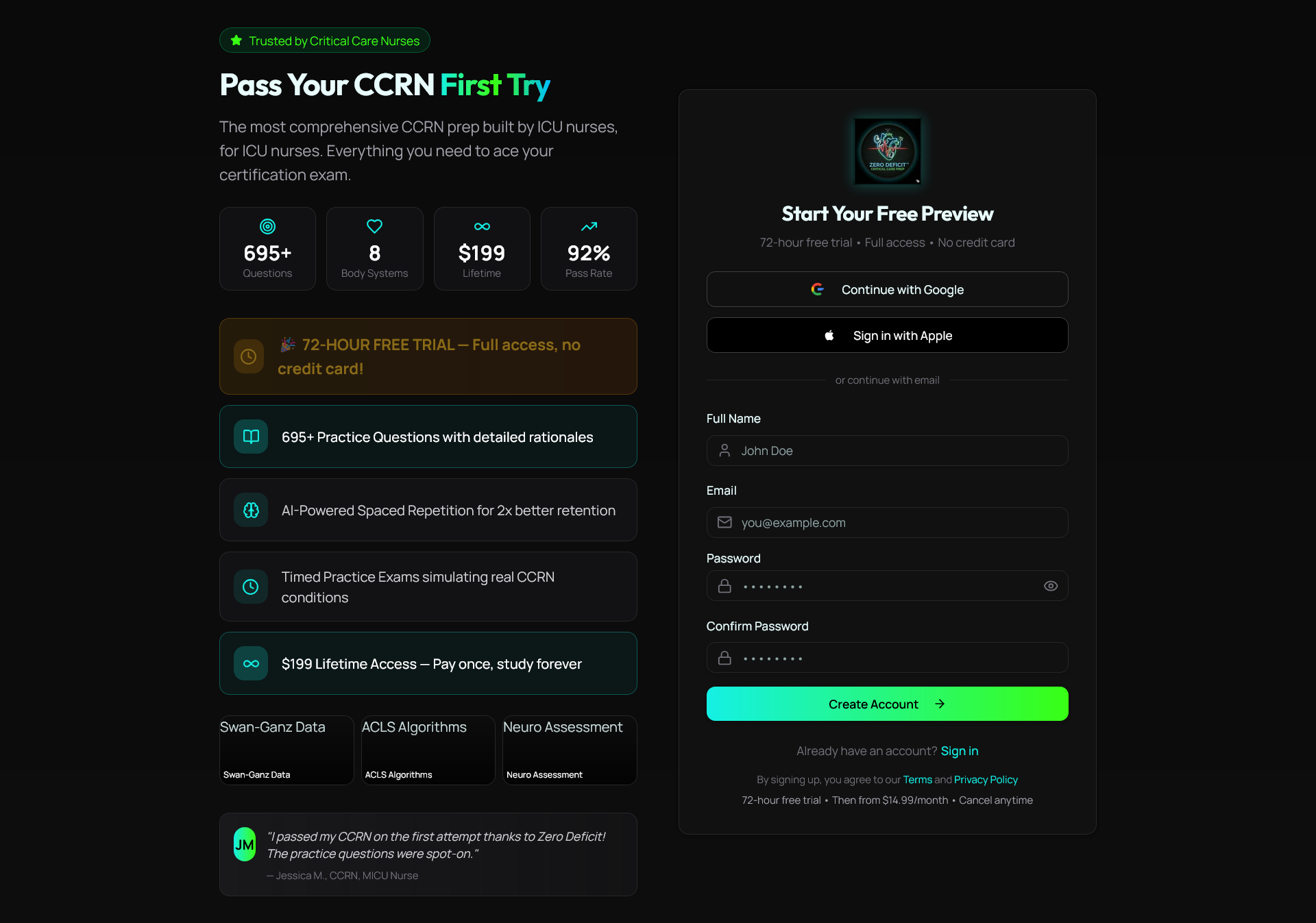
Here is what you get with Zero Deficit™:
- Practice questions with detailed rationales, built by ICU nurses.
- AI-powered review tools that personalize what you study next.
- Spaced repetition and exam simulations to build retention and stamina.
- Study guides organized by body system and topic.
Plans include $14.99 per month for Premium Monthly or $84.99 per year for Yearly Access, and a Lifetime Mastery option is also available. Try our CCRN practice questions and see whether the format works for your study rhythm.
FAQ
How do you prepare for the ANCC PMHNP exam?
Start with a baseline question block to find your weak domains, then build a content review around them. Add short daily practice for spaced recall and finish with timed, full-length simulations in the final weeks. Note that the AANPCB PMHNP exam is a separate exam from the ANCC version, so confirm which one you are sitting and use its blueprint.
How much does BoardVitals cost?
Pricing varies by plan and changes over time, so check the vendor’s current page and ask about trial or refund terms before you buy. Compare the subscription length to your actual study timeline so you are not paying for months you will not use.
How hard is the NP board exam?
Difficulty depends on your clinical experience and how recently you finished your program. The exam is long, with 150 multiple-choice items covering assessment, diagnosis, planning, and evaluation, so stamina and pacing matter as much as content knowledge.
How much is Pocket Prep per month?
Pocket Prep’s price depends on the plan and exam you choose and can change, so confirm the current rate on its site. Look for any free trial so you can judge whether short mobile sessions suit your routine before paying.
Should I use more than one platform?
Often yes, because the tools do different jobs. A common pairing is a high-fidelity question bank for simulation with a mobile app for daily reinforcement, and a lecture or self-paced course underneath if your content knowledge needs rebuilding.
Where can you find the official PMHNP exam references?
For the exam structure and domain breakdown, go straight to the certifying body rather than relying on vendor summaries.
- AANPCB PMHNP certification exam page: eligibility, testing details, and the item distribution across exam domains.
Take a Neurological practice quiz
Test your knowledge of stroke, ICP, seizures, and neuro assessment.
Get Your Free 20-Question CCRN Diagnostic
20 high-yield CCRN-style questions across every body system, with detailed rationales — emailed to you instantly.
No spam. One email + a couple of helpful follow-ups. Unsubscribe anytime.
Ready to pass your CCRN?
Join 12,000+ nurses using Zero Deficit — 695+ practice questions with rationales, AI-powered weak-area drilling, and spaced-repetition flashcards.
Start Free Trial →