CCRN vs CEN for U.S. ICU Nurses: Clinical Hours or RN License?

For most sustained ICU bedside roles, CCRN is the credential that matches your daily practice. For ED-focused triage and rapid-response work, CEN lines up better with what you actually do. AACN and BCEN each set distinct eligibility and testing standards, and AACN reports a 72.02% CCRN first-time pass rate in 2025. Read on for the eligibility and scoring details that decide which path fits you.
TL;DR:
- CCRN eligibility requires documented clinical hours through one of three pathways, while CEN requires only a current unrestricted RN license; check current handbooks before applying.
- CCRN renewal requires documented practice hours or 100 CERPs with category minimums; CEN renews every four years and requires continuing education.
- AACN reported that 72.02% of CCRN Adult candidates passed on their first attempt in 2025, but CEN statistics use different reporting conventions.
- From 2026, CEN’s passing threshold rises to 99 of 150 scored items, and its updated outline emphasizes triage, patient flow, and varied emergencies.
Table of Contents
- CCRN and CEN at a glance
- What eligibility and renewal actually require
- How the exams differ in content and format
- What the pass rates and cut scores tell you
- Which nurses should pursue CCRN, CEN, or both
- Your next steps: a short decision checklist
- A nurse-to-nurse take on choosing your path
- Get your CCRN exam prep started with Zero Deficit™
- FAQ
- Sources
CCRN and CEN at a glance
CCRN and CEN serve different populations, and that difference shapes everything from eligibility to study focus. CCRN, issued by AACN, certifies nurses caring for acutely or critically ill adult patients. CEN, issued by BCEN, certifies nurses working across the full range of emergency department presentations.
- Certifying body: AACN for CCRN, BCEN for CEN
- Setting: CCRN targets ICU and critical care units, CEN targets emergency departments
- Eligibility gate: CCRN requires documented direct-care clinical hours, while CEN requires only a current unrestricted RN license
- Scoring: both use scaled cut scores set through psychometric review, with CEN’s updated passing score taking effect in 2026
- Pass rate reporting: CCRN publishes first-time pass rates, while CEN data has historically used different reporting conventions, so raw percentages are not directly comparable
Your clinical hours and daily patient population are the fastest way to see which credential you already qualify for.
What eligibility and renewal actually require
CCRN eligibility runs through three pathways, Direct Care, Knowledge Professional, and Tele-critical Care, each built around documented hours caring for acutely or critically ill patients, as outlined in the CCRN exam handbook. Renewal keeps that clinical focus alive.
- CCRN renewal through Synergy CERPs requires 100 CERPs with category minimums
- Renewal by practice hours requires documented direct-care practice during the certification period, with a portion completed before renewal
- CEN eligibility requires only a current, unrestricted RN license, with no mandated clinical-hour minimum
- CEN certification runs on a four-year renewal cycle with continuing education expectations tracked through BCEN
Before you commit to either path, check the current handbook. AACN and BCEN both update timelines and hour thresholds periodically, and your own hospital’s documentation practices should match what the certifying body asks for.
How the exams differ in content and format
CCRN’s test plan is built around the AACN Synergy Model, which ties nursing competencies to patient characteristics rather than testing isolated facts. Expect heavy weighting on cardiovascular hemodynamics, shock, and ACS management, pulmonary and ventilator management, neuro and ICP concerns, sepsis and MODS, endocrine emergencies, renal and CRRT content, and professional caring and ethical practice, per the Knowledge Professional handbook.
CEN’s content outline shifted with BCEN’s 2025 role-delineation study, effective in 2026. The updated outline leans into triage accuracy, patient throughput, and the breadth of undifferentiated emergencies that walk through an ED door, from trauma to psychiatric crises to toxicology.
- CCRN and CEN both separate scored items from unscored pretest items on exam day
- BCEN’s candidate handbook notes delivery at testing centers or through live remote proctoring
- Both exams are built from job analyses, not arbitrary topic lists, so daily practice patterns predict tested content well
Pro Tip: Map your last ten shifts against the content outline for your target exam. If sepsis bundles and vasopressor titration dominate your week, you’re already studying CCRN content.
What the pass rates and cut scores tell you
AACN reports a CCRN Adult first-time pass rate of 72.02% in 2025, based on 17,151 candidates tested. That figure reflects first attempts only, which matters when you compare it to other credentials.

CEN’s passing score is set to rise to 99 out of 150 scored items, effective in 2026, following BCEN’s role-delineation update. CEN pass statistics have historically been reported differently than CCRN’s first-attempt framing, sometimes folding in all attempts rather than isolating first-timers.
Don’t treat a raw percentage comparison as a difficulty ranking between the two exams. Different reporting methods make that comparison misleading rather than informative.
Which nurses should pursue CCRN, CEN, or both
Your current patient population is the clearest signal here, more reliable than job title alone.
- If you provide sustained bedside care for acutely or critically ill patients in an ICU, step-down, or similar high-acuity unit, CCRN is the aligned credential
- If your primary role centers on ED triage, rapid assessment, and managing undifferentiated complaints across the acuity spectrum, CEN fits your daily work better
- If you float between ICU and ED, or you’re building toward a charge or educator role that spans both, dual certification can strengthen your resume, though it means budgeting for two study timelines and two exam fees
- New ICU grads inside their first year should confirm they meet CCRN’s clinical-hour gate before registering, since eligibility pathways differ by hours logged, not just title
Retakers benefit from identifying exactly which content areas cost them points the first time, rather than re-studying everything from scratch.
Your next steps: a short decision checklist
- Confirm which eligibility pathway you meet, Direct Care, Knowledge Professional, or Tele-critical Care for CCRN, or simply an active RN license for CEN
- Pull your last several months of clinical assignments and match them against the relevant content outline
- Block out focused study time, prioritizing cardiovascular hemodynamics, pulmonary and ventilator management, neuro, and sepsis if you’re CCRN-bound
- Schedule a full-length practice simulation before your test date
- Note your renewal timeline now, CERPs and practice hours for CCRN, continuing education for CEN’s four-year cycle, so recertification never catches you off guard
Pro Tip: Apply for your exam date before you start the heaviest phase of studying. A fixed date can help keep your study plan on track.
If you’re still weighing which specialty direction fits you long term, a short career fit quiz can help clarify whether your strengths point toward sustained critical care or the pace of emergency throughput work.
A nurse-to-nurse take on choosing your path
The nurses who struggle most aren’t the ones who pick “wrong,” they’re the ones who pick based on which exam sounds easier rather than which one reflects their actual shifts. CCRN rewards depth in a smaller number of high-acuity systems. CEN rewards breadth across a wider range of undifferentiated presentations. Study the one that matches what you already do every shift, and your preparation will feel like reinforcement rather than memorization from zero.
— Zero
Get your CCRN exam prep started with Zero Deficit™
If CCRN is your path, we built Zero Deficit™ CCRN Prep around the systems AACN tests. Our platform gives you over 695 practice questions with detailed rationales, AI-powered review tools, and spaced repetition to support your study.
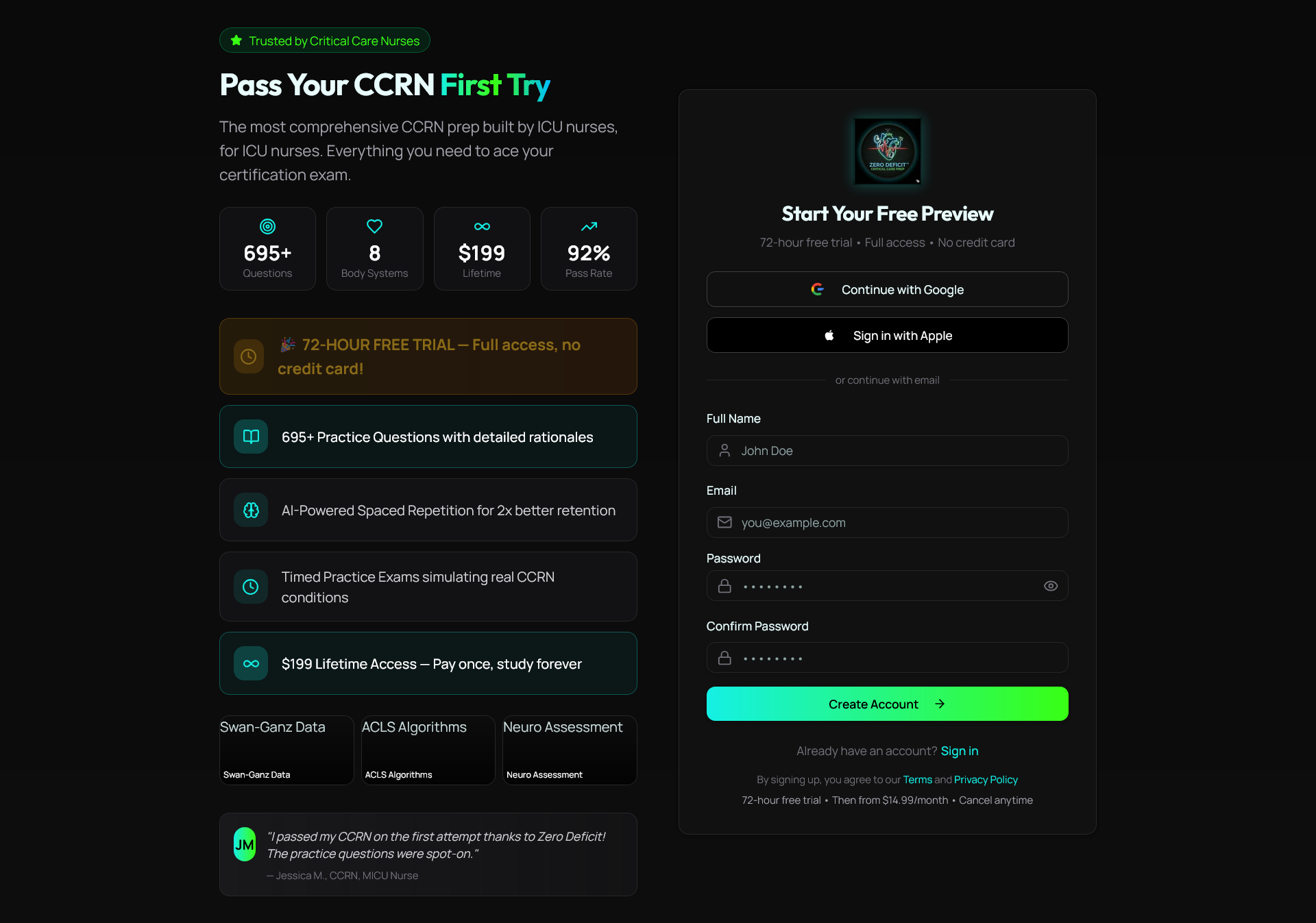
Our CCRN study guides cover body systems, and our high-yield topic guides cover shock, vasopressors, and sepsis. When you’re ready to simulate test conditions, our practice tests help you practice across tested systems.
Start with our CCRN practice questions to see where your knowledge stands, then choose a plan that fits your study window: Premium Monthly at $14.99 per month, Yearly Access at $84.99 per year, or Lifetime Mastery for ongoing access. Check our subscription options and pick your six-week practice plan today.
FAQ
What are the key differences between a registered nurse and a certified nurse?
A registered nurse holds a state license to practice, earned through nursing school and the NCLEX. A certified nurse has also passed a specialty exam, like CCRN or CEN, that verifies advanced knowledge in a specific practice area beyond base licensure.
Is CEN or TNCC better for emergency nurses?
They serve different purposes rather than competing directly. CEN is a certification verifying broad emergency nursing knowledge, while TNCC is a trauma-focused course and verification credential, so many ED nurses pursue both over the course of their careers.
What percent of RNs have their CCRN?
That specific proportion isn’t publicly tracked by AACN in a way we can cite here. AACN does report that 17,151 candidates tested for CCRN Adult in 2025 with a 72.02% first-time pass rate, which reflects testing volume rather than the share of all RNs holding the credential.
Which nurse specialty has the highest burnout rate?
Burnout rates vary by study and measurement method, and no single AACN or BCEN source in our research ties a definitive ranking to CCRN or CEN populations specifically. Both ICU and ED nursing carry documented, high-acuity demands that contribute to burnout risk.
Is CCRN worth it for an ICU nurse?
For nurses providing sustained direct care to acutely or critically ill patients, CCRN verifies knowledge tied directly to daily practice and is widely recognized across critical care units. Whether it’s worth pursuing depends on your eligibility pathway and career goals, but it aligns closely with ICU-specific competencies tested against the Synergy Model.
Sources
- Certification Exam Statistics and Cut Scores - AACN
- Evolving Excellence: Updating the CEN Exam | The Board of Certification for Emergency Nursing | BCEN
Recommended
Take a Neurological practice quiz
Test your knowledge of stroke, ICP, seizures, and neuro assessment.
Get Your Free 20-Question CCRN Diagnostic
20 high-yield CCRN-style questions across every body system, with detailed rationales — emailed to you instantly.
No spam. One email + a couple of helpful follow-ups. Unsubscribe anytime.
Ready to pass your CCRN?
Join 12,000+ nurses using Zero Deficit — 695+ practice questions with rationales, AI-powered weak-area drilling, and spaced-repetition flashcards.
Start Free Trial →