Best CCRN Prep Course: Clinical Judgment and an 8 to 12 Week Plan

If you want the fastest path to a pass, choose a prep course built around a large clinical-judgment question bank, detailed rationales, and timed exam simulations rather than one built around long lecture videos alone. We built Zero Deficit™ CCRN Exam Prep around that exact model, aligned to the Adult CCRN, so your study time maps directly to how the exam actually tests you.
TL;DR:
- Confirm any course reflects the revised Adult CCRN test plan, launched November 12, 2025, follows AACN weighting and the Synergy Model, and uses guidelines published since 2020.
- Shift workers should favor modular lessons they can finish in short sessions; long lecture blocks are harder to sustain after shifts lasting 12 hours.
- Before buying, answer 10 sample questions and read each rationale; explanations of clinical reasoning reveal more than a correct answer alone.
- Follow an 8 to 12 week schedule: take a baseline exam in week one, prioritize cardiovascular early, and reserve timed simulations for the final weeks.
- Treat all 150 exam items as scored during practice because 125 count toward your result and 25 are unscored pretest items.
Table of Contents
- How to choose a CCRN prep course that fits your schedule
- How course format and features shape your results
- Your 8-to-12 week CCRN study timeline
- Why Zero Deficit™ matches what the checklist demands
- A nurse-to-nurse note on pacing and test day
- Start practicing with Zero Deficit™
- FAQ
- Sources
How to choose a CCRN prep course that fits your schedule
You are not choosing a textbook. You are choosing the tool you will use at 6 AM after a night shift, so fit matters as much as content.
Start with alignment. Your course should map to the current Adult CCRN certification review structure and reflect the Synergy Model, since CCRN questions are written to test how you apply knowledge at the bedside, not just what you know. From there, run every option through this checklist:
- Confirm the content maps to AACN test plan percentages, not a generic ICU curriculum.
- Check the practice question volume and whether each item includes a detailed rationale, not just a correct answer.
- Look for progress tracking, spaced repetition, and personalized review that adjusts to your weak systems.
- Verify the content was written or reviewed by ICU nurses and reflects 2020 and later guidelines.
- Compare access models (monthly, annual, lifetime) and whether a trial lets you test the question style before you commit.
A course that scores well on rationale quality and progress tracking will save you more hours than one with flashier video production.
Pro Tip: Before you buy anything, pull up 10 free sample questions and read the rationales. If they explain the clinical reasoning instead of just stating the right answer, that course respects your time.
How course format and features shape your results
Format determines whether you actually finish a course or abandon it in week three. Long, linear lecture series work against shift workers because they demand uninterrupted blocks of time you rarely have after a 12-hour shift. Modular formats, where you can complete a 20-minute pulmonary module between tasks, fit real ICU schedules better.
Feature quality matters as much as format. According to the Adult CCRN certification review, prep resources range from multi-module digital review to platforms offering thousands of practice questions with AI-driven study tools, and practice questions with detailed rationales improve clinical reasoning and retention compared with question sets that skip the explanation.
- Modular video or mixed text-and-quiz formats let you study in short, frequent sessions instead of marathon blocks.
- Clinical-judgment style questions with rationales train you to reason through a scenario, which is what the exam actually rewards.
- Spaced repetition and AI-driven personalization push your weakest systems back in front of you automatically, so you stop guessing what to review.
- Timed simulations build the pacing and stamina you need for a 150-item exam.
Spaced repetition review paired with AI-driven personalization can cut wasted study time by surfacing the exact concepts you keep missing instead of making you re-review material you already know.
Your 8-to-12 week CCRN study timeline
A realistic timeline respects your shift rotation and still covers every tested system before test day.
- Week 1: Take a baseline practice exam to identify weak systems and set a target exam date.
- Weeks 2 to 3: Focus on cardiovascular, hemodynamics, shock states, and ACS drips, since this system carries heavy exam weight.
- Weeks 4 to 5: Move into pulmonary content: ARDS, ventilator modes, and ABG interpretation.
- Weeks 6 to 7: Cover neuro (ICP management, stroke) and sepsis or MODS pathophysiology.
- Week 8: Work through endocrine emergencies, renal and CRRT content, and the Synergy Model and ethics framework.
- Weeks 9 to 10 (for a 12-week plan): Run full-length, timed simulations and revisit every missed question with its rationale.
- Final 7 to 10 days: Taper new content, repeat spaced-repetition review of flagged weak areas, and take one last timed simulation three to four days before your exam.
Build daily question sets into every week rather than saving all practice for the end. Our CCRN practice tests organized by body system let you target a specific system the same week you study it, which reinforces recall while the material is still fresh.
Pro Tip: Schedule your hardest content review on your highest-energy days, not just whenever you have free time. Pulmonary and neuro deserve your sharpest focus, not your post-shift leftovers.

Why Zero Deficit™ matches what the checklist demands
Every feature in this CCRN Exam Prep course was built to answer a specific item on the checklist above, not to pad a feature list.
- A large number of practice questions, each with a detailed rationale, give you the volume and reasoning depth that clinical-judgment items demand.
- Review tools personalize what you see next based on where you are actually struggling.
- Spaced repetition keeps weak systems resurfacing until they stick, instead of letting them fade after one pass.
- Timed exam simulations build the pacing stamina you need for a 150-item test.
- Progress tracking shows you exactly which systems need more time before your exam date.
- Content focuses on adult critical care nursing and reflects current guidelines.
- Flexible access plans fit whether you are testing soon or building a long runway.
Our CCRN study guides organized by body system pair directly with the question bank, so you move from concept to application without switching platforms.
A nurse-to-nurse note on pacing and test day
We know what it is to study between night shifts and still feel behind. Protect short, consistent sessions over rare marathon ones, and treat every practice question as if it counts, since on exam day you will not know which 25 items are pretest and which are scored. In the final week, taper new content, trust your preparation, and prioritize sleep over last-minute cramming.
— Zero
Start practicing with Zero Deficit™
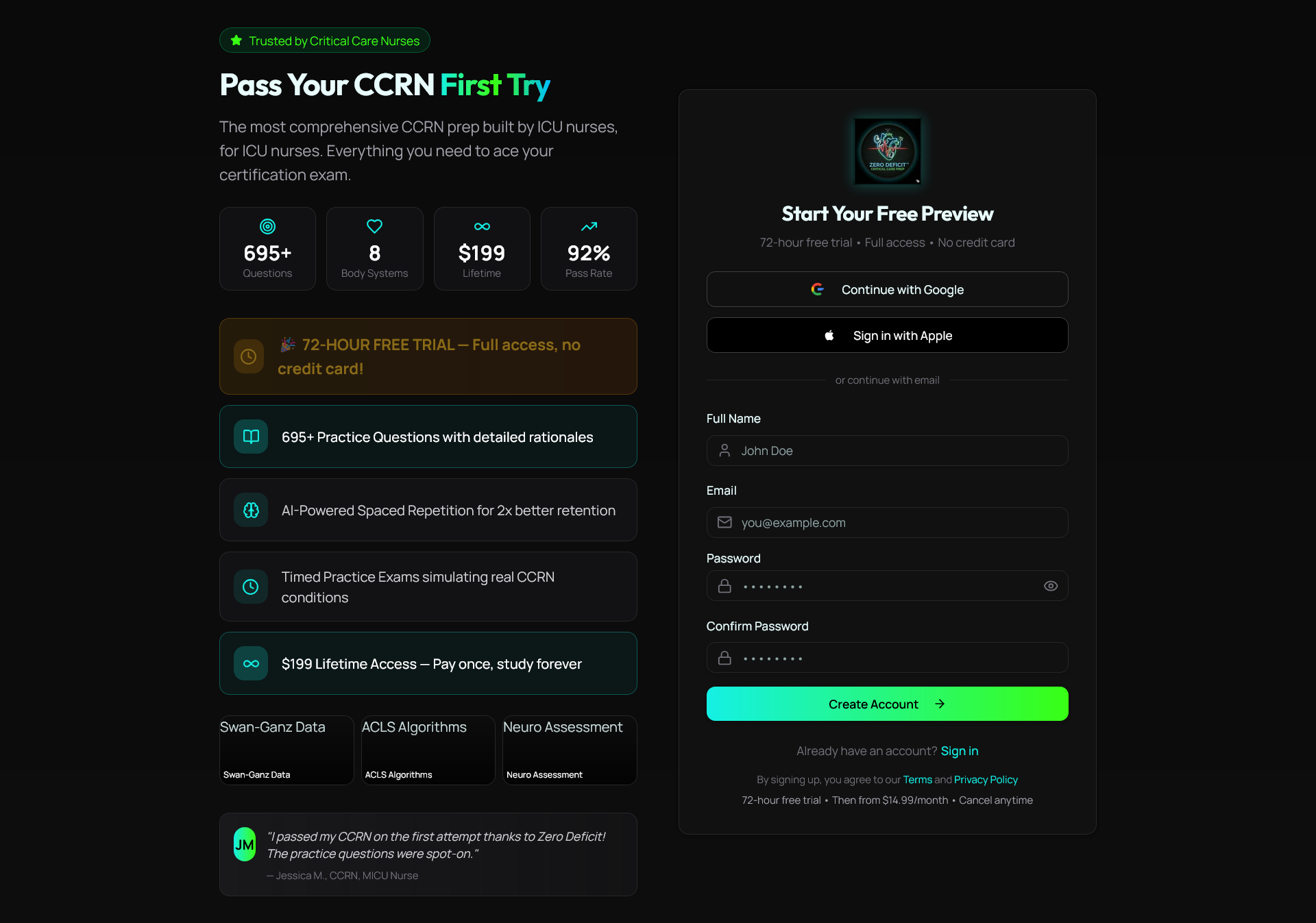
Everything above points to one combination: deep rationales, AI-driven review, and real simulation practice. Start with our CCRN practice questions and check Premium Monthly, Yearly Access, and Lifetime Mastery plans, including trial access, on our subscription page.
FAQ
What is the best way to prepare for the CCRN exam?
The most effective preparation combines content review mapped to the AACN test plan with a large bank of clinical-judgment practice questions and timed exam simulations. Prioritize rationale-based question practice over passive video watching, since the exam tests application, not recall.
How many questions are on the CCRN exam?
The CCRN exam contains 150 multiple-choice items, with 125 scored and 25 used as pretest items for future test development. Treat every item as scored during your practice, since you will not know which 25 are pretest on test day.
How much of the CCRN exam is clinical judgment?
Practicing with case-style questions and detailed rationales builds clinical judgment directly.
When did the revised CCRN exams launch?
The revised CCRN exams launched on November 12, 2025, and current review courses and practice exams have been updated to align with the new test plan. Confirm any course you use reflects this updated structure before you rely on it.
How does Zero Deficit™ support Adult CCRN prep specifically?
Zero Deficit™ CCRN Exam Prep focuses exclusively on the Adult CCRN, with a large number of practice questions, detailed rationales, AI-powered review, and timed simulations built to match current AACN test plan weighting. Flexible monthly, yearly, and lifetime access options let you choose a plan that fits your exam timeline.
Recommended
Take a Neurological practice quiz
Test your knowledge of stroke, ICP, seizures, and neuro assessment.
Get Your Free 20-Question CCRN Diagnostic
20 high-yield CCRN-style questions across every body system, with detailed rationales — emailed to you instantly.
No spam. One email + a couple of helpful follow-ups. Unsubscribe anytime.
Ready to pass your CCRN?
Join 12,000+ nurses using Zero Deficit — 695+ practice questions with rationales, AI-powered weak-area drilling, and spaced-repetition flashcards.
Start Free Trial →