Nurse Certification Advantages Every ICU RN Should Know
Nurse certification measurably improves patient safety, validates your specialty expertise, and accelerates career growth. For an ICU RN with one to five years of critical care experience, pursuing the CCRN is one of the highest-return professional moves you can make.
The core advantages of nurse certification, backed by peer-reviewed evidence:
- Better patient outcomes: Units with higher certification rates show fewer falls, fewer medication errors, fewer pressure injuries, and lower mortality rates.
- Hiring and promotion preference: Certified nurses are consistently rated higher by supervisors and are favored in competitive hiring and charge-nurse selection.
- Validated clinical confidence: Certification consolidates specialty knowledge and sharpens decision-making at the bedside, particularly in high-acuity situations.
- Employer incentives: Roughly 58% of employers support certification fees; many also offer one-time bonuses or premium pay.
- Magnet recognition support: Hospitals pursuing or maintaining ANCC Magnet status actively seek certified nurses on staff.
If you are an ICU RN prepping for the CCRN, the evidence is clear: certification is worth the investment of time and money.
Key Takeaways
Nurse certification delivers measurable benefits for patient safety, career advancement, and clinical confidence, making it one of the highest-return investments an ICU RN can make.
| Point | Details |
|---|---|
| Patient outcomes improve | Higher unit certification rates associate with fewer falls, medication errors, pressure injuries, and lower mortality. |
| Career gains are real but nuanced | Certification supports hiring preference and promotion; direct salary increases occur in a minority of cases, with bonuses and fee reimbursement more common. |
| Employer support is available | Roughly 58% of employers cover initial certification fees; ask before you pay out of pocket. |
| Renewal is a clinical tool | Use the 3-year CCRN recertification cycle to stay current with SCCM, AHA, and AACN guidelines. |
| Zerodeficitccrnprep accelerates your prep | 695+ practice questions with rationales, AI-powered review, and system-based study guides built for the AACN CCRN blueprint. |
Table of Contents
- What does research show about certification and patient outcomes?
- How does certification affect your career, salary, and recognition?
- Why do hospitals and employers value nursing certification?
- How does certification strengthen your clinical skills day to day?
- What certifications should critical care nurses consider?
- What does certification actually cost, and how long does it take?
- How do you maintain and renew your certification?
- How do you choose the right certification for your role?
- How to build a CCRN study plan that actually works
- What is nurse certification, and how does it differ from licensure?
- When certification paid off and what most nurses get wrong
- Zero Deficit™ gives you the CCRN prep structure you need to pass
- Sources
- FAQ
What does research show about certification and patient outcomes?
The advantages of nurse certification are not just professional; they show up directly in patient safety data. Observational studies consistently associate higher unit-level certification rates with fewer patient falls, reduced medication dosing errors, fewer pressure injuries, and lower 30-day mortality in ICU settings. Hospitals with greater proportions of certified, BSN-prepared nurses also show lower failure-to-rescue rates.

That association matters most in critical care, where a dosing error or a missed hemodynamic shift can be fatal. Certified nurses in these units tend to apply evidence-based protocols more consistently, which likely explains part of the outcome difference.
One important caveat: most of this evidence is observational. Certification rates correlate with better work environments, Magnet recognition, and higher BSN attainment, so it is difficult to isolate certification as the sole driver. What the research does confirm is that certification is part of a quality ecosystem, not a standalone fix.
Pro Tip: When discussing unit quality metrics with your manager, ask what percentage of your ICU staff are currently certified. Framing your own certification as a contribution to that metric is a concrete, data-backed argument for employer support.
How does certification affect your career, salary, and recognition?
Certification increases your marketability and often improves promotion prospects. Salary gains are real but inconsistent, so go in with accurate expectations.
Career benefits you can realistically expect:
- Hiring preference: Many nurse managers and recruiters screen for specialty credentials, particularly in competitive ICU markets.
- Promotion eligibility: Charge nurse, preceptor, and clinical educator roles frequently list certification as a preferred or required qualification.
- Leadership pipeline access: Certification signals readiness for expanded responsibility, which opens doors to unit-based leadership.
- Professional credibility: Supervisor ratings of certified nurses are consistently higher on technical accuracy and clinical preparedness.
- Networking: Certification connects you to a national community of specialty-credentialed nurses through AACN and specialty organizations.
On compensation: a systematic review finds that intrinsic benefits, including personal accomplishment and knowledge validation, rate highest across studies, while salary increases rate substantially lower. Employers more commonly respond with fee reimbursement, one-time bonuses, or premium shift pay rather than a base-salary adjustment.
A practical scenario: an ICU RN with two years of experience earns the CCRN, lists it on their résumé, and within six months is offered a charge-nurse rotation. The credential does not guarantee the promotion but makes the conversation possible. That is the realistic career arc for most certified nurses.

Pro Tip: List your CCRN credential directly after your name on your résumé (Jane Smith, RN, CCRN) and in your email signature. Hiring managers notice it before they read a single bullet point.
Why do hospitals and employers value nursing certification?
From an administrator’s perspective, certification is a visible quality signal that supports recruitment, retention, accreditation, and Magnet recognition. It is also a risk-management tool: certified nurses are associated with fewer errors and higher supervisor performance ratings.
The Magnet connection
ANCC Magnet recognition is one of the most competitive hospital designations in the United States. Magnet criteria include nursing education levels, shared governance, and specialty certification rates. Hospitals pursuing or renewing Magnet status actively track what percentage of eligible nurses hold specialty credentials. Research confirms that nurses at Magnet hospitals are more likely to be certified, partly because the work environment supports it and partly because the institution incentivizes certification.
Common employer incentives to ask about
- Exam fee reimbursement (initial certification)
- Recertification fee payment (roughly 40% of employers cover this)
- One-time certification bonus
- Premium pay for certified nurses on certain shifts or units
- Paid study time or access to prep resources
- Public recognition (badge displays, unit announcements, annual awards)
When you approach your manager about certification support, frame it around unit goals. If your ICU is working toward Magnet designation or tracking a quality metric like fall rates, your certification directly contributes to both. That framing shifts the conversation from “I want help paying for an exam” to “I want to help the unit hit its targets.”
How does certification strengthen your clinical skills day to day?
Certification consolidates specialty knowledge and supports faster, more confident clinical decisions at the bedside. The study process itself forces you to systematically review hemodynamics, ventilator management, sepsis protocols, and arrhythmia interpretation, which are exactly the skills that separate a competent ICU nurse from an exceptional one.
Day-to-day clinical benefits of certification:
- Sharper assessment skills: Structured exam prep reinforces systematic head-to-toe and system-based assessment frameworks.
- Evidence-based practice: Certification requires familiarity with current AHA, SCCM, and AACN guidelines, keeping your practice current.
- Structured continuing education: Recertification cycles create a built-in schedule for staying current with rapidly changing protocols.
- Peer recognition: Colleagues and physicians notice the credential, which often translates to being included in complex care discussions earlier.
- Reduced burnout: AACN guidance links certification to increased job satisfaction and a sense of professional accountability, both of which buffer against burnout.
A systematic review confirms this pattern: across multiple studies, personal accomplishment and knowledge validation are the highest-rated perceived benefits of certification, rated at 94–96% agreement in the ONCC survey data.
Pro Tip: Use your recertification CE hours as a targeted skill refresh. If your unit is seeing more CRRT patients, prioritize renal CE credits that year. Align your learning to where your practice is actually going.
What certifications should critical care nurses consider?
Critical care nurses have several specialty credentials to choose from, depending on their unit, patient population, and career goals. The CCRN, offered by AACN, is the benchmark credential for adult ICU nurses. Other certifications serve perioperative, oncology, emergency, and progressive care settings.
For a deeper breakdown of credential types and eligibility paths, the critical care certifications guide at Zerodeficitccrnprep covers the full landscape for ICU RNs.
This article focuses on the Adult CCRN for ICU RNs. Eligibility rules, fees, and renewal requirements differ across certifications; always verify current requirements directly with the credentialing body before applying.
What does certification actually cost, and how long does it take?
Most specialty certifications require documented clinical hours plus a written exam. Realistically, plan for three to twelve months from eligibility confirmation to exam day, depending on how much prep time you can carve out around your shifts.
Common eligibility requirements and cost factors:
- Clinical practice hours: The CCRN requires 1,750 hours of direct care of acutely or critically ill patients within the past two years, with 875 of those hours in the most recent year preceding application.
- Current RN licensure: All major specialty certifications require an active, unencumbered RN license.
- Exam fees: Fees typically range from $230 to $440 depending on the certification and whether you hold membership in the sponsoring organization (AACN members pay less for the CCRN).
- Prep materials: Study guides, question banks, and review courses add $50–$300+ depending on the resource.
- Timeline scenarios: A nurse who is already eligible and studies consistently for eight to ten weeks can sit for the exam within three months. A nurse who needs to accumulate hours first may plan for six to twelve months.
Roughly 58% of employers offer some form of financial support for certification fees. Use that statistic when you approach your manager.
Here is a script you can adapt: “I’m planning to sit for the CCRN within the next six months. I know the unit is tracking certification rates for Magnet renewal. Would you be willing to cover the exam fee? I’m committed to doing the prep on my own time.” Keep it specific, tie it to a unit goal, and make the ask easy to approve.
How do you maintain and renew your certification?
Most nursing certifications require renewal every three to five years. The CCRN renews every three years through either continuing education (CE) hours or a retesting option.
Renewal paths and options:
- CE-based renewal: Accumulate the required CE hours (100 hours for CCRN renewal, with specific requirements for clinical practice hours and CE categories) and submit documentation.
- Retesting: Sit for the full exam again; some nurses prefer this to reset their knowledge base systematically.
- Clinical practice hour logs: Maintain documentation of your critical care hours throughout the certification period, not just at renewal time.
- Portfolio options: Some certifications accept professional development portfolios that include presentations, publications, or preceptorship hours.
AACN frames recertification as a structured mechanism for maintaining clinical competence, not just a compliance requirement. Treat it that way.
A practical renewal checklist:
- Log CE credits as you earn them; do not wait until year two to start tracking.
- Keep a running document of your clinical practice hours with dates and unit type.
- Set a calendar reminder 12 months before your renewal deadline.
- Check whether your employer covers recertification fees (roughly 40% do).
- Choose CE topics that align with your current clinical gaps, not just what is easiest to complete.
For a deeper look at why staying certified matters beyond the credential itself, the certification retention guide at Zerodeficitccrnprep covers the clinical and professional case in detail.
Pro Tip: Align your CE choices with CCRN high-yield topics: hemodynamics, ventilator management, and sepsis/MODS. You stay current with SCCM and AHA guidelines and build toward recertification at the same time.
How do you choose the right certification for your role?
Choose the certification that aligns with your current unit and your next career move. If your clinical hours and role restrict your options, pick the most realistic on-ramp and build from there.
A three-step decision framework:
- Assess unit fit and eligibility. Do you meet the clinical hour requirements? Does the certification match your patient population? An ICU RN with 1,750 adult critical care hours is a natural CCRN candidate. A step-down nurse should look at the PCCN first.
- Weigh career benefit against investment. Will this credential open a specific role you want? Does your unit or health system list it as preferred or required for charge or educator positions? If the answer is yes, the return on investment is clear.
- Check employer incentives and requirements. Some units require certification for charge-nurse eligibility. Others offer bonuses or fee reimbursement. Know what your employer offers before you commit.
Questions to ask your manager or educator:
- Is certification required or preferred for any roles I’m interested in?
- Does the unit have a certification rate goal tied to Magnet or a quality program?
- What financial support does the hospital offer for exam fees and prep materials?
- Is there paid study time or access to institutional prep resources?
Red flags that suggest you should pause before committing:
- No employer support of any kind (financial or time)
- No clear clinical application for the credential in your current role
- Cost and time commitment that cannot be offset by any employer benefit or career outcome
| Dimension | What to evaluate |
|---|---|
| Primary benefit | Patient outcomes, career advancement, or pay? |
| Best fit | Does it match your current unit and patient population? |
| Eligibility | Do you meet the clinical hour and licensure requirements now? |
| Time and cost | Can you manage the prep timeline and exam cost, with or without employer support? |
| Renewal burden | Can you sustain CE requirements over the three-to-five-year cycle? |
How to build a CCRN study plan that actually works
A structured, system-based study plan focused on hemodynamics, ventilator management, sepsis/MODS, and the AACN Synergy Model is the most efficient path to passing the CCRN on your first attempt. Spreading prep across eight to twelve weeks, with consistent daily practice, outperforms cramming every time.
An 8–10 week sample schedule for busy ICU RNs:
- Week 1: Orientation and baseline. Take a full-length practice test to identify your weakest systems. Review the CCRN exam blueprint from AACN.
- Week 2: Cardiovascular. Hemodynamics (normal CO: 4–8 L/min; CI: 2.2–4.0 L/min/m²), shock states, ACS management, vasoactive drips.
- Week 3: Pulmonary. ARDS (P/F ratio <300 for mild, <200 moderate, <100 severe), ventilator modes, ABG interpretation (normal pH 7.35–7.45, PaO₂ 80–100 mmHg, PaCO₂ 35–45 mmHg).
- Week 4: Neurology. ICP management (normal ICP <15 mmHg, CPP = MAP minus ICP, target CPP 60–70 mmHg), stroke protocols, sedation/agitation scales.
- Week 5: Sepsis and MODS. Surviving Sepsis Campaign 2021 bundle elements, vasopressor selection, lactate clearance targets.
- Week 6: Renal and endocrine. CRRT indications and troubleshooting, DKA management (target glucose 150–200 mg/dL during treatment), thyroid storm, adrenal crisis.
- Week 7: Multisystem and Synergy Model. MODS pathophysiology, ethics frameworks, nurse competencies mapped to patient characteristics.
- Week 8: High-yield review and exam simulation. Work through 695+ practice questions by system, review rationales for every missed question, and run a timed full-length simulation.
Active recall strategies that work for shift nurses:
- Study in 30–45 minute blocks on days off; 15–20 minutes of targeted question review on shift days.
- Use spaced repetition to revisit missed questions at 24 hours, 72 hours, and one week.
- Work through high-yield topic guides by system rather than reading a textbook cover to cover.
- Review arrhythmia strips weekly; pattern recognition degrades fast without regular practice.
Balancing shifts and study is the hardest part. Three focused study days per week consistently beats seven scattered ones. Protect those days the way you protect your sleep after a night shift.
For a structured external study timeline, the 10-week CCRN study plan at Recallos offers a complementary schedule you can adapt alongside your Zerodeficitccrnprep resources.
What is nurse certification, and how does it differ from licensure?
Nurse certification is a voluntary, nationally recognized credential that validates specialty expertise beyond the baseline RN license. It is typically earned through a standardized exam or, in some cases, a professional portfolio, and it is awarded by a specialty credentialing body such as AACN or ANCC.
Understanding the terminology matters, especially when you are explaining your credentials to patients, employers, or interdisciplinary colleagues. For a full breakdown of certification-specific language, the nursing certification terminology guide at Zerodeficitccrnprep is worth bookmarking.
Key distinctions:
- RN licensure (state): Granted by your state board of nursing after passing the NCLEX-RN. Required to practice as a registered nurse. Renewed periodically with CE requirements set by the state.
- Specialty certification (national): Voluntary credential awarded by a national body (AACN for CCRN, ANCC for many others). Validates expertise in a specific clinical area above and beyond licensure.
- Educational certificates: Awarded by academic institutions or professional organizations for completing a CE program or course series. Not the same as a board certification; does not carry the same weight in hiring or Magnet criteria.
AACN administers the CCRN and several related critical care credentials. ANCC administers a broad portfolio of specialty certifications and oversees the Magnet Recognition Program. Both organizations publish eligibility requirements, exam blueprints, and renewal guidelines on their websites.
When certification paid off and what most nurses get wrong
Certification matters most when you treat it as a clinical investment, not a résumé checkbox. The nurses who get the most from it are the ones who use the prep process to genuinely close knowledge gaps, then leverage the credential deliberately in career conversations.
The most common pitfall is underestimating preparation time. The CCRN covers a wide scope, and nurses who assume their bedside experience alone will carry them through the exam often find themselves surprised by the depth of pharmacology, hemodynamic calculations, and Synergy Model content. Plan for structured prep, not just passive review.
The second pitfall is skipping the employer negotiation entirely. Many nurses pay out of pocket when their hospital would have covered the fee. Ask before you register. Tie the request to a unit goal. Most managers will say yes if you frame it correctly.
The third is treating certification as a one-time event. The recertification cycle is where the long-term clinical value lives. Use it to stay current with SCCM sepsis bundles, updated AHA resuscitation guidelines, and AACN practice alerts. Nurses who engage with recertification actively tend to stay sharper and more confident at the bedside than those who coast between renewal deadlines.
One practical move: find a recently certified colleague or a unit educator who can walk you through the exam experience. Local preceptors and study groups accelerate prep faster than solo studying, and they surface the high-yield gaps you might not find on your own.
Zero Deficit™ gives you the CCRN prep structure you need to pass
Passing the CCRN requires more than reading a textbook. You need targeted, system-based practice with detailed rationales that explain the why behind every answer, not just the correct letter. That is exactly what Zerodeficitccrnprep is built to deliver.
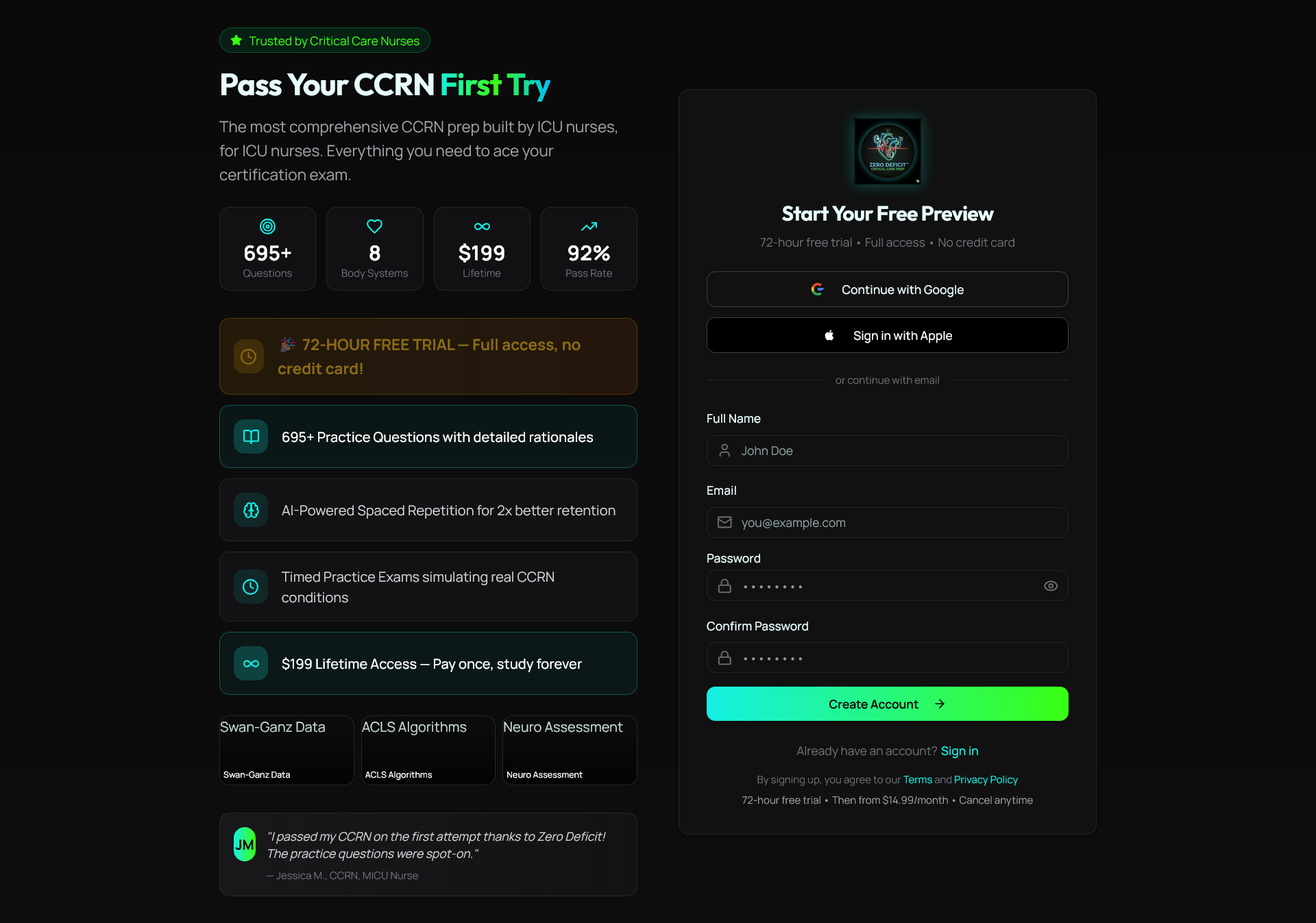
Zerodeficitccrnprep offers over 695 CCRN practice questions with detailed rationales written by expert ICU nurses, organized by body system to match the AACN exam blueprint. The platform includes AI-powered review tools that personalize your question feed based on your performance, so you spend more time on hemodynamics and less time on content you already know.
Key features mapped to your study plan:
- 695+ practice questions with rationales: Organized by system (cardiovascular, pulmonary, neuro, sepsis, renal, endocrine, and more), with explanations that teach clinical reasoning, not just answer recall.
- Arrhythmia flowchart: The arrhythmia interpretation tool gives you a visual decision framework for rhythm recognition, one of the highest-yield CCRN skill areas.
- High-yield topic guides: System-based study guides covering shock, vasopressors, sepsis, ARDS, and every other priority topic on the CCRN blueprint.
Start with a free trial and run your first full-length practice test today. Your baseline score tells you exactly where to focus first.
Sources
Peer-reviewed and official sources that support the claims in this article:
- Why Some Nurses Obtain Specialty Certification and Others Do Not - PMC
- Certification benefits patients, employers and nurses (AACN)
- ONCC Value of Certification Study Final Report
- Why Nursing Certification Matters | Maryville Nursing
- What Is the Perceived Value of Certification Among Registered Nurses? A Systematic Review
For clinical practice sections, prefer 2020+ guidelines from AACN, SCCM, and AHA. All clinical values cited in this article (hemodynamic parameters, ABG ranges, ICP targets) reflect current published normal ranges and should be verified against your institution’s protocols.
FAQ
What are the main benefits of nursing certification?
Certification validates specialty expertise, improves patient safety metrics at the unit level, and increases your competitiveness for hiring and promotion. Intrinsic benefits, including personal accomplishment and knowledge validation, are the most consistently reported advantages across multiple studies.
Do nurses get paid more for certifications?
Employers more commonly respond with one-time bonuses, premium shift pay, or exam fee reimbursement rather than a permanent salary adjustment.
Is there a difference between an RN license and a specialty certification?
Yes. Your RN license is a state-issued, legally required credential to practice nursing. Specialty certification, such as the CCRN from AACN, is a voluntary national credential that validates expertise in a specific clinical area above and beyond basic licensure.
Which certification is best for ICU nurses?
The CCRN, administered by AACN, is the benchmark credential for adult critical care nurses. It requires 1,750 hours of direct care of acutely or critically ill patients and covers cardiovascular, pulmonary, neuro, sepsis, renal, and endocrine content aligned to the AACN exam blueprint. Zerodeficitccrnprep’s practice question bank is built specifically around that blueprint.
How long does it take to prepare for the CCRN?
Most nurses complete focused CCRN prep in eight to twelve weeks when studying consistently around their shifts. The total timeline from eligibility confirmation to exam day depends on how much prep time you can protect each week and whether you are already meeting the clinical hour requirements.
Recommended
- Role of Nurses in the ICU: A Complete Clinical Guide | Zero Deficit CCRN Prep
- Types of Critical Care Certifications: Your 2026 Guide | Zero Deficit CCRN Prep
- Why Certification Retention Matters for Critical Care Nurses | Zero Deficit CCRN Prep
- CCRN Infection Control Review Topics: ICU Nurse Guide | Zero Deficit CCRN Prep
Take a Multisystem practice quiz
Master sepsis, shock, MODS, and multi-organ failure scenarios.
Get Your Free 20-Question CCRN Diagnostic
20 high-yield CCRN-style questions across every body system, with detailed rationales — emailed to you instantly.
No spam. One email + a couple of helpful follow-ups. Unsubscribe anytime.
Ready to pass your CCRN?
Join 12,000+ nurses using Zero Deficit — 695+ practice questions with rationales, AI-powered weak-area drilling, and spaced-repetition flashcards.
Start Free Trial →