Adaptive Learning for Adult CCRN Nurses: Spacing Beats Cramming

For critical care nurses prepping for the AACN Adult CCRN exam, Zero Deficit™ stands out as the adaptive learning approach built specifically for this test, pairing AI-driven review with 695+ practice questions and CCRN-aligned study guides. The reasoning is straightforward: personalized practice plus spaced retrieval plus rationale-driven learning, all mapped to the actual test plan, is what moves your score. Keep reading for the evidence behind this, the features that matter, and a full study workflow you can start this week.
TL;DR:
- A 2024 randomized study found spaced sessions improved retention over lecture review (p < 0.001), supporting brief, repeated practice instead of cramming.
- Take a full diagnostic in week one, then target your two or three weakest systems before timed blocks of 20 to 30 questions.
- Choose tools that map questions to AACN weighting, explain wrong answers, include lab references, and track topic trends; test sample blocks and verify update dates.
- After shifts, schedule 25 to 40 questions and review missed answers for 10 to 15 minutes; reread each rationale, even when your answer was correct.
- Monthly access costs $14.99, while yearly access costs $84.99; try the free trial first, and the lifetime option is not publicly priced.
Table of Contents
- Why adaptive learning works for critical care nurses
- Must-have adaptive features for CCRN exam prep tools
- How to evaluate and choose an adaptive CCRN study solution
- Practical 8-week adaptive study plan for the Adult CCRN
- Comparing adaptive learning tools for nurses: strengths and tradeoffs
- User experience and accessibility in adaptive learning platforms
- Pricing models and subscription options for adaptive CCRN platforms
- Support resources and community features for CCRN candidates
- Nurse-to-nurse notes on studying between shifts
- Zero Deficit™: how to start studying today
- FAQ
- Sources
Why adaptive learning works for critical care nurses
You already know how clinical knowledge sticks: you see a crashing patient, you act, you debrief, and the pattern locks in. Adaptive learning works the same way, and the research backs it up.
Test-enhanced learning (TEL), the practice of frequent low-stakes testing with feedback, produces measurably better retention than passive re-reading. In a controlled study of undergraduate nursing students, the group that practiced with repeated testing scored higher on final cumulative exams than the group that simply re-studied the material. That gap matters for CCRN prep, where you are not just memorizing facts but building clinical judgment under time pressure.
Spacing the practice out matters just as much as the testing itself. A 2024 randomized study of nurse anesthesia students found that spaced learning sessions produced significantly higher knowledge retention than conventional lecture-based review. For someone studying around 12-hour shifts, this is good news: short, frequent sessions beat marathon cramming, and they fit a schedule that already has little room to spare.
Here is why this matters for exam-day performance, not just study comfort:
- Retrieval practice forces your brain to reconstruct knowledge, which strengthens the neural pathways you will need under exam pressure.
- Spacing sessions across days reduces the cognitive overload that comes from cramming dense content like hemodynamics or ABG interpretation in one sitting.
- Feedback on each question, especially detailed rationales, turns a quiz into a clinical reasoning drill instead of a guessing game.
A 2024 randomized trial found spaced learning produced significantly higher retention than standard lecture review (p < 0.001). That single finding is the foundation for why adaptive, spaced tools outperform static review books for CCRN prep.
Must-have adaptive features for CCRN exam prep tools
Not every “adaptive” tool is built for this exam. Before you commit your study hours to one, confirm it has these features.
- A spaced repetition engine that resurfaces missed or weak items at increasing intervals, with intervals you can adjust as your exam date approaches.
- A CCRN-style question bank with detailed rationales mapped to the AACN test plan, including normal lab value references so you are not cross-checking a separate chart mid-question.
- Adaptive question selection and remediation that filters by system: cardiovascular, pulmonary, neuro, sepsis/MODS, renal/CRRT, endocrine, and ethics, so weak areas get more repetitions automatically.
- Performance analytics with topic-level breakdowns, trend reports over time, and a readiness metric you can watch improve.
- An exam simulation mode that mimics timing and item format, plus flashcard support you can run during a break or a commute.
Pro Tip: Run a baseline diagnostic before you study anything. Without it, you are guessing at your weak systems instead of letting the data point to them.
A tool missing any of these isn’t incomplete by accident. Spaced repetition without system-level filtering just reshuffles questions randomly. Rationales without lab value context leave you looking things up elsewhere, which breaks the retrieval loop the research depends on.
How to evaluate and choose an adaptive CCRN study solution
Picking a study tool is itself a decision worth making carefully, because the wrong one costs you weeks you do not have. Ask these questions before you commit:
- Does the question bank map directly to the AACN CCRN test plan and its topic weighting?
- How many practice questions are available, and are rationales detailed enough to explain the clinical reasoning, not just the correct answer?
- Is the spaced repetition schedule configurable, or fixed and generic?
- What analytics does the platform give you: topic breakdowns, trend lines, a readiness score?
- How often is content updated against current guidelines?
During a free trial, request or test a sample exam block, review the item-stem style for realism, and check the stated update cadence against recent guideline changes, such as the 2023 AHA ACLS focused update.
A practice question without a rationale is a coin flip. A practice question with a clinical rationale is a lesson.
This tool was built against this exact checklist. It offers many practice questions with detailed rationales, AI-powered review tools that adapt to your performance, and study guides organized by body system to match the way the AACN test plan actually weights content. For strategies on using those practice questions effectively, treat each rationale as a mini case review rather than an answer key to memorize.
Practical 8-week adaptive study plan for the Adult CCRN
An adaptive tool only pays off if you use it with a plan. Here is an 8-week structure that works around shift rotations.
- Week 1: Take a full diagnostic exam to establish your baseline, then review the analytics to identify your two or three weakest systems.
- Weeks 2 to 3: Front-load the highest-weighted systems on the test plan, typically cardiovascular and pulmonary, using timed question blocks of 20 to 30 items per session.
- Weeks 4 to 5: Shift to a spaced review schedule, mixing new content (neuro, sepsis/MODS) with resurfaced questions from weeks 2 and 3 to reinforce retention.
- Week 6: Run a mid-point simulation exam under timed conditions, then use the readiness report to reprioritize any system still lagging.
- Week 7: Target remaining weak areas (renal/CRRT, endocrine, ethics and the Synergy Model) with focused remediation blocks, and continue daily flashcard review.
- Week 8: Taper intensity, run one final full-length simulation, and spend the last few days on light review of flagged rationales rather than new material.
For a daily template, aim for one timed block of 25 to 40 questions after a shift, followed by 10 to 15 minutes reviewing only the items you missed. Add a short flashcard pass before bed on the days you are off. Track two measurable goals each week: your overall accuracy percentage and your weakest-system accuracy, and expect both to climb as the spacing effect takes hold.
A more detailed version of this workflow, including a step-by-step readiness checklist, can help you adjust the pacing if your exam date shifts.

Comparing adaptive learning tools for nurses: strengths and tradeoffs
Adaptive CCRN tools generally fall into a few categories, and each comes with real tradeoffs worth knowing before you choose one.
Pure question-bank apps are strong on volume but often weak on rationale depth, leaving you to look up the “why” elsewhere. Flashcard-only platforms are excellent for quick recall and spaced review but usually skip the exam-style item format you will face on test day. Full-spectrum platforms that combine a large question bank, AI-adjusted review, system-based study guides, and simulation exams give you the most complete coverage, though they ask for more of your time each week to use fully.

The tradeoff to watch for is depth versus convenience: a tool that only takes five minutes a day will rarely cover enough ground for an exam this comprehensive, while a tool with every feature imaginable can overwhelm a first-time test taker who needs a clear starting point. This service is built as a full-spectrum option, pairing a large question bank and AI review tools with system-organized guides so you get breadth and structure in the same place, without needing to stitch together separate apps for questions, flashcards, and analytics.
User experience and accessibility in adaptive learning platforms
A study tool you cannot use at 2 a.m. after a night shift is a tool you will not use at all. Accessibility here means more than screen readers, though that matters too. It means a clean mobile interface for quick review between tasks, flashcards that sync across devices, and navigation simple enough that you are not hunting through menus when you have fifteen minutes before report.
Look for adjustable text size, clear color contrast for readability under fatigue, and offline or low-bandwidth modes for units with unreliable WiFi. A platform that lets you filter by body system and jump straight into a weak-area review, without extra clicks, respects the reality that your study time is scattered across a week, not blocked out in long sessions. The fewer steps between opening the app and starting a focused review block, the more consistently you will actually use it.
Pricing models and subscription options for adaptive CCRN platforms
Most adaptive CCRN tools use a subscription model, typically offered monthly, annually, or as a one-time lifetime purchase. Monthly plans suit nurses who are close to their exam date and want full access for a short, intense stretch. Annual plans tend to fit candidates who are studying over several months or retaking the exam after a gap, since the per-month cost usually drops compared to paying monthly. Lifetime access appeals to anyone who wants to avoid tracking renewal dates entirely.
Zero Deficit™ offers a Premium Monthly plan at $14.99 per month, a Yearly Access plan at $84.99 per year, and a Lifetime Mastery option for nurses who want one-time access without a renewal. A free trial is available before you commit to a paid tier, which gives you room to test the question bank and rationale depth against the evaluation checklist above before spending anything.
Support resources and community features for CCRN candidates
Studying for the CCRN is isolating by design: you are reviewing alone, usually after a shift, often without a study group nearby. Platforms that help most pair your question bank with real support options, not just content.
Look for responsive customer support if something in your account or progress tracking breaks, clear documentation on how the spaced repetition and analytics work, and study guides written by people with ICU experience rather than generic test-prep copywriters. Community features, such as discussion around tricky rationales or shared study schedules, can help on the days motivation runs thin, though they matter less than the core question bank and analytics quality.
The study guides are written by ICU nurses and organized by body system, which gives you a built-in reference to return to whenever a rationale raises a question you want explored further. If you want a broader look at adaptive and AI-driven exam prep approaches outside the CCRN space, the BoardMaster guide to adaptive medical exam prep covers similar principles applied to other certification exams.
Nurse-to-nurse notes on studying between shifts
Here is what actually works: 30 to 45 minutes of active retrieval right after a shift, while the day’s cases are still fresh, beats an hour of passive reading on a day off. The most common mistake is skimming rationales instead of reading them fully, which quietly undoes the whole point of the practice question.
Treat every rationale like a bedside teaching moment. If you got the question right but do not fully understand why the wrong answers were wrong, you have not finished the question yet. That habit alone will close more gaps than adding extra study hours.
— Zero
Zero Deficit™: how to start studying today
Everything covered above, spaced repetition, system-based remediation, rationale-driven practice, and readiness analytics, is built into Zero Deficit™ around the actual AACN test plan. The 695+ question bank and AI review tools adjust to your performance automatically, and the study guides are organized by body system so you are never studying blind.
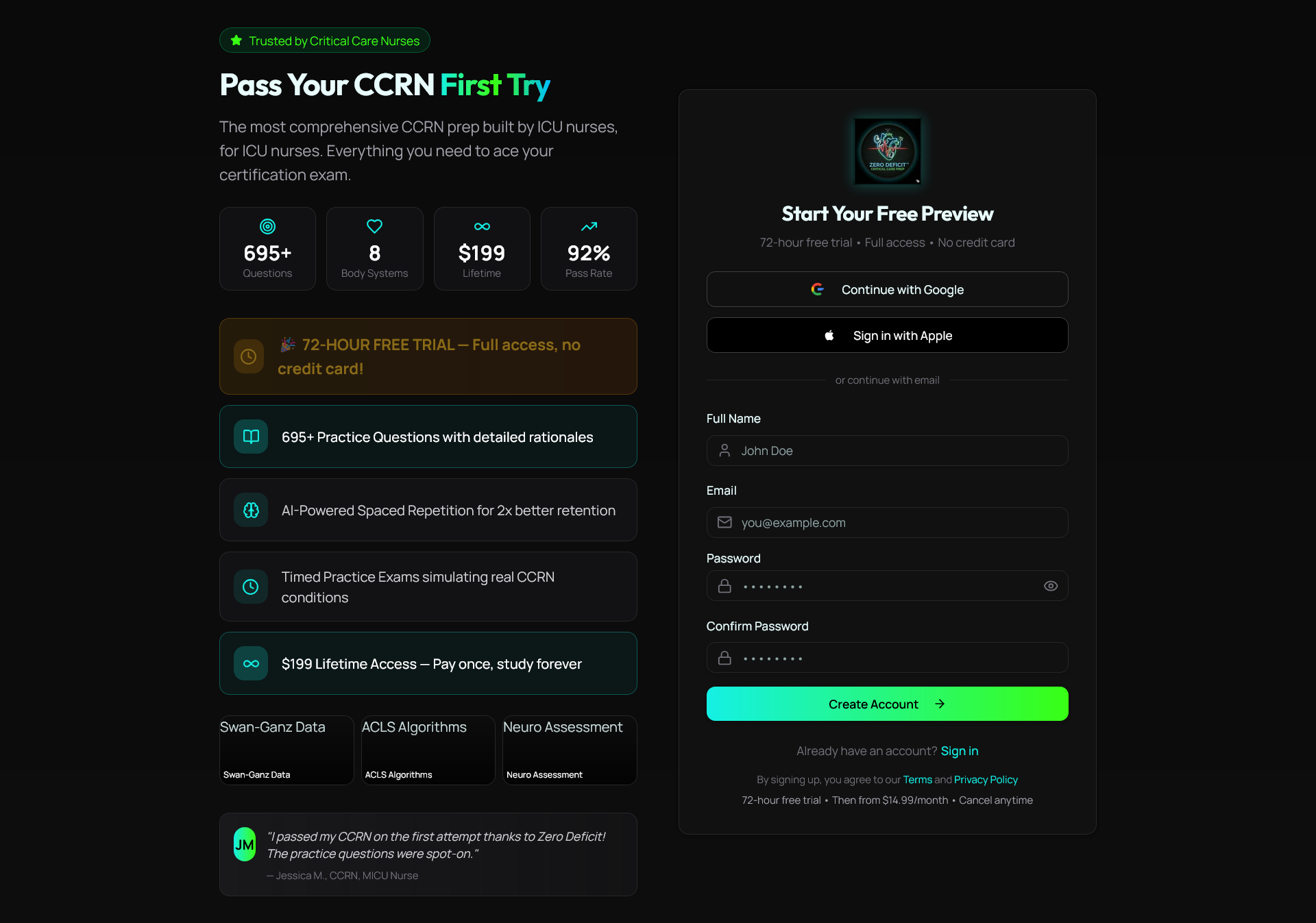
Start with a free trial, run the baseline diagnostic first, and let the system flag your weakest areas before you plan your first study week. From there, head straight to the CCRN practice questions to begin your first timed block, or review plan options if you are ready to commit to full access.
FAQ
What is adaptive learning in nursing exam prep?
Adaptive learning adjusts the questions and review material you see based on your performance, prioritizing weak topics and spacing out repetition for better retention. In CCRN prep, this means a platform shifts focus toward systems like cardiovascular or neuro when your accuracy there lags, rather than presenting content in a fixed order.
How many practice questions should I use to prepare for the CCRN?
There is no single required number, but a large, rationale-rich bank gives you more opportunities for the retrieval practice shown to improve retention. Zero Deficit™ offers 695+ practice questions with detailed rationales covering all eight body systems on the exam blueprint.
Does spaced repetition actually improve CCRN exam performance?
Spaced repetition is well supported in health professions education: a 2024 randomized study found spaced learning produced significantly higher retention than conventional lecture review among nurse anesthesia students. Applying the same spacing principle to CCRN question review is a reasonable, evidence-informed strategy for durable retention.
How do I know if a study tool aligns with the AACN CCRN test plan?
Check whether the platform explicitly organizes its content and questions by the categories listed in the AACN CCRN exam handbook, such as cardiovascular, pulmonary, neuro, and ethics. A tool that cannot show this mapping is harder to trust for focused, exam-weighted study.
How much does Zero Deficit™ cost?
Zero Deficit™ offers a Premium Monthly plan at $14.99 per month and a Yearly Access plan at $84.99 per year, along with a Lifetime Mastery option for one-time access. A free trial is available before choosing a paid plan.
Sources
- Test-enhanced learning: analysis of an experience with undergraduate nursing students | BMC Medical Education
- CCRN Exam Handbook - Tele-critical Care | AACN
Recommended
Take a Neurological practice quiz
Test your knowledge of stroke, ICP, seizures, and neuro assessment.
Get Your Free 20-Question CCRN Diagnostic
20 high-yield CCRN-style questions across every body system, with detailed rationales — emailed to you instantly.
No spam. One email + a couple of helpful follow-ups. Unsubscribe anytime.
Ready to pass your CCRN?
Join 12,000+ nurses using Zero Deficit — 695+ practice questions with rationales, AI-powered weak-area drilling, and spaced-repetition flashcards.
Start Free Trial →