Best CCRN Prep According to Reddit: What Nurses Recommend

By Zero Deficit Critical Care Prep
Scroll through r/nursing and the same names keep coming up for CCRN prep: Barron’s for content, the AACN question bank for exam-style practice, the Pass CCRN book and question bank for volume, and a video course from Nicole Kupchik or Laura Gasparis for a structured start. The nurses who pass tend to pair one content source with one or two question banks. Here is how those options compare, what they cost, where nurses say they fall short, and where Zero Deficit™ fits.
TL;DR
- Reddit’s most repeated pattern is one content resource (usually Barron’s or the Pass CCRN book) plus one or two question banks (AACN, Pass CCRN, or a similar bank).
- Nurses who passed say practice questions with solid rationales mattered more than reading more chapters.
- Complaints about apps are consistent: lost progress, timeouts, and questions that do not resemble the real exam.
- Zero Deficit™ gives you 695+ practice questions with detailed rationales, AI-powered review, spaced repetition and exam simulations from $14.99 per month.
- Check any resource against the current Adult CCRN test plan before you pay for it.
Table of Contents
- What Reddit actually recommends for CCRN prep
- CCRN prep options compared
- Books: Barron’s and Pass CCRN
- Courses: Kupchik and Gasparis
- Question banks: AACN, Pass CCRN, BoardVitals, UWorld, Archer
- Where Zero Deficit™ fits
- How to check a resource against the current blueprint
- Three study plans that match what passers describe
- Choosing on budget
- Start practicing with Zero Deficit™
- FAQ
- Sources
What Reddit actually recommends for CCRN prep
Reddit threads are opinions, not studies, so treat them as a map of what other ICU nurses tried. A snapshot of one recent discussion shows commenters recommending the Pass CCRN book, Barron’s Adult CCRN Exam Premium, and the AACN video lessons and question bank. The same thread calls the Archer app good value but doubts the quality of its hardest questions, and mentions a tool that generates flashcards and multiple-choice questions from chapters you upload.
The ranking threads in r/nursing say much the same thing in different words. Titles like “CCRN studying” and “Good CCRN prep course?” lead to a short list: Barron’s, Pass CCRN, AACN’s question banks, Kupchik, Gasparis, and Anki for flashcards. One commenter says Barron’s goes into more detail than the actual test on neuro. Another says the Pass CCRN app has good questions but times out and does not save progress.
The allnurses forum, where nurses post longer pass reports, backs up the pattern:
- A nurse who scored 98/125 recommends Barron’s plus the AACN practice questions, says the question wording was very familiar, and used nothing else. The same nurse found the exam a lot harder than the NCLEX but doable, and says they were always between two choices.
- Another nurse used Barron’s, the Pass CCRN question bank (1,124 questions) and the AACN bank (600 questions), and found the AACN bank closest to the real exam’s structure and format. They felt Barron’s plus AACN would have been enough, but the extra Pass CCRN questions added confidence and variety.
Take the lesson that matters: nobody says they passed on content reading alone. Every pass story includes a lot of questions.
CCRN prep options compared
Prices change, so use this as a starting point and confirm on each provider’s page. Figures come from the 2024 Nurse.org review course roundup and a September 2026 StaffDNA comparison, plus our own published pricing.
| Option | Type | What nurses say | Listed price |
|---|---|---|---|
| Barron’s Adult CCRN | Book with practice exams | Detailed, dense, a common content anchor | Check current retail |
| Pass CCRN (Robin Dennison) | Book plus question bank | Large question volume; app complaints about timeouts | $65 paperback |
| AACN practice exams | Question bank | Closest to exam format in many pass reports | Basic $25 member / $30 non-member; Premium $65 member / $75 non-member (2024) |
| Nicole Kupchik course | Video course plus book | Popular first step for structure | $269 book and course bundle (2024) |
| Laura Gasparis course | Video course | Called a gold standard on Reddit; no CEs or question booklet per Nurse.org | $199 |
| BoardVitals CCRN Qbank | Question bank | Repetition and testing stamina | $99 for 90 days |
| UWorld CCRN Qbank | Question bank | Rationale-driven practice | $189 for 90 days |
| Zero Deficit™ | Question bank, study guides, AI review, spaced repetition | Built by ICU nurses for the Adult CCRN | $14.99 per month or $84.99 per year |
The AACN practice-exam tiers per Nurse.org also include a free 7-day trial with 30 questions. Our Lifetime Mastery plan has no published price on the subscription page.
Books: Barron’s and Pass CCRN
Barron’s is the most recommended single book in the threads. Nurses like that it covers the content in depth and includes practice exams. The flip side, from commenters, is that it can be more detailed than you need for some systems, so you have to decide when to stop reading and start doing questions.
Pass CCRN is the other name you will see constantly. It is listed at $65 in paperback, and it pairs with an online question bank that nurses use for volume. If you go this route, plan to do your question work somewhere that reliably saves your progress. Several users report the app does not.
Books are also long-term references. Our guide to three ICU nursing books to buy first covers which ones earn shelf space for both exam prep and bedside care.

Courses: Kupchik and Gasparis
Kati Kleber, MSN, RN, notes that most CCRN prep books read like textbooks, dense and dry, and she suggests an online course to jump-start studying, then a study book and practice questions. That matches the Reddit pattern. Nicole Kupchik’s course is the most common pick for nurses who want a guided walkthrough, and Gasparis shows up often as a gold standard for content review.
Nurse.org lists Kupchik’s book and online course bundle at $269 and notes that Gasparis’ course does not offer CEs or a practice question booklet. If you choose a course, you still need a separate question bank. Nobody in the threads treats a video course as a replacement for practice questions.

Question banks: AACN, Pass CCRN, BoardVitals, UWorld, Archer
This is where pass stories cluster, so it deserves the most scrutiny. Look at five things:
- Exam-style stems. Do the questions ask you to prioritize, interpret data and choose a next action, or just recall facts?
- Rationales. A good rationale explains why each wrong answer is wrong, not just why the right one is right.
- Reliability. Does the platform save progress and work on your phone between shifts?
- Difficulty calibration. The Reddit snapshot above says Archer’s medium and easy questions were much easier than the real test while the hard ones felt out of proportion. A bank that is too easy or too odd tells you little about readiness.
- Review tools. Can you revisit missed questions on a schedule, or do they disappear into a log?
The research on prep apps backs up that last concern. A 2014 Critical Care Nurse article on smartphone review apps found quality varied widely, with weaknesses including poorly edited content, rote-memorization questions instead of application and analysis, and content too basic for experienced critical care nurses. Apps have changed since then, but the questions to ask have not.
For a deeper look at banks specifically, see our CCRN question bank guide.
Where Zero Deficit™ fits
Zero Deficit™ was built for one exam: the Adult CCRN. Here is what you get:
- 695+ practice questions with detailed rationales, written by expert ICU nurses.
- Study guides by system and topic, so you can go from a missed question to the content behind it.
- AI-powered review tools and personalized question generation to focus on your weak areas.
- Spaced repetition and flashcards, so what you miss comes back before you forget it.
- Progress tracking and exam simulations to build testing stamina.
We designed it to cover the gap Reddit keeps pointing at: a question bank with strong rationales and review tools in one place, instead of juggling a book, an app and a separate flashcard deck. You can try it first with the free trial, then choose monthly or yearly. If you want to see the style before you commit, start with the CCRN practice questions or the respiratory quiz with rationales.
Perspective
We build Zero Deficit™ as ICU nurses, so we read the Reddit threads the way you do: looking for what actually got people through. What stands out to us is that every pass story is a question story. Reading content builds a foundation, but the exam rewards the skill of looking at a patient scenario, sorting the data, and picking the safest priority action.
That is why we put rationales at the center. A rationale that explains the physiology and why the distractors fail is a mini-lesson you will remember on exam day. It is also why we pair questions with spaced repetition: a missed question about, say, a vasopressor choice in septic shock should come back to you days later, not once.
Our approach is simple. Practice by body system, learn from every rationale, let the AI review tools point you to weak spots, and run exam simulations as you get closer. We think a focused Adult CCRN platform does that job better than stitching together tools built for other purposes.
Zero
How to check a resource against the current blueprint
This is the question Reddit rarely answers, and it matters. Content review that is outdated or aimed at a different exam wastes weeks. Here is a practical check you can do in an evening:
- Download the current Adult CCRN exam handbook and test plan from AACN Certification Corporation. It lists the clinical judgment categories and the system breakdown with percentages.
- Confirm the exam type. Adult, Pediatric and Neonatal CCRN are separate exams. Make sure the resource says Adult.
- Compare the resource’s table of contents to the test plan. Does it cover cardiovascular, pulmonary, endocrine, hematology and immunology, neuro, GI, renal, musculoskeletal, integumentary, and the professional caring and ethical practice content?
- Check the dates. Look for references to guidelines from 2020 onward, such as current Surviving Sepsis Campaign and AHA guidance, and normal ranges stated clearly.
- Spot-check a topic you know well. If a rationale on something you manage every shift looks wrong or dated, it will be wrong elsewhere too.
Note that the Reddit threads are about different test-takers, years and versions. A resource a nurse loved in 2022 may not match what you will see. Your test plan is the tiebreaker.
Three study plans that match what passers describe
These are built from the patterns above, not guarantees. Adjust to your schedule and experience.
The lean plan: one book and one question bank
This mirrors the allnurses pass reports. Read your content book system by system, then switch to questions as soon as you finish a section. Do questions in small blocks, review every rationale, and log what you miss. Expect to cycle back through weak systems more than once.
The structured plan: course, then questions
Start with a video course for the big picture, which suits nurses who feel rusty outside their own unit. Then move to a question bank, ideally one with spaced repetition, so you are not relying on memory alone. Our guide to content review for CCRN success explains how to time that handoff.
The stamina plan: add a second bank for volume
StaffDNA suggests pairing the official AACN course for blueprint accuracy with BoardVitals for repetition, at around $370 total, and notes that testing stamina is where many first-time test-takers struggle. A second bank gives you fresh questions once you have exhausted the first. If you retake, this is the plan that makes sense.
Whichever plan you pick, learn how to dissect a question, not just recognize the answer. Our question breakdown methods and practice question strategies walk through it. If flashcards are your thing (Anki comes up a lot on Reddit), our post on CCRN spaced repetition shows how to schedule review.
Choosing on budget
Here is a quick way to decide:
- Tight budget, strong foundation: one book plus a monthly question bank subscription you can stop once you are scoring consistently.
- Rusty or new to your unit’s patient population: a course for structure, then a question bank with rationales and review tools.
- Retaking: go straight to targeted question work by body system and review what you missed last time.
- Short timeline: a monthly plan lets you pay only for the weeks you use. Zero Deficit™ Premium Monthly is $14.99 per month, and Yearly Access is $84.99 per year if you want more runway.
If you are comparing more options side by side, our posts on best CCRN prep for ICU nurses, best CCRN online prep and CCRNAcademy alternatives go deeper, and the study planner roundup helps you set a schedule.
Start practicing with Zero Deficit™
If you want your question practice, rationales, spaced repetition and AI-powered review in one Adult CCRN platform, Zero Deficit™ is built for that. Pick a body system, work through the questions, read every rationale, and let the review tools bring your misses back.
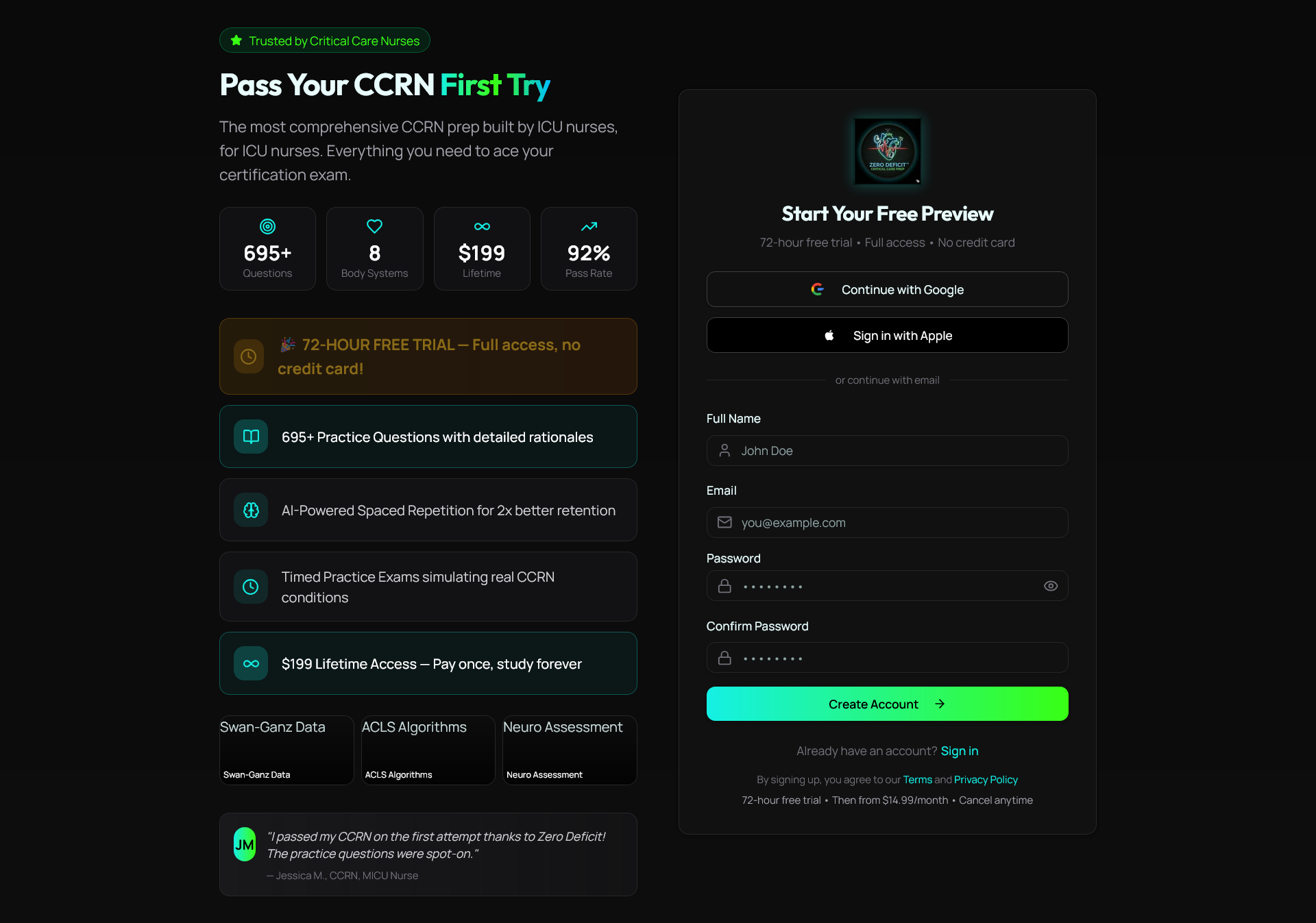
See monthly, yearly and lifetime options, or try the practice quiz first. Our practice tests across all eight body systems are a good place to find your weak spots, and the shock flowchart is a handy hemodynamics refresher.
FAQ
What is the best CCRN study resource on Reddit?
There is no single winner. The combination that appears most is Barron’s or the Pass CCRN book for content, plus the AACN question bank and one more bank for volume. Pick your resources by how you learn and how much practice you need, not by popularity alone.
Are practice questions enough to pass the CCRN?
Pass reports lean heavily on questions, but nurses still use a content source to fill gaps. Our approach is to let your missed questions tell you which content to review, so you read less and retain more. Pair every question with its rationale.
How much should I spend on CCRN prep?
Published prices range from about $25 for a basic AACN practice exam tier to $269 for a course and book bundle, per Nurse.org. Many nurses combine one book with one or two banks. A subscription such as Zero Deficit™ at $14.99 per month or $84.99 per year lets you scale to your timeline.
Is the CCRN harder than the NCLEX?
One nurse who scored 98/125 described it as a lot harder than the NCLEX but doable with effort. The exam tests clinical judgment on critical care scenarios, which is why exam-style questions with strong rationales matter.
Sources
- Reddit Sentiment Analyzer snapshot, April 2026
- CCRN Study Tips, allnurses
- I PASSED the CCRN!, allnurses
- Top CCRN Review Courses, Nurse.org
- The Best CCRN Certification Guide Options, StaffDNA
- The Ultimate List of CCRN Prep Courses and Books, FRESHRN
- Smartphone Applications: Potential Tools for Use in Critical Care Nursing, Critical Care Nurse
Ready to pass? Start with the Zero Deficit™ CCRN practice questions and build your confidence one rationale at a time.
Recommended
Take a Respiratory practice quiz
Master ARDS, ventilation, ABGs, oxygenation, and pulmonary emergencies.
Get Your Free 20-Question CCRN Diagnostic
20 high-yield CCRN-style questions across every body system, with detailed rationales — emailed to you instantly.
No spam. One email + a couple of helpful follow-ups. Unsubscribe anytime.
Ready to pass your CCRN?
Join 12,000+ nurses using Zero Deficit — 695+ practice questions with rationales, AI-powered weak-area drilling, and spaced-repetition flashcards.
Start Free Trial →