CCRNAcademy Alternatives: 6 Ways to Prep for the Adult CCRN

If CCRNAcademy isn’t the right fit, you have solid options. The best Adult CCRN plan pairs AACN’s own materials with a high-volume question bank that explains every answer, plus a book or video resource if you want guided content review. Below, we compare the main choices by what they include, what they cost where a price is published, and which kind of candidate each one suits. We wrote this nurse to nurse, so you can pick a plan and get back to your shifts.
By Zero Deficit Critical Care Prep
TL;DR
- Start with the AACN CCRN (Adult) Exam Handbook and Test Plan. Every study schedule should be built on it.
- Choose a question bank by rationale quality and volume, not by brand name. Rationales are where you learn.
- Published prices vary widely: BoardVitals listed one-time access at $119 to $189 as of July 2026, while Zero Deficit™ is $14.99 per month or $84.99 per year.
- Books and video courses fit candidates who need content review. Question banks fit candidates who already have the knowledge and need test-taking practice.
- Keep an error log of every missed question. It tells you what to study in the final week.
Table of Contents
- What to look for when you replace a CCRN course
- CCRNAcademy alternatives at a glance
- Zero Deficit™ CCRN Exam Prep
- AACN’s official practice resources
- BoardVitals
- Nicole Kupchik’s Ace the CCRN books
- Video courses and live reviews
- Free and low-cost supplements
- Which option fits which nurse
- Our perspective
- Build a plan that works with any resource
- Try Zero Deficit™ before you decide
- FAQ
- Sources
What to look for when you replace a CCRN course
Before comparing names, decide what you actually need from a prep resource. Most candidates who go looking for CCRNAcademy alternatives are missing one of four things: more practice questions, better rationales, a clearer study plan, or a lower price. Judge every option against these five criteria.
- Alignment with the blueprint. The Adult CCRN exam is built from a test plan published by AACN. A resource that doesn’t map to it spends your time on the wrong content. The RenewRN study guide, updated June 2026, recommends using the AACN CCRN (Adult) Exam Handbook and Test Plan as the foundation for your study schedule, and we agree.
- Question volume and variety. You want enough questions that you aren’t memorizing answers. Hundreds of questions across cardiovascular, pulmonary, neuro, renal, endocrine, sepsis and professional caring and ethical practice is a reasonable floor.
- Rationales that teach. A good rationale explains why the right answer is right, why each distractor is wrong, and what clinical principle connects them. If you only see the answer key, you’re paying for a quiz.
- Study structure. Spaced repetition, progress tracking and a timeline keep you from over-studying hemodynamics because you like it and avoiding acid-base because you don’t.
- Access period and cost. A short access window is fine for a 6-week sprint. It’s expensive if you work nights, get floated and need 12 weeks.
CCRNAcademy alternatives at a glance
The table covers the options candidates compare most often. Prices are the ones we could verify, with the date they were listed. Check each provider’s page for the current figure before you buy.
| Option | Format | What’s included | Published price | Best for |
|---|---|---|---|---|
| Zero Deficit™ CCRN Exam Prep | Online platform | 695+ practice questions with detailed rationales, AI-powered review, flashcards, study guides by system, spaced repetition, exam simulations, progress tracking | $14.99 per month, $84.99 per year, lifetime plan (no price published) | Working ICU nurses who want volume, rationales and a built-in study system |
| AACN practice exams and Exam Handbook | Official | Test plan, handbook and practice exam tools for the Adult CCRN | See AACN’s certification pages | Every candidate, as the first and last step |
| BoardVitals | Question bank | 500+ CCRN questions, optional CE credit package | $119 for 1 month, $169 for 3 months, $189 for 6 months (as of July 17, 2026) | Candidates who want a time-boxed question bank |
| Nicole Kupchik’s Ace the CCRN | Books | Study guide plus a practice question book with 150 questions in 3 exams | Books bundle $90 (listed December 2021) | Readers who like a structured text and a short practice set |
| Video and live review courses | Course | Lecture-style content review | Varies by provider | Candidates who learn by listening and need a content refresher |
| Flashcards, podcasts and study groups | Supplemental | Recall practice and peer discussion | Often free or low-cost | Filling gaps between question sessions |
Sources for the book and BoardVitals figures are the FreshRN prep list and the RenewRN study guide. Book pricing from 2021 may have changed, so treat it as a ballpark.
Zero Deficit™ CCRN Exam Prep
We built Zero Deficit™ for one exam: the Adult CCRN. The platform includes over 695 practice questions with detailed rationales, comprehensive study guides organized by system and topic, flashcards, spaced repetition, exam simulations, progress tracking, AI-powered review tools and personalized question generation. The content was created by expert ICU nurses.
Pricing is published on the subscription page: Premium Monthly is $14.99 per month, Yearly Access is $84.99 per year, and Lifetime Mastery is also offered. A free trial is available, so you can see how the questions and rationales feel before you commit.
Who it fits: the ICU RN with one to five years at the bedside who knows the clinical material but wants hundreds of scenario questions, and the retaker who needs to see exactly where points were lost. If you want to see the question style first, the respiratory practice questions are a good sample, and our question breakdown methods show how we read a stem, find what is being asked and eliminate distractors.
AACN’s official practice resources
AACN writes and administers the CCRN, so its test plan and practice tools are the closest thing to the real exam’s scope. Candidates in nursing communities often say to start with the AACN practice exams, and we agree that they belong in your plan. Use them as a diagnostic early on, then again near the end to check readiness.
What they don’t do for most people is supply volume. A short official practice set tells you where you stand, but it is too small to drill a weak area across several weeks. That’s where a question bank earns its place. We cover this pairing in our guide to CCRN question banks for ICU nurses.
BoardVitals
BoardVitals offers a question bank with 500+ CCRN practice questions. As of July 17, 2026, RenewRN listed one-time access at $119 for one month, $169 for three months and $189 for six months, with an optional CE credit package.

The access periods are the main thing to plan around. One month suits a final push. If you’re studying 8 to 12 weeks, you’re looking at the three- or six-month tier. Compare that against a plan where you can stay subscribed month to month and stop when you test.
Nicole Kupchik’s Ace the CCRN books
Nicole Kupchik is a well-known name in CCRN prep. According to the FreshRN list, her Ace the CCRN study guide pairs with a practice review question book of 150 questions across 3 exams, and the books were bundled at $90 when that list was published in 2021.
Books work well if you retain information by reading and annotating, and they’re easy on the commute or in the break room. Their limits are structural: a printed practice set is small, and it can’t track which topics you keep missing. Many candidates use a book for content and a digital bank for volume.
Video courses and live reviews
Video and live review courses are the closest match to what CCRNAcademy-style courses offer: lecture-driven content review that walks through each body system. They’re a good fit if it has been a while since you managed a patient on CRRT or an intra-aortic balloon pump, or if you’re a newer ICU nurse who hasn’t yet seen every scenario.
Cost and length differ a lot by provider, so look at the syllabus first and match it to the AACN test plan. Then check that the course includes practice questions with rationales, not just slides. If it doesn’t, you’ll need a bank alongside it. Our comparison of self-study versus a course walks through how to decide, and our roundup of five online CCRN prep options goes deeper on the online choices.

Free and low-cost supplements
Flashcards, podcasts, YouTube reviews and study groups cost little and fill the gaps between question sessions. Use them for recall: normal values, vent settings, drip titrations. A few examples worth knowing cold are a PaO2 of 80 to 100 mm Hg, a pH of 7.35 to 7.45, a PaCO2 of 35 to 45 mm Hg and HCO3 of 22 to 26 mEq/L. They aren’t a substitute for scenario questions, because the CCRN tests judgment, not definitions.
Which option fits which nurse
| If you are… | Start with |
|---|---|
| A new ICU grad building foundations | A content-first resource (book or video course) plus the AACN test plan, then a question bank |
| An ICU RN with 1 to 5 years who knows the material | A high-volume question bank with rationales, plus AACN practice exams |
| A retaker | Your error log, then targeted question practice in the systems you missed |
| On a tight budget | AACN materials, free flashcards and a monthly subscription you can cancel after you test |
| Working nights or floating | A platform with no short expiry, so your access doesn’t run out before your schedule settles |
Our perspective
We hear the same thing from ICU nurses who switch prep resources: the content wasn’t the problem, the practice was. They had watched the lectures. What they hadn’t done was answer enough scenario questions, read enough rationales and review the misses on a schedule.
That’s why Zero Deficit™ is built around questions. Every one of our 695+ practice questions comes with a detailed rationale written by ICU nurses, because the explanation is where a missed question becomes a point on exam day. Spaced repetition brings weak topics back at the right interval, and progress tracking shows you where you stand by system, so you stop guessing what to study tonight.
Our AI-powered review tools and personalized question generation are designed to put more of your time into the areas you actually miss. And we think the pricing should match a working nurse’s life: monthly if you want flexibility, yearly if you want a longer runway, lifetime if you want it for good.
Whatever you choose, build it on the AACN test plan, and let the official practice exams be your checkpoints. Then give yourself enough questions to walk in confident.
Zero
Build a plan that works with any resource
The resource matters less than how you use it. This is the structure we recommend for most working ICU nurses.
- Week 1: Baseline. Read the AACN test plan. Take an official practice exam or a mixed set of 50 questions to see your starting point.
- Weeks 2 to 8: System by system. Spend about a week each on cardiovascular, pulmonary, neuro, renal and endocrine, with sepsis and multisystem topics and professional caring and ethical practice woven in. Do questions first, then read content for what you missed.
- Throughout: Keep an error log. RenewRN recommends logging every missed practice question so you can target specific gaps in your final week. Write the concept, not just the answer.
- Weeks 9 to 10: Mixed, timed sets. Practice stamina and switching between systems the way the exam does.
- Final week: Review and rest. Redo your error log and take one last full-length simulation. Stop cramming the night before.
If you want a case-based structure, our 6-week case study plan and guide to practice question strategies fill in the details. For retention, see how spaced repetition changes what you review and when.
Try Zero Deficit™ before you decide
If a question-first plan sounds like what you were missing, Zero Deficit™ gives you 695+ rationale-backed questions, study guides by system, spaced repetition and exam simulations in one place. You can start with the free trial, then move to Premium Monthly at $14.99 per month or Yearly Access at $84.99 per year on our subscription page.
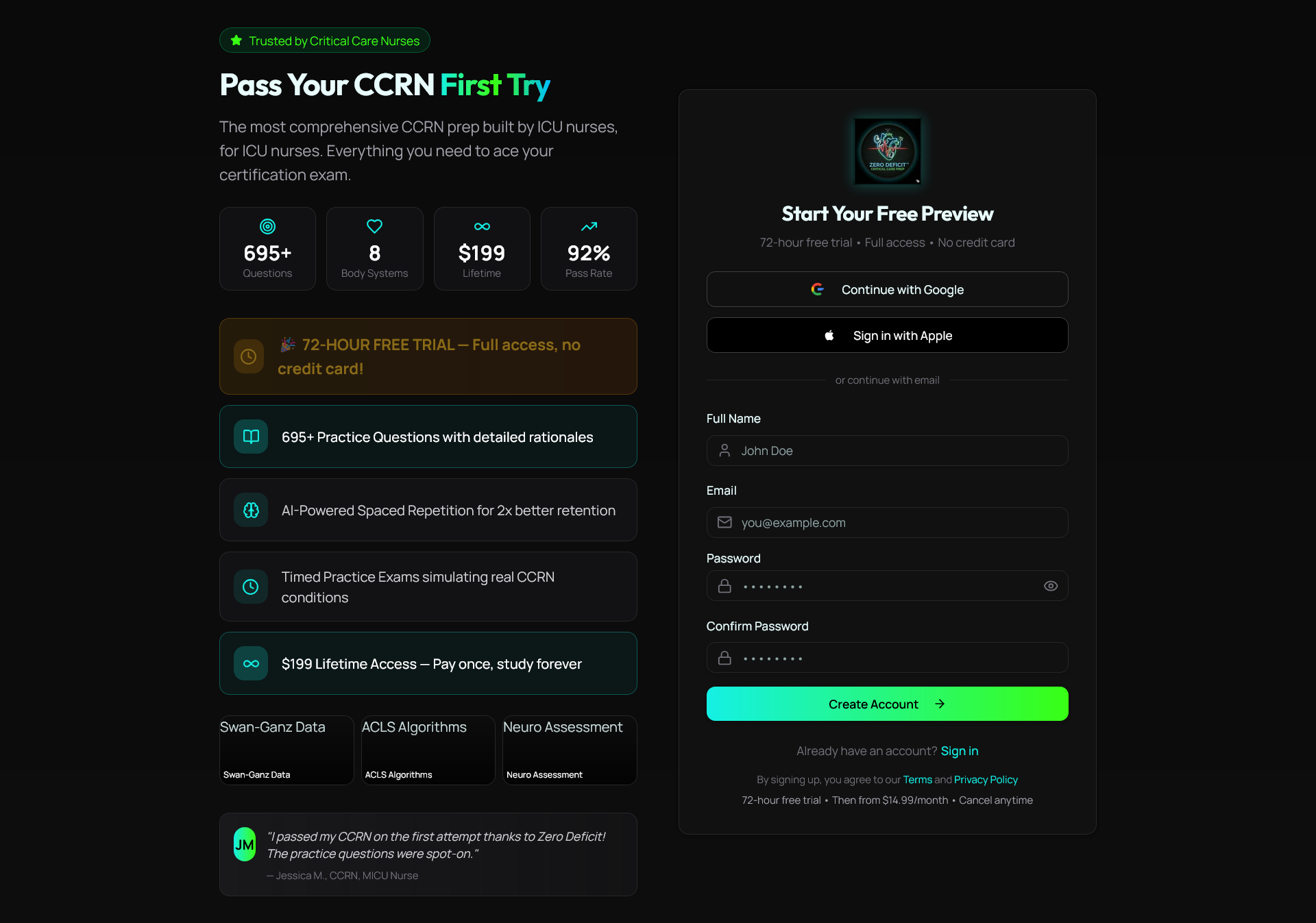
Prefer to look around first? The Zero Deficit™ learning hub shows how the study guides and tools fit together, and our CCRN prep blog has more comparisons and study plans.
FAQ
What is the best alternative to CCRNAcademy?
It depends on what was missing. If you need more practice and better rationales, a question bank like Zero Deficit™ is the strongest fit. If you need content review first, add a book or a video course, and use the AACN test plan to check any option’s coverage.
Do I need more than one CCRN resource?
Most candidates do well with two: one official source (the AACN handbook and practice exams) and one high-volume question bank. Add a book or video series only if your content knowledge has gaps. More than three resources usually just splits your time.
How long should I study for the CCRN?
Many working ICU nurses plan 8 to 12 weeks, studying a few hours per week around shifts. Your starting baseline matters more than the calendar, so take a practice set in week one and adjust the plan to your results.
Should I choose a monthly or yearly subscription?
If you’re testing within about two months, monthly at $14.99 keeps cost down. If you want a longer runway or may retake, yearly at $84.99 is the lower cost per month. Both are listed on our subscription page.
Sources
- The Ultimate List of CCRN Prep Courses and Books, FreshRN
- How to Pass the CCRN Exam (2026): Study Guide, RenewRN
Ready to put your prep into practice? Start with the Zero Deficit™ CCRN practice questions and see how detailed rationales change the way you study.
Recommended
Take a Respiratory practice quiz
Master ARDS, ventilation, ABGs, oxygenation, and pulmonary emergencies.
Get Your Free 20-Question CCRN Diagnostic
20 high-yield CCRN-style questions across every body system, with detailed rationales — emailed to you instantly.
No spam. One email + a couple of helpful follow-ups. Unsubscribe anytime.
Ready to pass your CCRN?
Join 12,000+ nurses using Zero Deficit — 695+ practice questions with rationales, AI-powered weak-area drilling, and spaced-repetition flashcards.
Start Free Trial →