CCRN101 Alternatives: 7 CCRN Prep Options Compared

If you are weighing CCRN101 against other Adult CCRN prep, the real choice is between four formats: official AACN practice exams, a video course, a high-volume question bank, and an all-in-one platform. Most nurses who pass combine two of them. Below you will find the main options, what they include, what they cost as published, and how to match them to your timeline and learning style.
We built Zero Deficit™ for ICU nurses, so we are on the field too. We say where we fit, and we give the other options their due.
TL;DR
- No single resource covers everything. The strongest plans pair one content source (course, book or study guides) with one high-volume question bank that explains every answer.
- AACN’s own practice exams and review course are the closest match to the official test plan, and they are priced per access window, not monthly.
- Video courses from independent educators run roughly $229 to $269 as of the last published comparison, and they teach content more than they drill questions.
- Zero Deficit™ combines 695+ practice questions with rationales, study guides by system, flashcards with spaced repetition and AI-powered review for $14.99 per month or $84.99 per year.
- Choose by your weakest link: content gaps need teaching, test-taking gaps need questions and rationales.
Table of Contents
- What to compare before you pick a CCRN prep resource
- CCRN101 alternatives at a glance
- Official AACN practice exams and review course
- Video courses: Kupchik, Gasparis and Critical Care Academy
- Question banks: Kaplan and BoardVitals
- Zero Deficit™: practice, study guides and spaced repetition in one place
- How to choose: three common situations
- Perspective
- Other comparisons worth reading
- Start with practice you can use today
- FAQ
- Sources
What to compare before you pick a CCRN prep resource
The CCRN is a clinical judgment exam. The current Adult test plan puts 80% on Clinical Judgment and 20% on Professional Caring and Ethical Practice. The body systems are grouped into five weighted clusters:
| Cluster | Weight |
|---|---|
| Endocrine, Hematology, GI, Renal, Integumentary | 21% |
| Musculoskeletal, Neurological, Behavioral | 18% |
| Multisystem | 16% |
| Cardiovascular | 13% |
| Respiratory | 12% |
AACN launched revised CCRN exams on November 12, 2025, built on its 2024 national study of practice. That matters for your choice. A resource that has not been updated since before that date may be organized around an older blueprint.
Use these five criteria to compare any option, CCRN101 included:
- Blueprint alignment. Does content map to the Adult test plan, including the Synergy Model and ethics portion?
- Question volume and rationales. Do you get enough questions to see patterns, and does each answer explain why the wrong options are wrong?
- Format. Video, book, flashcards or question bank. Match this to how you actually study after a 12-hour shift.
- Access length. A 30-day window and a 180-day window suit very different timelines.
- Total cost. Add up everything you need, not just the headline price.
Before buying anything, confirm your eligibility and exam fees on AACN’s site so you budget the whole path.
CCRN101 alternatives at a glance
| Option | Format | Published price | Best for |
|---|---|---|---|
| Zero Deficit™ | Question bank, study guides, flashcards, AI review | $14.99/month or $84.99/year | Daily practice with rationales and tracking |
| AACN Premium practice exams | Randomized practice exams | $75 members, $90 nonmembers (180 days) | Exam-style rehearsal |
| AACN Basic practice exams | 150 questions | $35 members, $45 nonmembers (30 days) | A short final check |
| AACN Adult CCRN review course | Online modular course | $159 members, $199 nonmembers | Structured content review |
| Nicole Kupchik course and book | On-demand video plus book | $269 bundle | Story and mnemonic learners |
| Laura Gasparis course (nursing.com) | Video course | $229 for 90 days | Lecture-style review |
| Critical Care Academy | 400+ minutes of video, 9 quizzes, final exam | See provider | Guided video learners |
| Kaplan and BoardVitals | Question banks | See provider | Extra question volume |
Prices for the AACN products come from AACN’s own pages. Independent course prices come from a 2024 comparison, so confirm current figures on each provider’s page before you pay.
Official AACN practice exams and review course
Start here if you want the closest thing to the certifying body’s own materials. The Premium practice exam subscription gives you hundreds of randomized questions for 180 days, plus content-area exams, at $75 for members and $90 for nonmembers. Basic offers 150 questions for 30 days at $35 or $45. A 7-day free trial includes 30 questions with rationales.

The questions follow the current test plan and mirror the style of real exam items. One point is worth keeping in mind: AACN states its practice exams are not psychometrically valid and cannot predict or guarantee performance. Use scores as a study signal, not a verdict.
The AACN review course covers all body systems plus Professional Caring and Ethical Practice and carries 15.5 contact hours. It lists at $159 for members and $199 for nonmembers.
Where it fits: a strong content backbone and an official benchmark. Because the practice window is limited, many nurses start it in the last month or two.
Video courses: Kupchik, Gasparis and Critical Care Academy
Video courses teach. If your weak spot is understanding why a patient in cardiogenic shock needs a different approach than one in septic shock, a good instructor helps.
- Nicole Kupchik. Her on-demand course and book bundle costs $269. Reviewers describe her use of stories, mnemonics and rhymes to make difficult disease processes stick.
- Laura Gasparis. Her course through nursing.com is listed at $229 for 90 days of access.
- Critical Care Academy. It offers 400+ minutes of video modules, 9 quizzes and a final exam, with a pass guarantee.
Where they fit: early in your prep, when you are building or refreshing content knowledge. The tradeoff is simple: video time is passive time, so pair it with active question practice. If mnemonics are your thing, our guide to nursing mnemonics for CCRN gives you a head start.
Question banks: Kaplan and BoardVitals
Question banks are for volume. Kaplan’s CCRN QBank emphasizes exam-style difficulty, detailed explanations and learning reports that point to strengths and weaknesses. It works best as a supplement to a content source, not a teaching course on its own. BoardVitals builds its program on the official AACN blueprints and offers a pass guarantee on its 3-month and 6-month packages, per the same comparison.
Where they fit: weeks four through the end of your plan, when you need hundreds of questions and want to track weak systems.

Zero Deficit™: practice, study guides and spaced repetition in one place
We designed Zero Deficit™ for the nurse who studies in 20-minute pockets between shifts. Instead of splitting your plan across a book, a video course and a separate bank, you get these in one login:
- 695+ practice questions with detailed rationales, so each miss becomes a lesson. See how we handle rationales in our rationale-first breakdown.
- Study guides by body system written by expert ICU nurses.
- Flashcards with spaced repetition, progress tracking and exam simulations.
- AI-powered review tools and personalized question generation aimed at your weak areas.
Our pricing is published: $14.99 per month or $84.99 per year, with a free trial and a Lifetime Mastery plan listed on the subscription page. If you prefer to see the content first, try the practice quizzes by body system or the shock flowchart.
How to choose: three common situations
You have 8 to 12 weeks and solid ICU experience. Use a question bank daily with a content source on weak systems. Zero Deficit™ covers both in one subscription, and the yearly plan costs less than most single video courses.
You are a newer ICU nurse with content gaps. Begin with structured teaching: study guides by system, then add questions as soon as a topic feels familiar. Our high-yield topic guides on shock, vasopressors and sepsis are a good first week.
You are a retaker. Look at your score report first, then rebuild around your weakest clusters. Personalized question generation and progress tracking help you spend time where points are lost.
A simple 8-week sketch
- Weeks 1 to 2: baseline quiz by system, then study guides for your lowest two.
- Weeks 3 to 6: 30 to 50 questions a day, reading every rationale, flashcards on misses.
- Weeks 7 to 8: timed exam simulations and a review of the Synergy Model and ethics content.
Perspective
We hear the same thing from ICU nurses: they do not fail for lack of effort, they fail because their time went to the wrong place. Hours of passive review feel productive, but the CCRN rewards nurses who can reason through a changing patient.
That is why we built Zero Deficit™ around rationales. When you understand why a distractor is wrong, you build the judgment the exam tests. Add spaced repetition and the facts you keep forgetting come back right before you would lose them.
Our approach is designed to give you one place to practice, review and track progress, so you stop juggling tabs and start closing gaps. Whatever you pick, practice with explanations every day.
Zero
Other comparisons worth reading
If you are comparing several platforms, these breakdowns may help: Passetra alternatives, CriticalCareHealthServices.org alternatives and our guide to the best CCRN prep for ICU nurses. For flashcard-specific advice, see our CCRN flashcards guide.
Start with practice you can use today
The fastest way to compare any CCRN prep is to see how it handles a hard question. Our free trial lets you work through questions with full rationales and see your progress by system.
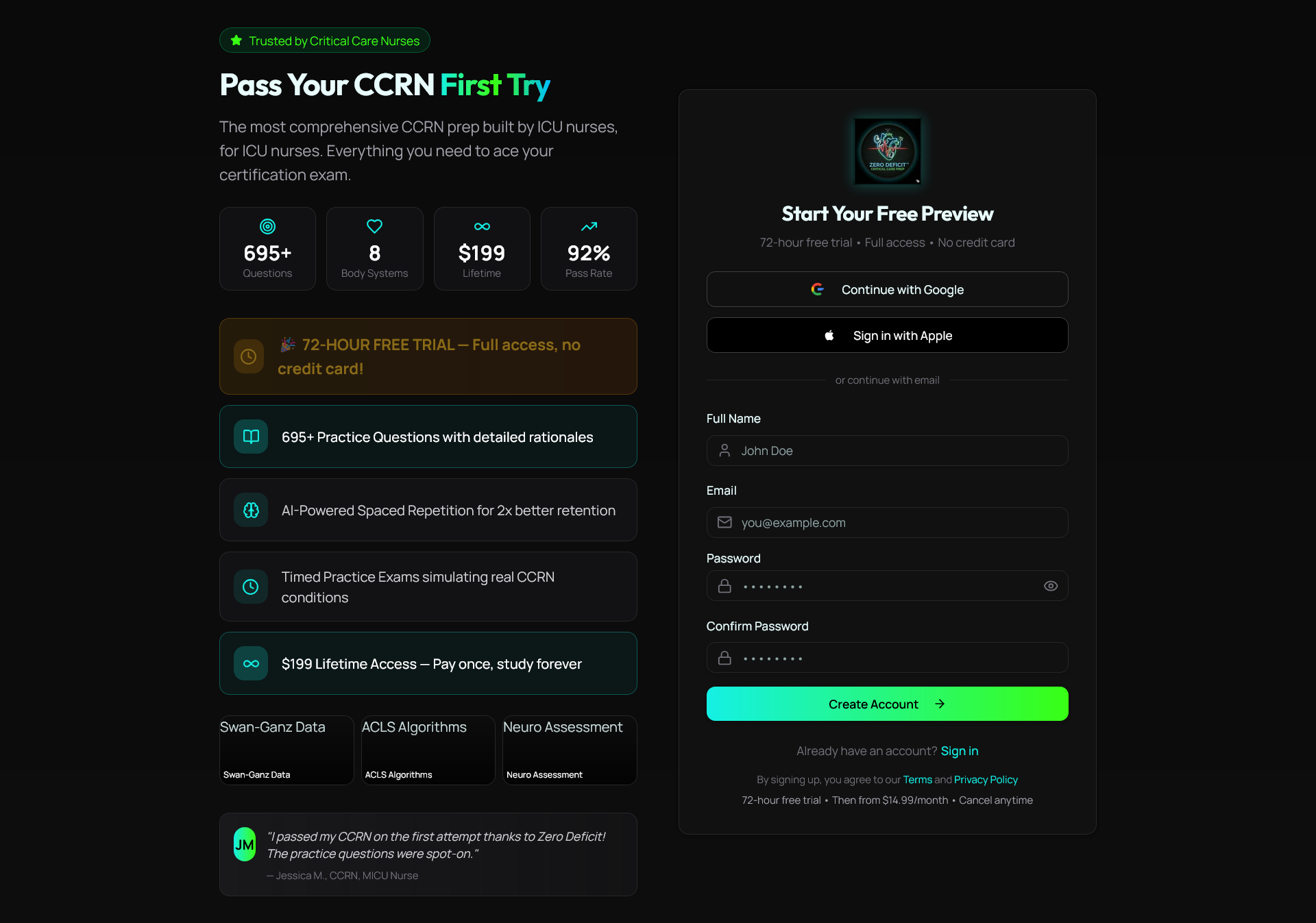
When you are ready for full access, pick monthly or yearly on the subscription page.
FAQ
Can I pass the CCRN with just one resource?
Some nurses do, especially with strong ICU experience. Most plans work better with a content source plus a question bank that explains every answer. A platform that offers both, like Zero Deficit™, keeps that in one place.
Should I use official AACN practice exams?
They are a good benchmark because they follow the current test plan. AACN notes that scores cannot predict actual exam performance, so treat them as a study guide for where to focus. Pair them with a larger bank for volume.
How much should I budget for CCRN prep?
Published prices range from $35 for a 30-day AACN Basic practice exam to $269 for the Kupchik bundle. Zero Deficit™ costs $14.99 per month or $84.99 per year. Exam fees are separate, so check AACN’s site.
How long should I study?
Many nurses plan 8 to 12 weeks. Choose an access window that covers your plan with a few weeks of buffer.
Ready to practice? Start with the Zero Deficit™ CCRN practice questions and see the rationale behind every answer.
Sources
- CCRN Adult Certification Practice Exam and Questions Premium Subscription, AACN
- Certification Practice Exams, AACN
- Revised CCRN Certification Exams Launch Nov. 12, 2025, AACN
- Adult CCRN review course syllabus and test plan, AACN
- Top 4 CCRN Review Courses, Nurse.org
- Best CCRN Review Courses and Practice Questions, Beyond the States
Recommended
Take a Respiratory practice quiz
Master ARDS, ventilation, ABGs, oxygenation, and pulmonary emergencies.
Get Your Free 20-Question CCRN Diagnostic
20 high-yield CCRN-style questions across every body system, with detailed rationales — emailed to you instantly.
No spam. One email + a couple of helpful follow-ups. Unsubscribe anytime.
Ready to pass your CCRN?
Join 12,000+ nurses using Zero Deficit — 695+ practice questions with rationales, AI-powered weak-area drilling, and spaced-repetition flashcards.
Start Free Trial →