CCRN Rhythm Strips: Master ECG Interpretation for 2026
TL;DR:
- Mastering CCRN rhythm strip interpretation involves a systematic approach and connection to patient physiology. Recognizing high-yield rhythms and practicing daily with clinical scenarios enhances accuracy and decision-making. This skill is crucial for success in the CCRN exam and critical patient care.
CCRN rhythm strips are standardized ECG tracings used to identify and classify cardiac rhythms in critically ill patients. The cardiovascular domain accounts for roughly 17–18% of the 125 scored CCRN exam questions, making it the largest single content area on the test. Within that domain, dysrhythmia interpretation carries 21–26 dedicated questions. That number alone tells you where to focus your prep. Mastering the interpretation of ECG strips is not optional for CCRN candidates. It is the skill that separates nurses who pass on the first attempt from those who retake.
What key features do you analyze when reading CCRN rhythm strips?
A systematic approach to rhythm strips follows a fixed sequence: check for electrical activity, assess heart rate, evaluate rhythm regularity, examine QRS complexes, identify P waves, correlate with a clinical pulse, and then classify the rhythm. Skipping any step creates blind spots that cost you points on the exam and, more critically, delay interventions at the bedside.

Step 1: Electrical activity and heart rate
The first question is simple. Is there any electrical activity on the strip? A flat line is asystole until proven otherwise. If activity exists, count the rate. The standard method uses the 300 rule on a 6-second strip: count the number of QRS complexes in 6 seconds and multiply by 10. Normal sinus rate is 60–100 beats per minute. Anything below 60 is bradycardia. Anything above 100 is tachycardia.
Step 2: Rhythm regularity and QRS morphology
Measure the R-to-R intervals across the strip. Consistent intervals signal a regular rhythm. Variable intervals point toward atrial fibrillation, second-degree heart block, or a wandering pacemaker. Next, examine the QRS complex. A narrow QRS (less than 0.12 seconds, or fewer than 3 small boxes) means the impulse originated above the ventricles. A wide QRS suggests a ventricular origin or aberrant conduction, which changes your clinical response immediately.
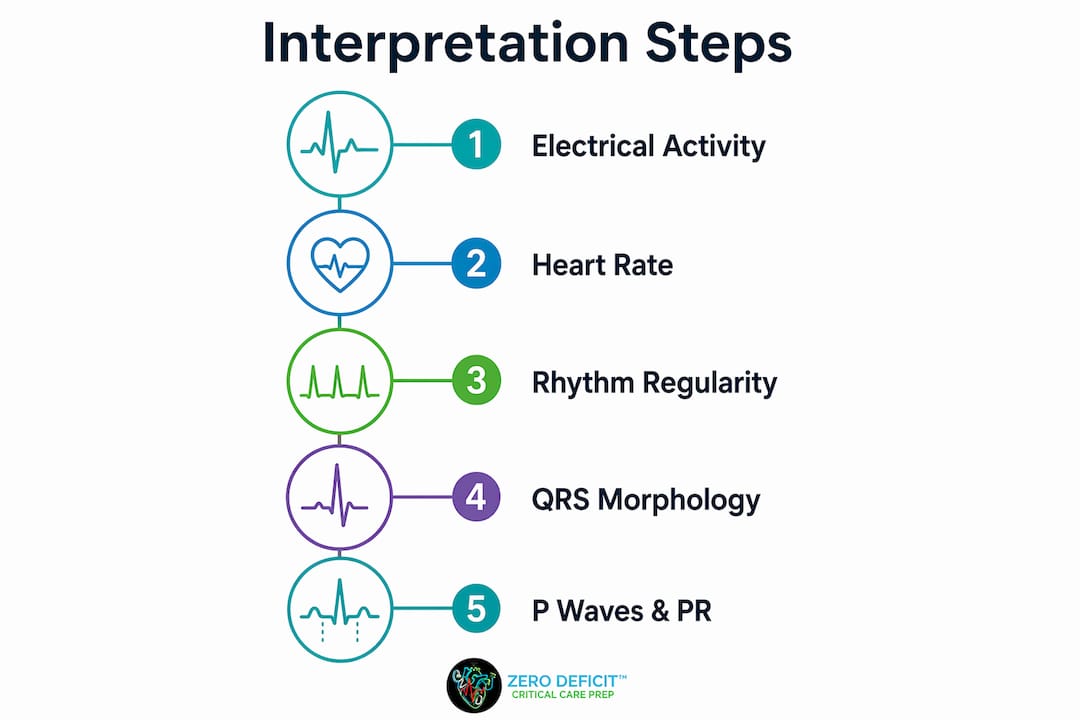
Step 3: P waves and PR interval
Every normal sinus beat has a P wave before each QRS, and every P wave looks the same. If P waves are absent, chaotic, or dissociated from QRS complexes, you are dealing with an abnormal rhythm. The PR interval should measure 0.12–0.20 seconds. A prolonged PR interval signals a first-degree AV block. Absent P waves with an irregular rhythm point directly to atrial fibrillation.
Pro Tip: On the CCRN exam, always correlate the rhythm to the patient’s clinical status before selecting an intervention. A heart rate of 40 beats per minute in an asymptomatic patient is managed differently than the same rate in a patient with hypotension and altered mental status.
Which common cardiac rhythms should CCRN candidates master?
High-yield CCRN rhythms include normal sinus rhythm, sinus bradycardia, sinus tachycardia, atrial fibrillation, ventricular tachycardia, asystole, and pulseless electrical activity. Each has a distinct ECG signature and a distinct clinical response. Knowing the strip alone is not enough. You must connect the rhythm to the intervention.
| Rhythm | Key ECG Features | Clinical Significance | First Intervention |
|---|---|---|---|
| Normal sinus rhythm | Rate 60–100, regular, narrow QRS, P before every QRS | Baseline normal | Monitor |
| Sinus bradycardia | Rate below 60, otherwise normal morphology | May cause hypotension, syncope | Atropine if symptomatic |
| Atrial fibrillation | Absent P waves, irregularly irregular, narrow QRS | Stroke risk, hemodynamic compromise | Rate control, anticoagulation |
| Ventricular tachycardia | Rate above 100, wide QRS, no clear P waves | Shockable if pulseless | Synchronized cardioversion or defibrillation |
| Asystole | Flat line, no electrical activity | Non-shockable, CPR-driven | CPR, epinephrine |
| PEA | Organized rhythm, no palpable pulse | Non-shockable, treat the cause | CPR, identify reversible cause |
The ACLS algorithm divides rhythms into two categories: shockable and non-shockable. Ventricular fibrillation and pulseless ventricular tachycardia are shockable. Asystole and pulseless electrical activity are not. This distinction drives every resuscitation decision in the ICU.
Key recognition clues for the rhythms you will see most often:
- Atrial fibrillation: No two R-to-R intervals are equal. The baseline looks chaotic, not flat.
- Ventricular tachycardia: Wide, bizarre QRS complexes at a rate typically above 150. Cannon A waves may appear on the monitor.
- PEA: The strip looks organized, sometimes even normal. The patient has no pulse. This is the trap the exam sets for you.
- Third-degree AV block: P waves and QRS complexes march through the strip independently. The atria and ventricles are completely dissociated.
Pro Tip: When you see a wide-complex tachycardia on the exam, assume ventricular tachycardia until proven otherwise. Treating SVT with aberrancy as VT is far safer than the reverse.
How can you practice and sharpen rhythm strip interpretation?
Consistent, structured practice is the only method that builds reliable speed and accuracy. Experts recommend interpreting 3 rhythm strips daily, paired with 3 arterial blood gas interpretations, throughout your final study month. That combination mirrors the multi-system reasoning the CCRN exam demands.
Effective practice goes beyond simply reading strips. Use this approach:
- Log every missed interpretation. Write down what you identified, what the correct rhythm was, and why you missed it. Patterns in your errors reveal your actual knowledge gaps.
- Review rationales, not just answers. Understanding why atrial flutter produces a sawtooth baseline at 300 beats per minute is more durable than memorizing the image alone.
- Reinterpret missed strips after 48 hours. Active recall after a delay confirms whether you retained the concept or just recognized it in the moment.
- Run one full-length simulated exam weekly. Timed, full-length exams build the endurance needed to maintain accuracy across 150 questions. Fatigue is a real factor in CCRN performance.
- Use a flowchart for borderline rhythms. The arrhythmia flowchart from Zerodeficitccrnprep walks you through decision points systematically, which is especially useful when a strip does not fit a clean category.
The most common practice mistake is passive reading. Scrolling through rhythm strip images without writing down your interpretation first does not build the retrieval speed the exam requires. Treat every practice strip as a timed clinical decision.
How do rhythm strip skills apply in CCRN exam scenarios?
The CCRN exam does not test rhythm recognition in isolation. Exam questions embed indirect clues in the clinical scenario, requiring you to synthesize the rhythm with labs, hemodynamics, and patient symptoms. A candidate who only recognizes the rhythm misses the question. The candidate who connects the rhythm to the physiology gets it right.
Hyperkalemia is a classic example. Peaked, narrow T-waves on a rhythm strip paired with a potassium level of 6.8 mEq/L and a widening QRS should trigger calcium gluconate as the first intervention, not antiarrhythmic therapy. The rhythm is the clue, not the diagnosis. Similarly, a patient in sinus tachycardia with a CVP of 2 mmHg (normal range: 2–6 mmHg) and a cardiac index below 2.5 L/min/m² points toward hypovolemia, not pain or anxiety, as the driver.
Integrating hemodynamic values with rhythm data is a skill the exam tests repeatedly. Memorizing normal ranges matters, but applying them in a multi-step scenario is what the CCRN actually measures. Candidates who practice multi-step prioritization consistently outperform those who rely on content memorization alone.
The shockable versus non-shockable distinction from ACLS also appears in CCRN scenario questions. Knowing that ventricular fibrillation requires immediate defibrillation while PEA requires CPR plus identification of the reversible cause (the Hs and Ts) is tested directly. Tension pneumothorax, cardiac tamponade, and hypovolemia all produce PEA. The rhythm strip tells you the category. The clinical scenario tells you the cause.
Pro Tip: When an exam question gives you a rhythm strip and a set of labs, read the labs first. Electrolyte abnormalities and acid-base disturbances explain most arrhythmias in the ICU. The strip confirms what the labs already suggested.
Key takeaways
Mastering CCRN rhythm strips requires a systematic interpretation method, recognition of high-yield arrhythmias, and the ability to connect ECG findings to patient physiology and clinical interventions.
| Point | Details |
|---|---|
| Cardiovascular is the largest CCRN domain | Dysrhythmia interpretation covers 21–26 questions, making it the highest-yield single skill area. |
| Use a fixed 7-step sequence | Check electrical activity, rate, regularity, QRS, P waves, pulse correlation, and rhythm classification every time. |
| Know shockable vs. non-shockable rhythms | VF and pulseless VT are shockable; asystole and PEA are not. This drives every resuscitation decision. |
| Practice 3 strips daily with error logging | Daily drills plus rationale review build speed and close knowledge gaps faster than passive reading. |
| Connect rhythm to physiology on the exam | Hyperkalemia, hypovolemia, and tamponade all produce rhythm changes. The strip is a clue, not a standalone answer. |
What I have learned from watching nurses struggle with rhythm strips
Most nurses who struggle with rhythm strips are not struggling with the rhythms themselves. They are struggling with the step they skip: correlating the strip to the patient in front of them. I have seen nurses correctly identify atrial fibrillation on a strip and then freeze when the exam question asks what to do next, because the question adds a blood pressure of 78/40 mmHg and a history of Wolff-Parkinson-White syndrome. That is not a rhythm recognition problem. That is a clinical reasoning problem.
The fix is not more strip memorization. The fix is practicing strips inside clinical scenarios from day one. Every time you interpret a rhythm, add a patient. Give that rhythm a blood pressure, a potassium level, a mental status. Ask yourself what you would do in the next 60 seconds. That habit is what the CCRN exam actually tests.
The systematic approach matters more than speed. Speed comes with repetition. Accuracy comes from never skipping a step. Nurses who build the habit of checking P waves even when the rhythm looks obvious are the ones who catch third-degree AV block masquerading as a slow sinus rhythm. That catch is the difference between a correct answer and a wrong one, and between a safe patient and a deteriorating one.
— Zero
Zerodeficitccrnprep resources for rhythm strip mastery
Rhythm strip interpretation is one of the most tested skills on the CCRN, and Zerodeficitccrnprep is built specifically to help you master it before exam day.
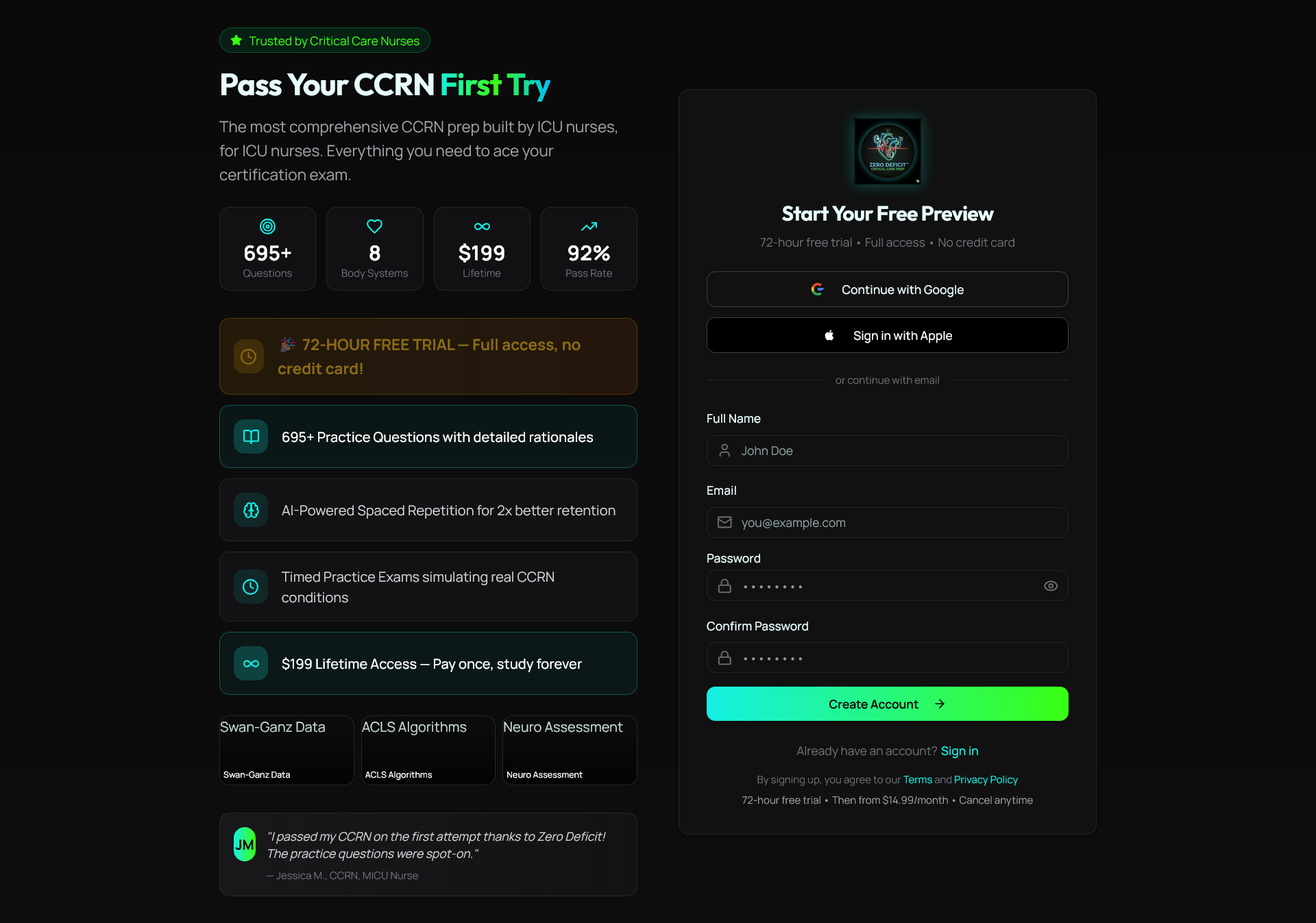
The CCRN study guides cover all 8 body systems, including a dedicated cardiovascular section with ECG rhythm analysis, hemodynamic integration, and clinical scenario practice. The CCRN practice tests include over 695 questions with detailed rationales, built by expert ICU nurses who know exactly how the exam tests rhythm interpretation. Each question includes the reasoning behind the correct answer, so you build clinical judgment alongside content knowledge. Start with a diagnostic test to identify your weakest rhythm categories, then use the structured study guides to close those gaps systematically.
FAQ
What percentage of the CCRN exam covers rhythm interpretation?
The cardiovascular domain accounts for 17–18% of CCRN questions, with 21–26 questions specifically on dysrhythmia interpretation. This makes cardiac rhythms the single highest-yield skill area on the exam.
What is the correct order for interpreting a rhythm strip?
The standard sequence is: check for electrical activity, assess rate, evaluate regularity, examine QRS width and morphology, identify P waves and PR interval, correlate with a clinical pulse, and classify the rhythm using ACLS categories.
How do I tell ventricular tachycardia from SVT with aberrancy?
Assume ventricular tachycardia for any wide-complex tachycardia until you have strong evidence otherwise. VT is more common in ICU patients, and treating SVT as VT is clinically safer than the reverse.
How often should I practice rhythm strips before the CCRN exam?
Interpret at least 3 rhythm strips daily during your final study month, log every error with a rationale, and run one full-length timed exam weekly to build endurance and accuracy.
What is PEA and why does it appear on CCRN exams?
Pulseless electrical activity is an organized cardiac rhythm with no palpable pulse. It is a non-shockable rhythm requiring CPR and identification of a reversible cause such as tension pneumothorax, cardiac tamponade, or hypovolemia. The CCRN exam tests it because it requires multi-step clinical reasoning beyond simple rhythm recognition.
Recommended
Take a Cardiovascular practice quiz
Test your mastery of hemodynamics, ACLS, MI, arrhythmias, and heart failure.
Get Your Free 20-Question CCRN Diagnostic
20 high-yield CCRN-style questions across every body system, with detailed rationales — emailed to you instantly.
No spam. One email + a couple of helpful follow-ups. Unsubscribe anytime.
Ready to pass your CCRN?
Join 12,000+ nurses using Zero Deficit — 695+ practice questions with rationales, AI-powered weak-area drilling, and spaced-repetition flashcards.
Start Free Trial →