Best Endocrine CCRN Review: How the Top Options Compare

The best endocrine CCRN review is the one that makes you reason through DKA, HHS, SIADH, diabetes insipidus, adrenal crisis and thyroid emergencies, then explains every wrong answer. For most ICU nurses that means a question bank with detailed rationales, paired with a focused endocrine study guide. Video courses and flashcards add to that base. They rarely replace it. Below, we compare the options you will actually see in search results, what to check before you pay, and how to turn endocrine questions into a study plan.
TL;DR
- Endocrine is a smaller slice of the Adult CCRN exam, but the topics are predictable: DKA, HHS, SIADH, diabetes insipidus, adrenal insufficiency and thyroid disorders.
- A strong endocrine review combines a focused study guide, scenario-based questions and rationales that explain why each distractor is wrong.
- AACN’s course, Archer Review, Quizlet-style flashcards, live review sessions and Zero Deficit™ each fit a different learning style and budget.
- Zero Deficit™ offers endocrine practice questions and a study guide, with monthly ($14.99 per month) and yearly ($84.99 per year) plans.
- Use every missed question to find the pattern behind it: lab interpretation, treatment sequence or fluid and electrolyte logic.
Table of Contents
- What the CCRN exam actually asks about endocrine
- What to compare before you choose
- How the main options compare
- Why rationale quality decides the winner
- How to use endocrine questions to close gaps
- Building an endocrine plan around your timeline
- Which option fits you
- Our perspective
- Try Zero Deficit™ endocrine prep
- FAQ
- Sources
What the CCRN exam actually asks about endocrine
A useful endocrine review starts with the test plan, not with a product. The topics summarized from the current Adult CCRN test plan include adrenal insufficiency, diabetes insipidus, diabetes mellitus types 1 and 2, DKA, hyperglycemia, HHS, SIADH and thyroid disorders. That same summary says that for exams taken on and after November 12, 2025, endocrine sits in a combined category with hematology/immunology, GI, renal/GU and integumentary, representing 21% of the exam. Always confirm the current blueprint on AACN’s own certification page before you build a schedule.
What does that mean for you? Endocrine is not the biggest system, but it is one of the most learnable. The questions cluster around a handful of decisions:
- Is this DKA or HHS? Anion gap, ketones, osmolality and the degree of dehydration drive the answer.
- What goes first, fluids, insulin or potassium? Sequence is the classic trap.
- Is the sodium problem SIADH or diabetes insipidus? Urine output, urine concentration and volume status separate them.
- Is this adrenal crisis? Hypotension that does not respond to fluids in a patient on chronic steroids should make you think of it fast.
- Thyroid storm or myxedema coma? Opposite presentations, opposite priorities.
Because the same few conditions come back in different clinical wrappers, a review resource that gives you many varied scenarios beats one that simply lists facts.
What to compare before you choose
Before looking at specific products, decide which of these features matter to you. They are the criteria we use below.
- Endocrine depth. Is there a dedicated endocrine module, question set or study guide, or is endocrine buried in a general review?
- Question volume and style. Do questions mirror the application and analysis level of the real exam, or do they test recall?
- Rationales. Does every answer, right and wrong, get an explanation tied to physiology and current guidelines?
- Teaching format. Video, live webinar, flashcards, text or adaptive practice. Match it to how you retain information.
- Tracking. Can you see weak areas by system and topic, and does the tool bring missed concepts back?
- Cost and access period. Compare the current price on the provider’s own page, and note whether access is monthly, annual or one-time.
- CE credit. Useful if you also need contact hours, but separate from passing the exam.
How the main options compare
Prices change, so we point you to each provider’s own page for current figures rather than quoting numbers that may be out of date. Here is how the options that show up for this search stack up on the criteria above.
| Option | Format | Endocrine focus | Best for |
|---|---|---|---|
| AACN Adult CCRN Certification Review | Online course, 16 modules | Part of a comprehensive clinical review | Nurses who want the certifying body’s own review structure |
| Archer Review CCRN | Video library plus 1,000+ question QBank, 13.75 contact hours | Covered within a broad program | Nurses who want video teaching and CE credit |
| Quizlet-style endocrine flashcards | Free user-made decks | Targeted terms and quick lab comparisons | Quick recall practice, with no guarantee of accuracy |
| Live endocrine review sessions | Zoom or in-person, instructor-led | Single-topic endocrine session | Learners who like a lecturer and live Q&A |
| Zero Deficit™ | Question bank, study guides, AI review tools | Dedicated endocrine quiz and study guide | Nurses who want rationale-driven practice and tracking |
AACN Adult CCRN Certification Review
AACN publishes the exam, and its review course is built from 16 modules covering clinical and professional practice. Its strength is alignment with the certifying body’s view of the content. Its limit for endocrine is scope: the course is a broad review of every system, so you will probably want extra scenario practice on DKA, HHS and sodium disorders. Check AACN’s site for current pricing and access terms.
Archer Review
Archer’s CCRN program pairs a video library with a question bank of more than 1,000 questions and offers 13.75 contact hours. If you learn best by watching an instructor walk through a case, this is a reasonable choice. Compare its endocrine question count and rationale depth against what you need, and check its own site for the current price.
Flashcards and free decks
Free flashcard decks, such as the endocrine sets on Quizlet, are convenient for quick comparisons like which labs separate DKA from HHS. Treat them as a supplement. User-made cards can be incomplete or out of date, and they rarely explain why a distractor is wrong.
Live endocrine review sessions
Single-topic live reviews exist, including endocrine sessions taught over Zoom by nurse educators. They can be a good way to hear an expert reason through a case. They are one-time events, though, so you still need a bank of questions to practice what you heard.
Zero Deficit™
Zero Deficit™ is built around practice and rationales. You get free endocrine practice questions with rationales to try first, a CCRN endocrine study guide written by ICU nurses, and the full bank of 695+ questions with AI-powered review tools, flashcards, spaced repetition, progress tracking and exam simulations. Our tools are designed to help you find weak spots and revisit them until they hold.
Why rationale quality decides the winner
Two question banks can have the same number of endocrine questions and still teach very differently. A thin rationale tells you the answer is B. A good one tells you why B is right, why A, C and D are tempting, and what finding in the stem should have steered you.
Take the DKA versus HHS decision. A good rationale walks through the stem: how fast did symptoms develop, what is the glucose, is ketosis prominent, how dehydrated is the patient, and what does that mean for fluid choice and the timing of insulin and potassium. Our DKA vs HHS guide for CCRN and the critical care nurse’s guide to DKA vs HHS diagnosis are built the same way: reasoning first, facts second.
Adrenal crisis works the same. The question is rarely “what is the drug.” It is “what do you do first when the patient is hypotensive and on long-term steroids.” The walkthrough in adrenal crisis rapid action for CCRN nurses shows how a rationale should connect the recognition cue to the action.

How to use endocrine questions to close gaps
Buying a resource does not raise your score. How you review does. Here is a method that works with any bank, including ours.
- Take a short endocrine block cold. Ten to fifteen questions, untimed at first. Do not look anything up.
- Sort every miss. Label it: did you not know the fact, misread the stem, or know the fact but pick the wrong priority? Each needs a different fix.
- Read the rationale for the right answer and for every wrong one. This is where most of the learning happens. Our guide on how to review CCRN rationales lays out the process.
- Write the rule in one line. For example: sodium low with concentrated urine and euvolemia points toward SIADH; high sodium with large dilute urine points toward diabetes insipidus.
- Return in a few days. Spaced repetition beats cramming. Re-test the same concept in a different scenario.
- Break down new question types. If wording trips you up, use a step-by-step approach like our question breakdown methods.
The pattern to watch is the sequence trap. Many endocrine misses are not knowledge gaps. They are order-of-action errors: giving insulin before you know the potassium, or correcting sodium too fast. Track those separately.
Building an endocrine plan around your timeline
If you have eight weeks or more, treat endocrine as a two-week block inside your broader plan. Week one: study guide plus a baseline quiz. Week two: mixed questions, then a second quiz to measure change. Because endocrine shares a test-plan category with other systems, interleave it with renal, GI and hematology questions rather than isolating it for too long. Fluid, electrolyte and acid-base reasoning carries across all of them.

If you have three or four weeks, go straight to questions. Use the study guide only for concepts you miss. Pair endocrine with shock, since sepsis, adrenal crisis and thyroid storm all appear in the unstable-patient mindset. Our CCRN shock guide helps connect those threads.
Which option fits you
- You want the certifying body’s structure: start with AACN’s course, then add a question bank for volume.
- You learn from video and want CE hours: a video-plus-QBank program like Archer’s is worth pricing out.
- You need quick recall between shifts: flashcards help, as long as you verify them against a trusted source.
- You want practice, rationales and tracking at a clear price: Zero Deficit™ is our recommendation, and the free endocrine quiz lets you test it before paying.
Most successful candidates use two resources: one to teach, one to test. The testing resource is where endocrine confidence is built.
Our perspective
We built Zero Deficit™ for nurses who already know how to run an ICU shift and need to translate that into exam answers. Endocrine is a good example. You manage insulin drips and sodium problems every week, but the exam asks you to choose among four reasonable-sounding actions.
That is why we put rationales first. Every practice question explains the correct answer and the reasoning behind each distractor, written by ICU nurses. Our AI-powered review tools and spaced repetition are designed to bring back the concepts you miss, so a weak spot like DKA fluid sequencing or SIADH versus DI gets revisited until it sticks.
We believe a bank of 695+ questions used well beats a bigger bank skimmed. Many of our users report passing on their first attempt after preparing with us. Start with the free endocrine quiz, read the rationales slowly, and let your results tell you where to go next.
Zero
Try Zero Deficit™ endocrine prep
Our free endocrine practice questions let you see the rationale style before you commit. When you are ready for the full bank, the subscription page lists Premium Monthly at $14.99 per month and Yearly Access at $84.99 per year. A Lifetime Mastery option is also listed there, and you will find its terms on that page.
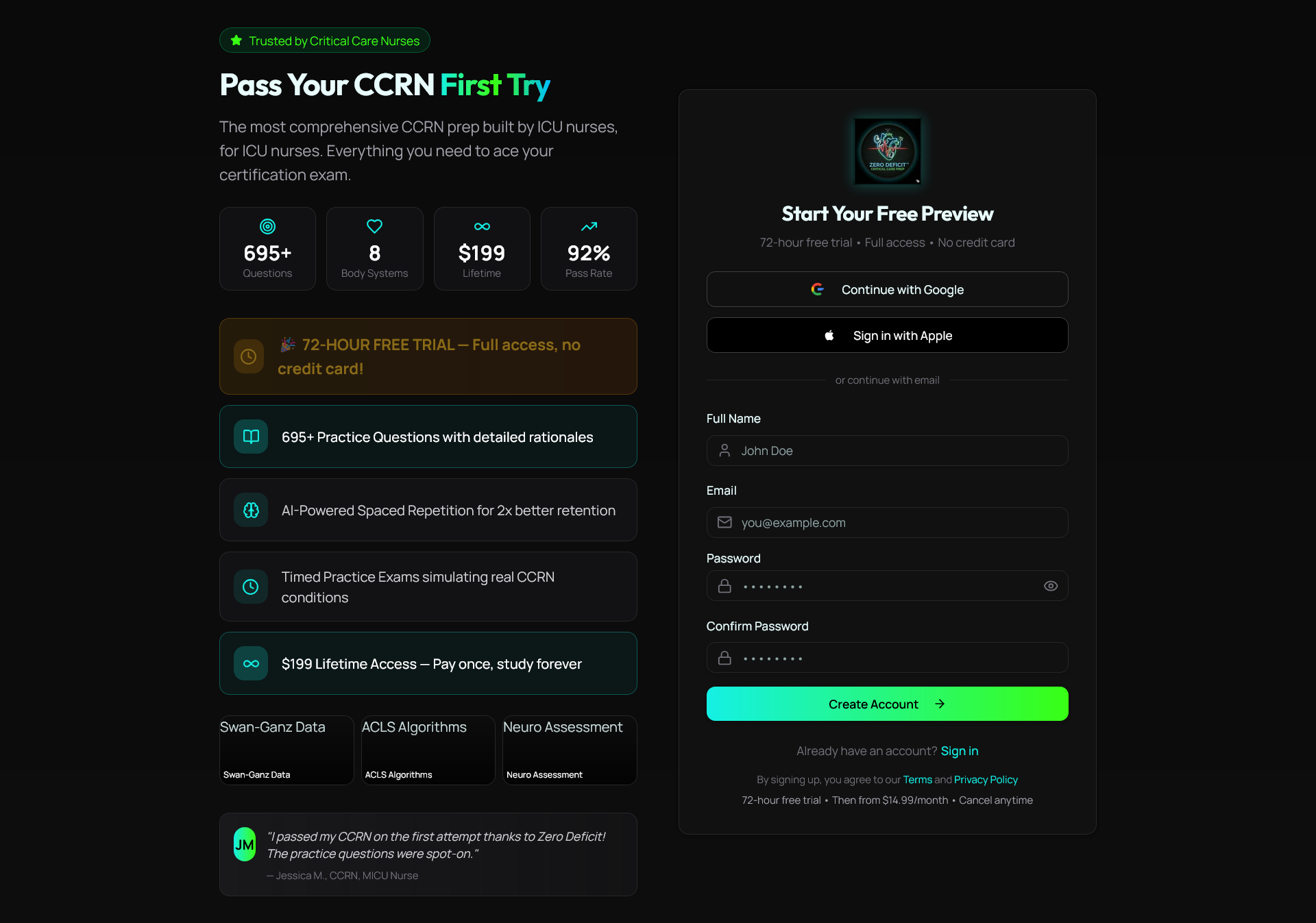
You also get study guides by system, flashcards, progress tracking and exam simulations, so one login covers teaching, testing and review.
FAQ
How much of the CCRN exam is endocrine?
A summary of the test plan for exams taken on and after November 12, 2025 places endocrine in a combined category with hematology/immunology, GI, renal/GU and integumentary that totals 21% of the exam. Endocrine is therefore a portion of that category, not a standalone block. Confirm the current breakdown on AACN’s official page.
Is a free endocrine CCRN quiz enough to pass?
A free quiz is a good diagnostic, but most nurses need a larger set of varied scenarios and full rationales to build reliable reasoning. Use it to find weak topics, then practice those topics in a larger bank.
Should I study endocrine or the high-volume systems first?
Start with the systems where you feel least confident, but do not leave endocrine for last. The topics are limited and predictable, so a focused week or two often brings quick gains in confidence.
What is the most common endocrine mistake on practice questions?
Sequence errors. Nurses often know the condition but pick the wrong first action, such as insulin timing relative to potassium. Label those misses separately and rehearse the order of care.
Sources
Ready to put this into practice? Start the Zero Deficit™ CCRN endocrine practice questions and read every rationale.
Recommended
Take a Endocrine practice quiz
Test your DKA, HHS, thyroid storm, and adrenal crisis knowledge.
Get Your Free 20-Question CCRN Diagnostic
20 high-yield CCRN-style questions across every body system, with detailed rationales — emailed to you instantly.
No spam. One email + a couple of helpful follow-ups. Unsubscribe anytime.
Ready to pass your CCRN?
Join 12,000+ nurses using Zero Deficit — 695+ practice questions with rationales, AI-powered weak-area drilling, and spaced-repetition flashcards.
Start Free Trial →