Best Pharmacology CCRN Prep: 6 Options Compared

The best pharmacology prep for the adult CCRN is the one that makes you apply drugs to patients, not recite them. For most ICU nurses that means a question bank with detailed rationales as the primary resource, backed by a reference text and a flashcard habit. Below we compare the main options, say what each does well, and show how to build a pharmacology plan that fits your shifts.
TL;DR
- Pharmacology on the CCRN is tested through patient scenarios: drip titration, drug choice in shock, and recognizing adverse effects, not isolated drug trivia.
- Commit to one primary resource, then add one supporting tool. Stacking five subscriptions splits your attention.
- Rationales matter more than scores. Review why the wrong answers are wrong, drug class by drug class.
- Zero Deficit™ pairs 695+ practice questions with detailed rationales, AI-powered review tools, and spaced repetition, from $14.99 per month.
- Practice timed 150-question sets near the end of your prep so drug decisions feel automatic.
Table of Contents
- What pharmacology looks like on the adult CCRN
- How to judge a pharmacology prep resource
- The best pharmacology CCRN prep options compared
- How to pick one primary resource
- A pharmacology study routine that works around shifts
- Drug topics worth extra time
- Reading rationales like a test writer
- Perspective
- Try the questions before you commit
- FAQ
- Sources
What pharmacology looks like on the adult CCRN
You will not get a list of drug names to define. Pharmacology is woven into every body-system section of the adult exam: you see a hemodynamic picture, a lab trend, or a ventilator problem, and you pick the drug, the adjustment, or the next assessment.
The themes that show up again and again in ICU practice, and in our own question bank, are:
- Vasoactive and inotropic drips in shock: norepinephrine, vasopressin, epinephrine, dopamine, dobutamine, milrinone, and phenylephrine. Know the receptor action, the expected hemodynamic change, and what a bad response looks like.
- Cardiac drugs: antiarrhythmics, nitroglycerin and nitroprusside, beta blockers, calcium channel blockers, antiplatelets, anticoagulants, and thrombolytics in ACS and stroke.
- Sedation, analgesia, and delirium: propofol, dexmedetomidine, benzodiazepines, opioids, and neuromuscular blockers, including monitoring and complications.
- Pulmonary: bronchodilators, sedation strategies on the ventilator, and drugs used in ARDS and pulmonary hypertension.
- Neuro: osmotic therapy for ICP, antiepileptics, and blood pressure targets around stroke treatment.
- Endocrine and renal: insulin infusions in DKA and HHS, electrolyte replacement, and drug dosing considerations in AKI and CRRT.
- Sepsis: antimicrobial timing, fluids, and vasopressor selection.
For current drug and dose guidance, anchor your study to the guidelines the profession uses: AHA for cardiac and stroke care, SCCM for sepsis and ICU sedation, and AACN for practice standards. Use guidelines published in 2020 or later, and confirm any reference range against your own lab’s published values, because they differ slightly between institutions.
How to judge a pharmacology prep resource
Before comparing products, set your criteria. A resource earns your time if it does these five things.
- Tests application. Questions give you a patient, not a drug name.
- Explains every answer. Rationales for the right and the wrong options teach drug comparisons, which is where most missed questions come from.
- Organizes by system. You study norepinephrine in the shock context, not alphabetically.
- Brings drugs back. Spaced repetition or flashcards stop last month’s vasopressin facts from fading.
- Fits your schedule. If you work three 12s, a tool you can use on a phone in 15 minutes beats a 40-hour video course you never finish.
The approach lines up with what nurse certification guidance recommends: pick a realistic timeline, use employer resources if you have them, commit to one primary resource, practice full 150-question timed exams, and review rationales for both correct and incorrect answers.
The best pharmacology CCRN prep options compared
| Option | Best for | Pharmacology strength | Watch for |
|---|---|---|---|
| Zero Deficit™ | Applying drugs to scenarios, with spaced review | 695+ questions with detailed rationales, AI-powered review tools, flashcards, and study guides by system | Subscription format, so plan your exam date around your access |
| AACN review materials | Learners who want the certifying body’s own framing | Aligned to the AACN exam outline and practice standards | Review the current format and price on AACN’s own site |
| Barron’s Adult CCRN Exam book | Readers who like a structured print review | Content review by system plus practice items | A book does not adapt to your weak spots |
| Elsevier’s Pass CCRN! | Learners wanting a longer text with practice tests | Broad content review with included practice tests | Dense reading; pair it with active recall |
| Lecture series, such as the Laura Gasparis lectures nurses often recommend | Auditory learners who want an instructor walking through drugs | Instructor-led explanations of drug classes and hemodynamics | Lectures teach, but do not test you by themselves |
| Free flashcard decks (Quizlet and similar) | Quick medication recall between tasks | Fast drug-and-indication drilling | Quality varies by author; verify against current guidelines |
We do not list competitor prices here because they change, and a stale number does you no favors. Check each provider’s own page for its current price and access length before you buy.
Zero Deficit™: question-driven pharmacology
We built Zero Deficit™ for the way ICU nurses actually make drug decisions: from a patient picture. Our 695+ practice questions come with detailed rationales, so a missed question on, say, titrating a vasopressor tells you why the other choices were less appropriate for that patient. Our AI-powered review tools and personalized question generation help you return to the drug classes you miss, and spaced repetition resurfaces them before you forget. Study guides by system and topic were created by expert ICU nurses, so the drug content sits with the physiology it belongs to.
You can see the options on our subscription page: Premium Monthly is $14.99 per month, Yearly Access is $84.99 per year, and Lifetime Mastery is also offered. A free trial is available.

AACN materials
The AACN writes and owns the exam, so its own review products are a natural check on what the blueprint emphasizes. They are a reasonable choice when your unit or employer pays for them. Look at the current formats and pricing on AACN’s site, since offerings are updated.
Barron’s and Pass CCRN!
Books suit nurses who retain best from reading and highlighting. Barron’s Adult CCRN Exam and Elsevier’s Pass CCRN! both come up repeatedly when nurses discuss the best CCRN material, and Pass CCRN! includes practice tests. The weakness of any book is that pharmacology lives across chapters, so build your own drug tables as you read and test yourself from them.
Lectures and flashcards
A good lecturer makes hemodynamics and drug mechanisms click, and many nurses credit a lecture series for the moment shock physiology made sense. Flashcards, whether paper or a Quizlet deck of ACS and pulmonary hypertension drugs, are excellent for recall. Neither tells you whether you can choose between two plausible drugs under exam pressure. That is why we treat them as supporting tools.
How to pick one primary resource
Match the tool to your gap.
- You know the drugs but miss questions: you need application practice. Choose a question bank with strong rationales.
- You never learned the drugs well: start with a system-based guide or lecture, then switch to questions within a week or two.
- You are a retaker: look at your score report categories, find your weak systems, and use targeted questions on those drug groups first.
- You are a new ICU grad: tie each drug to a patient you cared for. Memory sticks to real faces.
Then add exactly one supporting tool. A question bank plus a flashcard deck is a strong, light pairing.
A pharmacology study routine that works around shifts
The easiest way to learn pharmacology is to learn by class and by problem, not by alphabetical drug. Here is a routine you can run in 30 to 45 minutes on a study day.
- Pick one system. For example, shock and vasoactive drips.
- Build a one-page grid. Columns: drug, receptor or mechanism, expected effect, key monitoring, main hazard.
- Answer 10 to 15 scenario questions. Read every rationale, including those for questions you got right.
- Log misses by reason. Did you not know the drug, misread the hemodynamics, or ignore a lab? Each needs a different fix.
- Return in 2 days, then a week. Re-attempt your missed items. This is the spaced repetition principle; see our guide to CCRN spaced repetition.
On a night shift, flip it: 10 minutes of flashcards on break, rationale review at home.
How many hours should you study?
There is no single official number. Nurses commonly plan a multi-week schedule built around their shifts, and the cleanest way to decide is to work backward from a test date. Our 12-week CCRN study plan spreads systems across weeks and reserves the final stretch for timed mixed practice. Booking the exam creates accountability, a tip echoed in the certification guidance above.
Drug topics worth extra time
If you must prioritize, put your hours into the areas where drug decisions are highest stakes and most commonly tested together with another concept.
- Shock and vasoactives: compare distributive, cardiogenic, and hypovolemic shock and decide which agent fits each. Our high-yield topic guides cover shock, vasopressors, and sepsis.
- ACS and antithrombotics: antiplatelet, anticoagulant, and fibrinolytic choices, plus reversal and bleeding risk.
- Sedation and neuromuscular blockade: monitoring depth, hemodynamic effects, and what to do first when a patient fights the ventilator.
- Insulin and electrolytes in endocrine emergencies: potassium comes first in DKA decisions, so know your lab’s reference range and the thresholds your protocol uses.
- Renal dosing and CRRT: which drugs accumulate and which are cleared.
- ICP and stroke: osmotic agents, blood pressure management, and antiepileptic choices.
The broader list lives in our guide to top CCRN study topics, and a deeper walk-through is in Pharmacology for Critical Care: ICU Nurse’s Guide.
Reading rationales like a test writer
The fastest score gains come from rationale review. For each drug question, ask:
- What patient problem is the question really asking me to solve?
- Which finding makes the right answer right (a low cardiac output, a rising lactate, a prolonged QT)?
- Why does the nearest distractor fail? Often it is the right drug at the wrong time, or the right class with a contraindication.
Write one sentence per miss. After two weeks you will see your own patterns. Our question breakdown methods walk through this step by step, and practice question strategies covers pacing.
No prep resource should reproduce actual AACN exam questions. Any tool that claims to is one to avoid; good prep teaches the reasoning, not memorized items.
Perspective
We built Zero Deficit™ because pharmacology is where critical care nurses most often know more than they can prove on a test. You titrate norepinephrine on a Tuesday night without a second thought, then freeze when a question wraps that same drug in a paragraph of lab values.
That gap is not a knowledge problem. It is a practice problem. So we put the work where it belongs: 695+ questions with detailed rationales written by ICU nurses, review tools that bring your weak drug classes back at the right time, and study guides by system so every drug sits beside the physiology that explains it.
Our position is simple. A primary resource that makes you explain your choices will do more for your pharmacology than one more read-through of a drug book. Our users report passing on the first attempt, and we designed every feature to make that outcome more likely: personalization, spaced repetition, and rationale-first review.
Zero
Try the questions before you commit
If you are ready to test your drug decisions, start with our 695+ CCRN practice questions. Each one comes with a detailed rationale, and our AI-powered review tools help you focus on what you miss.
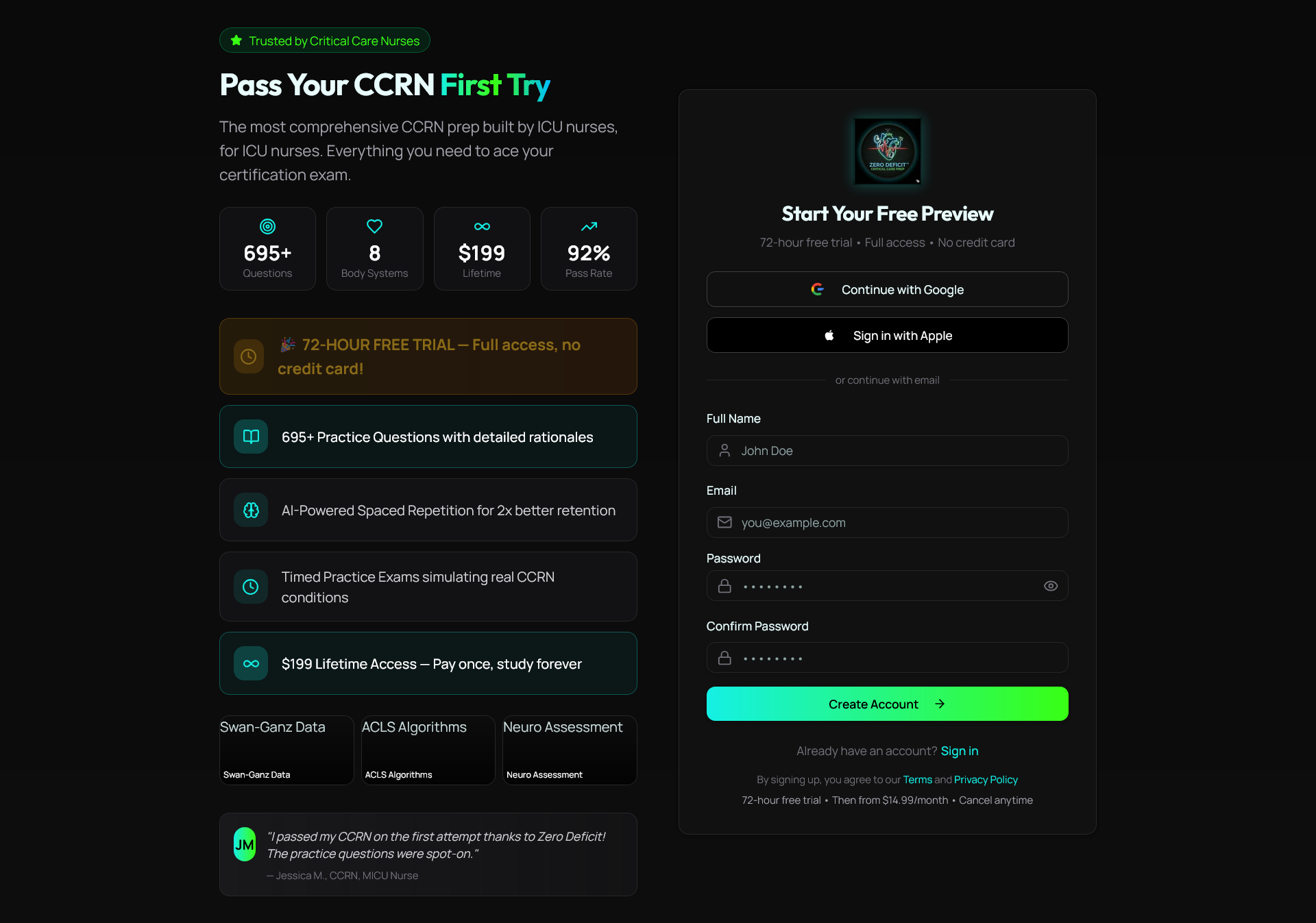
When you want full access, Premium Monthly at $14.99 per month or Yearly Access at $84.99 per year unlocks the question bank, study guides, flashcards, progress tracking, and exam simulations. Lifetime Mastery is listed on the same page.
FAQ
How much pharmacology is on the adult CCRN?
Pharmacology is not a separate section. It appears inside each body-system area as drug choices, titration, and adverse-effect recognition. Study drugs in the context of shock, ACS, ARDS, sepsis, and the other priority systems, and check the current AACN exam outline for the weighting of each area.
What is the easiest way for nurses to learn pharmacology?
Learn by class and by clinical problem. Build a one-page grid per system, answer scenario questions, and read the rationales. Tie each drug to a patient you have cared for, and revisit it on a spaced schedule.
Do I need more than one study resource?
No. Choose one primary resource and add one supporting tool, such as flashcards. Using too many tools makes it hard to finish any of them, and finishing matters more than collecting.
When should I take timed practice exams?
Once you have covered each system once, begin mixed timed sets, and finish with full 150-question runs in your last couple of weeks. Review every rationale afterward, including the ones you answered correctly.
Sources
Ready to turn pharmacology into points? Start with Zero Deficit™ CCRN practice questions and see how detailed rationales change the way you study.
Recommended
Take a Multisystem practice quiz
Master sepsis, shock, MODS, and multi-organ failure scenarios.
Get Your Free 20-Question CCRN Diagnostic
20 high-yield CCRN-style questions across every body system, with detailed rationales — emailed to you instantly.
No spam. One email + a couple of helpful follow-ups. Unsubscribe anytime.
Ready to pass your CCRN?
Join 12,000+ nurses using Zero Deficit — 695+ practice questions with rationales, AI-powered weak-area drilling, and spaced-repetition flashcards.
Start Free Trial →