Best Pulmonary CCRN Review: How to Compare Your Options

The best pulmonary CCRN review is the one that matches how you learn and gets you doing respiratory questions with rationales early. For most ICU nurses that means a focused respiratory study guide, a question bank that explains every answer, and a spaced schedule that keeps vent and ABG content fresh. Below, we compare the main options and show you how to choose.
TL;DR
- Respiratory is 12% of the Adult CCRN exam, so it deserves a dedicated block of study, not a last-week cram (test plan summary).
- Compare options on four things: test-plan alignment, question volume with rationales, format, and what access costs.
- Video courses teach concepts well. Question banks show you what you actually retain. Most nurses do best combining both.
- Zero Deficit™ gives you a respiratory study guide, 695+ practice questions with detailed rationales, AI review tools and spaced repetition from $14.99 per month.
Table of Contents
- What the pulmonary section of the CCRN actually tests
- How to compare pulmonary CCRN review options
- Pulmonary CCRN review options compared
- What a good pulmonary review should teach you
- Perspective
- A four-week pulmonary study plan
- Is a paid course worth it for pulmonary?
- Try the respiratory material from Zero Deficit™
- FAQ
- Sources
What the pulmonary section of the CCRN actually tests
Before you compare resources, know the target. The respiratory content area makes up 12% of the exam for candidates testing on or after November 12, 2025 (test plan summary). The topic list in that summary includes:
- Acute respiratory failure and ARDS
- Acute pulmonary embolus and acute pulmonary edema
- Pneumonia and other acute respiratory infections
- COPD, asthma, bronchitis and emphysema, plus status asthmaticus
- Mechanical ventilation complications
- Pleural space abnormalities: pneumothorax, hemothorax, empyema, pleural effusion
- Pulmonary hypertension and pulmonary hemorrhage
- Thoracic and airway trauma, and thoracic surgery
The exam is 150 questions, 125 of them scored, and a passing result needs 83 correct on the scored items (exam format summary). The same summary lists the exam fee at $260 for AACN members and $375 for non-members. Confirm current figures on the AACN certification site before you register.
Two things follow. First, a strong pulmonary review is more than a topic list: ventilation, ABGs and ARDS also show up inside cardiovascular, neuro and sepsis questions. Second, much of the exam tests clinical judgment, so a resource that only recites facts leaves a gap. One 2026 study guide estimates judgment questions at about 80% of the exam and flags lung-protective ventilation as high yield (study guide).
How to compare pulmonary CCRN review options
Use these criteria on any resource, including ours.
- Test-plan alignment. The plan changed for exams from November 2025. Look for a resource that says which test plan it follows and shows respiratory broken down by the topics above.
- Rationales. A rationale that explains why the three wrong answers are wrong teaches more than a key that only gives the letter.
- Question volume and respiratory share. Ask how many questions are respiratory-specific and whether you can filter by system.
- Format. Live or recorded video, text guides, audio, flashcards, apps. Pick what fits your shift pattern.
- Retention tools. Spaced repetition and a way to see weak areas matter more than another hour of lecture.
- Cost and access terms. Monthly, yearly, lifetime or one-time. Check the provider’s own page for the current price and how long access lasts.
Pulmonary CCRN review options compared
Prices change, so we list formats and features here and point you to each provider’s own page for current pricing. Our own plan prices are the published ones.
| Option | Format | Best for | Pulmonary strength | What to check |
|---|---|---|---|---|
| Zero Deficit™ | Study guides by system, 695+ questions with rationales, AI review, flashcards, spaced repetition, simulations | Nurses who want practice and retention tools in one place | Dedicated respiratory guide, respiratory quiz, ARDS and ventilation topic guides | Free trial first, then $14.99 per month or $84.99 per year |
| AACN Adult CCRN Certification Review | Course from the certifying body, built for acute and critical care nurses | Nurses who want instruction from the organization that writes the exam | Broad coverage of every content area | Current course price and access length on AACN’s site |
| Critical Care Academy | Self-paced video lessons, practice questions, AI coach, final exam with diagnostic report, pass guarantee | Nurses who want a structured video course aligned to the 2025 test plan | Full respiratory coverage inside a complete course | Guarantee terms and price on the provider’s page |
| Nicole Kupchik Consulting | Online on-demand review courses for CCRN and PCCN | Visual learners who like instructor-led explanations | Cardiovascular, pulmonary and endocrine emphasis | Course bundle, price and access window |
| Question-bank and CE platforms with 1000+ questions | Video library, QBank, live webinars, CE hours | Nurses who also need contact hours | Volume of questions across systems | Whether respiratory can be isolated, and which rationales are included |
| Free college and hospital handouts | PDF outlines and slides | Quick refresh of anatomy, physiology and ABGs | Hagerstown Community College’s pulmonary review covers anatomy, physiology, ABG interpretation, mechanical ventilation and respiratory conditions (PDF) | No practice questions to test retention, and age of the content |
The pattern in this table is simple. Courses explain. Banks test. Handouts refresh. The strongest pulmonary prep uses at least one from the first two groups.
Where video courses fit
If you struggle with the physiology behind vent waveforms or shunt versus dead space, hearing an instructor reason through it helps. Free webinars and YouTube walk-throughs are a reasonable way to sample an instructor’s style before paying. The downside of video alone is passive learning: you can watch two hours of ARDS content and still miss the question on plateau pressure.
Where question banks fit
Questions show you what you can retrieve under exam conditions. Do them in small respiratory blocks, read every rationale, and note the pattern behind each miss. Our guide to CCRN practice question strategies walks through how to review misses instead of just counting scores.
What a good pulmonary review should teach you
Whatever you pick, check that it handles these four clusters with real depth.
ABG interpretation
You should be able to read an ABG in under a minute. Reference values most ICU nurses know: pH 7.35 to 7.45, PaCO2 35 to 45 mmHg, HCO3 22 to 26 mEq/L, PaO2 80 to 100 mmHg on room air. A good resource drills the stepwise approach: pH first, then which of CO2 or bicarbonate matches it, then compensation, then oxygenation. It also gives you mixed disorders, because those are where exam writers hide the trap.

Mechanical ventilation
Look for modes, PEEP titration, alarms, complications and weaning. Lung-protective ventilation for ARDS, with tidal volumes of 4 to 6 mL/kg predicted body weight, is flagged as high yield in a 2026 study guide (ARDSNet summary). Predicted body weight comes from height and sex, not actual weight. That detail is a classic miss.
Our mechanical ventilation topic guide covers modes, PEEP and weaning for CCRN candidates.
ARDS and acute respiratory failure
You need the Berlin criteria, the logic of low tidal volume, when proning applies and how to recognize refractory hypoxemia. See our ARDS management guide for a focused walk-through.
The rest of the blueprint
PE, status asthmaticus, pneumothorax and chest tube management, pleural effusion and thoracic trauma each get a handful of questions. A review that only covers ARDS and vents leaves you exposed here. Check that the resource lists these topics by name.
Perspective
We built Zero Deficit™ around one belief: you should never have to guess whether you are ready. Pulmonary content is where many ICU nurses feel confident at the bedside and still lose points, because the exam asks you to pick the best answer among several reasonable ones.
That is why every practice question in our bank comes with a detailed rationale written by ICU nurses, and why our AI-powered review tools and spaced repetition bring missed respiratory concepts back before you forget them. Our design goal is simple: turn each wrong answer into a concept you own.
If you are choosing between a lecture course and a question-driven platform, we think the question-driven route puts your study time where it counts. Use any video you like for the physiology, then prove it to yourself with questions.
Zero
A four-week pulmonary study plan
This plan works with any resource. Adjust the pace to your shifts.
- Week 1: foundations. Review oxygenation and ventilation physiology, then ABG interpretation. Finish with 20 ABG questions and read every rationale.
- Week 2: ventilation. Modes, settings, alarms, complications and weaning. End with ARDS and lung-protective strategy.
- Week 3: the disease list. PE, COPD and asthma exacerbations, pneumonia, pleural abnormalities, thoracic trauma, pulmonary hypertension.
- Week 4: mixed practice. Timed respiratory blocks, then mixed-system sets. Return to your weakest topic twice.
Spread repeat exposure over days instead of rereading in one sitting. Our article on CCRN spaced repetition explains how to schedule it. If you commute or work nights, an audio review can cover the physiology while your question blocks handle retrieval.
Is a paid course worth it for pulmonary?
It depends on where your gap is. If you lack the concepts, a structured course earns its price. If you know the concepts but miss questions, a bank with strong rationales is the better spend. If you are on a budget, a monthly plan lets you study intensely for a few weeks and stop, which usually costs less than a bundled course. A first-time pass saves you a second exam fee, which AACN lists at $260 for members and $375 for non-members according to a fee summary.

Before buying anything, take a free sample. Try a respiratory quiz, read the rationales and ask yourself whether they teach you something. That is the best test of any platform, including ours.
Try the respiratory material from Zero Deficit™
Our respiratory material is built for exactly this step. Start with the respiratory CCRN study guide, then test yourself with the respiratory practice questions, each with a full rationale.
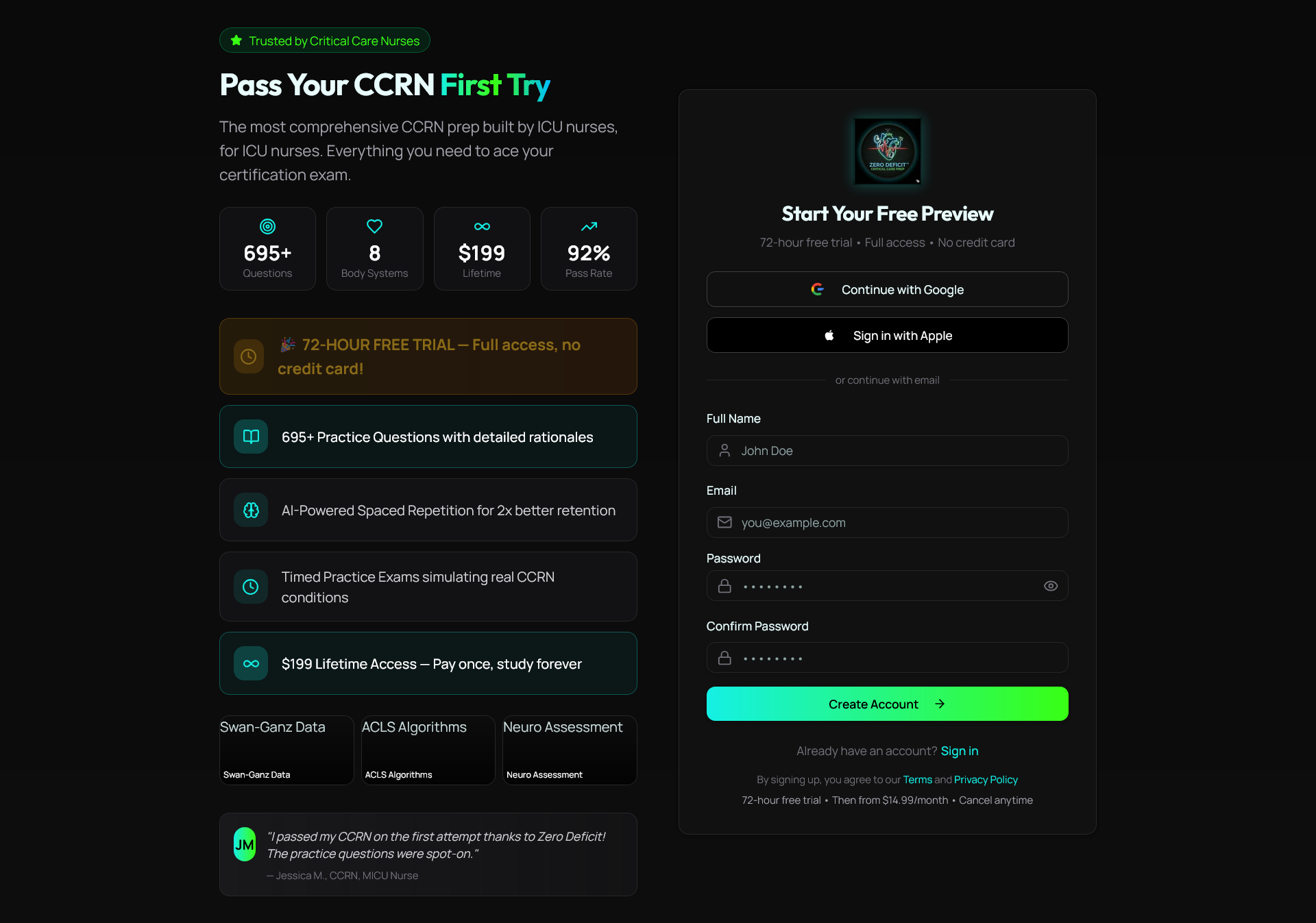
When you are ready for the whole bank, flashcards, spaced repetition, exam simulations and personalized question generation, choose a plan on our subscription page: Premium Monthly is $14.99 per month and Yearly Access is $84.99 per year. Lifetime Mastery is also available on that page. You can browse the full set of 696-question practice resources too.
FAQ
What is the best study material for the CCRN pulmonary section?
Pair one explanatory resource, such as a respiratory study guide or video course, with a question bank that gives full rationales. Respiratory is 12% of the exam, and the questions reward judgment more than recall. Check that the resource follows the current test plan.
Is the AACN CCRN review course worth it?
It is a reasonable choice if you want instruction from the certifying organization and prefer a structured course. Compare its current price and access length on AACN’s site with a question-based platform, and decide based on whether your gap is concepts or test performance.
How many pulmonary questions should I do before the exam?
There is no official number. A practical target is to keep doing respiratory sets until you are consistently getting them right and can explain each rationale in your own words, then mix them into cross-system sets.
Can I prepare for the CCRN with a phone app or online platform?
Yes. Short daily sessions work well for ABGs and vent settings. Look for progress tracking and spaced repetition so weak topics return automatically. You can start with our free respiratory quiz and move to full access when you are ready.
Sources
- CCRN Adult Test Plan summary (effective November 12, 2025)
- CCRN Adult 2026 exam format and fees
- CCRN Study Guide 2026
- Hagerstown Community College pulmonary review
Recommended
Take a Respiratory practice quiz
Master ARDS, ventilation, ABGs, oxygenation, and pulmonary emergencies.
Get Your Free 20-Question CCRN Diagnostic
20 high-yield CCRN-style questions across every body system, with detailed rationales — emailed to you instantly.
No spam. One email + a couple of helpful follow-ups. Unsubscribe anytime.
Ready to pass your CCRN?
Join 12,000+ nurses using Zero Deficit — 695+ practice questions with rationales, AI-powered weak-area drilling, and spaced-repetition flashcards.
Start Free Trial →